Career Change Resume: It's a Translation, Not a Plea
A career change resume fails on translation, not persuasion. The format your instinct reaches for is the one most likely to get rejected.

On this pageWhat actually stops a career change resume?
A career change resume fails on translation rather than persuasion. Career changers are 11% of professional hires, so employers do this regularly — the question is whether a recruiter can see the connection without you explaining it. Two traps cause most of the damage: the functional format, which is the one applicant tracking systems reject most often, and apologetic framing that presents the pivot as a deficit.
Most advice about the career change resume is about persuasion — how to convince an employer to take a chance on you. Independent work has its own rules, so see how to build a freelance resume. Whichever direction you move, start by updating your resume for the role you want next.
That framing is wrong, and it produces weaker resumes. LinkedIn data1 puts career changers at 11% of professional hires, which means roughly one professional hire in nine is someone arriving from a different field. Employers do this regularly. Nobody needs convincing that it can work. If you are switching fields later in your working life, the age-specific pitfalls are covered in these resume tips for job seekers over 50.
Not sure which role to target? An AI career map suggests next roles and the skill gaps to close.
For role-specific layouts you can adapt, see our resume examples by job title.
What they need is to see the connection, quickly, without you explaining it. That is a translation problem, and it has a method.
What actually stops a career change resume?
Not a lack of relevant experience, but the way it gets described. Candidates stall when they describe past jobs by title and industry, and gain traction when they describe them by outcomes, tools, decisions and business impact. The evidence is usually already there under the wrong labels.
In practice, the pattern repeats across career-change coaching: people present their history in the vocabulary of the industry they are leaving. The sharpest case is a military to civilian resume, where whole job titles mean nothing to a civilian reader.
"Managed a retail team" means nothing to someone hiring an HR specialist. "Ran hiring, onboarding and scheduling for 22 staff across two sites, cutting turnover from 40% to 18%" is the same job, described in the target field's terms — and now it is obviously relevant.
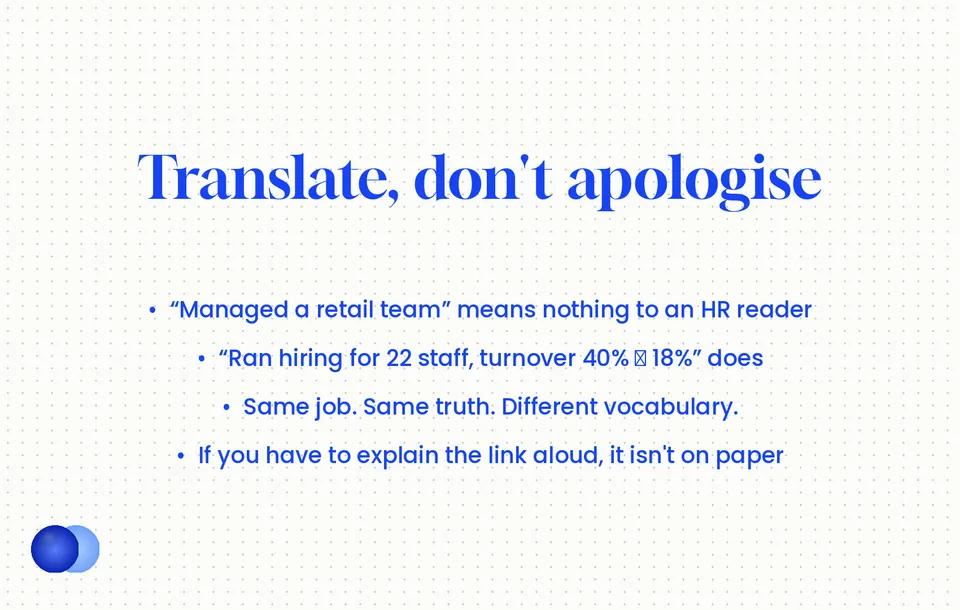
Nobody fabricated anything. The work was always there; only the label changed. If you want a head start, turn a career-change story into a resume draft and then edit every line.
That gives you the test to apply to every line: if you have to explain the connection out loud, it is not clear enough on paper. A recruiter spending seven seconds on the first scan will not do that translation for you.
Which resume format should a career changer use?
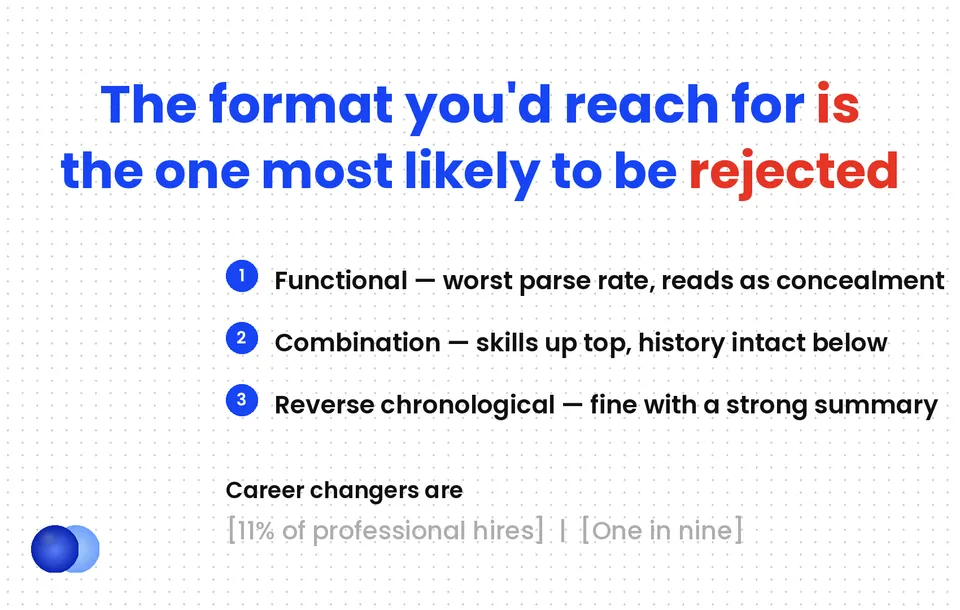
Reverse chronological or combination. The functional format is the one career changers instinctively reach for and the one applicant tracking systems reject most often — it also reads as concealment to recruiters. Combination gives skills prominence while keeping real employment history visible.
Unfortunately, this is the trap, and it catches people precisely because the reasoning feels sound.
The logic goes: my job titles do not match, so I should lead with skills and downplay the history. That produces a functional resume — and a skills-only layout2 is both the format parsers handle worst and the one recruiters distrust fastest, because its usual purpose is hiding something.
| Format | Suits a career changer? | Why |
|---|---|---|
| Reverse chronological | Yes, with a strong summary | Parses reliably; history stays visible |
| Combination | Usually best | Skills near the top, employment history intact below |
| Functional | No | Highest ATS rejection risk; reads as concealment |
The combination format resolves the tension the functional format tries to dodge. A skills section near the top gives your transferable evidence prominence, and a condensed employment history below shows you have actually worked. You get the emphasis without the suspicion. For the wording itself, see how to highlight skills on a resume.
Keep the headings conventional too — Experience, Skills, Education — since a creative label is one more thing a parser can miss. How an ATS works covers why that matters more than it should.
If your official title obscures the work, show both: "Operations Coordinator (Hiring & Onboarding Lead)". That is accurate, it is searchable for the role you want, and it stops a recruiter dismissing you on a title mismatch in the first two seconds. Inventing a title you never held is a different thing entirely — this is clarification, not fiction.
What goes in the summary?
Claim the new professional identity, name two or three transferable skills tied to the posting, and state the target role. Four to five sentences, 75 to 100 words. Without a summary, the recruiter assembles your pivot narrative from job titles alone, which rarely goes well.
The summary matters more for a career changer than for anyone else, because it is the only place you control the narrative before the reader forms a conclusion from your history.
The structure holds in four parts:
1. The identity you are claiming. Not "experienced retail manager seeking a change" — "HR professional with six years leading hiring and retention."
2. Two or three transferable skills, in the posting's vocabulary.
3. One quantified achievement that works in both worlds.
4. The target role, named explicitly.
Jobscan's 2025 resume research3 found summaries in the 75 to 100 word range draw 34% more recruiter engagement than longer alternatives, which is a useful ceiling.
Summary, never objective
One thing to avoid entirely: the objective. An objective states what you want; a summary states what you offer. A career changer is already asking for consideration across a gap — making the document about your own aspirations compounds that rather than answering it. If you decide to open with one anyway, these resume objective examples for a career change at least keep the focus on the employer.
Apologetic: "Although I don't have direct HR experience, I am a motivated retail manager eager to transition into human resources and learn from an established team."
Translated: "HR professional with six years leading hiring, onboarding and retention for teams of 20+. Cut turnover from 40% to 18% across two sites by rebuilding the onboarding programme. SHRM-CP certified, targeting an HR Specialist role."
One asks for a favour and volunteers a weakness nobody raised. The other states a claim and supports it — from the same underlying career.
How do you find your transferable skills?
Build a master list of everything you can do, then pick the five or six that map most closely to the job description. Skills-based hiring makes this productive: 41% of recruiters review skills first, and 81% of employers report favouring practical abilities over background.
Encouragingly, the market has moved in your favour here, and the numbers are worth knowing.
Around 41% of recruiters review the skills section first on a resume. Merit America's 2025 analysis found 81% of employers favour practical abilities over credentials or industry background, and skills-based hiring practices are now used by a large majority of employers.
The method has three steps:
1. Inventory everything. Every tool, process, responsibility and outcome from your working life. Not filtered yet — just listed.
2. Read three postings for your target role. Mark every skill and tool they name. The repeated ones are the requirements. Then ask someone already in the role a few questions for an informational interview to confirm which ones matter most.
3. Map and pick five or six. Where your list and theirs overlap, you have transferable evidence. Mix hard skills that prove technical readiness with the judgement-based ones that show how you work.
Anything on your list with no match on theirs stays off the resume. That is not dishonesty — it is relevance, and a career change resume has less room than most.
Do
- Show active investment in the new field. A certification, a portfolio project, volunteer work, a finished course — evidence that the pivot is already underway separates the candidates who get hired from those who do not.
Don’t
- Write "although I lack direct experience". It draws attention to a gap the reader might not have flagged, and it frames your application as a request rather than a proposition.
Free ATS score, the text the software extracts and your missing keywords. No sign-up.
How do you handle the gap or the pivot itself?
In the cover letter, not the resume. The resume presents evidence; the letter carries the context a bullet list cannot. One honest paragraph explaining the switch is enough, and it belongs where a human is reading rather than where a parser is scanning.
Meanwhile, career changers routinely try to explain the pivot inside the resume, and it never fits.
A resume is a document of evidence. There is no natural place in it for a narrative about why you left teaching for analytics, and attempting one produces an awkward paragraph that dilutes the rest.
The cover letter is built for exactly this. It exists to answer the questions a resume cannot — and "why this switch" is the clearest example there is. How to write a cover letter covers the structure; for a career change, one paragraph does the work: what you did, why the move, what transfers. A cover letter for a career change shows how that paragraph reads in full. For a complete letter, see a full career change cover letter sample.
Keep it forward-looking. The reason for the change is genuinely less interesting to the reader than what you bring — and a paragraph that dwells on the past is describing the thing you are trying to move away from.
People stall because they describe their old jobs by title and industry. They gain traction when they describe their work by outcomes, decisions, tools and business impact.
Career-change coaching pattern, repeated across sources
What does the finished resume look like?
A combination layout: summary claiming the new identity, a skills section mapped to the posting, condensed employment history rewritten in the target field's vocabulary, then certifications and projects that prove the transition is active.
The order, top to bottom:
Summary — 75 to 100 words, the four-part structure above.
Skills — five or six, drawn from the overlap with the posting.
Experience — reverse chronological, every bullet rewritten in outcome terms. Older roles condensed to a line each.
Certifications and projects — the evidence of active investment. For fields where portfolios matter more than pedigree, this section earns its place near the top. Our guide to listing certifications on a resume covers where each one belongs and which ones to leave off.
Education — last, unless the qualification is the pivot.
Finally, check the result against the demand you built it from. An free ATS resume checker run against a specific posting will show you whether the translation actually landed — whether the vocabulary now matches, and whether the fields extract cleanly. That check matters more for a career change resume than for most, because you are relying on a match the reader will not construct on your behalf.
Keep the profile consistent too. When a resume says one thing and a LinkedIn profile says another, recruiters lose confidence quickly — and a career changer has less margin for that than most candidates.
Frequently asked questions
How do you write a career change resume?
Translate your existing work into the target field's vocabulary. Use a combination format, lead with a summary claiming the new identity, map five or six transferable skills to the posting, and rewrite every bullet in terms of outcomes rather than job titles.
Is a functional resume good for career changers?
No. It is the format applicant tracking systems reject most often and the one recruiters distrust fastest, because its usual purpose is concealment. Use a combination format instead.
How common are career changes?
Common enough that employers handle them routinely — LinkedIn data puts career changers at 11% of professional hires, roughly one in nine.
Should I explain my career change on my resume?
No, put it in the cover letter. A resume is a document of evidence with no natural place for narrative; the letter exists precisely to carry the context a bullet list cannot.
What are transferable skills on a career change resume?
Capabilities that appear in both your history and the target posting — leadership, analysis, specific tools, process design. Build a master list, then keep the five or six that overlap with three postings for your target role.
Should I use an objective instead of a summary?
No. An objective states what you want; a summary states what you offer. A career changer is already asking for consideration across a gap, so a document about your own aspirations works against you.
Do certifications help a career changer?
They help when paired with evidence. Employers rarely hire on certificates alone, so combine a credential with a project, volunteer work or applied practice that shows the transition is underway.
How far back should a career change resume go?
Ten to fifteen years, with older roles condensed to a single line. Space is tighter than usual because the relevant material needs room, and anything with no overlap with the posting can go.
Sources
We opened and read each page below. The small numbers in the text point here. Pages that carry no publication date show n.d.
- Resume Optimizer Pro2026
LinkedIn 2024 data shows career changers represent 11% of professional hires; a…
- Resume.io2026
41% of recruiters review skills first; functional resumes are the layout an…
- The Interview Guys2026
Jobscan 2025 research found summaries of 75-100 words draw 34% more recruiter…
- GoHires2026
Merit America's 2025 analysis found 81% of employers favour practical abilities; candidates…
- CrawlJobs2026
Employers rarely hire on certificates alone and want evidence; portfolio projects often…
Mohammad has spent more than ten years designing consumer products and leads product at Rezoom, deciding what gets built and what gets left out. His guides cover the whole job search, from resume sections and cover letters to interview answers and career moves.
Goodi, M. (2026, October 25). Career Change Resume: It's a Translation, Not a Plea. Rezoom. https://rezoom.io/career-change-resume/