

Summary
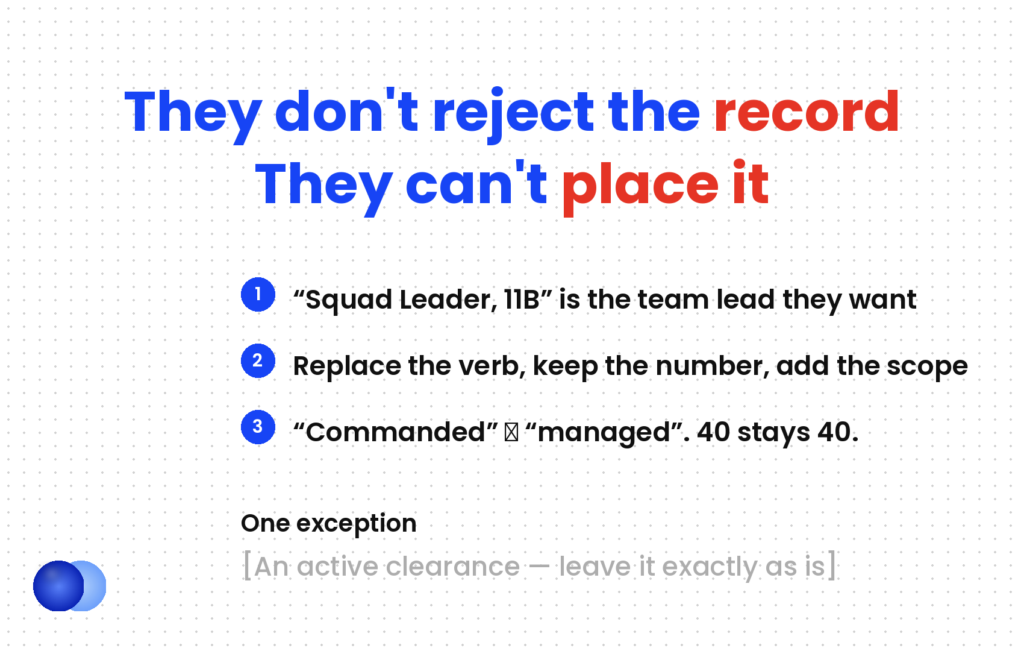
Hiring managers do not reject veterans for lack of skill. They stall on the first pass because they cannot map a platoon sergeant to their own org chart. The fix is mechanical — replace the verb, keep the number, add the scope. One element is the exception that should stay exactly as it is: an active security clearance needs no translation at all.
A military to civilian resume rarely fails on the record. A squad leader has managed people, equipment and risk in ways most civilian candidates never will.
It fails because the page speaks a language the reader cannot process. "Squad Leader, 11B" describes exactly the team lead a recruiter is screening for, and means nothing to them. Most civilian hiring managers have no military experience — they do not know what an MOS is, and they cannot map a platoon sergeant or a chief petty officer onto their own org chart.
So a military to civilian resume is a translation problem rather than a qualification problem. And there is exactly one element you should leave untranslated.
What is the one thing you should not translate?
An active security clearance. "Active TS/SCI" or "Secret clearance (active, last investigation 2023)" is read correctly by every employer it matters to, because it represents a five-figure cost and a months-long wait they no longer have to absorb.
This is the exception, and it works in the opposite direction from everything else here.
It is already in their language. Defense contractors, federal roles and any employer with cleared work read "Active Secret clearance" and understand precisely what it saves them.
It thins the field dramatically. Recruiters filling specialised cleared roles routinely go weeks without a single organic applicant. The veteran who already holds the clearance walks into far less competition than the same veteran applying to an uncleared role.
Say it plainly and stop. Level and status, positioned where both a parser and a human will catch it — the contact block or the top of the summary. Do not elaborate, and do not drift into anything resembling classified detail.
Translate everything else on the page.
How do you translate a bullet?
Replace the verb, keep the number, add the scope. "Commanded" becomes "managed", "Soldiers" becomes "staff", "platoon" becomes "40-person team". The headcount, budget and outcome stay identical, because those are the parts a civilian recruiter is reading for.
In practice, the rule is mechanical, which makes it faster than it looks.
| Before | After |
|---|---|
| Commanded platoon of 40 Soldiers during OIF deployment | Managed a 40-person team with $2.4M equipment accountability across high-risk field operations |
| Served as NCOIC for battalion supply | Directed supply operations for an 800-person organisation, maintaining 98% inventory accuracy |
| Conducted PMCS on assigned vehicles | Performed scheduled preventive maintenance on a 22-vehicle fleet, sustaining 96% operational readiness |
| Trained junior enlisted on weapons systems | Designed and delivered technical training to 60+ personnel, reducing qualification failures by a third |
| Manpower Planner, USMC | HR Operations Manager — Talent Forecasting and Workforce Planning |
Notice what does not change: the numbers. Forty people, $2.4 million, 98%, 96%. Those were always the strongest part of the bullet — military records carry quantification that most civilian resumes lack entirely, and it survives translation untouched.
Write the header for the job you want
The most common structural miss is describing who you were rather than who you are applying to be. A Marine Corps manpower planner stuck in application loops rewrote her header from "Manpower Planner, USMC" to "HR Operations Manager — Talent Forecasting, Workforce Planning" and started getting screens. Same work, same record. The header told a recruiter which pile she belonged in, which is a question they answer in the first three seconds and rarely revisit.
What should you cut?
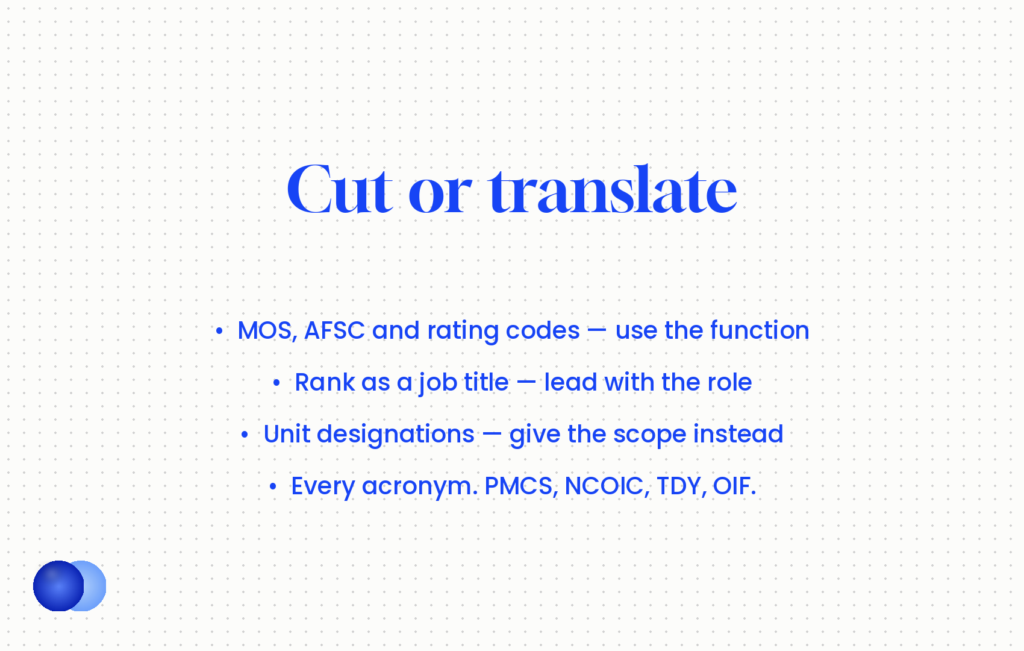
MOS and AFSC codes, unit designations, rank as a job title, award names without explanation, and acronyms of every kind. If a civilian recruiter cannot read the line, it does not count — and a line that does not count is occupying space that could hold one that does.
Broadly, five things cost more than they add:
MOS, AFSC and rating codes. "11B", "3D0X2", "IT2" mean nothing outside the service. Translate to the function.
Rank as a job title. Captain, Major, Sergeant. Lead with the functional title — Operations Manager, Logistics Supervisor, Communications Technician — and rank can appear afterwards if it adds context.
Unit designations. "2nd Battalion, 7th Marines" tells a civilian nothing. "An 800-person organisation" tells them the scope.
Unexplained awards. A Joint Service Commendation Medal means something to a veteran and nothing to a recruiter. Either explain what it recognised in a clause, or leave it off.
Every remaining acronym. PMCS, NCOIC, TDY, OIF. Spell it out or replace it.
One caveat worth holding: check where the resume is going first. A defense contractor reads all of this fluently, and over-translating for that audience strips useful specificity. The translation is for civilian-sector readers.
Which format should you use?
Reverse chronological or hybrid, never functional. The instinct to hide unfamiliar job titles behind a skills-first layout is understandable and it backfires — recruiters associate functional resumes with concealment, and they parse worst.
The temptation is real and the format is wrong.
Military titles look foreign, so a skills-first layout feels like it solves the problem. What it actually does is trigger both a parsing failure and a recruiter's suspicion — the same trap covered in resume format types and, for the same reason, in the career change resume.
Hybrid gives you what you wanted without the cost: a core skills block near the top in civilian vocabulary, then an intact chronological history with translated titles and bullets. The reader gets capability first and a legible timeline second.
Untranslated: "SSgt, 3043, United States Marine Corps, 2018–2026. NCOIC, Manpower Section, 2nd MLG."
Translated: "HR Operations Manager — Workforce Planning | United States Marine Corps | 2018–2026. Led manpower forecasting for an 8,000-person organisation; reduced staffing gaps 18% through predictive models, saving $1.2M annually."
This invents nothing. The second version names the function, the scope and the outcome in terms a civilian recruiter can place immediately.
Keep the numbers exactly as they are. Headcount, dollar value, readiness percentage, accuracy rate — military records are unusually well quantified, and that is the part civilian resumes most often lack.
Downplay the service to sound more civilian. The goal is legibility rather than camouflage, and an employer who understands what you did values it more, not less.
Is the federal route different?
Yes, and the translation still matters. Veterans' preference adds 5 or 10 points to a passing score, and VRA and VEOA authorities open routes outside the competitive process. But preference does not waive the resume screen — you still have to pass it.
Three things worth knowing about USAJOBS specifically:
Preference is real and it is not a bypass. Five points for most honourable active-duty service, ten for a service-connected disability or Purple Heart, among other categories. It applies after you clear the screen rather than instead of it.
Special authorities exist. The Veterans Recruitment Appointment lets agencies hire eligible veterans outside the full competitive process for many positions. The Veterans Employment Opportunities Act lets eligible veterans apply to roles otherwise restricted to current federal employees.
Federal resumes are longer. Thoroughness that would read as excessive in the private sector works in your favour on USAJOBS, where reviewers expect detail rather than tolerate it.
And for anyone still serving: SkillBridge allows the final 180 days of active duty to be spent training or interning with a civilian employer while still drawing military pay. It requires command approval, thousands of organisations participate, and it produces a civilian resume line — frequently an offer — before separation.
Hiring managers do not reject veterans for lack of skill. They reject the first pass because they cannot map a platoon sergeant, a chief petty officer, or a company commander to their own org chart.
What should you do first?
Pick the target role before translating anything. The same service record translates differently for a logistics manager, an operations analyst and a project manager — and translating without a target produces a resume aimed at nobody.
Finally, four steps in order:
1. Choose the target role. Not "what civilian job matches my MOS" but "which function best fits what I actually did." One record often supports several paths.
2. Collect the vocabulary. Read ten postings for that role and note the exact terms. Those are the words your translation should land on.
3. Translate bullet by bullet. Replace the verb, keep the number, add the scope. Nothing else changes.
4. Check it reads. An AI resume checker against a real posting flags remaining jargon and shows whether the translated vocabulary actually matched — which matters more here than for most candidates, because the gap between your source language and theirs is unusually wide.
One last framing. Veteran unemployment sat at 4.1% in February 2026, close to the general rate. The evidence does not describe a workforce that employers reject. It describes a first pass that a document can fail — and that is a fixable problem.
Frequently asked questions
How do you write a military to civilian resume?
Translate every military term into its civilian function, keeping the numbers intact. Replace the verb, keep the number, add the scope — "commanded a platoon of 40" becomes "managed a 40-person team with $2.4M equipment accountability."
Should I put my MOS on a civilian resume?
No, unless you are applying to a defense contractor. Translate the code into the function it describes, because a civilian recruiter cannot read it and a line they cannot read does not count.
What should I not translate on a military resume?
An active security clearance. "Active TS/SCI" or "Secret clearance (active, last investigation 2023)" is understood exactly as written by every employer it matters to.
Should I list my rank?
Lead with the functional title rather than the rank. Operations Manager, Logistics Supervisor or Communications Technician places you on an org chart in a way that Sergeant does not.
Should veterans use a functional resume?
No. The instinct to hide unfamiliar titles behind a skills-first layout backfires — functional resumes parse worst and recruiters associate them with concealment. Use a hybrid.
Does veterans' preference mean I don't need to worry about my resume?
No. Preference adds 5 or 10 points to a passing score on federal applications, which means it applies after you clear the resume screen rather than instead of it.
What is SkillBridge?
A programme allowing the final 180 days of active duty to be spent training or interning with a civilian employer while drawing military pay. It requires command approval and frequently produces an offer before separation.
How do I know which civilian job fits my experience?
Ask which function best matches what you actually did rather than which job matches your MOS. One record usually supports several civilian paths depending on the environment you want.



Comments