

Summary
List a security clearance at the top of your resume, in the header or summary, using the level, status, and any polygraph, for example "Active TS/SCI with CI Polygraph." Use "Active" only while you hold access in a cleared job, "Current" for up to two years after, and drop or qualify it once expired. Never include classified program names, locations, or case numbers, and keep the details off public profiles.
To list a security clearance on a resume, put one line near the top with three facts: the level, the status, and any polygraph. For example: "Active TS/SCI with CI Polygraph." Recruiters for cleared roles screen on that line first, so it belongs in your header or summary, not buried at the bottom.
The harder part is wording. "Active," "current," and "expired" mean different things, and using the wrong one can end an application. There are also firm limits on what you may say about cleared work.
This guide covers how to list security clearance on a resume with the right status term, where to place it, what to leave out, and how to protect yourself when you post it.
How do you list security clearance on a resume?
Write one line with the clearance level, its status, and any polygraph, such as "Active Secret Clearance" or "Active TS/SCI with Full-Scope Polygraph." Place it in the header under your contact details or as the first line of your summary. Add dates only if the clearance is no longer active.
Use this formula: Status + Level + Access or Polygraph (if any) + Date (if inactive).
Each part answers a question a cleared recruiter asks. Is it usable now? At what level? With what extra access? And, if it is not active, how long ago?
The level itself should match the official names. Executive Order 13526 defines three classification levels: Confidential, Secret, and Top Secret. Top Secret covers information whose disclosure could cause "exceptionally grave damage" to national security. The Department of Energy uses its own L and Q access authorizations, which ClearanceJobs describes as roughly equivalent to Secret and Top Secret.
Marcus Reyes
Huntsville, AL | (256) 555-0182 | [email protected] | linkedin.com/in/marcusreyes
Active TS/SCI with CI Polygraph
Sensitive Compartmented Information (SCI) is an access added on top of Top Secret, not a separate level. Write it as "TS/SCI." Polygraph types also differ. ClearanceJobs lists counterintelligence, lifestyle, and full-scope polygraphs, so name the one you completed.
What is the difference between active, current, and expired clearance?
A clearance is active while you hold a job that requires access to classified information. It becomes current when you leave that job, and generally stays reinstatable for up to two years if you remain in continuous vetting. After two years without access, it is expired and requires a new investigation.
This is where most resumes go wrong. Recruiters sort candidates by status because an active clearance lets a hire start sooner.
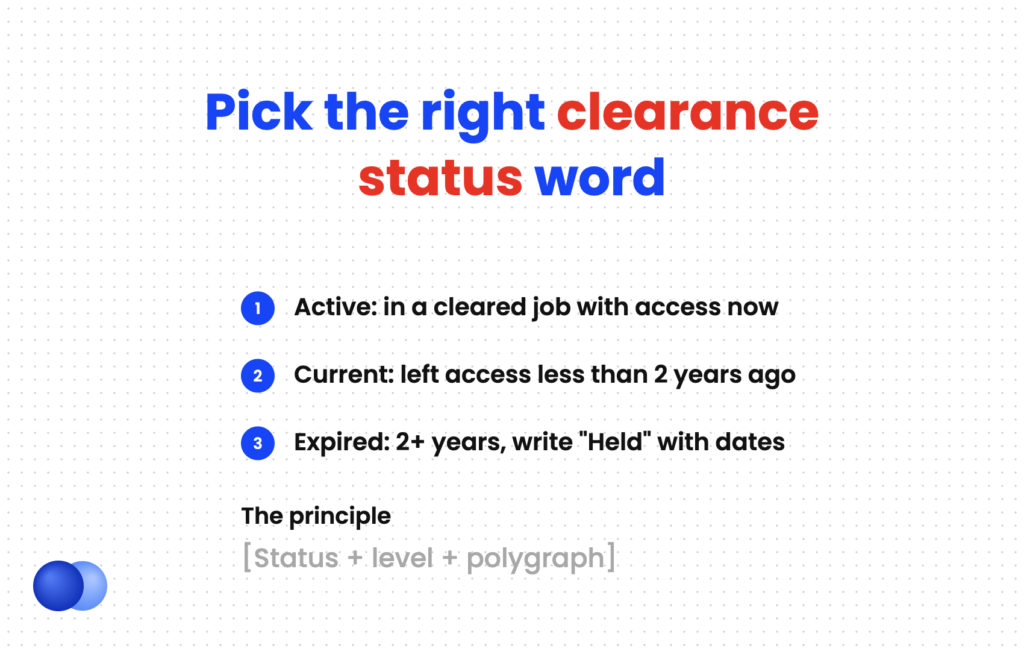
ClearanceJobs explains the three status terms this way. Active means you are in a position that requires access. Current means you held access within the past two years and remain in a continuous vetting program. Expired means two or more years have passed, and you would need a new application and investigation.
Continuous vetting changed the old rules. The Defense Counterintelligence and Security Agency (DCSA) enrolled all DoD clearance holders in continuous vetting in 2021. DCSA's fact sheet says about 4 million federal employees and contractors are now enrolled. If you are unsure of your status, ask your facility security officer before you apply.
Use this table to pick your exact wording.
| Your situation | Status term | How to write it |
|---|---|---|
| In a cleared job with access now | Active | Active Top Secret Clearance |
| Left a cleared job less than 2 years ago | Current | Current Secret Clearance (inactive since 03/2026) |
| Left 2 or more years ago | Expired | Held TS/SCI, 2017–2022 |
| Granted temporary eligibility pending final decision | Interim | Interim Secret Clearance |
| Investigation in progress, not yet granted | None yet | Leave it off, or note in a cover letter |
| Never held one | None | Do not write "clearable" as a status |
Interim clearances are common. DCSA issues about 100,000 interim determinations a year for cleared contractors. Label yours as interim so no one assumes it is final.
Where should a security clearance go on a resume?
Put your security clearance in two places at most: the header or summary at the top, and a short line in the job entry where you held it. A separate Clearance section is optional if you have several items, such as a clearance plus a polygraph and DoE access. Do not repeat it more than that.
The top of the page matters most. Cleared recruiters filter by clearance before they read anything else. Placing it with your contact block or in your resume summary means it is seen in the first pass.
Some guides suggest repeating your clearance up to four times for ATS visibility. That adds clutter without adding information. An ATS keyword search finds one clear mention just as well. Our resume keywords guide explains how matching works.
A mention inside the relevant job entry does add context. It shows where and when you held access.
Summary Network engineer with 8 years supporting DoD programs. Active Secret Clearance. Certified CISSP and Security+ with experience hardening classified and unclassified networks.
Network Engineer | Defense contractor, Colorado Springs, CO | Jun 2021 – Present - Held Secret clearance supporting a DoD customer's secure network operations - Maintained 99.9% uptime across a 2,000-user enclave by automating patch validation
A dedicated section works for complex profiles. For example, list "Clearances" as a heading with one line each for the clearance, polygraph, and any DoE access. Put certifications such as Security+ in their own section, since they are separate credentials.
What can you not include about a security clearance on a resume?
Do not include classified information, program or project code names, specific sensitive locations, investigation case numbers, or names of supervisors at intelligence agencies. Describe your work in unclassified terms. You may state your clearance level, background investigation type, and polygraph with dates.
Your obligations do not end when you leave. A joint NCSC, FBI, and DCSA bulletin reminds former cleared employees they have a legal obligation to protect classified data even after government service.
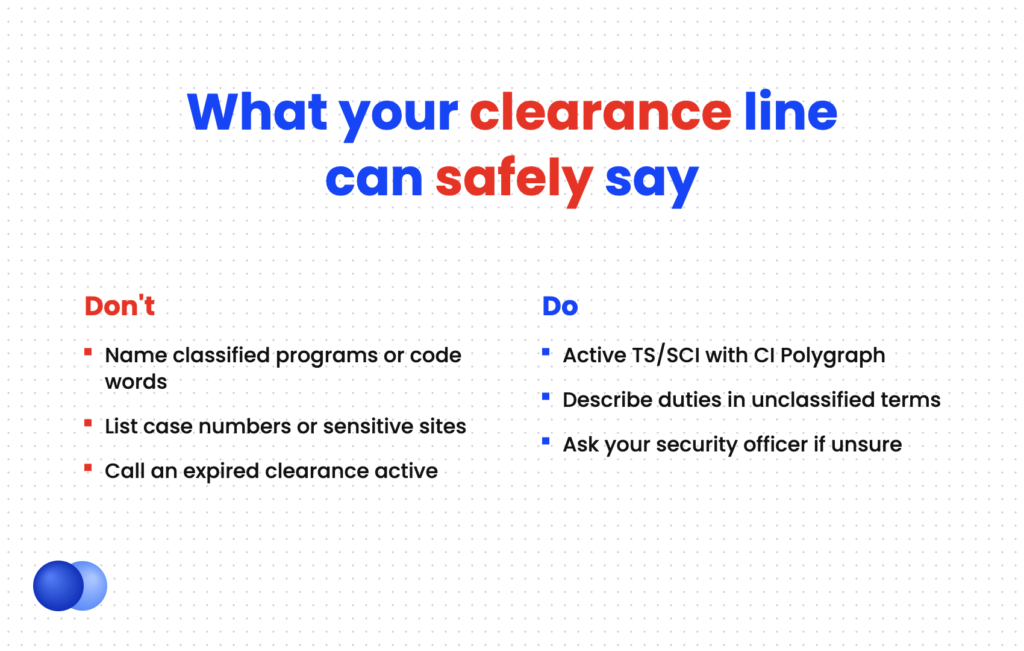
The NSA publishes a resume do's and don'ts sheet for its personnel. It is agency-specific, but its logic applies widely. It says you may:
- State that you are cleared TS/SCI, as appropriate.
- Say you had a background investigation and a polygraph, with dates.
- Describe your work in an unclassified manner.
- Refer to a "field site" or "overseas location" without naming it.
It says you may not use project names or covernames, reveal organizational details such as staffing or budgets, name certain sensitive locations, include supervisor names, or add classification markings.
If you are unsure whether a detail is sensitive, leave it out and check with your security office. Some agencies require a prepublication review before you share any description of your duties. The same care applies to military-to-civilian resumes, where unit and mission details can creep in.
Write "Active TS/SCI with CI Polygraph" on one line do: Use "Current" plus a date if you left access recently do: Describe duties in plain, unclassified terms do: Ask your security officer when in doubt
Name classified programs, projects, or code words dont: List case numbers or investigation file details dont: Call an expired clearance "active" or "current" dont: Write "clearable" as if it were a status
Should you list a security clearance on public profiles and job boards?
Be selective. Foreign intelligence services target clearance holders through professional networking sites and fake recruiters. List your clearance on resumes you send to vetted employers and on trusted cleared-job boards, but consider leaving it off public profiles such as LinkedIn or open resume databases.
This is the risk most resume guides skip. The NCSC, FBI, and DCSA bulletin warns that foreign intelligence entities target current and former government employees through fake online job offers. It advises: "Be careful what you post online about your work (particularly security clearances)."
The bulletin lists red flags to watch for:
- Remote work with a disproportionately high salary.
- Pressure to move off the networking platform quickly.
- Heavy flattery, especially about your government background.
- Requests for written reports that drift toward non-public information.
A practical approach is two versions. Your application resume shows the full clearance line. Your public profile states your field and experience without the clearance details. See our guide to LinkedIn profile optimization for building a strong profile without oversharing.
Keep a public and a private version
Save two resume files. The application version includes your clearance line and goes only to employers and recruiters you have verified. The public version, for open databases and networking, says "Eligible for cleared roles; details on request." You lose little visibility and remove the easiest target for bad actors.
How do you list an expired or pending security clearance on a resume?
For an expired clearance, write the level and the years you held it, such as "Held TS/SCI, 2016–2021." This shows you passed a prior investigation. For a pending clearance, leave it off the resume or mention it in the cover letter, since an application in progress is not a clearance.
An expired clearance still has value. It tells an employer you passed a full investigation before, which can make sponsorship feel less risky. Just be precise with dates.
Cleared jobs have their own path in. According to ClearanceJobs, you cannot apply for a clearance on your own. A government agency or cleared contractor must sponsor you. That means a pending clearance belongs to the employer that sponsored it.
Held Top Secret/SCI, 2016–2021 (DoD)
Interim Secret Clearance, granted 07/2026
Citizenship questions often come up alongside clearance. Our sibling guide covers whether to put U.S. citizen on a resume. If you link to a portfolio or profile, our guide on how to add a hyperlink to a resume covers the mechanics.
When your clearance line and job entries are set, Rezoom's AI resume builder can help you tailor the rest of your resume to each cleared posting.

Frequently asked questions
Should I put my security clearance on my resume?
Yes, if you are applying for jobs that require one and your clearance is active or current. It is often the first thing cleared recruiters screen for.
How do I write TS/SCI on a resume?
Write the status, then "TS/SCI," then any polygraph, such as "Active TS/SCI with Full-Scope Polygraph." SCI is access on top of Top Secret, so it is written together.
Can I put an expired security clearance on my resume?
Yes, if you label it clearly with dates, such as "Held Secret, 2018–2022." Never call it active or current once two years have passed without access.
Is it safe to list a security clearance on LinkedIn?
It carries risk. A 2025 NCSC, FBI, and DCSA bulletin warns clearance holders to be careful what they post online about their clearances. Many people keep the details to applications only.
What does "clearable" mean on a resume?
It is not an official status. Employers use it to describe candidates likely to qualify. On your resume, list only clearances you actually hold or held.
How long does a security clearance stay current after leaving a job?
Generally up to two years, provided you remain in continuous vetting. After that, it is typically considered expired and needs a new investigation.



Comments