Firefighter and EMT Brendan Kowalczyk
Probationary Firefighter and EMT
[email protected] | (414) 555-0742 | Milwaukee, United States
Profile
Certified firefighter with Firefighter I and Firefighter II to NFPA 1001, HazMat Awareness and Operations, and a current NREMT EMT certification, each fire certificate carrying an IFSAC seal. Passed the Candidate Physical Ability Test in 9 minutes 41 seconds on the first attempt and completed a 14 week recruit academy. Two years as an EMT on a 911 transport contract running roughly 1,100 calls a year, and six months riding probationary on an engine company.
Work Experience
03/2026 - Present, Probationary Firefighter and EMT, Ravenwood Fire Department, Ravenwood, United States
- Ride the back step on a two engine, one ladder department covering roughly 1,400 incidents a year, on a 24 on and 48 off rotation.
- Completed a 14 week recruit academy covering NFPA 1001 Firefighter I and II job performance requirements, HazMat Operations and vehicle extrication.
- Carry the EMT position on medical responses, which are about two thirds of the department call volume.
- Assigned hydrant inventory and pre-incident planning for a 640 address first due district.
01/2024 - 02/2026, Emergency Medical Technician, Hollisburg Medical Transport, Milwaukee, United States
- Worked a 911 transport contract running roughly 1,100 calls a year, primary on basic life support and attendant on advanced life support intercepts.
- Completed electronic patient care reports on every response, with a first pass quality assurance return rate under 3%.
- Trained six new EMTs through their field orientation.
Education
08/2022 - 05/2024, Associate of Applied Science, Fire Protection Technology, Milwaukee Area Technical College, Milwaukee, United States
Coursework included fire behavior and combustion, building construction for fire protection, hazardous materials and fire prevention. Firefighter I and II certification completed through the program.
Skills
Engine company operations, 65
Basic life support and patient assessment, 85
SCBA use and maintenance, 75
Hazardous materials operations level, 65
Vehicle extrication, 60
NFIRS and ePCR reporting, 80
Pre-incident planning, 60
Languages
English, native
Polish, intermediate
Spanish, beginner
Certificates
05/2024, Firefighter I and Firefighter II, NFPA 1001, State of Wisconsin fire service certification, IFSAC accredited, WI-FF-208431
IFSAC seal. Issued on completion of the Fire Protection Technology program.
11/2023, NREMT Emergency Medical Technician, National Registry of Emergency Medical Technicians, E2144038
Current through March 2028.
04/2024, HazMat Awareness and Operations, State of Wisconsin fire service certification
01/2026, Candidate Physical Ability Test, Licensed regional CPAT test site
Passed in 9 minutes 41 seconds on the first attempt.
Summary
A firefighter resume is a one to two page scored credential file. It names your Firefighter I and II certification and who accredited it, your emergency medical level, your hazardous materials training and your physical ability test result. This guide gives you three adaptable versions, the order that matches a department scoring sheet, and current Bureau of Labor Statistics pay and outlook.
Firefighter resume examples by experience level
In short, a firefighter resume is a one to two page document that lists, in an order a reviewer can score, the certifications you hold, who accredited each one, the emergency medical level you can work at, and the physical ability test you have passed.
Indeed, that word "score" is the whole difference between this resume and most others. In contrast, a private employer reads a resume to form an impression. A fire department under civil service rules reads an application to fill in a form: a written examination with a number attached, a physical ability test that is pass or fail, and a credential review where each certification is a line the reviewer either ticks or does not. Therefore, the file that wins is the one where every scorable item is findable in four seconds, named exactly as the standard names it, with the accrediting body beside it.
Resume guide for a firefighter resume
To that end, this guide and the corresponding firefighter resume example will cover:
- To begin with, how to write a firefighter resume, section by section
- Then, the certification stack, in the order departments read it
- Why the accrediting seal matters more than the course title
- Also, three adaptable summaries: recruit, firefighter and paramedic, and company officer
- Finally, what the job market looks like and what you can expect to earn
How to write a firefighter resume
Overall, seven blocks: contact header, summary, certifications, emergency medical level, incident experience, education and skills. One page while you are probationary or first-due, two once you hold rank or an instructor credential.
Certifications come second, immediately under the summary and before experience. That is unusual advice and it is correct here: in the fire service a credential is a legal permission to perform a task, and the department removes an application that does not clear the credential bar before anyone reads the narrative.
| Block | What it is answering | Where it goes |
|---|---|---|
| Certification stack | Can this candidate legally be put on an apparatus? | Directly under the summary |
| Emergency medical level | EMT, paramedic, or neither, and is it current? | Inside the certification block, at the top |
| Physical ability test | Have they already cleared the physical gate? | One line, with the date and the test site |
| Incident experience | What have they actually run, and how much of it? | Reverse chronological, with call volumes |
| Education | Fire science coursework, and the degree if promotion is the goal | After experience |
Write the accrediting seal next to every fire certification
Fire certifications are issued by state and regional certifying entities, but the portable part is the accreditation. The two accrediting bodies are the Pro Board, formally the National Board on Fire Service Professional Qualifications, and the International Fire Service Accreditation Congress, which describes itself as providing accreditation for public fire service certifying entities and for fire and emergency degree programs at post-secondary institutions (IFSAC, accessed September 2026).
A department in another state cannot evaluate the name of your state's academy at a glance. It can evaluate a seal. So write the line in full: "Firefighter II, NFPA 1001, issued 2023, IFSAC seal" rather than "Firefighter 2 certified". If you carry both seals on one certificate, say so; reciprocity reviews are done by a person with a checklist, and the checklist has a column for it.
Run the finished file through the ATS resume checker before you submit. City departments and county civil service commissions take applications through portals that parse the document before a human opens it.
Choosing the best resume format for a firefighter resume
Reverse chronological, single column. Generally, one page for a recruit or first-term firefighter, two once you have a company officer role and an instructor credential.
Functional and skills-first formats fail here because a fire service reviewer is checking continuity and currency: which department, which apparatus, which years, and whether a medical certification lapsed in between. Above all, keep the certification block as a plain dated list, not a graphic. After all, skill bars and badge icons are exactly the content a portal drops.
Include your contact information
| ✅ Right | ❌ Wrong |
|---|---|
| Brendan Kowalczyk | Brendan Kowalczyk |
| Firefighter and Paramedic, NREMT #P2144038 | Dedicated first responder committed to serving the community |
| Firefighter I and II, NFPA 1001, IFSAC seal, #WI-FF-208431 | Fire certified, EMS certified |
| (414) 555-0742, [email protected], Milwaukee, WI | (414) 555-0742, [email protected], Wisconsin |
Also put the certificate numbers in the header. A reviewer verifies them against the issuing registry anyway, and the file that lets them do it without an email exchange moves faster through a slow process.
Make use of a summary
In effect, four lines: certification level, medical level, call volume, and one thing a captain would recognize.
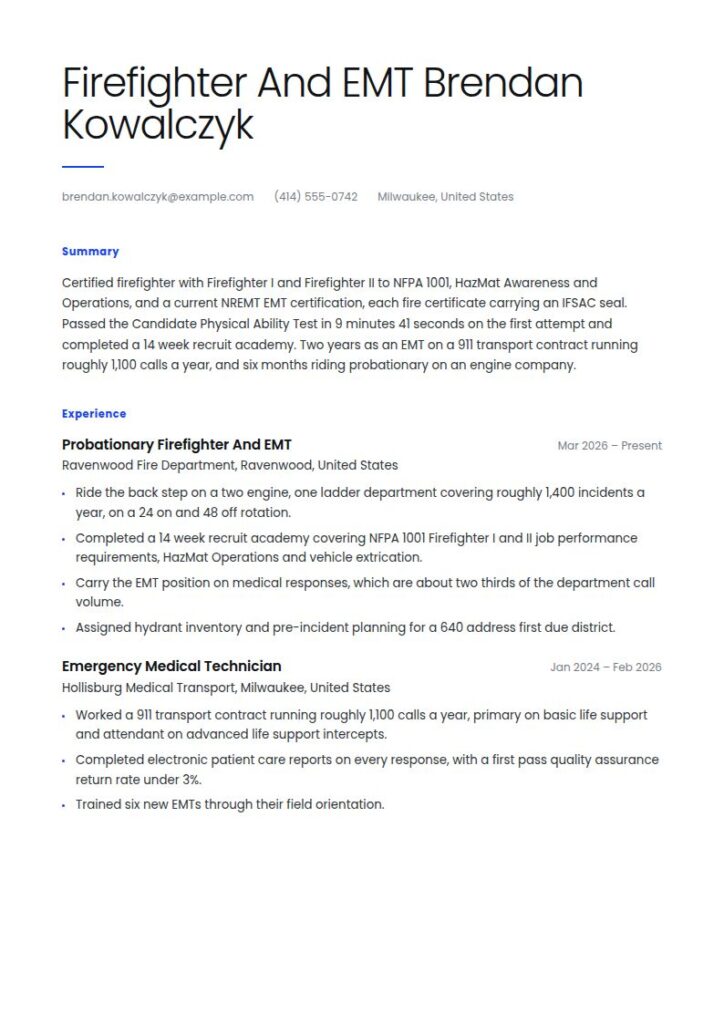
Certified firefighter with Firefighter I and Firefighter II to NFPA 1001, HazMat Awareness and Operations, and a current NREMT EMT certification, each fire certificate carrying an IFSAC seal. Passed the Candidate Physical Ability Test in 9 minutes 41 seconds on the first attempt and completed a 14 week recruit academy. Two years as an EMT on a 911 transport contract running roughly 1,100 calls a year, and six months riding probationary on an engine company.
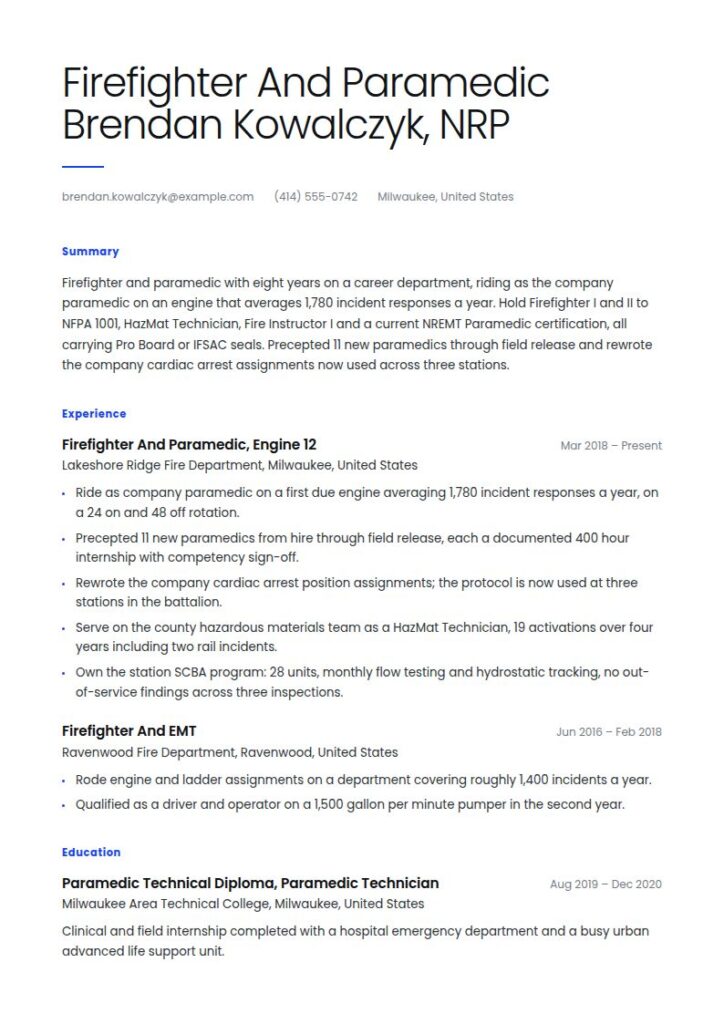
Firefighter and paramedic with eight years on a career department, riding as the company paramedic on an engine that averages 1,780 incident responses a year. Hold Firefighter I and II to NFPA 1001, HazMat Technician, Fire Instructor I and a current NREMT Paramedic certification, all carrying Pro Board or IFSAC seals. Precepted 11 new paramedics through field release and rewrote the company cardiac arrest assignments now used across three stations.
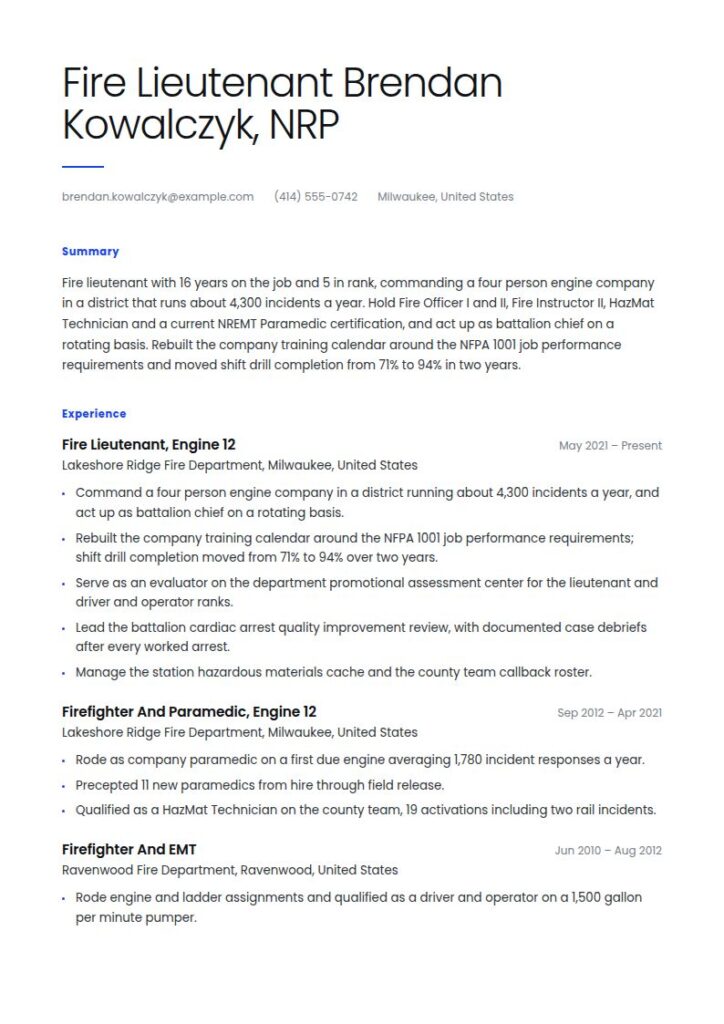
Fire lieutenant with 16 years on the job and 5 in rank, commanding a four person engine company in a district that runs about 4,300 incidents a year. Hold Fire Officer I and II, Fire Instructor II, HazMat Technician and a current NREMT Paramedic certification, and act up as battalion chief on a rotating basis. Rebuilt the company training calendar around the NFPA 1001 job performance requirements and moved shift drill completion from 71% to 94% in two years.
Right vs wrong: the same firefighter summary, twice
| ✅ Right | ❌ Wrong |
|---|---|
| Firefighter and paramedic with eight years on a career department. | Dedicated firefighter with a passion for helping people in their worst moments. |
| Firefighter I and II to NFPA 1001, HazMat Technician, Fire Instructor I, NREMT Paramedic, all with Pro Board or IFSAC seals. | Fully certified in all required areas with extensive training. |
| Rides as company paramedic on an engine averaging 1,780 responses a year. | Responds to a wide variety of emergency calls. |
| Precepted 11 new paramedics through field release. | Mentors junior personnel and assists with training. |
On one hand, a reviewer can score the right column. The left column, however, cannot, and a reviewer working through 300 applications against a checklist is scoring, not reading.
Outline your experience
Then give the department, city, apparatus, riding position, shift pattern and dates. Then three to five bullets, each carrying a volume or a named responsibility.
Moreover, the riding position matters more than applicants expect. "Firefighter, Engine 12" says almost nothing. "Firefighter and paramedic, Engine 12, nozzle and paramedic positions, 24 on and 48 off" says what you have done for eight years.
| Instead of | Use |
|---|---|
| Responded to fire and emergency calls | Responded to roughly 1,780 incidents a year on Engine 12, of which about two thirds were EMS and rescue |
| Performed fire suppression duties | Assigned nozzle and back-up positions on the first due engine in a district with 41 working structure fires in 2025 |
| Assisted with training new personnel | Precepted 11 new paramedics from hire to field release, each a 400 hour field internship with documented competency sign-off |
| Maintained equipment and apparatus | Owned the SCBA program for the station: 28 units, monthly flow tests, annual hydrostatic tracking, zero out-of-service findings in three inspections |
| Participated in hazardous materials response | Ran as a HazMat Technician on the county team, 19 activations over four years including two rail incidents |
Firefighter and Paramedic, Engine 12, Lakeshore Ridge Fire Department, Milwaukee, WI, March 2018 to Present
Ride as the company paramedic on a first due engine averaging 1,780 incident responses a year, on a 24 on and 48 off rotation.
Precepted 11 new paramedics from hire through field release, each a documented 400 hour internship with competency sign-off.
Rewrote the company cardiac arrest assignments around a fixed position model; the protocol is now used at three stations in the battalion.
Serve on the county hazardous materials team as a HazMat Technician, 19 activations over four years including two rail incidents.
Own the station SCBA program: 28 units, monthly flow testing and hydrostatic tracking, with no out-of-service findings across three inspections.
The certification stack that decides which departments can score you
This is the section the rest of the resume exists to support; however, it is also where most applications quietly lose points.
Firefighter certifications and who accredits them
Almost every fire service credential traces back to a published standard with a number. For instance, NFPA 1001, the Standard for Fire Fighter Professional Qualifications, published by the National Fire Protection Association, defines Firefighter I and Firefighter II. That standard, with the driver and operator, airport firefighter and marine firefighting qualifications standards, has since been consolidated into the single NFPA 1010 all hazards standard (International Association of Fire Chiefs, accessed September 2026). Therefore, write the standard number, because it is what makes the claim checkable.
| Credential | Who defines or accredits it | What it changes about your file |
|---|---|---|
| Firefighter I | NFPA 1001, certified by a state entity accredited by Pro Board or IFSAC | The floor. Below it, most postings do not accept the application |
| Firefighter II | NFPA 1001 | The realistic minimum for a career posting, and often what shortens a recruit academy |
| HazMat Awareness and Operations | Issued by the same state certifying entity, at the awareness and operations levels | Almost universally expected; the absence is noticed more than the presence |
| HazMat Technician | County or regional team qualification on top of Operations | Moves you onto a specialty roster and a specialty pay line |
| EMT | National Registry of Emergency Medical Technicians | Required outright by many departments, because of what the call volume actually is |
| Paramedic | National Registry of Emergency Medical Technicians | The single largest mover of a firefighter application |
| CPAT | Fire Service Joint Labor Management Task Force, through the IAFF and IAFC | Clears the physical gate before the department has to schedule you |
| Driver and operator, pump and aerial | Formerly NFPA 1002, now inside NFPA 1010 | Makes you staffable in more seats on a short-handed shift |
| Fire Officer I and II | State certification against the officer qualifications standard | The promotion track, and worth listing before you are eligible |
Most of the job is not fire, and the paramedic line is why
The U.S. Fire Administration's Fire Department Overall Run Profile recorded 26,959,000 fire department incident runs in 2020, of which 64.2 percent were emergency medical services and rescue calls and 3.9 percent were fire calls (U.S. Fire Administration, published June 2022).
Two thirds of what a fire company does is medicine. A department hiring a firefighter without a medical certification pays to send them to EMT school and staffs around the absence; a department hiring a paramedic has filled a seat that is genuinely hard to fill. BLS guidance is consistent with that: firefighters may need emergency medical technician and paramedic certifications, and requirements vary by location (BLS Occupational Outlook Handbook, Firefighters, last modified 27 August 2026).
So if you are deciding where to spend the next 18 months, paramedic moves a file further than any other single certification, and it keeps moving it after you are hired, because medical officer, field training and specialty assignments all draw from that pool.
The physical ability test and scoring order
The physical test deserves its own line. The Candidate Physical Ability Test was created in 1997 by the Fire Service Joint Labor Management Task Force and runs eight events in sequence in a 50 pound weighted vest, with an additional 25 pound hose pack carried on the stair climb, against a pass time of 10 minutes and 20 seconds on a pass or fail basis (International Association of Fire Chiefs, accessed September 2026). In particular, write the date you passed and the test site. Some regional consortia accept a card issued at another licensed site; confirm that against the posting rather than assume it.
Finally, order the block to match the scoring sheet. Where a department runs a points-based credential review, it usually publishes the weighting in the job announcement or in the civil service rules it refers to. Read that before you format the page, then list your certifications in the order that document lists them. As a result, reviewers tend to score a file that is easy to score generously.
Build a snapshot of your key skills
For skills, similarly, ten to fourteen entries in four groups: fireground, medical, specialty and department systems.
Fireground: Engine company operations, Nozzle and back-up positions, Truck company ventilation, Search and rescue, Rapid intervention team, Ladder and aerial operations
Medical: Advanced life support, Cardiac arrest resuscitation, 12 lead interpretation, Advanced airway management, Mass casualty triage
Specialty: Hazardous materials technician level, Vehicle extrication, Confined space awareness, Ice and cold water rescue
Systems and records: NFIRS incident reporting, ePCR patient care reporting, SCBA maintenance and flow testing, Pre-incident planning, Incident command system to ICS 300
In addition, keep the medical group separate from the fireground group. That is because different people often read those two blocks, and a paramedic reviewer scanning for advanced life support competencies should not have to read past ladder work.
List your education and certifications
In other words, certifications first, with numbers, issuing entity, seal and expiry. Then degrees, then the academy.
Firefighter I and Firefighter II, NFPA 1001, State of Wisconsin fire service certification, IFSAC seal, #WI-FF-208431, issued 2016
NREMT Paramedic, National Registry of Emergency Medical Technicians, #P2144038, current through March 2028
HazMat Technician, county hazardous materials team qualification, current. HazMat Awareness and Operations, 2016.
Fire Instructor I and Fire Officer I, state certification, Pro Board seal, 2022 and 2024
Candidate Physical Ability Test, passed March 2018, 9 minutes 41 seconds, licensed regional test site
Associate of Applied Science, Fire Protection Technology, Milwaukee Area Technical College, Milwaukee, WI, 2016
Recruit Academy, 14 weeks, Lakeshore Ridge Fire Department, 2018
Equally, put an expiry date on anything that has one. After all, a reviewer reads a medical certification with no date as possibly lapsed, and a reviewer with 300 clearer files has no reason to give you the benefit of the doubt.
Choose the right layout and design
In general, single column, 11 or 12 point body type, plain headings, no photograph, no graphics. Moreover, fire service applications route through civil service portals that parse into a structured record, and multi-column layouts, text boxes and icons are where that parsing breaks.
Put the certification block directly under the summary. Name the standard number, the issuing entity and the accrediting seal on every fire certificate. Give the expiry date on every medical certification. Write your CPAT result with the date and the test site. State the apparatus and the riding position, not just the rank. Put a call volume on the page. Read the posting for the scoring sheet and order the block to match it.
Do not write "fire certified" or "EMS certified" without the level; the level is the entire content of the claim. Do not omit the accrediting seal, since that is the part another state can read. Do not list a lapsed certification without marking it lapsed and giving the renewal date. Do not use a two-column template on a civil service portal. Do not describe a call in narrative detail; reviewers read volumes and positions, not stories.
Firefighter job market and outlook
Specifically, a mid-sized occupation growing at about the national average, almost all of it in local government, with most openings coming from replacement.
| Measure | Value |
|---|---|
| Firefighter jobs, 2025 | 355,300 |
| Projected change, 2025-35 | 4% (as fast as average), +13,100 |
| Projected annual openings | ~26,800 |
| Typical entry-level education | Postsecondary nondegree award |
| On-the-job training | Long-term |
| Median annual wage, May 2025 | $59,280 |
Source: U.S. Bureau of Labor Statistics, Occupational Outlook Handbook, Firefighters, 2025-35 projections and May 2025 wage data, last modified 27 August 2026.
Meanwhile, where the jobs sit, and what each sector pays:
| Employer | Share of employment | Median annual wage (May 2025) |
|---|---|---|
| State government | 4% | $64,980 |
| Federal government | 2% | $63,270 |
| Local government | 87% | $59,850 |
Source: U.S. Bureau of Labor Statistics, Occupational Outlook Handbook, Firefighters, May 2025 wage data.
At 87 percent local government, this is a civil service occupation, so the resume is one scored input rather than the whole application. Note the entry requirement too: BLS lists a postsecondary nondegree award, long-term on-the-job training and no prior work experience required (BLS Occupational Outlook Handbook, Firefighters, last modified 27 August 2026). That nondegree award is the certification.
What salary you can expect as a firefighter
For example, the median annual wage for firefighters was $59,280 as of May 2025, or $28.50 an hour. The lowest 10 percent earned less than $34,910 and the highest 10 percent more than $101,040 (BLS Occupational Outlook Handbook, Firefighters, May 2025).
In fact, firefighters negotiate very little of that spread. Instead, most of it is three things: which department you are in, how many years you have on the seniority step, and which specialty differentials you qualify for. Departments commonly pay a differential for paramedic certification, hazardous materials technician status, driver and operator qualification and instructor credentials, and they pay those against a documented credential rather than a conversation. So every certification you list with a number and a date is a differential the department can process from the first pay period rather than two years later.
Overtime is structural rather than exceptional: BLS describes firefighters as commonly working 24 hour shifts followed by 48 or 72 hours off, with overtime common (BLS Occupational Outlook Handbook, Firefighters, last modified 27 August 2026). Worth knowing before you compare a posted salary against a private sector offer.
Key takeaways for a firefighter resume
- Firstly, put the certification block under the summary, not at the bottom; it is the gate.
- Secondly, name the standard, the issuing entity and the Pro Board or IFSAC seal on every fire certificate.
- Lead the block with your medical level, because two thirds of the call volume is medical.
- Paramedic moves a firefighter application further than any other single credential.
- Write your CPAT result with the date and the test site.
- Likewise, give the apparatus, the riding position and an annual call volume, not just a rank.
- Finally, read the posting for the scoring sheet and order your certifications to match it.
Build your firefighter resume in 15 minutes with our AI resume builder.
Related security and protective service resume examples
- EMT resume
- Paramedic resume
- Volunteer firefighter resume
- Police officer resume
- Dispatcher resume
- Security and protective services resume
- Correctional officer resume
- Military resume
- Federal resume
- Government resume
- Lifeguard resume
- Criminology resume
Pair it with a matching firefighter cover letter.
Firefighter resume questions, answered
How long should a firefighter resume be?
One page as a recruit or first-term firefighter. Two once you hold rank, an instructor credential and a specialty team qualification. The certification block is allowed to be dense; the narrative is not.
Do I need to be a paramedic to get hired as a firefighter?
Not everywhere, but it is the credential that changes a file most. BLS notes firefighters may need EMT and paramedic certifications and that requirements vary by location (BLS Occupational Outlook Handbook, Firefighters, last modified 27 August 2026). Some departments require paramedic at hire, some require EMT at hire and paramedic within a set period, and some hire at either level and pay a differential.
What do I put on a firefighter resume with no fire service experience?
The certification stack, written exactly as the standards name it, then any work with a defensible overlap: ambulance or hospital emergency work, military service with a fire or medical specialty, wildland seasons, trades work involving ladders and load handling, and any role with a commercial driver license. Then the CPAT result and the academy you have completed. Physical work history and a current medical certification are what a recruit reviewer is looking for.
Should I put my CPAT result on the resume?
Yes, with the date and the licensed test site, and the time if it was comfortably inside the standard. The test is pass or fail against 10 minutes and 20 seconds in a 50 pound vest across eight events (International Association of Fire Chiefs, accessed September 2026), so a current card tells a department it can skip a scheduling round with you.
Does it matter whether my certification is Pro Board or IFSAC?
It matters to whoever decides whether your certificate transfers. Both are accrediting bodies rather than issuers: your state entity certifies you, and the seal is what an out-of-state reviewer recognizes. Write it on the page, write both if you carry both, and check the target state's reciprocity rules before assuming an equivalency.
Is a fire science degree worth listing?
List it, but do not expect it to substitute for certification at entry. It matters most later: BLS notes many departments require a bachelor's degree, preferably in fire science, for advancement beyond battalion chief (BLS Occupational Outlook Handbook, Firefighters, last modified 27 August 2026). On a promotion track the degree belongs high on the page; applying to an academy, the certifications do.