Access Control and Patrol Officer Garrett Lindqvist
Access Control and Patrol Officer (Military Police Specialist, E-4)
[email protected] | (719) 555-0730 | Colorado Springs, United States
Profile
Army military police specialist leaving active duty after four years, with an active Secret clearance and 3,100 hours of access control, patrol and detention operations at an installation of 24,000 personnel. Wrote 143 incident and blotter reports in the last 12 months, none returned for correction. Trained 6 incoming soldiers on post orders, evidence handling and use-of-force reporting.
Work Experience
09/2022 - Present, Access Control and Patrol Officer (Military Police Specialist, E-4), United States Army, 759th Military Police Battalion, Fort Carson, United States
- Stand 12-hour access control and patrol shifts at an installation of 24,000 personnel, covering 4 gates and 137 buildings.
- Wrote 143 incident and blotter reports in the last 12 months, none returned for correction by the operations sergeant.
- Trained 6 incoming soldiers on post orders, evidence handling and use-of-force reporting.
- Accountable for $180,000 of vehicles, radios and optics across two change-of-command inventories with no loss.
04/2023 - 10/2023, Detention Operations Officer (Military Police Specialist, E-3), United States Army, 759th Military Police Battalion, Fort Carson, United States
- Worked a 7-month rotation in detention operations, running counts, escorts and searches on a 24-hour schedule.
- Logged every movement and use-of-force event against the unit standard operating procedure.
Education
08/2017 - 05/2021, High School Diploma, General studies, Widefield High School, Colorado Springs, United States
Military Police One Station Unit Training, 20 weeks, Fort Leonard Wood, 2022. Armed Services Vocational Aptitude Battery completed 2022.
Skills
Access control and credentialing, 80
Incident and blotter report writing, 85
Patrol and response, 75
Evidence handling, 70
Property accountability and inventory control, 75
Radio and dispatch communications, 80
Languages
English, native
Swedish, beginner
Certificates
03/2023, Active Secret clearance, U.S. Department of Defense
Adjudicated March 2023. Active.
01/2026, First Aid, CPR and AED, American Red Cross
Summary
A military resume is a one to two page civilian document that translates your occupational specialty, your rank and your clearance into terms a civilian recruiter can act on. This guide gives you three adaptable versions, a translation table for military phrasing, and the federal pay structure and veteran employment data that actually apply to service.
Military resume examples by experience level
A military resume is a one to two page civilian document that names the job you actually did, the clearance you actually hold, and the scale you actually ran, in language a civilian recruiter can price.
In fact, the problem is not that your record is thin. Instead, your record uses a language the reader does not speak. "31B, E-6, Platoon Sergeant" is a complete professional history to anyone who has served and an empty line to a recruiter with two hundred applications open. Therefore, everything on this page exists to solve that one problem.
Resume guide for a military resume
To that end, this guide and the corresponding military resume example will cover:
- To begin with, how to write a military resume, section by section, for a civilian reader
- Then, how to translate an MOS, rating or AFSC into a civilian job title
- Also, three adaptable summaries: junior enlisted, non-commissioned officer and senior leader
- In addition, where the clearance line goes, and why it outranks every bullet on the page
- Finally, what the pay structure and veteran employment data say, and what they do not
How to write a military resume
Overall, seven sections: contact header, summary, clearance, experience under civilian job titles, skills, education and training, and awards. Generally, one page for a first enlistment, two once you have supervised people. The order matters more here than in most careers, because a recruiter scans for two things before reading a word of prose: what you are, and whether you can start on a cleared contract.
| Section | What it is answering | Where it goes |
|---|---|---|
| Clearance | Can I put this person on the contract this month? | Its own line, under the summary |
| Civilian job title | What is this person, in my vocabulary? | The job title on every experience entry |
| Experience | What did they run, how big, for how long? | Reverse chronological, with numbers |
| Education and training | Does the service school count toward anything? | With contact hours and the issuing school |
The clearance line is the highest-value item on the page
A current clearance is worth more to a defense or federal contractor than any bullet you will write, because it removes a cost and a delay from their side of the hire rather than adding a skill to yours. Write it as a checkable fact: the level, the date of the most recent adjudication, and whether it is active. "Active Secret clearance, adjudicated March 2023" can be verified. "Security clearance" cannot, and a recruiter who has to ask has moved on.
Do not describe the work the clearance covered: not the program, the system, the location or the mission. The line says a gate is open, and the discipline you show in saying nothing more is part of what is being assessed. If it has lapsed, name it anyway with the date last held.
Run the finished file through the ATS resume checker before you send it. Contractors and federal integrators parse applications before a human opens them, and a resume with acronyms in the job title fields is the file that parses badly.
Choosing the best resume format for a military resume
Above all, reverse chronological, with civilian job titles as the headings and the military title in a secondary position. In other words, one page for a single enlistment, two once you have led a team or run a program.
Functional formats are tempting, because a service record can feel like a pile of skills that needs rearranging. Resist it. After all, a hiring manager reads a transition resume for progression: same organization, growing scope, more people, bigger budget. As a result, a functional layout destroys the thing your record is strongest on.
One exception. A federal application through USAJOBS is a different document: it runs long, asks for hours per week, supervisor names and salary, and reviewers score it against published specialized experience statements rather than read it. Keep the two files apart.
Include your contact information
| ✅ Right | ❌ Wrong |
|---|---|
| Garrett Lindqvist | SFC Garrett Lindqvist |
| Physical Security and Antiterrorism Program Manager | 31B4O Military Police Operations NCO |
| Active Top Secret clearance, adjudicated June 2024 | TS cleared |
| (719) 555-0730, [email protected], Colorado Springs, CO | (719) 555-0730, [email protected] |
Also drop the rank from the header and from the email address. That is because it is not a civilian credential, it does not map to a grade the reader understands, and the file reads as someone who has not made the transition in their own head. Instead, rank belongs inside the experience entries, where it has context.
Make use of a summary
In effect, four lines: what you are in civilian terms, how long, the scale you ran, and the clearance. One number in the middle.
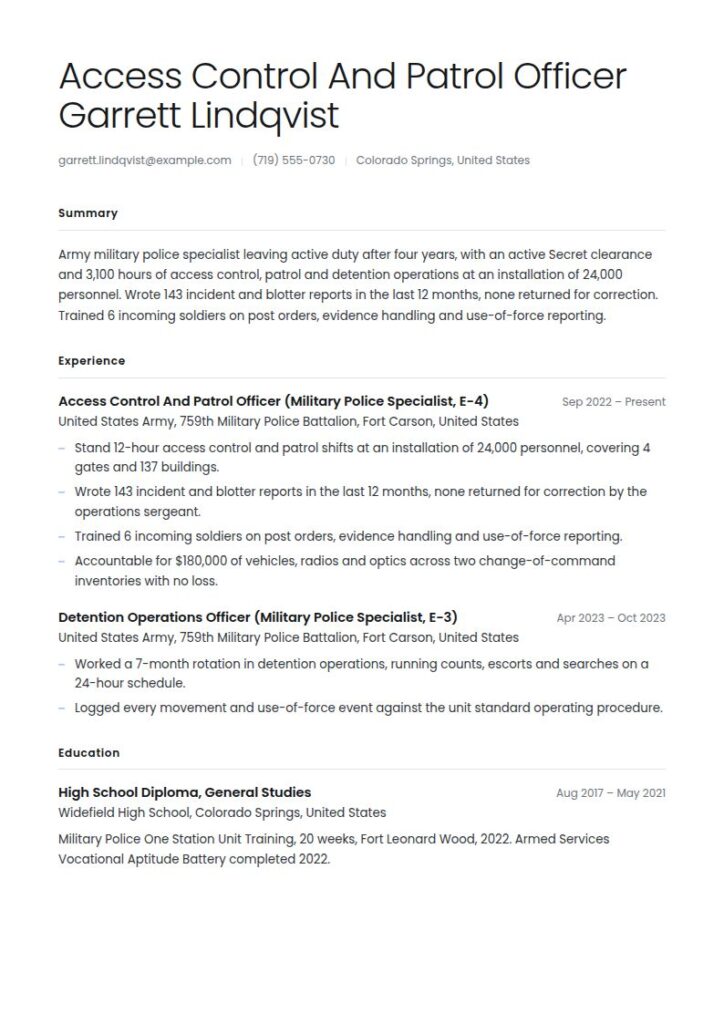
Army military police specialist leaving active duty after four years, with an active Secret clearance and 3,100 hours of access control, patrol and detention operations at an installation of 24,000 personnel. Wrote 143 incident and blotter reports in the last 12 months, none returned for correction. Trained 6 incoming soldiers on post orders, evidence handling and use-of-force reporting.
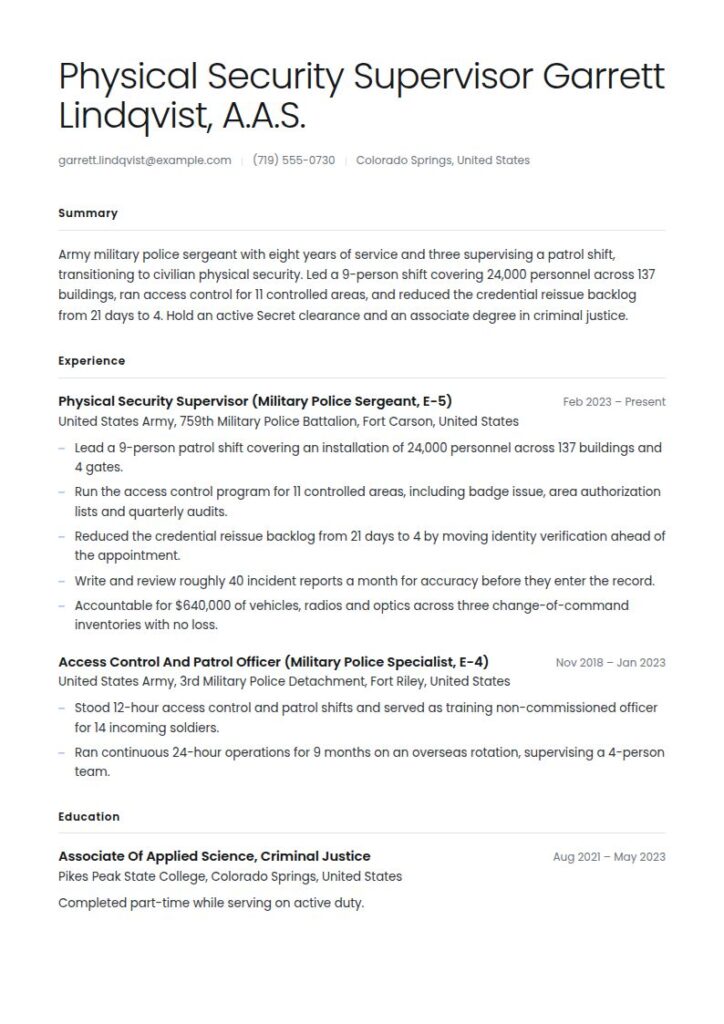
Army military police sergeant with eight years of service and three supervising a patrol shift, transitioning to civilian physical security. Led a 9-person shift covering 24,000 personnel across 137 buildings, ran access control for 11 controlled areas, and reduced the credential reissue backlog from 21 days to 4. Hold an active Secret clearance and an associate degree in criminal justice.
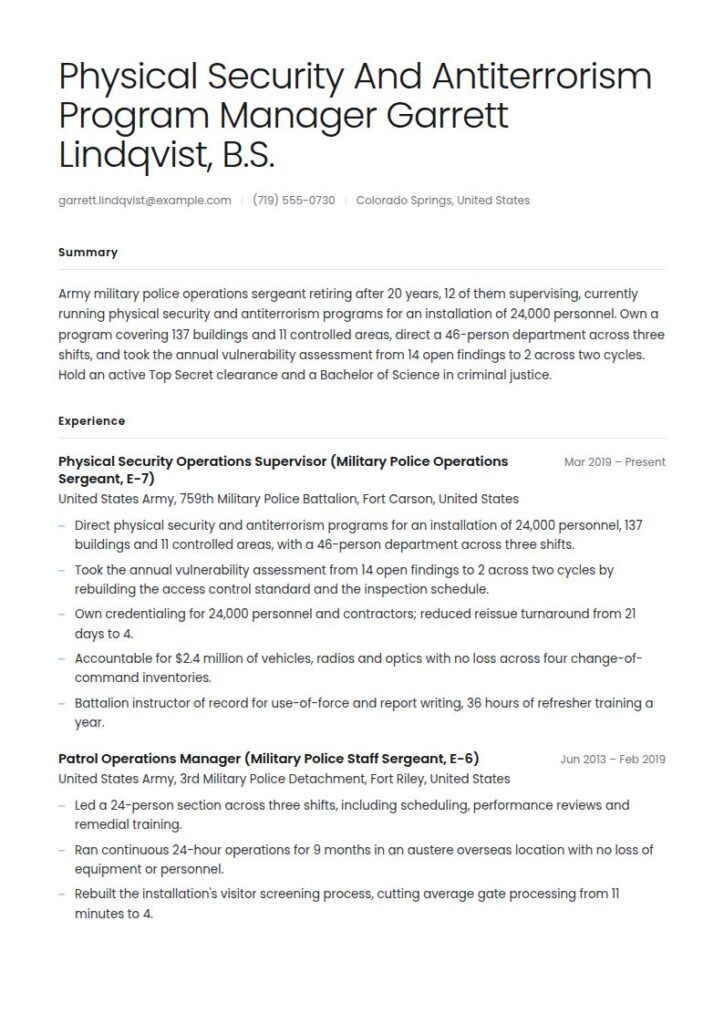
Army military police operations sergeant retiring after 20 years, 12 of them supervising, currently running physical security and antiterrorism programs for an installation of 24,000 personnel. Own a program covering 137 buildings and 11 controlled areas, direct a 46-person department across three shifts, and took the annual vulnerability assessment from 14 open findings to 2 across two cycles. Hold an active Top Secret clearance and a Bachelor of Science in criminal justice.
Right vs wrong: the same military summary, twice
| ✅ Right | ❌ Wrong |
|---|---|
| Army military police sergeant with eight years of service and three supervising a patrol shift. | Highly motivated NCO with a proven record of mission accomplishment. |
| Led a 9-person shift covering 24,000 personnel across 137 buildings. | Supervised personnel in a fast-paced, high-stress environment. |
| Reduced the credential reissue backlog from 21 days to 4. | Consistently exceeded standards and received multiple awards. |
| Active Secret clearance, adjudicated March 2023. | Holds a security clearance. |
On one hand, a recruiter can compare the right column with a civilian candidate. On the other hand, the reader can only compare the left with another service member, and the person reading has not served.
Outline your service history
Civilian job title first, then the unit and installation, then the dates. Three to five bullets under each, every one carrying a number: people, buildings, dollars, hours, incidents, or a before and after.
| Instead of | Use |
|---|---|
| Performed law enforcement duties in accordance with regulations | Ran vehicle and pedestrian access control for 24,000 personnel across 4 gates |
| Supervised subordinate soldiers | Led a 9-person shift, including scheduling, performance reviews and remedial training |
| Responsible for millions of dollars of equipment | Accountable for $2.4 million of vehicles, radios and optics with zero loss across 4 inventories |
| Received the Army Commendation Medal | Recognized by the installation commander for rebuilding the access control program |
Physical Security Operations Supervisor (Military Police Operations Sergeant, E-7), United States Army, 759th Military Police Battalion, Fort Carson, CO, March 2019 to Present
Direct physical security and antiterrorism programs for an installation of 24,000 personnel, 137 buildings and 11 controlled areas, with a 46-person department working three shifts.
Took the annual vulnerability assessment from 14 open findings to 2 across two cycles by rebuilding the access control standard and the inspection schedule.
Own credentialing for 24,000 personnel and contractors; reduced reissue turnaround from 21 days to 4 by moving verification ahead of the appointment rather than behind it.
Accountable for $2.4 million of vehicles, radios and optics with no loss across four change-of-command inventories, and serve as the battalion's instructor of record for use-of-force and report writing.
Moreover, that entry never spells out the unit's mission, never uses an acronym without a civilian meaning, and never describes anything a clearance covers. In short, it reads as a security operations job.
Translate your MOS, rating or AFSC into a civilian job title
This is the section that decides whether the reader gets through the rest of the page, and almost nobody does it properly.
Your occupational specialty code is a payroll and assignment classification. It is not a job title, and it carries no meaning outside the service that issued it. The Department of Labor publishes a crosswalk for exactly this reason: the ONET Military Crosswalk accepts Army and Marine Corps MOS codes, Navy and Coast Guard ratings, Air Force Specialty Codes and Space Force Specialty Codes, and returns the civilian occupations each maps to (U.S. Department of Labor, Employment and Training Administration, ONET Military Crosswalk, accessed September 2026). A crosswalk gives you a plausible occupation; a resume needs the title in the advertisement you are answering, which is usually narrower.
Three rules for translating military roles
Three rules make the translation work.
Title by function, not by code. Civilian title in the job title field, military one in brackets after it, so the reader gets an answer and then the verifiable fact.
Convert rank into scope. Nobody outside the service knows what an E-6 supervises. Write the headcount, the shifts, the budget and the equipment value instead.
Name the organization by size, not by designation. "759th Military Police Battalion" tells a recruiter nothing. "An installation of 24,000 personnel across 137 buildings" tells them the size of the problem you handled. The same applies to awards: the ribbon is invisible to a civilian, so write the reason you received it.
| Military phrasing | Civilian equivalent |
|---|---|
| 31B Military Police, E-6, Platoon Sergeant | Security Operations Supervisor, 24-person team |
| 25B Information Technology Specialist | Systems Administrator, enterprise Windows and network infrastructure |
| 68W Combat Medic Specialist | Emergency Medical Technician, prehospital and trauma care |
| 92Y Unit Supply Specialist | Inventory and Warehouse Coordinator, $2.4 million of assets |
| Navy Boatswain's Mate, BM1 | Marine Operations Supervisor, deck and small-boat operations |
| Air Force 3D0X2 Cyber Systems Operations | Systems Operations Analyst, server and virtualisation estate |
| Platoon Sergeant | Front-line manager, 30 to 40 direct reports across three shifts |
| Permanent change of station | Relocation, not a job change; group the roles under one employer |
| Conducted operations in a deployed environment | Ran continuous 24-hour operations for 9 months in an austere location |
Military documents that translate your record
Two documents do much of this work if you pull them before you leave. In particular, the Verification of Military Experience and Training, DD Form 2586, comes from your service records and, in the Defense Manpower Data Center's own words, "describes your Service occupations in civilian terms" (Defense Manpower Data Center, milConnect, accessed September 2026). Indeed, it is the fastest way to recover training hours and course titles you have forgotten.
DoD SkillBridge gives you a civilian job title before you separate: service members with 180 days or fewer remaining before discharge can be authorized to work with an industry partner while still on active duty (DoD SkillBridge, accessed September 2026). A SkillBridge placement written as a civilian role is often the most useful entry on a transition resume, because it is the one line the reader does not have to translate.
Build a snapshot of your key skills
For skills, similarly, ten to fourteen entries in groups, all in civilian words. If a line needs a service acronym to make sense, it is not finished.
Security operations: Physical security program management, Access control and credentialing, Antiterrorism planning, Vulnerability assessment and remediation, Incident reporting and investigation
Leadership: Shift supervision across 24-hour coverage, Performance review and counseling, Training design and delivery, Cross-training planning
Compliance and systems: Property accountability and inventory control, Standard operating procedure authorship, Records management, Incident management and case tracking systems
Clearance: Active Top Secret clearance, adjudicated June 2024. Instructor of record for use-of-force and report writing.
That last group is unusual and worth keeping: both entries are gates rather than skills, and gates belong where the eye lands.
List your education, training and certifications
Civilian education first if you have it, then service schools with their contact hours, then civilian certifications.
However, service schools are the most undersold asset on a transition resume. Specifically, they are full-time, assessed courses with published hour counts, and most service members list them as three-letter abbreviations or not at all. Basic training runs 7 to 13 weeks, and technical training for an occupational specialty generally runs 10 to 20 weeks, reaching a year for some specialties (BLS Occupational Outlook Handbook, Military Careers, last modified 27 August 2026).
Bachelor of Science, Criminal Justice, Colorado Technical University, Colorado Springs, CO, 2019
Associate of Applied Science, Criminal Justice, Pikes Peak State College, Colorado Springs, CO, 2013
Service schools: Senior Leader Course, 6 weeks, U.S. Army Military Police School (2018). Advanced Leader Course, 8 weeks (2014). Antiterrorism Officer Level II, 40 hours (2020). Physical Security Course, 80 hours (2017). Military Police One Station Unit Training, 20 weeks, Fort Leonard Wood (2006).
Certifications: Active Top Secret clearance, adjudicated June 2024. First aid, CPR and AED, American Red Cross (2026). Army Basic Instructor Course (2016).
Choose the right layout and design
In general, single column, plain type at 11 or 12 point, clear headings, no photograph, no rank insignia and no unit crest. Applicant systems parse the file into a structured record before anyone reads it, and two columns, text boxes and graphics are where that parsing fails. Likewise, name the file for a civilian: your name and the civilian job title, not a rank and an MOS code.
Lead every experience entry with a civilian job title. Put the clearance level and its adjudication date on its own line. Convert rank into headcount, budget and shift coverage. Expand every acronym on first use, or delete it. Group multiple postings under one employer so relocations do not read as job-hopping. Pull your DD Form 2586 before you separate.
Do not put rank in the header or the email address. Do not name a program, system or location that your clearance covers. Do not write "eligible for clearance" when no determination has been made. Do not list awards as a ribbon rack without the reason each was given. Do not attach your DD Form 214 to a civilian application; it holds discharge and separation codes an employer has no business reading at this stage.
Military job market and outlook
BLS employment projections cover the civilian workforce only, so there is no BLS median wage, no job count and no ten-year outlook for military service the way there is for a nurse or an electrician (BLS Occupational Outlook Handbook, Military Careers, last modified 27 August 2026). However, any page offering you a national median salary for "the military" has made it up. What you can source, instead, is the size of the force you are leaving and the labor market you are entering.
| Measure | Value |
|---|---|
| Active duty, Army (February 2024) | 441,226 |
| Active duty, Navy (February 2024) | 323,856 |
| Active duty, Air Force (February 2024) | 303,675 |
| Active duty, Marine Corps (February 2024) | 166,542 |
| Active duty, Coast Guard (February 2024) | 39,085 |
| Active duty, Space Force (February 2024) | 9,016 |
| Reserve components (February 2024) | about 755,238 |
Source: U.S. Bureau of Labor Statistics, Occupational Outlook Handbook, Military Careers, last modified 27 August 2026.
More than 1.2 million people were on active duty in total. Entry is itself gated: all branches typically require a high school diploma or equivalent, officers usually need a bachelor's degree in any field, recruits take the Armed Services Vocational Aptitude Battery to determine suitability for occupational specialties, and maximum enlistment age runs from 28 in the Marine Corps to 42 in the Air Force and Space Force (BLS, 27 August 2026).
Veterans are employed at a better rate than nonveterans, which is not the same as being hired well
In 2025 the unemployment rate for all veterans was 3.5 percent, up from 3.0 percent the year before, against 4.2 percent for nonveterans. Veterans who served on active duty at any time since September 2001, the group BLS calls Gulf War era II, were at 3.6 percent. In total, 17.3 million people held veteran status in 2025, about 7 percent of the civilian noninstitutional population aged 18 and over (U.S. Bureau of Labor Statistics, Employment Situation of Veterans 2025, published 28 April 2026).
Read those numbers before they reassure you. They say veterans find work. They say nothing about whether the work matches the responsibility the person carried in uniform, and underemployment is the complaint transitioning service members actually make.
What salary you can expect
There is no single military salary, and no honest way to publish one, because pay is set by a federal schedule rather than by a labor market. For example, basic pay is based on rank and time in service, and the pay bands are the same for all branches. Members may receive additional pay based on job assignment or qualifications, and they are either housed free of charge on base or receive a housing allowance (BLS Occupational Outlook Handbook, Military Careers, last modified 27 August 2026).
Moreover, the Defense Finance and Accounting Service publishes the schedule. The current tables, posted in January 2026 and effective from that month, are issued separately for Enlisted Members, Warrant Officers, Commissioned Officers, and Commissioned Officers Credited with More Than 4 Years of Creditable Service, with matching drill pay tables for reserve components. Every table is a grid of pay grade against years of creditable service, which is why two people holding the same rank in different branches earn identical pay and two holding the same rank with different time in service do not (Defense Finance and Accounting Service, pay tables posted January 2026).
Compare against the civilian occupation
Your compensation is therefore not a negotiating anchor, because it was never set by your performance, and allowances such as housing and subsistence are not taxed the way salary is, so a civilian headline that looks like a rise may not be one.
In contrast, the useful comparison is the published median for the occupation you are aiming at:
| Destination occupation | Median annual wage, May 2025 |
|---|---|
| Detectives and criminal investigators | $93,790 |
| Police and detectives | $77,310 |
| Firefighters | $59,280 |
| Protective service occupations, all | $50,080 |
| Security guards and gambling surveillance officers | $38,050 |
Source: U.S. Bureau of Labor Statistics, Occupational Outlook Handbook, May 2025 wage data, last modified 27 August 2026.
That spread is the argument for spending your effort on the translation rather than on the application count. The gap between top and bottom is roughly two and a half times, and which end you land on depends largely on whether the reader understood what you did.
Key takeaways for a military resume
- Firstly, put a civilian job title on every experience entry and the military one after it.
- Secondly, give the clearance its own line with a level and an adjudication date, and say nothing about what it covered.
- Equally, convert rank into headcount, budget, buildings and shift coverage.
- Moreover, expand every acronym on first use or cut it, and start from the O*NET Military Crosswalk.
- Group postings under one employer so ordered moves do not read as job-hopping.
- In addition, write service schools with their contact hours, because a civilian cannot tell a briefing from a residential course.
- Finally, price yourself against the civilian occupation you are entering, not against your base pay.
Build your military resume in 15 minutes with our AI resume builder.
Related security and protective service resume examples
- Police officer resume
- Correctional officer resume
- Security officer resume
- Security guard resume
- Federal resume
- Government resume
- Cyber security resume
- Firefighter resume
- EMT resume
- Dispatcher resume
- Criminology resume
- Security and protective services resume
Pair it with a matching military cover letter.
Military resume questions, answered
How long should a military resume be?
One page for a single enlistment. Two once you have supervised people, run a program or held budget authority. A federal resume submitted through USAJOBS is a separate document and routinely runs longer, because it is scored rather than read.
Should I put my rank on my resume?
Not in the header and not in your email address. Put it inside the experience entry, in brackets after the civilian job title. A recruiter cannot convert E-6 into a level of responsibility, so give them the headcount, the budget and the shift coverage instead.
How do I write about a security clearance?
Level, adjudication date and current status, on its own line, and nothing else. "Active Secret clearance, adjudicated March 2023" is checkable and complete. Never name the program, system, unit mission or location it covered. If it has lapsed, say so with the date last held: a prior adjudication still puts you ahead of an uncleared candidate.
What do I do with an MOS or rating that has no civilian equivalent?
Stop translating the code and translate the work. Run it through the O*NET Military Crosswalk to see which civilian occupations it maps to, then describe what you did in the language of the advertisement: the people, the equipment value, the hours of coverage, the compliance regime, the training you delivered. Most specialties that look untranslatable are made of translatable parts.
Does veterans' preference help in private-sector hiring?
Veterans' preference is a federal hiring rule and does not apply to private employers, so do not assume it is working in the background. What carries across is the clearance, which removes a real cost from the employer, and any civilian-titled work you did before separating.