Garrett Lindqvist Physical Security and Antiterrorism Program Manager Colorado Springs, 80911, United States [email protected] · (719) 555-0730
11 September 2026
Ms. Adriana Reyes Director of Corporate Security Arroyo Defense Systems Colorado Springs, United States
Application for Physical Security Manager, Arroyo Defense Systems
Dear Ms. Reyes,
I am applying for the Physical Security Manager post at Arroyo Defense Systems. For the last seven years I have run physical security and antiterrorism programs for an Army installation of 24,000 personnel, 137 buildings and 11 controlled areas, with a 46-person department across three shifts. I hold an active Top Secret clearance, adjudicated June 2024, and I separate in March 2027.
The part of that work most relevant to your Colorado Springs site is the assessment record. When I took the program over, the annual vulnerability assessment closed with 14 open findings. I rebuilt the access control standard and the inspection schedule around the findings rather than around the calendar, and the next two cycles closed with 4 and then 2. Over the same period I moved credential reissue from 21 days to 4 by putting identity verification ahead of the appointment instead of behind it, which removed the backlog that generated most of the complaints.
I noticed that Arroyo has three cleared facilities in Colorado and is advertising for a manager rather than a supervisor, which suggests you want the program owned rather than staffed. That is the work I have been doing, and I would want to start with the inspection schedule and the escort procedure, since those are usually where findings accumulate quietly. I would also be glad to take the internal training on report writing; I have been the battalion instructor of record for it since 2019.
My clearance is current, my separation date is fixed, and I can interview at any point before then. Thank you for your time.
Sincerely, Garrett Lindqvist
Summary
A military cover letter turns your service record into three things a civilian reader can act on: the job you are applying for, the clearance you hold, and one measured result. This guide gives you a full adaptable letter, the openings that work, what counts as evidence when the detail is classified, and the veteran employment data behind the market you are entering.
Military cover letter examples by experience level
In short, a military cover letter is a one-page letter that tells a civilian hiring manager what you are in their vocabulary, what gate your clearance opens, and one thing you measurably changed.
In other words, it is a translation document, not a summary of your service. Rank does not impress the reader, because they cannot price it. Instead, what they can act on is a civilian job title, a clearance with a date, and a number.
Guide to a military cover letter
Specifically, this guide and the corresponding military cover letter example will cover:
- First, how to structure the letter, paragraph by paragraph
- Then, why the civilian job title belongs in the first sentence
- Finally, where the clearance line goes and what must never follow it
- What counts as evidence when the detail cannot be written down
- The openings that make a reader study a transition file rather than file it
How to write a military cover letter
| Paragraph | Its job | Length |
|---|---|---|
| Opening | The post, your civilian job title, and the clearance | 2 to 3 sentences |
| Evidence | One program, one number, one period of time | 4 to 5 sentences |
| Fit | Something specific about the employer, and what you would take on | 3 to 4 sentences |
| Close | Availability, separation date, thank you | 2 sentences |
Open with the civilian title, not the rank
The first sentence of a transition letter decides whether the second one gets read, and a hiring manager who sees "Sergeant First Class, 31B" has to do work before they can place you.
Write the job instead: "I am applying for the Physical Security Manager post. I have run physical security and antiterrorism programs for an installation of 24,000 personnel for the last seven years, and I hold an active Top Secret clearance." Every noun in that sentence exists in the reader's world. The rank can follow later, inside the evidence paragraph, where the scale around it gives it meaning.
A military cover letter example you can adapt
Dear Ms. Reyes,
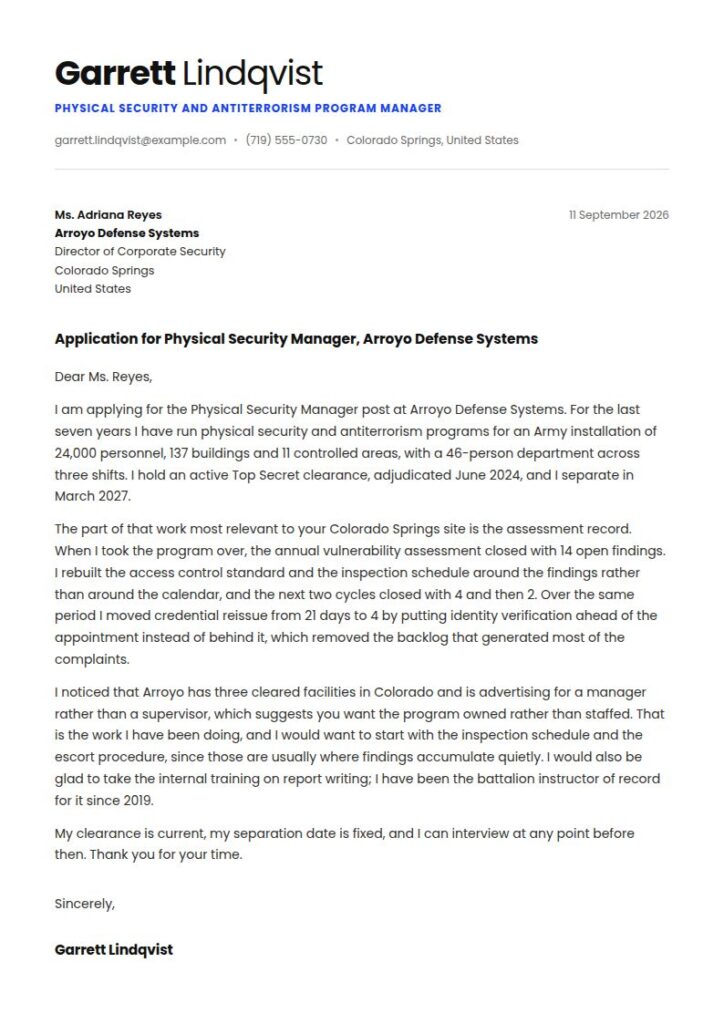
I am applying for the Physical Security Manager post at Arroyo Defense Systems. For the last seven years I have run physical security and antiterrorism programs for an Army installation of 24,000 personnel, 137 buildings and 11 controlled areas, with a 46-person department across three shifts. I hold an active Top Secret clearance, adjudicated June 2024, and I separate in March 2027.
The part of that work most relevant to your Colorado Springs site is the assessment record. When I took the program over, the annual vulnerability assessment closed with 14 open findings. I rebuilt the access control standard and the inspection schedule around the findings rather than around the calendar, and the next two cycles closed with 4 and then 2. Over the same period I moved credential reissue from 21 days to 4 by putting identity verification ahead of the appointment instead of behind it, which removed the backlog that generated most of the complaints.
I noticed that Arroyo has three cleared facilities in Colorado and is advertising for a manager rather than a supervisor, which suggests you want the program owned rather than staffed. That is the work I have been doing, and I would want to start with the inspection schedule and the escort procedure, since those are usually where findings accumulate quietly. I would also be glad to take the internal training on report writing; I have been the battalion instructor of record for it since 2019.
My clearance is current, my separation date is fixed, and I can interview at any point before then. Thank you for your time.
Sincerely, Garrett Lindqvist
Openings that work
| Instead of | Use |
|---|---|
| I am a highly motivated NCO with a proven record of mission accomplishment | I am applying for the Physical Security Manager post and I hold an active Top Secret clearance |
| After 20 years of honorable service I am seeking new challenges | For seven years I have run physical security for an installation of 24,000 personnel |
| My military training has prepared me for a wide range of roles | I manage a 46-person department across three shifts and a program covering 137 buildings |
| I would bring discipline and leadership to your organization | I took the annual vulnerability assessment from 14 open findings to 2 across two cycles |
In practice, every line on the right is a fact a civilian can check or compare. Meanwhile, every line on the left is a sentence the reader has already seen this week.
What counts as evidence when the detail cannot be written down
You cannot describe a great deal of military work, which is why so many transition letters retreat into adjectives. The answer is to describe the management of the work rather than the mission, since the rules almost never restrict it.
| Kind of evidence | What it looks like in a sentence |
|---|---|
| Scale | A department of 46 people across three shifts, covering 137 buildings |
| Compliance | Annual assessment closed at 14 findings, then 4, then 2 |
| Throughput | Credential reissue turnaround cut from 21 days to 4 |
| Money | $2.4 million of vehicles and equipment, no loss across four inventories |
| Continuity | Ran continuous 24-hour operations for 9 months in an austere location |
Also, none of those sentences names a program, a system, a location or a mission. All of them describe a manager.
The clearance line, and what must never follow it
Name the level, the adjudication date and whether it is active, in the first paragraph. Say your separation or retirement date so the reader can plan. Use the employer's own job title as your self-description. Give one number with a before, an after and a period of time. Read the employer's site and name one real thing about them.
Do not describe the work the clearance covered, the systems you touched, the unit's mission or where you were. Do not write "eligible for clearance" when no determination has been made. Do not open with rank, an occupational specialty code or a service acronym. Do not thank the reader for their service to the country, and do not ask them to thank you for yours.
Veterans find work, which is not the same as being placed well
In 2025 the unemployment rate for all veterans was 3.5 percent, up from 3.0 percent a year earlier, against 4.2 percent for nonveterans. Veterans who served on active duty at any time since September 2001 were at 3.6 percent, and 17.3 million people held veteran status in 2025, roughly 7 percent of the civilian noninstitutional population aged 18 and over (U.S. Bureau of Labor Statistics, Employment Situation of Veterans 2025, published 28 April 2026).
Those figures say veterans get hired. They say nothing about the level at which they get hired, and the complaint transitioning service members actually make is underemployment rather than unemployment.
The letter is where that gets decided, more than the resume is. A resume is scanned against a job description; a letter is the only place you can say that the thing you ran was the same size as the thing they are advertising.
Length, format and sending it
Overall, one page, four paragraphs, 250 to 400 words. PDF unless the portal says otherwise, named for yourself and the post rather than for a rank.
Address a person. A company site usually names security and facilities leadership; as a result, "Dear Hiring Manager" on a file that is otherwise precise reads as a letter sent to twenty employers.
Keep every figure identical to the one on your resume. Our military resume example uses the same numbers, and a letter that disagrees with its attachment is the discrepancy a reader remembers.
Key takeaways
- First, open with the civilian job title from the advertisement, not with your rank.
- Then put the clearance level and adjudication date in the first paragraph, and stop there.
- Give your separation or retirement date so the reader can plan around it.
- Pick one program and one number with a before, an after and a time frame.
- Describe the management of the work, not the mission, when the rules restrict the detail.
- Finally, name one real thing about the employer, and match every figure to your resume.
Write your military cover letter in 10 minutes with our AI cover letter builder.
Military cover letter questions, answered
How long should a military cover letter be?
One page, four paragraphs, 250 to 400 words. A civilian hiring manager reads these in batches, and length is not read as effort. A federal application through USAJOBS is a scored document rather than a letter, and follows different rules.
Should I mention my rank in the cover letter?
Not in the opening. Put the civilian job title first and let the rank appear later, inside the evidence paragraph, where the headcount and budget around it give it meaning. A reader who cannot convert E-7 into a level of responsibility will skip the sentence containing it.
How do I write about a security clearance in a letter?
Level, adjudication date and current status, in the first paragraph, and nothing further. "Active Top Secret clearance, adjudicated June 2024" is complete. Never name the program, system, location or mission it covered. If it has lapsed, give the date last held: a prior adjudication still places you ahead of an uncleared applicant.
What do I write if most of my work cannot be described?
Describe the management rather than the mission. Headcount, shifts, budget, equipment value, assessment findings closed, throughput times and training hours delivered are all unrestricted and all comparable to civilian work. A letter built from those reads as a manager's letter.
Should I mention that I am still serving?
Yes, with the date. A fixed separation or retirement date lets the reader decide whether the timing works, and vagueness costs you interviews you would otherwise have had. If you are inside your final 180 days, say whether you are available for a SkillBridge placement.