Imani Okafor In-House Security Officer, Campus Posts Charlotte, 28202, United States [email protected] · (704) 555-0718
11 September 2026
Mr. Brennan Tilley Corporate Security Uwharrie Financial Group Charlotte, United States
Application for Security Officer, Uwharrie Financial Group
Dear Mr. Tilley,
I am applying for the in-house Security Officer post at the Uwharrie Financial Group headquarters. I am registered with the North Carolina Private Protective Services Board and I have spent the last three years on the in-house campus team at Piedmont Crescent University, covering residence halls, the library and the north campus entrance across a 14,000-student site.
The part of the work I would bring across is the written record. I file roughly 220 incident reports a year across theft, medical assist, access violation and conduct referral, and four have been returned to me for correction in three years. I own card access for 11 residence halls and 1,900 active credentials, audited monthly against the housing roster, and I review CCTV on every after-hours alarm on a 96-camera estate with the clip reference attached to the report before shift end. Last year I drafted the post order revision that was adopted for the north campus entrance after the after-hours entry route changed.
Your posting mentions Lenel OnGuard and a console shift pattern, both of which I have run. What interests me about a headquarters post is that the reporting goes somewhere: the incident file at a university closes with the conduct office, while in a corporate building it reaches risk, legal and the insurer. I would want to work on the escalation sequences, which is where I have seen most reports fail review, and I am glad to take the overnight rotation.
My board registration, my report writing certification and my CPR, first aid and AED are all current, and I can work nights, weekends and holiday cover. I can start four weeks after an offer. Thank you for reading.
Sincerely, Imani Okafor
Summary
A security officer cover letter is read by somebody who will one day read your incident reports, so it should be written the same way: observation before conclusion, and every claim attached to a volume. This guide gives you a full adaptable letter, the lines that earn a second reading, and what changes when the post is in-house rather than on contract.
Security Officer cover letter examples by experience level
A security officer cover letter is a one-page letter for the person who will later read everything else you write.
If they hire you, that manager will spend years reading your incident reports, your access exceptions and your handover notes. The cover letter is the first sample of that writing they will see, and they will judge the rest against this page whether they mean to or not.
Guide to a security officer cover letter
Specifically, this guide and the corresponding security officer cover letter example will cover:
- First, how to structure the letter, paragraph by paragraph
- Then, why you should write the letter the way you write a report
- Finally, what volumes to put in, and which ones to leave out
- What changes when the post is in-house rather than contract
How to write a security officer cover letter
| Paragraph | Its job | Length |
|---|---|---|
| Opening | The post, your registration, and the setting you have worked | 2 to 3 sentences |
| Record | Report volume, category mix, and one quality number | 4 to 5 sentences |
| Fit | Their systems, their setting, and what you would take on | 3 to 4 sentences |
| Close | Currency of registration and training, availability, thank you | 2 sentences |
Give one quality number, not five volume numbers
Most officers who quantify anything quantify volume: reports written, patrols walked, badges issued. Volume proves the post was busy. It does not prove you were good at it.
The number that does is the one about correction: how many of your reports came back for rework, or how many did not. "Roughly 220 incident reports a year, 4 returned for correction in three years" is a sentence a security manager will read twice, because it is the exact thing they cannot find out from a reference call.
If your employer does not track returns, use something adjacent and honest: reports filed before end of shift, or retention holds that found your file already complete.
A security officer cover letter example you can adapt
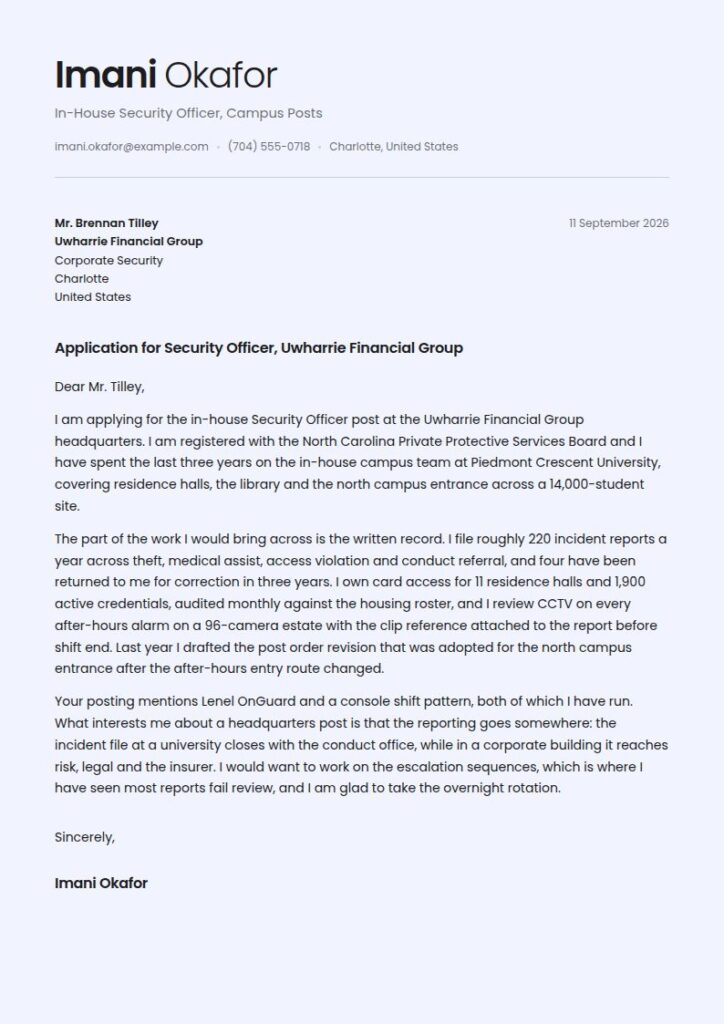
Dear Mr. Tilley,
I am applying for the in-house Security Officer post at the Uwharrie Financial Group headquarters. I am registered with the North Carolina Private Protective Services Board and I have spent the last three years on the in-house campus team at Piedmont Crescent University, covering residence halls, the library and the north campus entrance across a 14,000-student site.
The part of the work I would bring across is the written record. I file roughly 220 incident reports a year across theft, medical assist, access violation and conduct referral, and four have been returned to me for correction in three years. I own card access for 11 residence halls and 1,900 active credentials, audited monthly against the housing roster, and I review CCTV on every after-hours alarm on a 96-camera estate with the clip reference attached to the report before shift end. Last year I drafted the post order revision that was adopted for the north campus entrance after the after-hours entry route changed.
Your posting mentions Lenel OnGuard and a console shift pattern, both of which I have run. What interests me about a headquarters post is that the reporting goes somewhere: the incident file at a university closes with the conduct office, while in a corporate building it reaches risk, legal and the insurer. I would want to work on the escalation sequences, which is where I have seen most reports fail review, and I am glad to take the overnight rotation.
My board registration, my report writing certification and my CPR, first aid and AED are all current, and I can work nights, weekends and holiday cover. I can start four weeks after an offer. Thank you for reading.
Sincerely, Imani Okafor
Write the letter the way you write a report
An incident report has a shape: what you observed, then what you did, then what you concluded, with the three kept apart. A cover letter written in that order is unusually easy to read, and it signals competence at the job before it makes a single claim about it.
The habit to carry over is separating observation from conclusion. "I file roughly 220 incident reports a year and four have been returned for correction" is an observation. "I am a meticulous report writer" is a conclusion, and it is the writer's own conclusion about themselves, which is exactly what a trained reader discounts.
In practice, the habit to leave behind is the passive voice of official writing. "The area was secured and the individual was escorted from the premises" belongs in a report where the actor is obvious from the header. In a letter, however, it removes you from your own sentence.
Lines that earn a second reading
| Instead of | Use |
|---|---|
| I have excellent report writing skills | Roughly 220 incident reports a year, four returned for correction in three years |
| I am familiar with access control systems | I own card access for 11 residence halls and 1,900 credentials, audited monthly against the housing roster |
| I monitor CCTV and respond to alarms | I review footage on every after-hours alarm across 96 cameras and attach the clip reference to the report |
| I follow all company policies and procedures | I drafted the post order revision adopted for the north campus entrance |
| I work well with law enforcement | I hand off to the campus police liaison on anything that becomes a criminal referral, with the scene preserved |
What changes when the post is in-house
Name their platform if the posting names it, since in-house teams run one system and want somebody who already knows it. Say who read your reports: the facilities director, the conduct office, risk, legal, the insurer. Give the category mix, not just the total, because it tells a manager what kind of site you are used to. Say plainly which shifts you will take. Give a start date.
Do not retell a single incident; it identifies people and it proves less than a volume does. Do not list duties that every applicant shares, such as patrolling and monitoring. Do not send a contract guarding letter to an in-house employer, where the reader is filling one fixed post rather than a rota. Do not claim a registration category or a training hour you cannot evidence, since the board register is public.
The in-house premium, in published numbers
The Bureau of Labor Statistics counts security guards and security officers as one occupation, with a median wage of $38,050 a year, or $18.29 an hour, as of May 2025, 1,304,000 jobs in 2025, and about 157,200 openings projected each year through 2035 (BLS Occupational Outlook Handbook, Security Guards and Gambling Surveillance Officers, last modified 27 August 2026).
Inside that single occupation, investigation, guard and armored car services employ 58% of officers at a median of $37,350, while educational services pay $44,250 and healthcare and social assistance pay $44,920, all May 2025 figures (BLS, last modified 27 August 2026).
No separate wage series is published for corporate in-house officers. What the published settings show is the pattern anyway: the posts where somebody with legal exposure reads your writing pay roughly $7,000 more than the posts where a supervisor files it. That is the gap your letter is arguing about.
Length, format and sending it
One page, four paragraphs, 250 to 400 words. PDF unless the portal insists otherwise, named for you and the post: imani-okafor-security-officer-cover-letter.pdf.
Address a named person. An employer's own site almost always lists directors of corporate security, facilities directors and campus safety directors; as a result, a letter naming their systems but not them reads as a template with the fields filled in.
Keep every number identical to the one on your resume. Our security officer resume example is built on the same figures, so a reader comparing the two files finds them consistent.
Key takeaways
- First, write in report order: observation, action, conclusion, kept apart.
- Give one quality number, such as reports returned for correction.
- Give a category mix, not just a total, so the reader knows the site type.
- Name their platform if the posting names it.
- Say who read your reports, because that is what makes a post in-house.
- Then keep incidents as categories, and never retell one.
- Finally, close with shift availability and a start date.
Write your security officer cover letter in 10 minutes with our AI cover letter builder.
Security officer cover letter questions, answered
How long should a security officer cover letter be?
One page, four paragraphs, 250 to 400 words. A security manager reads these between shifts, and a letter that takes longer than a shift handover to read is already arguing against itself.
Is a cover letter worth writing for a security post?
For contract work it is often skipped. For an in-house post it is the best tool you have, because the resume cannot show how you write and the in-house job is largely writing. It is also the only place to say which shifts you will take and when you can start.
What if my employer never tracked report corrections?
Use a number you can defend instead: reports completed before end of shift, months with no outstanding log entries, or audits passed. Say where the figure comes from. An honest adjacent number is stronger than a precise one you cannot source.
Should I mention the registration in the letter as well as the resume?
Yes, in the first two sentences, and name the board. State registration is a gate rather than a credential, and a reader who has to hunt for it will assume you do not have it.
How do I write this letter with no security experience?
Write the nearest thing you have done that produced a record somebody else relied on: a front desk log, a care or incident log, a shift handover, a dispatch record. Then the entry facts for the occupation, which are being 18 or over, clearing a background check and completing your state's training (BLS Occupational Outlook Handbook, last modified 27 August 2026), and the date your registration was or will be issued.