Probationary Volunteer Firefighter and EMT Hana Sugiyama
Probationary Volunteer Firefighter and EMT
[email protected] | (207) 555-0748 | Bangor, United States
Profile
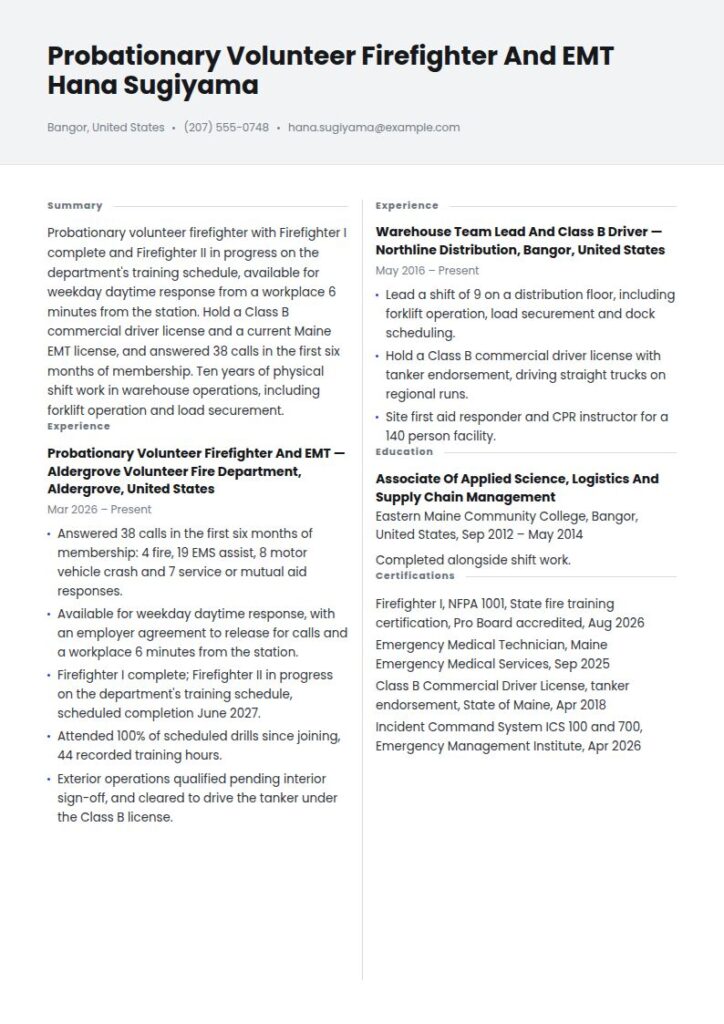
Probationary volunteer firefighter with Firefighter I complete and Firefighter II in progress on the department's training schedule, available for weekday daytime response from a workplace 6 minutes from the station. Hold a Class B commercial driver license and a current Maine EMT license, and answered 38 calls in the first six months of membership. Ten years of physical shift work in warehouse operations, including forklift operation and load securement.
Work Experience
03/2026 - Present, Probationary Volunteer Firefighter and EMT, Aldergrove Volunteer Fire Department, Aldergrove, United States
- Answered 38 calls in the first six months of membership: 4 fire, 19 EMS assist, 8 motor vehicle crash and 7 service or mutual aid responses.
- Available for weekday daytime response, with an employer agreement to release for calls and a workplace 6 minutes from the station.
- Firefighter I complete; Firefighter II in progress on the department's training schedule, scheduled completion June 2027.
- Attended 100% of scheduled drills since joining, 44 recorded training hours.
- Exterior operations qualified pending interior sign-off, and cleared to drive the tanker under the Class B license.
05/2016 - Present, Warehouse Team Lead and Class B Driver, Northline Distribution, Bangor, United States
- Lead a shift of 9 on a distribution floor, including forklift operation, load securement and dock scheduling.
- Hold a Class B commercial driver license with tanker endorsement, driving straight trucks on regional runs.
- Site first aid responder and CPR instructor for a 140 person facility.
Education
09/2012 - 05/2014, Associate of Applied Science, Logistics and Supply Chain Management, Eastern Maine Community College, Bangor, United States
Completed alongside shift work.
Skills
Exterior fireground operations, 60
EMT level patient assessment, 75
Class B commercial driving, tanker endorsement, 90
Forklift and heavy equipment operation, 90
CPR and automated defibrillation instruction, 85
SCBA checks and air management, 60
Weekday daytime availability, 95
Languages
English, native
Japanese, intermediate
Certificates
08/2026, Firefighter I, NFPA 1001, State fire training certification, Pro Board accredited
Funded by Aldergrove Volunteer Fire Department. Firefighter II in progress, scheduled completion June 2027.
09/2025, Emergency Medical Technician, Maine Emergency Medical Services, ME-E-44017
Current through 2028. NREMT certified.
04/2018, Class B Commercial Driver License, tanker endorsement, State of Maine
04/2026, Incident Command System ICS 100 and 700, Emergency Management Institute
Summary
A volunteer firefighter resume has one job that a paid firefighter resume does not: it has to supply evidence that unpaid service never produces on its own. No pay stub, no roster title, no timesheet. This guide shows you how to state run counts, call types, duty hours, drill attendance and department-funded certifications, whether you are applying to join a department or turning years of service into a career application.
Volunteer Firefighter resume examples by experience level
In practice, a volunteer firefighter resume is a one to two page document whose real task is to supply evidence that unpaid service never generates by itself.
First, think about what a paid job leaves behind. For example, a pay stub proves you were there. Similarly, a job title tells a stranger what you were allowed to do. Likewise, a schedule proves how much of your week it took. Volunteer service produces none of those. You have a membership, a pager and a set of qualifications, and unless you write the numbers down, nobody can tell the difference between someone who answered six calls last year and someone who answered two hundred and fourteen.
This page solves that for two readers: a membership committee deciding whether to let you join, and a career department deciding whether your volunteer years count as experience. However, they want different things, and the sections below say which is which.
Resume guide for a volunteer firefighter resume
To start, this guide and the corresponding volunteer firefighter resume example will cover:
- How to write a volunteer firefighter resume, section by section
- The numbers that turn unpaid service into readable evidence
- Where to get them from your own department
- What a membership committee looks at that a career department does not
- Three adaptable summaries: new member, active member, line officer
How to write a volunteer firefighter resume
Overall, use six blocks: contact header, summary, service record with its numbers, certifications, employment history and skills.
In particular, two things in that order are specific to volunteer service. The service record sits above paid employment, even though it is the unpaid part, because it is what the reader is assessing. Also, the day job stays on the page: it is where your availability, physical work history and often your commercial driver license come from.
| Block | What it is answering | Where it goes |
|---|---|---|
| Service record | How much service is this, in numbers? | Directly under the summary |
| Certifications | What can they do on a fireground, and who paid for it? | After the service record |
| Availability | Which hours can they actually respond in? | One line in the header |
| Employment history | What does the day job give them, and does it conflict? | After certifications, kept short |
| Skills | Mechanical, medical and driving competencies | Grouped, near the end |
Write availability as hours, not as a promise
Every volunteer department has the same shortage, and it is not people. It is people at eleven o'clock on a Tuesday morning. Evenings and weekends are usually covered; weekday daytime is where a duty roster falls apart, because the membership is at work, often forty minutes away.
So write availability as three facts: the hours you can respond, your distance from the station during those hours, and whether your employer will release you. "Available weekday daytime, workplace 6 minutes from the station, employer releases for calls" is worth more to a chief than a paragraph about commitment. If you can take scheduled station duty nights, say how many a month; that is the number a duty roster is built from.
Run the finished file through the ATS resume checker before you send it. Career and larger combination departments take applications through civil service portals that parse the document before a person reads it.
Choosing the best resume format for a volunteer firefighter resume
Reverse chronological, single column, with the volunteer service listed as a dated role rather than tucked into a "volunteering and interests" line at the bottom.
In fact, that placement is the most common mistake on these resumes. Service running 214 calls a year is not an interest. Instead, give it a role title, a department, a city, a date range and bullets, exactly as you would a job, then be scrupulous in the title line that it is volunteer: "Volunteer Firefighter and EMT" or "Volunteer Lieutenant". In other words, naming it plainly buys the right to format it like employment. One page while you are new; two once you have a decade of runs and an officer position.
Include your contact information
| ✅ Right | ❌ Wrong |
|---|---|
| Hana Sugiyama | Hana Sugiyama |
| Volunteer Firefighter and EMT, Interior Qualified | Volunteer firefighter and community volunteer |
| Firefighter I and II, NFPA 1001, Pro Board seal. Maine EMT license #ME-E-44017 | Certified in firefighting and first aid |
| (207) 555-0748, [email protected], Bangor, ME. Daytime response available | (207) 555-0748, [email protected] |
Two of those lines are specific to this resume. For instance, "Interior qualified" tells a fire service reader whether you go inside a burning building, the first thing they want to know. The availability line tells a volunteer department whether you solve their actual problem.
Make use of a summary
Then write four lines: qualification level, annual run count, duty hours or drill attendance, and what you are asking for.
Probationary volunteer firefighter with Firefighter I complete and Firefighter II in progress on the department's training schedule, available for weekday daytime response from a workplace 6 minutes from the station. Hold a Class B commercial driver license and a current Maine EMT license, and answered 38 calls in the first six months of membership. Ten years of physical shift work in warehouse operations, including forklift operation and load securement.
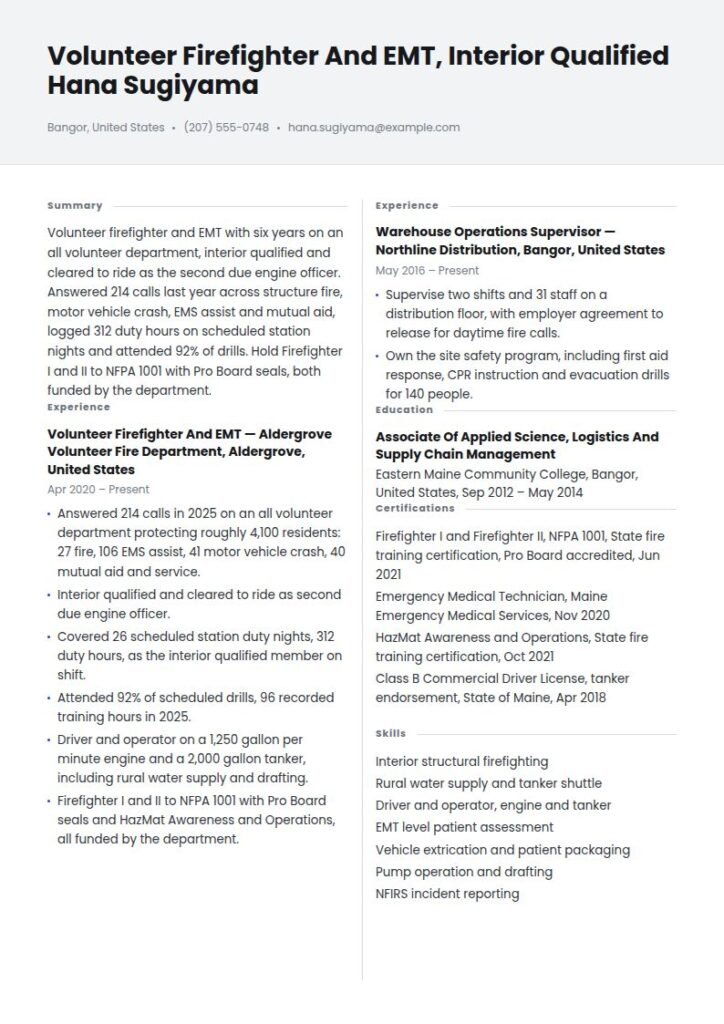
Volunteer firefighter and EMT with six years on an all volunteer department, interior qualified and cleared to ride as the second due engine officer. Answered 214 calls last year across structure fire, motor vehicle crash, EMS assist and mutual aid, logged 312 duty hours on scheduled station nights and attended 92% of drills. Hold Firefighter I and II to NFPA 1001 with Pro Board seals, both funded by the department.
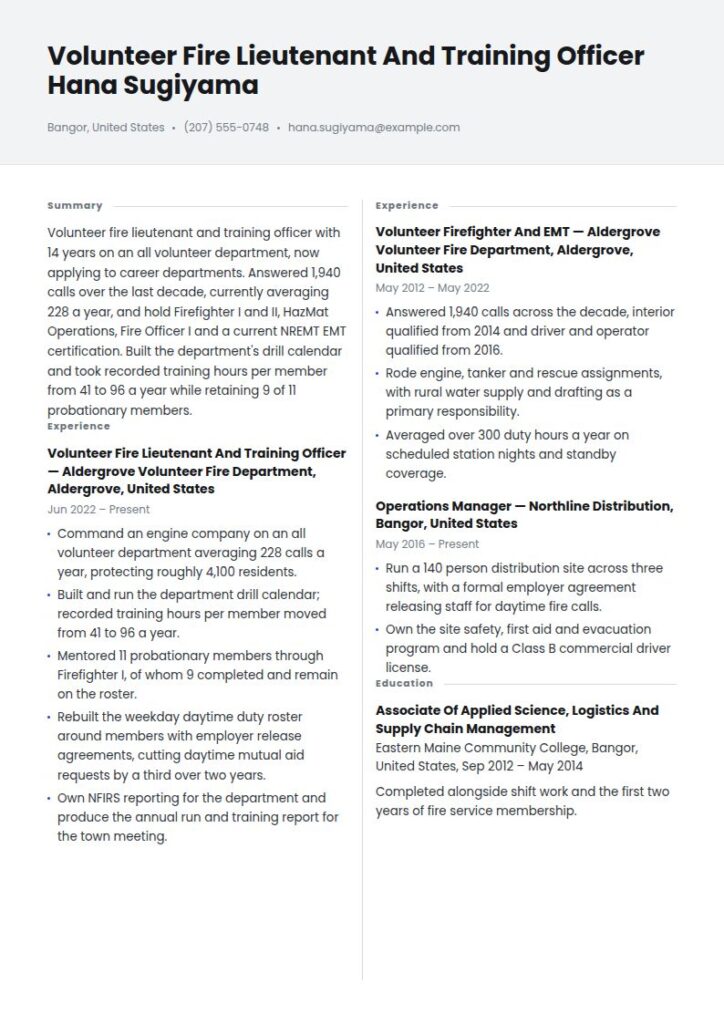
Volunteer fire lieutenant and training officer with 14 years on an all volunteer department, now applying to career departments. Answered 1,940 calls over the last decade, currently averaging 228 a year, and hold Firefighter I and II, HazMat Operations, Fire Officer I and a current NREMT EMT certification. Built the department's drill calendar and took recorded training hours per member from 41 to 96 a year while retaining 9 of 11 probationary members.
Right vs wrong: the same volunteer firefighter summary, twice
| ✅ Right | ❌ Wrong |
|---|---|
| Volunteer firefighter and EMT with six years on an all volunteer department, interior qualified. | Volunteer firefighter with several years of experience helping my community. |
| Answered 214 calls last year across structure fire, motor vehicle crash, EMS assist and mutual aid. | Responds to a wide range of emergency calls whenever needed. |
| Logged 312 duty hours on scheduled station nights and attended 92% of drills. | Regularly attends training and is always willing to help out. |
| Firefighter I and II to NFPA 1001 with Pro Board seals, both funded by the department. | Has completed extensive firefighter training. |
The left column can be compared against another applicant. By contrast, the right column cannot, and it is what almost every volunteer firefighter resume already says.
Outline your experience
Department, city, role title with the word volunteer in it, dates, then the numbers. In short, the bullets should read like a records extract, not a job description.
| Instead of | Use |
|---|---|
| Responded to emergency calls as a volunteer | Answered 214 calls in 2025: 27 fire, 106 EMS assist, 41 crash, 40 mutual aid and service |
| Attended regular training sessions | Attended 92% of scheduled drills, 96 recorded training hours in 2025 |
| Helped out around the station | Covered 26 station duty nights, 312 duty hours, as the interior qualified member on shift |
| Certified in firefighting | Firefighter I and II to NFPA 1001, Pro Board seal, 2020 and 2021, funded by the department |
| Assisted with new members | Mentored 11 probationary members through Firefighter I; 9 remain on the roster |
Volunteer Firefighter and EMT, Aldergrove Volunteer Fire Department, Aldergrove, ME, April 2020 to Present
Answered 214 calls in 2025 on an all volunteer department protecting roughly 4,100 residents: 27 fire, 106 EMS assist, 41 motor vehicle crash, 40 mutual aid and service.
Interior qualified and cleared to ride as second due engine officer, with driver and operator qualification on a 1,250 gallon per minute engine and a 2,000 gallon tanker.
Covered 26 scheduled station duty nights in 2025, 312 duty hours, and attended 92% of scheduled drills.
Hold Firefighter I and II to NFPA 1001, HazMat Awareness and Operations and a current EMT license, all funded by the department.
Mentored 11 probationary members through Firefighter I; 9 remain on the roster.
Convert call time into runs, hours and certifications a paid department can score
What decides whether volunteer service reads as a hobby or as experience is that the reader has no independent record of what you did. Of course, a department reviewing eight years on an ambulance can read a job title and a payroll history. Reviewing eight years of volunteer service, they have your name on a roster, and that is the entire external record unless you put numbers beside it.
| What the reader cannot see | The number that supplies it | Where you get it |
|---|---|---|
| What you were allowed to do | Qualification level: interior or exterior, driver and operator, officer | The department's qualification matrix |
| How much service this is | Calls answered per year, and a running total | Incident records, which most departments file to NFIRS |
| What kind of work it was | Call type breakdown: fire, EMS, crash, mutual aid, service | The same records, filtered by type |
| How much time it took | Duty hours: station nights, standby, coverage shifts | The duty roster or station log |
| Whether you kept current | Drill attendance percentage and recorded training hours | The training officer's records |
| What training cost | Certifications, and who funded them | Your certification file |
Getting volunteer firefighter records in writing
Ask your records officer and training officer for those figures in writing once a year, and keep them. It is a five minute request and almost nobody makes it. Even so, if the records live in a filing cabinet and a chief's head, ask anyway and start your own log the same week.
Most of the American fire service is volunteer, and the numbers are how you stand out inside it
Of an estimated 1,018,100 firefighters in the United States, 635,100 are volunteers, about 62 percent (National Volunteer Fire Council Volunteer Fire Service Fact Sheet, accessed February 2026, citing National Fire Protection Association data accessed 19 January 2026).
The department count is more lopsided still. Of 29,452 fire departments, 18,873 are all volunteer and a further 5,335 mostly volunteer, against 2,785 all career departments (NFPA, U.S. Fire Department Profile 2020, published September 2022). That volunteer time saves localities an estimated $46.9 billion a year (Fire Protection Research Foundation, Total Cost of Fire in the United States, October 2017).
Two conclusions follow. For a career application, volunteer service is not exotic; it is how most of the country's fire protection is delivered, and the reviewer has read a hundred of these files. The numbers are what separate yours. For a volunteer department application the scale cuts the other way: most departments need members badly, so the question is whether you can answer at the hours they are short.
If you are applying to join a volunteer department, the file is short and answers four questions. When can you respond. Can you pass a physical and a background check. Will you complete Firefighter I on the department's schedule. And what do you bring on day one: a commercial driver license, a medical certification, a trade, military service, or reliable weekday availability. Say all four plainly and keep the day job on the page so the committee can see where your hours come from.
Turning volunteer service into a career file
If you are converting volunteer service into a career application, the file is longer and it is about scale and currency. Lead with total runs and the annual rate, then the call type mix, then the qualification level with its accrediting seal, then duty hours and drill attendance. Career departments score credentials, so name the standard each certificate was issued against. And never blur the status: write "Volunteer Firefighter" in the title line, because a reviewer who works out on their own that an unlabelled role was unpaid will discount the page.
There is also a cost argument almost nobody makes explicitly. In addition, the National Volunteer Fire Council reports that the cost to train and equip a firefighter can exceed $35,000 (NVFC Volunteer Fire Service Fact Sheet, accessed February 2026, citing chart data provided January 2026). As a result, every certification your department already paid for is training the hiring department does not have to buy, which is the clearest way to say you arrive cheap to onboard.
Build a snapshot of your key skills
Generally, list ten to fourteen entries in four groups. Also keep the driving and mechanical group; on a volunteer department it is often the scarcest competence on the roster.
Fireground: Interior structural firefighting, Engine company operations, Search and rescue, Ventilation, Rural water supply and tanker shuttle
Medical: EMT level patient assessment, CPR and automated defibrillation, Bleeding control, Extrication patient packaging
Driving and mechanical: Class B commercial driver license, Driver and operator on engine and tanker, Pump operation and drafting, Apparatus checks
Records and training: NFIRS incident reporting, Drill planning and delivery, Probationary member mentoring, SCBA checks, Incident command system to ICS 200
List your education and certifications
Next, put certifications first, each with the standard it was issued against, the accrediting seal, the date and who funded it. Then any degree or trade qualification, then the driving license class.
Firefighter I and Firefighter II, NFPA 1001, state fire training certification with Pro Board seal, 2020 and 2021, funded by Aldergrove Volunteer Fire Department
HazMat Awareness and Operations, state fire training certification, 2021. Fire Officer I, Pro Board seal, 2024.
Emergency Medical Technician, Maine Emergency Medical Services license #ME-E-44017, current through 2028. NREMT certified.
Class B Commercial Driver License with tanker endorsement, State of Maine, current
Incident Command System ICS 100, 200 and 700, Emergency Management Institute, 2021
Associate of Applied Science, Logistics and Supply Chain Management, Eastern Maine Community College, Bangor, ME, 2014
Choose the right layout and design
Finally, use a single column, 11 or 12 point body type, plain headings, no photograph, no icons. This matters because a career department file passes through a civil service portal that parses it, and multi-column layouts and graphics are where parsing breaks. A volunteer department file may be printed and handed round a committee table, which is another argument for plain type.
List volunteer service as a dated role with the word volunteer in the title. Put an annual run count and a call type breakdown on the page. Give drill attendance as a percentage and training as recorded hours. State your qualification level, interior or exterior, in the header. Name who funded each certification. Keep your paid employment on the page, because it explains your availability.
Do not bury the service under "volunteering and interests" at the bottom. Do not write "responded to numerous calls". Do not imply the role was paid, or drop the word volunteer to make it look like employment. Do not claim interior qualification if your department has you on exterior operations. Do not list a lapsed medical certification without a renewal date.
Volunteer firefighter job market and outlook
Volunteer service is a membership rather than a labor market, so the published data describes the career occupation it feeds into.
| Measure | Value |
|---|---|
| Firefighters in the United States | 1,018,100, of which 635,100 volunteer |
| All volunteer fire departments | 18,873 of 29,452 |
| Career firefighter jobs, 2025 | 355,300 |
| Projected change, 2025-35 | 4% (as fast as average), +13,100 |
| Projected annual openings | ~26,800 |
| Median annual wage, career firefighters, May 2025 | $59,280 |
Sources: NVFC Volunteer Fire Service Fact Sheet, accessed February 2026, citing NFPA data accessed 19 January 2026; NFPA U.S. Fire Department Profile 2020, published September 2022; U.S. Bureau of Labor Statistics, Occupational Outlook Handbook, Firefighters, 2025-35 projections and May 2025 wage data, last modified 27 August 2026.
Two trends shape what departments want. The number of volunteer firefighters reached a low in 2023, and call volume has more than tripled over the last forty years (NVFC Volunteer Fire Service Fact Sheet, accessed February 2026, citing NFPA data accessed 19 January 2026). Fewer people, far more calls, so a candidate who can document availability at the hours a duty roster is thin is answering the problem the fire service actually has.
The work has also shifted under the job title. The U.S. Fire Administration recorded 26,959,000 fire department incident runs in 2020, of which 64.2 percent were emergency medical services and rescue calls and 3.9 percent were fire calls (U.S. Fire Administration, Fire Department Overall Run Profile, published June 2022). If your call breakdown is mostly medical, that is not a weakness. It is the occupation.
What salary you can expect as a volunteer firefighter
Volunteer service is unpaid. Some departments pay a per call stipend, a length of service award or a property tax credit, and those vary by state and municipality, so check your own department and town rather than any national figure.
Still, the number that matters here is the one the service leads to. Specifically, the median annual wage for career firefighters was $59,280 as of May 2025, or $28.50 an hour, with the lowest 10 percent under $34,910 and the highest 10 percent over $101,040 (BLS Occupational Outlook Handbook, Firefighters, May 2025). BLS gives the typical entry-level education as a postsecondary nondegree award, which in practice is the certification, and notes that working as a volunteer firefighter may be helpful in getting a job as a career firefighter (BLS Occupational Outlook Handbook, Firefighters, last modified 27 August 2026).
That is the economic case for writing this resume properly: your volunteer years are the unpaid route into a paid occupation with a documented median.
Key takeaways for a volunteer firefighter resume
- First, list volunteer service as a dated role, with the word volunteer in the title line.
- Then put an annual run count and a call type breakdown on the page; nothing substitutes.
- Give duty hours, and drill attendance as a percentage rather than a claim.
- State your qualification level, interior or exterior, in the header.
- Also name the standard each certification was issued against, and who funded it.
- Finally, write availability as hours, distance and employer release, not enthusiasm.
- Ask your records officer for the figures in writing once a year.
Build your volunteer firefighter resume in 15 minutes with our AI resume builder.
Related security and protective service resume examples
- Firefighter resume
- EMT resume
- Paramedic resume
- Dispatcher resume
- Lifeguard resume
- Police officer resume
- Security guard resume
- Security officer resume
- Military resume
- Correctional officer resume
- Security and protective services resume
- Government resume
Pair it with a matching volunteer firefighter cover letter.
Volunteer firefighter resume questions, answered
Can I put volunteer firefighting in the work experience section?
Yes, as long as the title line says volunteer. Service running to hundreds of calls a year belongs where the reader is looking, not in an interests line at the bottom. What you must not do is drop the word volunteer to make it read as employment: a reviewer who works that out stops trusting the page.
How do I get my run counts and duty hours?
Ask your records officer and training officer in writing, for the calendar year. Most departments file incident data to the National Fire Incident Reporting System, so call totals and the type breakdown already exist in exportable form. Duty hours come off the roster or station log, drill attendance from the training officer's records.
What does a volunteer fire department look for in an application to join?
Four things: when you can respond, whether you can pass a physical and a background check, whether you will complete Firefighter I on their schedule, and what you already bring. Weekday daytime availability is the scarcest by a wide margin, so if you have it, put it in the header. A commercial driver license, a medical certification or a mechanical trade will also move your file.
Will volunteering actually help me get a career firefighting job?
BLS states that working as a volunteer firefighter may be helpful in getting a job as a career firefighter (BLS Occupational Outlook Handbook, Firefighters, last modified 27 August 2026). It helps most when it is documented. With 635,100 volunteer firefighters nationally (NVFC, accessed February 2026, citing NFPA data accessed 19 January 2026), the service itself is not unusual; the run counts and the seal on your certifications are what make one file readable against another.
My department's calls are nearly all medical. Does that weaken my resume?
No, and say so with the number rather than hide it. Nationally, 64.2 percent of fire department runs in 2020 were emergency medical services and rescue calls and 3.9 percent were fires (U.S. Fire Administration, published June 2022). A mostly medical breakdown matches the occupation, and paired with an EMT or paramedic certification it is what career departments are short of.
I have no certifications yet and my department would pay for them. What do I write?
Write what you have committed to and when. "Firefighter I in progress, scheduled completion June 2026, on the department's training schedule" is a real line. Then lead with what made them take you: availability, a driving license class, physical work history, a clean background check. New members are assessed on what they will turn up for, not on what they know.