Lifeguard, Deep Water Dashiell Pankratz
Seasonal Lifeguard
[email protected] | (757) 555-1888 | Virginia Beach, United States
Profile
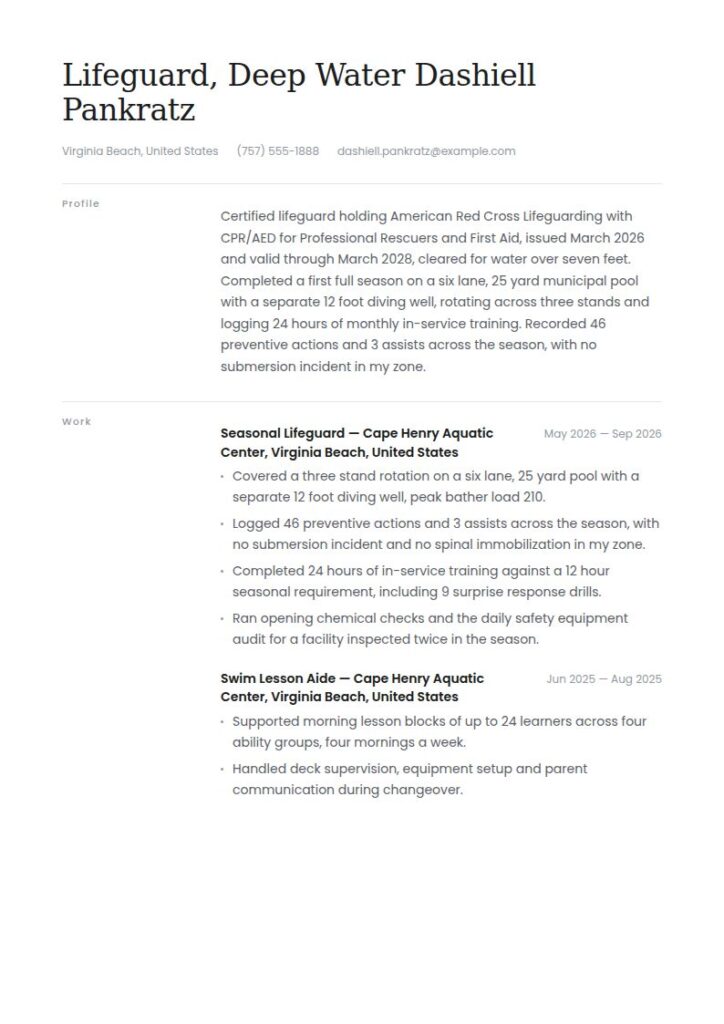
Certified lifeguard holding American Red Cross Lifeguarding with CPR/AED for Professional Rescuers and First Aid, issued March 2026 and valid through March 2028, cleared for water over seven feet. Completed a first full season on a six lane, 25 yard municipal pool with a separate 12 foot diving well, rotating across three stands and logging 24 hours of monthly in-service training. Recorded 46 preventive actions and 3 assists across the season, with no submersion incident in my zone.
Work Experience
05/2026 - 09/2026, Seasonal Lifeguard, Cape Henry Aquatic Center, Virginia Beach, United States
- Covered a three stand rotation on a six lane, 25 yard pool with a separate 12 foot diving well, peak bather load 210.
- Logged 46 preventive actions and 3 assists across the season, with no submersion incident and no spinal immobilization in my zone.
- Completed 24 hours of in-service training against a 12 hour seasonal requirement, including 9 surprise response drills.
- Ran opening chemical checks and the daily safety equipment audit for a facility inspected twice in the season.
06/2025 - 08/2025, Swim Lesson Aide, Cape Henry Aquatic Center, Virginia Beach, United States
- Supported morning lesson blocks of up to 24 learners across four ability groups, four mornings a week.
- Handled deck supervision, equipment setup and parent communication during changeover.
Education
08/2024 - 05/2026, Associate of Science, Exercise Science, Tidewater Coast Community College, Virginia Beach, United States
Coursework in anatomy, emergency care and aquatic facility operations.
Skills
Deep water and surface rescue, 75
Zone scanning and stand rotation, 75
CPR/AED for Professional Rescuers, 85
Spinal immobilization and backboarding, 65
Chemical testing and log keeping, 70
Incident reporting and documentation, 65
Languages
English, native
Spanish, intermediate
Certificates
03/2026, Lifeguarding with CPR/AED for Professional Rescuers and First Aid, American Red Cross
Cleared for water over seven feet. Valid for two years, through March 2028.
Summary
A lifeguard resume is a one page document naming the water you guarded, the zone you were assigned, and your certification with its issue and expiry dates. This guide gives you three adaptable versions, the incident record that aquatic supervisors actually read, and current Bureau of Labor Statistics pay and outlook for the occupation.
Lifeguard resume examples by experience level
A lifeguard resume is a one page document that names the water you guarded, the zone you were assigned to watch, the certification you hold with its issue and expiry dates, and what you did in the minutes before anybody had to be pulled out.
That last part is where most applicants lose the job. First of all, an aquatics supervisor is not hiring a swimmer. Instead, they are filling a rotation schedule for a facility with a stated bather load, a defined number of stands and an inspection due in the spring. That is why the resume that says which stand you can cover on the first Saturday of the season wins.
Resume guide for a lifeguard resume
In short, this guide and the corresponding lifeguard resume example will cover:
- How to write a lifeguard resume, section by section
- Why your certification expiry date belongs above your experience
- Three adaptable summaries: first season, head lifeguard and supervisor
- How to write a record of preventive actions rather than rescues
- What the job market looks like and what you can expect to earn
How to write a lifeguard resume
Six sections: contact header, summary, certifications with dates, aquatic experience, a zone and facility block, and skills, with education last. One page at every level, including supervisory, because the reader is checking a short list of facts rather than reading a career.
Certifications come before experience because they are a gate, not an achievement. A guard whose card expired in March cannot sit a stand in June, however many seasons they have worked.
| Section | What it is answering | Where it goes |
|---|---|---|
| Certifications and dates | Can this person legally sit a stand on opening day? | Directly under the summary, with issue and expiry |
| Aquatic experience | What water have they actually watched, and how deep? | Reverse chronological, facility named and described |
| Zone and facility detail | Which stand in my rotation can they cover? | Its own block, not buried in bullets |
| Skills and in-service record | Will they hold up in an audit and a surprise drill? | Grouped, with the training hours stated |
Put the expiry date on the page, not just the certification name
The American Red Cross states that its Lifeguarding course awards a Lifeguarding with CPR/AED for Professional Rescuers and First Aid certification "which is valid for two years and accepted nationwide" (American Red Cross, redcross.org, retrieved 17 September 2026).
Two years is short enough that a supervisor reading applications in April is doing arithmetic about every file. Make it unnecessary. Write a date range: "American Red Cross Lifeguarding with CPR/AED for Professional Rescuers and First Aid, issued March 2026, valid through March 2028."
The Red Cross also notes that a recertification course is available for candidates whose certification expired within the last 30 days. If yours lapsed and you have rebooked, say which course and when: a supervisor can schedule around a known date, not around a blank.
Run the finished file through the ATS resume checker first. Parks departments and waterpark operators both run seasonal hiring through an applicant system before a person opens anything.
Choosing the best resume format for a lifeguard resume
Reverse chronological, one page, no exceptions. However, seasonal work produces a long list of short entries, and the temptation is a functional layout that hides the gaps. Do not. After all, the gaps are the job, and everybody reading knows an outdoor municipal pool closes in September.
Group by facility rather than by season. For example, four summers at the same aquatic center is one entry with the seasons listed inside it, not four entries that push your certifications onto a second page. Keep pool, waterfront and waterpark settings separate, because they are genuinely different work.
Include your contact information
| ✅ Right | ❌ Wrong |
|---|---|
| Dashiell Pankratz | Dashiell Pankratz |
| Lifeguard, Deep Water and Waterfront | Strong swimmer and team player |
| Red Cross Lifeguarding, CPR/AED for Professional Rescuers, First Aid, valid through March 2028 | Red Cross certified |
| (757) 555-1888, [email protected], Virginia Beach, VA | (757) 555-1888, [email protected] |
Also, write the certification line into the header. Human resources verifies it before anyone calls you, and the file that lets them do it in five seconds moves ahead.
Make use of a summary
Then write four lines: the water you guard, the seasons or years, the zone you covered, and one number from your own record.
Certified lifeguard holding American Red Cross Lifeguarding with CPR/AED for Professional Rescuers and First Aid, issued March 2026 and valid through March 2028, cleared for water over seven feet. Completed a first full season on a six lane, 25 yard municipal pool with a separate 12 foot diving well, rotating across three stands and logging 24 hours of monthly in-service training. Recorded 46 preventive actions and 3 assists across the season, with no submersion incident in my zone.
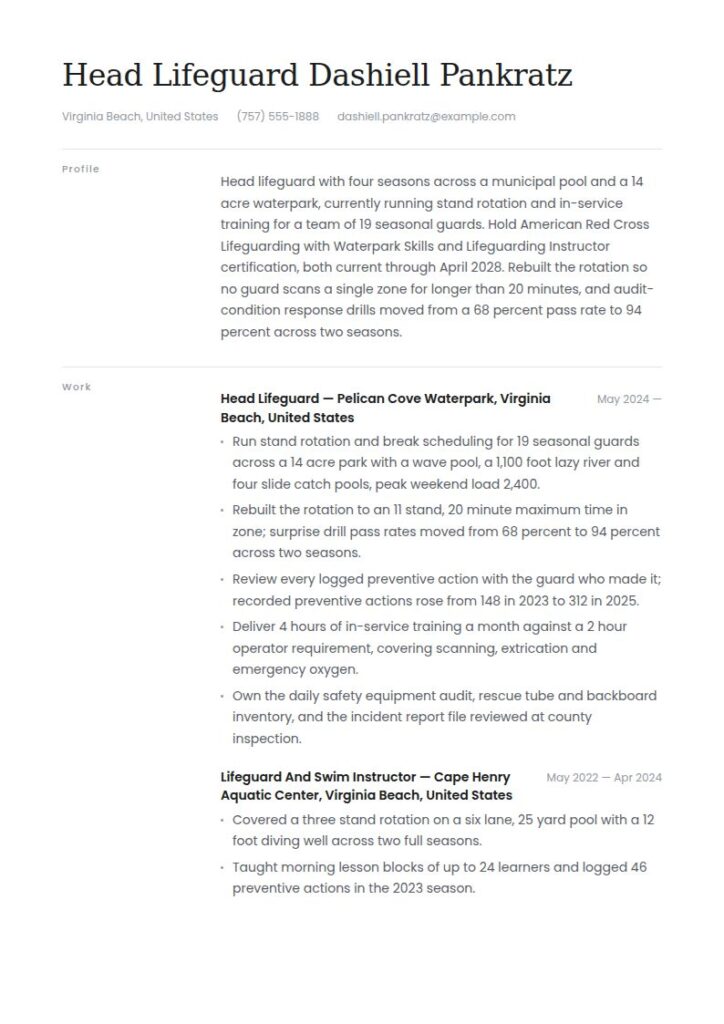
Head lifeguard with four seasons across a municipal pool and a 14 acre waterpark, currently running stand rotation and in-service training for a team of 19 seasonal guards. Hold American Red Cross Lifeguarding with Waterpark Skills and Lifeguarding Instructor certification, both current through April 2028. Rebuilt the rotation so no guard scans a single zone for longer than 20 minutes, and audit-condition response drills moved from a 68 percent pass rate to 94 percent across two seasons.
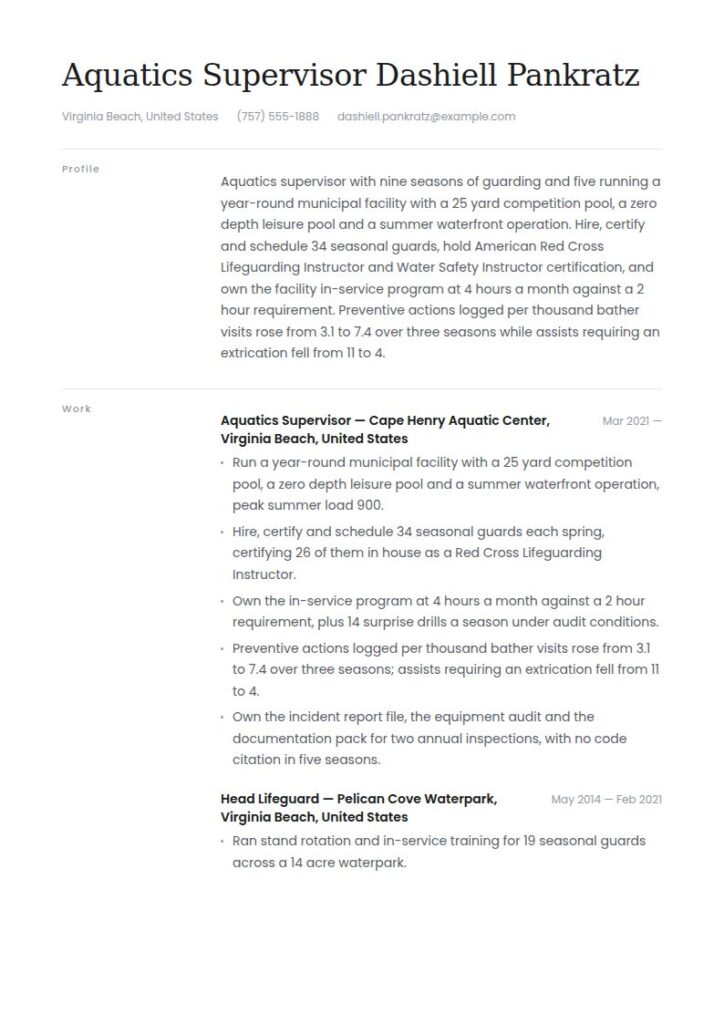
Aquatics supervisor with nine seasons of guarding and five running a year-round municipal facility with a 25 yard competition pool, a zero depth leisure pool and a summer waterfront operation. Hire, certify and schedule 34 seasonal guards, hold American Red Cross Lifeguarding Instructor and Water Safety Instructor certification, and own the facility in-service program at 4 hours a month against a 2 hour requirement. Preventive actions logged per thousand bather visits rose from 3.1 to 7.4 over three seasons while assists requiring an extrication fell from 11 to 4.
Right vs wrong: the same lifeguard summary, twice
| ✅ Right | ❌ Wrong |
|---|---|
| Head lifeguard with four seasons across a municipal pool and a 14 acre waterpark. | Responsible lifeguard with a passion for water safety and helping others. |
| Red Cross Lifeguarding with Waterpark Skills and Lifeguarding Instructor, current through 2027. | Red Cross certified in lifeguarding, CPR and first aid. |
| Rebuilt the rotation so no guard scans a single zone longer than 20 minutes; drill pass rate moved from 68 percent to 94 percent. | Ensured the safety of all patrons at all times. |
As a result, a supervisor can put the right column on a schedule and defend it in an inspection. By contrast, the left column cannot, and a supervisor filling 30 posts in six weeks is scheduling.
Outline your lifeguarding experience
Facility, city and dates by season, then three to five bullets. Additionally, in experience, each bullet names the water, the zone, the rotation or the record, and carries a number.
| Instead of | Use |
|---|---|
| Watched swimmers and enforced pool rules | Covered a three stand rotation on a six lane, 25 yard pool with a 12 foot diving well, peak bather load 210 |
| Performed rescues when necessary | Logged 46 preventive actions and 3 assists across the season, none requiring spinal immobilization |
| Kept the pool area clean and safe | Ran opening chemical checks and the daily safety equipment audit for a facility inspected twice a season |
| Attended training sessions | Completed 24 hours of in-service training against a 12 hour seasonal requirement, including 9 surprise response drills |
| Helped train new guards | Certified 11 new guards as a Red Cross Lifeguarding Instructor and ran their first four weeks of in-service |
Head Lifeguard, Pelican Cove Waterpark, Virginia Beach, VA, May 2024 to Present, seasonal May to September
Run stand rotation and break scheduling for 19 seasonal guards across a 14 acre park with a wave pool, a 1,100 foot lazy river and four slide catch pools.
Rebuilt the rotation so no guard scans a single zone for longer than 20 minutes, and moved surprise drill pass rates from 68 percent to 94 percent across two seasons.
Log and review every preventive action and assist with the guard who made it, which produced 312 recorded preventive actions in the 2025 season against 148 in 2023.
Deliver 4 hours of in-service training a month against a 2 hour operator requirement, covering scanning, extrication and emergency oxygen.
Own the daily safety equipment audit, the rescue tube and backboard inventory, and the incident report file the county inspector reads.
Your zone, your certification dates, and the preventions you logged
In practice, this is the block almost nobody includes, and it decides seasonal hiring.
For instance, a resume that says "lifeguard at a community pool" tells a supervisor nothing they can act on. Water is not interchangeable, and neither are the certifications: the American Red Cross lists separate options including Lifeguarding for water over seven feet, Shallow Water Lifeguarding, Aquatic Attraction Lifeguarding for water three feet or less, Waterpark Skills and Waterfront Skills (American Red Cross, redcross.org, retrieved 17 September 2026).
Write four things.
The water and the zone you guarded
The facility and the shape of the water. Dimensions, depth, features and peak bather load. A six lane 25 yard pool with a 12 foot diving well is a different scanning problem from a zero depth leisure pool, and both are different from open water.
Your zone and your scanning responsibility. Say whether you sat a single guard zone or a rotation with overlapping coverage, how many stands were in the rotation, and how long a guard stayed in one zone. If you set that rotation, say so. Facilities train to a stated scanning and response standard and test it under audit conditions: name the standard yours trained to and your drill results, rather than asserting a number you have not been given in writing.
Lifeguard in-service hours and your record
Your in-service hours, required and actual. Aquatic operators run monthly in-service training and document it, because the documentation is what an inspection looks at. Write both numbers, required and logged. A guard who did 24 hours against a 12 hour requirement is saying something no adjective can.
Your record, written as preventive actions and assists. The work is overwhelmingly preventive: repositioning a weak swimmer, moving a child out of the deep end, stopping a run on wet deck, clearing a drop slide landing before the next rider. Those are logged at any well-run facility and they are the truest measure of a guard's scanning. Put the preventive count first, the assists second, and then, only if it happened and only in flat language, any rescue requiring extrication, spinal immobilization or CPR.
Facility: 14 acre waterpark. Wave pool at 9 foot maximum depth, 1,100 foot lazy river, four slide catch pools, peak weekend bather load 2,400.
Zone and rotation: 11 stands, 20 minute maximum time in zone, overlapping coverage on the wave pool and every slide catch pool. Set and published the rotation as head lifeguard.
Certifications: American Red Cross Lifeguarding with CPR/AED for Professional Rescuers, First Aid and Waterpark Skills, issued April 2024, valid through April 2026, renewed April 2026 and valid through April 2028. American Red Cross Lifeguarding Instructor, issued February 2025.
In-service: 4 hours a month delivered, against a 2 hour operator requirement. 9 surprise response drills in the 2025 season, pass rate 94 percent.
Record, 2025 season: 312 preventive actions, 27 assists, 2 extrications, 0 submersion incidents, 0 spinal immobilizations.
Meanwhile, state and county bathing codes set guard staffing, supervision, in-service documentation and minimum certifications, and they vary a great deal between jurisdictions. Therefore, do not write a national rule onto your resume. Instead, write what your facility required, name the county or state that inspected it, and let the reader match it to their own code.
Build a snapshot of your key skills
Later, in skills, list twelve to sixteen entries in three groups: water and rescue, facility operations, training.
Water and rescue: Deep water and surface rescue, Passive and active victim extrication, Spinal immobilization and backboarding, Emergency oxygen administration, Waterfront and open water search patterns, Wave pool and catch pool scanning
Facility operations: Stand rotation and break scheduling, Daily safety equipment audit, Chemical testing and log keeping, Incident reporting and documentation, Opening and closing procedure, Bather load monitoring
Training and people: In-service training delivery, Surprise drill design, New guard onboarding and certification, Swim lesson instruction, Public communication in a crowded facility
List your education and certifications
Certifications first with issue and expiry dates, then instructor credentials, then education. Education goes last, and for a first season guard it is one line.
American Red Cross Lifeguarding with CPR/AED for Professional Rescuers and First Aid, including Waterpark Skills, issued April 2026, valid through April 2028
American Red Cross Lifeguarding Instructor, issued February 2025, current
American Red Cross Water Safety Instructor, issued June 2023, current
Administering Emergency Oxygen, completed as part of the 2025 facility in-service program
Associate of Science, Exercise Science, Tidewater Coast Community College, Virginia Beach, VA, 2024
The Red Cross states that lifeguarding students must be at least 15 years old by the last day of class, and facilities apply their own minimum ages to supervisory posts on top of that. If you are under 18, a current card and a completed season already make you a strong seasonal hire, so put both above your education rather than below it.
Choose the right layout and design
Lastly, use a single column, plain type at 11 or 12 point, clear headings, no photograph, no water graphics. Parks department portals and waterpark operator systems parse the file into a structured record before anyone sees it, and two columns, text boxes and decorative headers are where that parsing breaks. Also, keep the certification dates in plain text rather than inside an icon row: a parser reads "valid through March 2028", not a small blue badge.
Put your certification with its issue and expiry dates in the header and again in the certifications block. Describe the water: dimensions, depth, features and peak bather load. Say how many stands were in your rotation and how long you sat one zone. Give both in-service numbers, required and logged. Lead your record with preventive actions, then assists. Say which seasons you are available for and when your card expires.
Do not write "responsible for the safety of all patrons"; every file says it and none of them means anything. Do not open with a rescue story; a supervisor reads preventive counts as the stronger signal. Do not describe an individual swimmer, their age, their appearance or what happened to them, on a resume or in an interview. Do not list a lapsed certification without saying it is lapsed and when you are rebooked. Do not stretch a seasonal record to two pages.
Lifeguard job market and outlook
Overall, a mid sized occupation with steady growth and extraordinary turnover, which makes it a hiring market shaped by seasonality.
| Measure | Value |
|---|---|
| Lifeguard, ski patrol and other recreational protective service worker jobs, 2025 | 162,000 |
| Projected change, 2025-35 | 5% (faster than average), +8,900 |
| Projected annual openings | ~45,400 |
| Typical entry-level education | No formal educational credential |
| Median annual wage, May 2025 | $33,580 |
Source: U.S. Bureau of Labor Statistics, Occupational Outlook Handbook, 2025-35 projections and May 2025 wage data.
Lifeguards do not have a Handbook profile of their own; they are published inside lifeguards, ski patrol, and other recreational protective service workers, so every figure on this page covers that combined occupation. That is worth knowing if pay comes up in an interview, because the ski patrol half of the group works under different credentials.
The openings number is the whole story
The occupation holds 162,000 jobs and is projected to add 8,900 between 2025 and 2035, which is 5 percent growth. Yet BLS projects about 45,400 openings a year (U.S. Bureau of Labor Statistics, Occupational Outlook Handbook, 2025-35 projections, published 27 August 2026).
That is roughly 28 openings a year for every 100 jobs that exist, and almost none of it is growth. It is the same posts filled again every spring, because the work is seasonal and many guards stay two or three summers.
For an applicant that means availability is a real qualification: say which months you can work and whether you can stay through Labor Day, because September coverage is where facilities hurt. It also means being the guard who comes back is worth more than almost anything else on the page. A third season with a current card and instructor training makes you the person the rotation is built around rather than one of the 30 who have to be certified from scratch.
Where the jobs sit:
| Setting | Share of employment, 2025 |
|---|---|
| Local government (excluding education and hospitals) | 34% |
| Fitness and recreational sports centers | 22% |
| Civic and social organizations | 12% |
| Amusement parks and arcades | 8% |
| Educational services (state, local, private) | 6% |
Source: U.S. Bureau of Labor Statistics, Occupational Outlook Handbook, 2025-35 projections.
A third of the occupation works for a city or county, and municipal aquatics hiring runs on a published calendar that opens in late winter and closes long before the pools do. For that share of the market, the application date matters more than the resume.
What salary you can expect as a lifeguard
For reference, the median annual wage for lifeguards, ski patrol and other recreational protective service workers was $33,580 as of May 2025, published by BLS as an hourly median of $16.14. The lowest 10 percent earned less than $25,780 and the highest 10 percent more than $43,970 (BLS, May 2025).
Read the hourly figure rather than the annual one. BLS notes that part-time work is common in this occupation and that the jobs are often seasonal, so the annual median describes a full-year schedule that a large share of guards never work. Even so, a guard doing 35 hours a week for 15 weeks at the median hourly rate is not earning $33,580.
Industry makes a visible difference:
| Setting | Median annual wage (May 2025) |
|---|---|
| Amusement parks and arcades | $35,040 |
| Local government (excluding education and hospitals) | $34,470 |
| Educational services (state, local, private) | $33,440 |
| Fitness and recreational sports centers | $31,200 |
| Civic and social organizations | $31,000 |
Source: U.S. Bureau of Labor Statistics, May 2025.
In other words, where a resume moves money here is at the edges of the rotation. Head lifeguard and shift lead posts carry a differential, and so does instructor certification, because a facility that certifies its own guards stops paying an outside instructor. For example, swim lesson instruction is often paid separately at a higher rate, which is the most common reason a returning guard's pay jumps in their third season.
Key takeaways for a lifeguard resume
- To start, put the certification with its issue and expiry dates in the header; it is the gate, not an achievement.
- Describe the water: dimensions, depth, features and peak bather load.
- Then name your zone, the number of stands in the rotation, and how long you sat one zone.
- Give both in-service numbers, the hours required and the hours you logged.
- Lead your record with preventive actions, then assists, then anything more serious in flat language.
- Similarly, say what your facility's code required rather than asserting a national rule.
- In addition, state your availability by month; September coverage is where facilities hurt.
- Finally, keep it to one page, single column, and parseable.
Build your lifeguard resume in 15 minutes with our AI resume builder.
Related sport and fitness resume examples
- Swimming coach resume
- Recreational facility attendant resume
- Fitness instructor resume
- Personal trainer resume
- Athletic trainer resume
- Sports resume
- Sport and fitness resume
- Coach resume
- Referee resume
- Rowing coach resume
- Student athlete resume
- Yoga instructor resume
Pair it with a matching lifeguard cover letter.
Lifeguard resume questions, answered
How long should a lifeguard resume be?
One page, at every level. Even an aquatics supervisor with a decade of seasons is read for a short list of facts: certifications and dates, water guarded, rotation run, people supervised, record. Two pages reads as padding.
What do I put on a lifeguard resume with no experience?
The certification with its dates, your swim background written as distances and strokes rather than adjectives, the water you are cleared for, your availability by month, and anything showing you can hold attention and handle the public: swim lessons, camp work, a food service job with a rush period. Then say you passed the Red Cross final skills assessments and written exam, which the Red Cross states requires a minimum of 80 percent on a 50 question exam (redcross.org, retrieved 17 September 2026). Almost nobody writes that, and it is a real fact about you.
Should I list rescues on a lifeguard resume?
List preventive actions first, then assists, then anything more serious in one flat sentence with no narrative. Preventive counts are the better measure of scanning and what an experienced supervisor reads first. Never describe an individual swimmer, on paper or in an interview.
Does it matter which lifeguarding certification I hold?
Yes, because the certifications are scoped to the water. The American Red Cross lists Lifeguarding for water over seven feet, Shallow Water Lifeguarding, Aquatic Attraction Lifeguarding for water three feet or less, Waterpark Skills and Waterfront Skills (redcross.org, retrieved 17 September 2026). A shallow water card does not put you on a diving well, so write the exact option you hold.
How do I explain gaps between seasons?
You do not need to. Seasonal aquatic work has gaps by definition and every reader knows it. Group by facility, list the seasons inside the entry, and list winter work separately and briefly. Supervisors are looking for whether you came back, so make the returning seasons obvious.