Assistant Baseball Coach and Pitch Count Recorder Trevor Mahoney
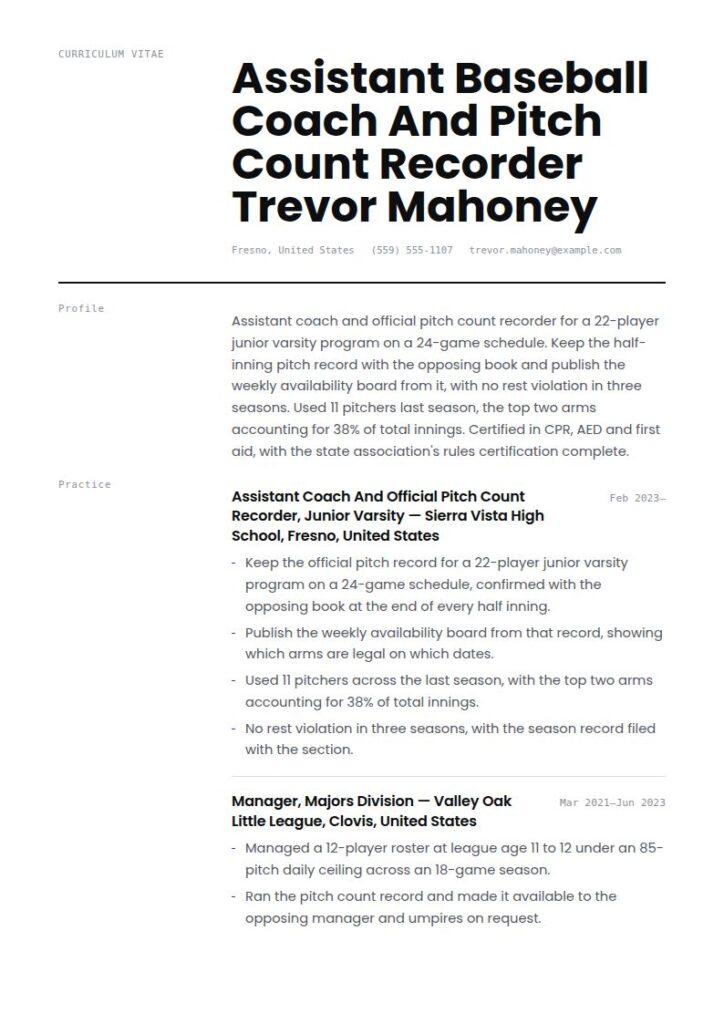
Assistant Coach and Official Pitch Count Recorder, Junior Varsity
[email protected] | (559) 555-1107 | Fresno, United States
Profile
Assistant coach and official pitch count recorder for a 22-player junior varsity program on a 24-game schedule. Keep the half-inning pitch record with the opposing book and publish the weekly availability board from it, with no rest violation in three seasons. Used 11 pitchers last season, the top two arms accounting for 38% of total innings. Certified in CPR, AED and first aid, with the state association's rules certification complete.
Work Experience
02/2023 - Present, Assistant Coach and Official Pitch Count Recorder, Junior Varsity, Sierra Vista High School, Fresno, United States
- Keep the official pitch record for a 22-player junior varsity program on a 24-game schedule, confirmed with the opposing book at the end of every half inning.
- Publish the weekly availability board from that record, showing which arms are legal on which dates.
- Used 11 pitchers across the last season, with the top two arms accounting for 38% of total innings.
- No rest violation in three seasons, with the season record filed with the section.
03/2021 - 06/2023, Manager, Majors Division, Valley Oak Little League, Clovis, United States
- Managed a 12-player roster at league age 11 to 12 under an 85-pitch daily ceiling across an 18-game season.
- Ran the pitch count record and made it available to the opposing manager and umpires on request.
Education
08/2019 - 05/2023, Bachelor of Arts, Kinesiology, California State University, Fresno, Fresno, United States
Coursework in motor learning and sport administration. Four years on the varsity baseball roster.
Skills
Pitch record keeping, 85
Availability planning, 70
Bullpen session design, 65
Defensive positioning, 70
Situational hitting, 70
State association pitching policy, 80
Languages
English, native
Spanish, conversational
Certificates
01/2026, State Association Rules Certification, Baseball, California Interscholastic Federation
Current for the 2026 season, with the coaching education requirements complete.
08/2025, CPR, AED and First Aid, American Red Cross
Current through August 2027.
01/2026, Concussion and Heat Illness Training, California Interscholastic Federation
Completed for the current season, as required before contact with a team.
Summary
A baseball coach resume is a one to two page document showing how you managed a pitching staff across a schedule you did not choose. This guide gives you three adaptable versions, the available-arms block most applicants leave out, the published pitch-count and rest rules stated accurately, and current Bureau of Labor Statistics pay and outlook for coaches and scouts.
Baseball Coach resume examples by experience level
A baseball coach resume is a one to two page document showing how you ran a pitching staff across a schedule you did not choose, inside limits you did not set.
Every other roster decision in baseball is reversible. Pitching is not. A pitcher who throws 70 pitches on Tuesday is unavailable for a fixed number of days afterward, by rule, whatever the game situation. So the real planning job is arithmetic done a week ahead: how many games, on which dates, and which arms will legally be available on each. An athletic director hiring a head coach is buying that arithmetic.
Resume guide for a baseball coach resume
This guide and the corresponding baseball coach resume example will cover:
- How to write a baseball coach resume, section by section
- Why the pitching staff belongs on the page as a resource, not a story
- Three adaptable summaries: assistant, pitching coach and head coach
- What the published pitch count and rest rules say, and who sets them
- What the job market looks like and what you can expect to earn
How to write a baseball coach resume
Six sections: contact header, summary, coaching experience, the pitching staff block, certifications, and education. The pitching staff block sits high because it is the section nobody else writes.
| Section | What it is answering | Where it goes |
|---|---|---|
| Coaching experience | Which level, which roster, how long? | Reverse chronological, under the summary |
| The pitching staff | Can this person plan arms across a schedule? | Its own block |
| Certification | Can they be in a dugout this season? | After the pitching block |
| Education | Degree, plus any coaching coursework | Near the bottom |
Write arms, dates and innings, not wins
"Three seasons as head coach, 51 and 33" tells an athletic director almost nothing, because the schedule and the league decided most of that.
What they cannot get anywhere else is how you distributed work. "28 games in 11 weeks, 14 pitchers used, top two arms threw 31% of total innings against 54% the season before, zero rest violations" is a management record.
Give four numbers whenever you describe a staff: games scheduled, pitchers used, the share of innings from your top two arms, and rest violations. The first three come out of the score book and the last is a yes or no. Do not estimate any of them; if the program kept no pitch record, say what you did keep.
Run the finished file through the ATS resume checker before you submit. Districts, leagues and travel organizations parse applications before a human opens them.
Choosing the best resume format for a baseball coach resume
Reverse chronological, with the level named on every role. One page for an assistant, two once you have run a varsity staff or a multi-level program.
Level is how baseball hiring reads seniority, and the levels are not interchangeable. A Little League manager, a junior varsity coach, a varsity head coach and a travel program director work under different rulebooks, pitch limits and schedule densities. Write the level on every line, because a reader who has to guess will guess low.
Include your contact information
| ✅ Right | ❌ Wrong |
|---|---|
| Trevor Mahoney | Trevor Mahoney |
| Head Varsity Baseball Coach, 14-pitcher staff, 28-game schedule | Baseball lifer and student of the game |
| Pitch record kept to section standard, zero rest violations in three seasons | Player safety focused |
| (559) 555-1107, [email protected], Fresno, CA | (559) 555-1107, [email protected] |
The second and third lines are the ones that matter. Every applicant says they care about arms; very few can say what their innings distribution was.
Make use of a summary
Four lines: the level and roster you ran, the schedule density, one innings-distribution number, and your pitch record.
Assistant coach and official pitch count recorder for a 22-player junior varsity program on a 24-game schedule. Keep the half-inning pitch record with the opposing book and publish the weekly availability board from it, with no rest violation in three seasons. Used 11 pitchers last season, the top two arms accounting for 38% of total innings. Certified in CPR, AED and first aid, with the state association's rules certification complete.
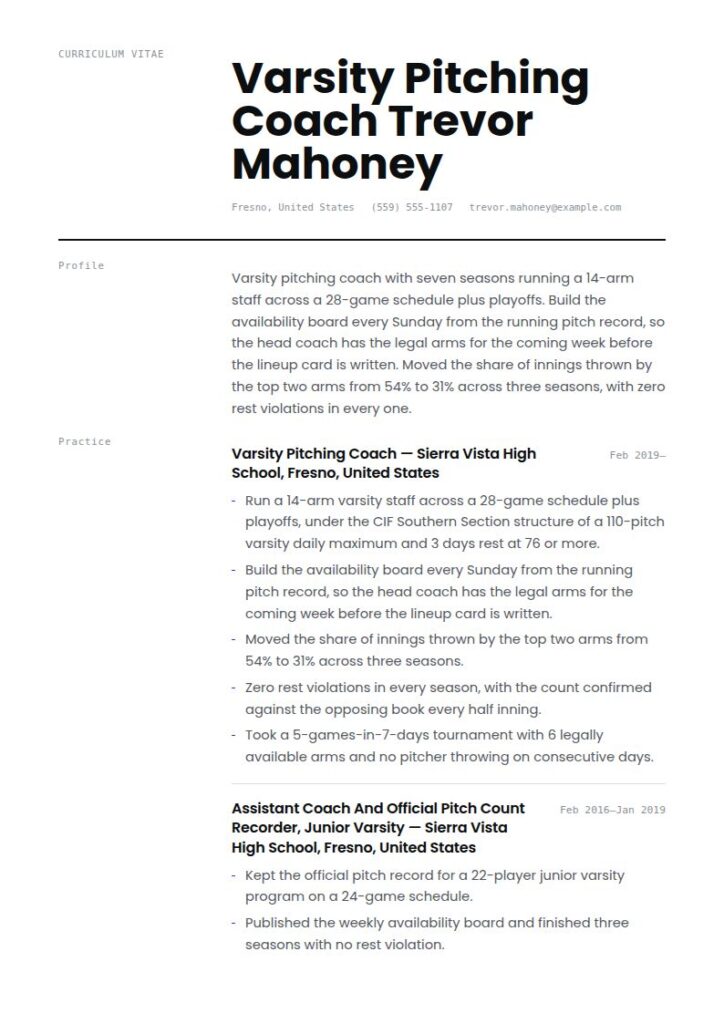
Varsity pitching coach with seven seasons running a 14-arm staff across a 28-game schedule plus playoffs. Build the availability board every Sunday from the running pitch record, so the head coach has the legal arms for the coming week before the lineup card is written. Moved the share of innings thrown by the top two arms from 54% to 31% across three seasons, with zero rest violations in every one.
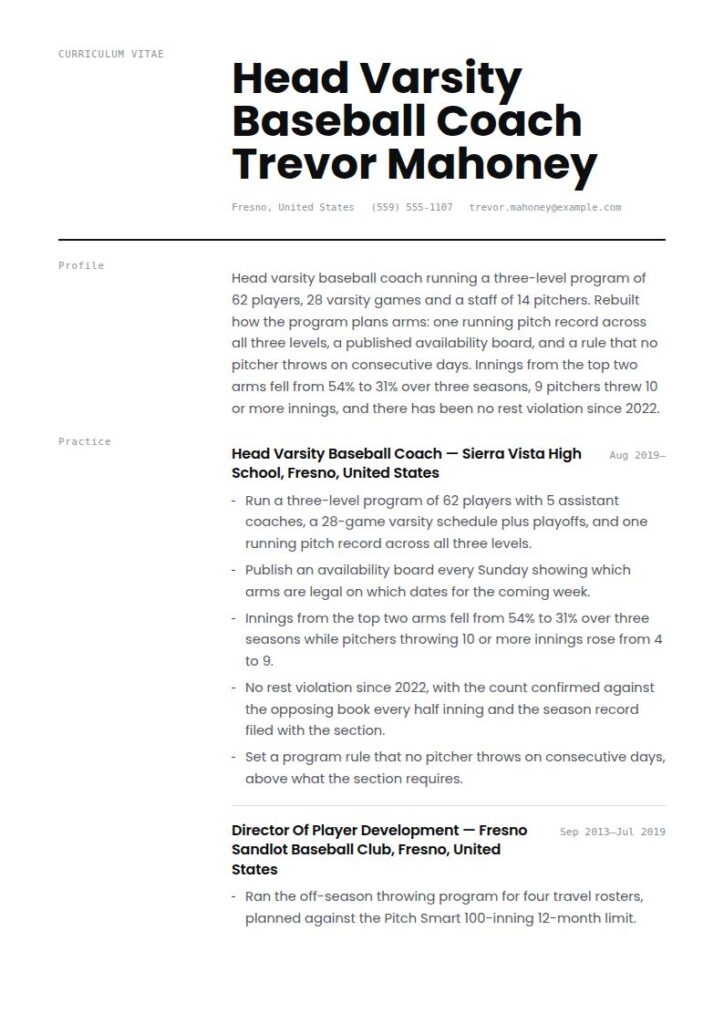
Head varsity baseball coach running a three-level program of 62 players, 28 varsity games and a staff of 14 pitchers. Rebuilt how the program plans arms: one running pitch record across all three levels, a published availability board, and a rule that no pitcher throws on consecutive days. Innings from the top two arms fell from 54% to 31% over three seasons, 9 pitchers threw 10 or more innings, and there has been no rest violation since 2022.
Right vs wrong: the same baseball coach summary, twice
| ✅ Right | ❌ Wrong |
|---|---|
| Varsity pitching coach running a 14-arm staff across a 28-game schedule plus playoffs. | Experienced baseball coach with a deep love of the game and a commitment to development. |
| Build the availability board every Sunday from the running pitch record. | Responsible for managing pitchers and monitoring their workload. |
| Innings from the top two arms fell from 54% to 31% across three seasons. | Developed a deep and talented pitching staff. |
The right column is a management record an athletic director can check against a score book. The left column is what every other file in the folder says.
Outline your coaching experience
Program, level, roster size, schedule length and dates. Then three to five bullets, each carrying a number out of the book.
| Instead of | Use |
|---|---|
| Coached high school baseball | Head varsity coach, 62-player program across three levels, 28-game schedule |
| Managed the pitching staff | Used 14 pitchers across 28 games, 9 of them throwing 10 or more innings |
| Kept players healthy | Zero rest violations in three seasons, verified against both score books |
| Planned for tournaments | Entered a 5-games-in-7-days tournament with 6 legally available arms |
| Developed pitchers | Innings from the top two arms fell from 54% to 31% across three seasons |
Head Varsity Baseball Coach, Sierra Vista High School, Fresno, CA, August 2019 to Present
Run a three-level program of 62 players with 5 assistant coaches, a 28-game varsity schedule plus playoffs, and one running pitch record across all three levels.
Publish an availability board every Sunday showing which arms are legal on which dates for the coming week, built from the pitch record rather than memory.
Innings from the top two arms fell from 54% to 31% over three seasons while pitchers throwing 10 or more innings rose from 4 to 9.
Zero rest violations in three seasons, with the count confirmed against the opposing book every half inning and the season record filed with the section.
Took a 5-games-in-7-days tournament with 6 legally available arms and no pitcher throwing on consecutive days.
The pitching staff a baseball coach manages, arm by arm
This is the block almost nobody writes, and in baseball it is the planning job.
Start from the fact that the limits are not yours. High school baseball moved to pitch-count-based restriction by rule, and the rule pushes the numbers down to the state. The National Federation of State High School Associations rule states that "Each NFHS member state association will be required to develop its own pitching restriction policy based on the number of pitches thrown during a game to afford pitchers a required rest period between pitching appearances", as published by the Kansas State High School Activities Association (kshsaa.org, retrieved 17 September 2026). There is no national high school pitch limit to cite. There are fifty-odd of them, and you name yours.
Two published examples show how far apart they sit. Kansas sets a daily maximum of 105 pitches, with rest of 0 days at 1 to 30 pitches, 1 day at 31 to 45, 2 days at 46 to 60, 3 days at 61 to 75 and 4 days at 76 to 105 (kshsaa.org, retrieved 17 September 2026). The CIF Southern Section sets 110 for varsity and 90 for freshman, frosh-soph and junior varsity, with rest of 0 days at 1 to 30, 1 day at 31 to 50, 2 days at 51 to 75 and 3 days at 76 or more (CIF Southern Section Baseball Blue Book, Article 1500, cifss.org, retrieved 17 September 2026). Same sport, same age, different arithmetic. Write the policy you planned under.
Youth baseball is stricter and tiered by age. Little League's regular season pitching rules set 50 pitches a day at league age 6 to 8, 75 at 9 to 10, 85 at 11 to 12 and 95 at 13 to 16, with rest for ages 14 and under of "1-20 Pitches = 0 Days Rest" rising to "66+ Pitches = 4 Days Rest" (littleleague.org, retrieved 17 September 2026). MLB and USA Baseball's Pitch Smart guidelines give 95 pitches at ages 13 to 14 and 105 at 17 to 18, and add two constraints that are not about a single day: "Do not exceed 100 combined innings pitched in any 12-month period" and "No pitcher shall appear in a game as a pitcher for three consecutive days, regardless of pitch counts" (mlb.com Pitch Smart, retrieved 17 September 2026).
| What you planned under | Daily maximum | Rest structure | What the resume line says |
|---|---|---|---|
| Kansas high school | 105 | 4 days at 76 to 105 | Planned 28 games under a 105-pitch, 4-day ceiling |
| CIF Southern Section varsity | 110 | 3 days at 76 or more | Availability board built on a 110 and 3-day structure |
| CIF Southern Section JV and frosh | 90 | 3 days at 76 or more | Ran the sub-varsity staff under a 90-pitch ceiling |
| Little League, league age 11 to 12 | 85 | 4 days at 66 or more | Managed a 12-pitcher roster under an 85-pitch ceiling |
| Pitch Smart, ages 13 to 14 | 95 | 4 days at 66 to 95 | Held the 100-inning 12-month cap across two programs |
Once the limits are named, the block is three numbers and a process.
The first is availability. Take next week's schedule, every pitcher's last outing and its count, apply the rest table, and you have a list of who can legally throw on each date. That list is the product. Write how often you produced it and who received it.
The second is distribution. Innings concentrated in two arms is visible in the book. Give the share of total innings thrown by your top two pitchers and how it moved, plus how many pitchers threw ten or more innings.
The third is the record itself, because a pitch count is worth what its bookkeeping is worth. The CIF Southern Section requires that "At the end of each half inning, the head coaches will confirm and both team score books will record the pitch count for all pitchers who threw a pitch in that half inning", and that each school keep a record of all pitches thrown and make it available to the section office on request (cifss.org, retrieved 17 September 2026). Little League requires that "The pitch count recorder must provide the current pitch count for any pitcher when requested by either manager or any umpire" (littleleague.org, retrieved 17 September 2026). Say who kept your record, how it was confirmed and where it was filed.
Two arms and fifty-four percent is the number that gets a coach replaced
Concentration is the failure mode. A staff where two pitchers throw more than half the innings looks efficient in April and has nothing left in May, and the schedule does not adjust for it. The fix is a planning habit rather than a philosophy: build the availability board before the lineup card. If a date has only two legal arms on it, that was decided nine days earlier.
Write the number both ways: the share of innings from your top two arms, and the count of pitchers who threw ten or more innings. Together they say whether the staff was a staff or a pair.
If the program kept no innings log, do not reconstruct one. Give games, pitchers used and rest violations, and leave distribution out.
Policy planned under: CIF Southern Section, varsity daily maximum 110 pitches and 3 days rest at 76 or more, junior varsity and freshman 90.
Staff and schedule: 14 pitchers across a 28-game varsity schedule plus playoffs, one running pitch record shared across all three program levels.
Availability: board published to the coaching staff every Sunday, listing legal arms by date for the coming week.
Distribution: innings from the top two arms 54% to 31% across three seasons; pitchers throwing 10 or more innings rose from 4 to 9.
Record: pitch count confirmed with the opposing book at the end of every half inning, season record filed with the section, zero rest violations in three seasons.
Build a snapshot of your key skills
Twelve to fourteen entries in four groups: staff management, on-field, program and compliance.
Staff management: Availability planning, Innings distribution, Bullpen and long relief roles, Tournament arm budgeting, Pitch record keeping
On-field: Pitching mechanics, Bullpen session design, Defensive positioning, Baserunning systems, Situational hitting
Program: Multi-level roster construction, Schedule and tournament planning, Assistant coach assignment, Field management, Equipment inventory
Compliance: State association pitching policy, Little League Regulation VI, Pitch Smart guidelines, Rules certification, CPR, AED and first aid
List your education and certifications
Certifications first with dates, then the degree. Keep the rules certification on the page, because most state associations require it of a head coach.
California Interscholastic Federation coaching education requirements complete, including the state association rules certification for baseball, current for the 2026 season.
CPR, AED and first aid, American Red Cross, current through 2027
Concussion and heat illness training complete for the current season
Bachelor of Arts, Kinesiology, California State University, Fresno, Fresno, CA, 2011
Write the certification your state association requires, with the year. Requirements vary by state and level, so a generic "certified coach" line reads as somebody who has not checked.
Choose the right layout and design
Single column, plain type at 11 or 12 point, clear headings, no photograph and no team logo. Keep the pitching table simple, because district portals parse resumes before a person reads them and nested tables break that parsing.
Name the level on every role. Name the pitching policy you planned under and who publishes it. Give games, pitchers used, innings share from the top two arms and rest violations. Say who kept the pitch record and how it was confirmed. Write tournament planning as available arms against dates. Name the rules certification your state association requires.
Do not cite a national high school pitch limit, because there is not one. Do not name a player, their velocity or their college commitment. Do not reconstruct an innings log from memory. Do not lead with a win and loss record, which the schedule mostly decided. Do not write "monitored pitch counts" without saying who confirmed the book. Do not claim a Pitch Smart figure as your own program's rule unless you adopted it.
Baseball coach job market and outlook
Baseball coaching sits inside one federal occupation. The Bureau of Labor Statistics publishes no separate profile for baseball coaches: the published occupation is coaches and scouts, and the figures below describe that occupation rather than baseball alone.
| Measure | Value |
|---|---|
| Coaches and scouts jobs, 2025 | 298,800 |
| Projected change, 2025-35 | 6%, 18,100 |
| Projected annual openings | ~36,400 |
| Typical entry-level education | Bachelor's degree |
| Median annual wage, May 2025 | $47,320 |
Source: U.S. Bureau of Labor Statistics, Occupational Outlook Handbook, Coaches and Scouts, 2025-35 projections and May 2025 wage data.
A large school sport with a fragmented rulebook
In the 2024-25 National Federation of State High School Associations participation survey, baseball recorded 472,598 participants, the fifth largest boys sport (NFHS, 2024-25 High School Athletics Participation Survey, retrieved 17 September 2026).
That participation runs under fifty-odd separate pitching policies, because the NFHS rule requires each member state association to write its own rather than adopting a national limit (kshsaa.org, retrieved 17 September 2026).
Set that against the employment split for coaches and scouts: 64 percent of jobs are in educational services at a median of $46,890, 22 percent in arts, entertainment and recreation at $48,440, and 8 percent self-employed (BLS Occupational Outlook Handbook, May 2025).
The practical consequence is specificity. A coach moving between states is moving between rulebooks, and the file that names the policy it planned under, with its daily maximum and rest structure, reads as somebody who will learn the new one in a week.
Where the jobs sit:
| Setting | Share of employment | Median annual wage (May 2025) |
|---|---|---|
| Educational services, state, local and private | 64% | $46,890 |
| Arts, entertainment and recreation | 22% | $48,440 |
| Self-employed | 8% | Not published |
| Religious, grantmaking and civic organizations | 2% | $43,870 |
| Local government, excluding education | 1% | $38,730 |
Source: U.S. Bureau of Labor Statistics, Occupational Outlook Handbook, Coaches and Scouts, May 2025.
What salary you can expect as a baseball coach
The median annual wage for coaches and scouts was $47,320 as of May 2025, with the lowest 10 percent earning less than $28,790 and the highest 10 percent more than $98,860 (BLS Occupational Outlook Handbook, May 2025).
Baseball sits at the low end of that range more often than the sport's visibility suggests. A high school head coaching job is usually a seasonal stipend on a teaching contract, and an assistant's is smaller again. Little League and most community leagues are volunteer. The paid, year-round work is in travel organizations, academies, private instruction and facility management.
That is why the pitching staff block is worth the space. A coach who can produce an availability board, an innings log and a clean compliance record is arguing for a program role rather than a seasonal one, and the same evidence reads well to an athletic director.
The second income line is lessons, camps, off-season throwing programs and facility hours. Write those as their own roles with their own counts.
Key takeaways for a baseball coach resume
- Name the level on every role; readers treat it as seniority.
- Name the pitching policy you planned under, with its daily maximum and rest structure.
- Give games, pitchers used, top-two innings share and rest violations.
- Say who kept the pitch record and how it was confirmed.
- Write tournament planning as available arms against dates.
- List lessons, camps and off-season programs as their own roles.
- Keep it single column and parseable, because portals read it first.
Build your baseball coach resume in 15 minutes with our AI resume builder.
Related sport and fitness resume examples
- Coach resume
- Football coach resume
- Soccer coach resume
- Basketball coach resume
- Hockey coach resume
- Track coach resume
- Referee resume
- Athletic trainer resume
- Student athlete resume
- Sports resume
- Golf instructor resume
- Sport and fitness resume
Pair it with a matching baseball coach cover letter.
Baseball coach resume questions, answered
How long should a baseball coach resume be?
One page for an assistant or a first head coaching job. Two once you have run a varsity staff, a multi-level program or a travel organization.
Is there a national high school pitch count limit?
No. The NFHS rule requires that "Each NFHS member state association will be required to develop its own pitching restriction policy based on the number of pitches thrown during a game" (kshsaa.org, retrieved 17 September 2026). Limits and rest tables differ by state, so name the one you coached under.
What pitch counts apply in youth baseball?
It depends on the organization. Little League's regular season rules set 50 pitches a day at league age 6 to 8, 75 at 9 to 10, 85 at 11 to 12 and 95 at 13 to 16, with rest thresholds alongside them (littleleague.org, retrieved 17 September 2026). Pitch Smart sets 95 at ages 13 to 14 and 105 at 17 to 18, plus a 100-inning limit in any 12-month period (mlb.com Pitch Smart, retrieved 17 September 2026).
How do I show pitching management without naming players?
Use staff-level counts. "14 pitchers used across 28 games", "top two arms fell from 54% to 31% of innings" and "zero rest violations in three seasons" describe the staff and identify nobody. For college commitments, give the count and the season, never the name.
What if my program did not keep an innings log?
Give what you did keep. Games, pitchers used and rest violations are usually recoverable from the score book even when innings are not. Say plainly that the innings log was not kept rather than reconstructing one, because a reconstructed number is the fastest way to lose a reader who knows the sport.
Does a Little League or travel role count toward a school job?
Yes, if you write it at the same level of detail: the roster size, the games, the pitch ceiling you worked under, how availability was planned and whether the record was clean. Those transfer directly; the league name does not.