Assistant Coach, 10U and 12U Erik Lindholm
Assistant Coach, 10U A and 12U B
[email protected] | (651) 555-0209 | Saint Paul, United States
Profile
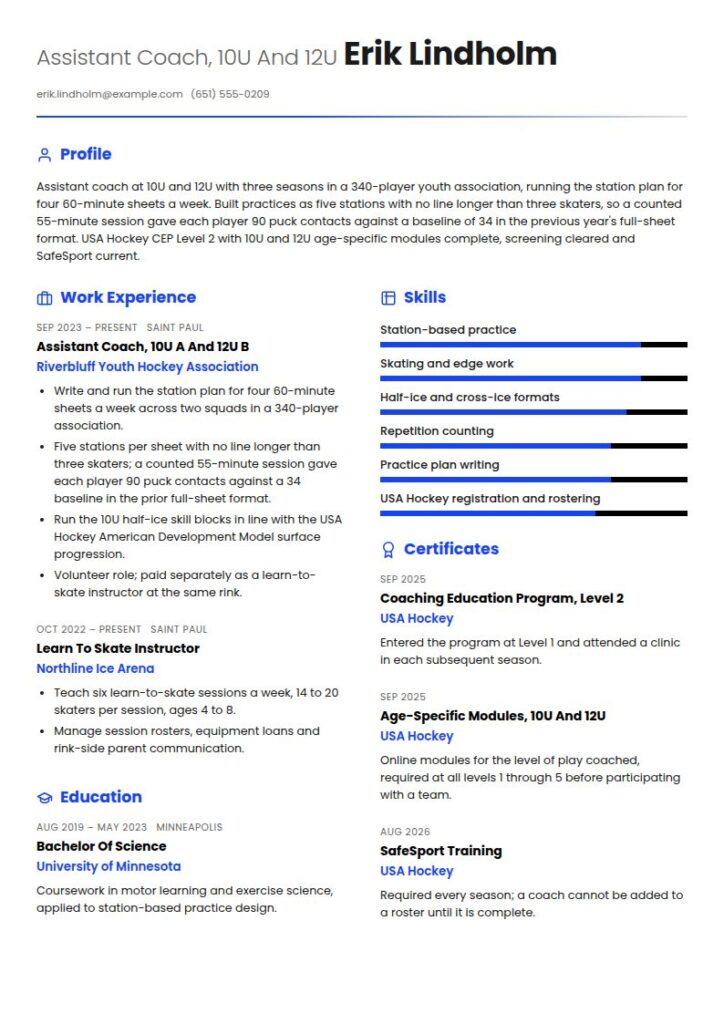
Assistant coach at 10U and 12U with three seasons in a 340-player youth association, running the station plan for four 60-minute sheets a week. Built practices as five stations with no line longer than three skaters, so a counted 55-minute session gave each player 90 puck contacts against a baseline of 34 in the previous year's full-sheet format. USA Hockey CEP Level 2 with 10U and 12U age-specific modules complete, screening cleared and SafeSport current.
Work Experience
09/2023 - Present, Assistant Coach, 10U A and 12U B, Riverbluff Youth Hockey Association, Saint Paul, United States
- Write and run the station plan for four 60-minute sheets a week across two squads in a 340-player association.
- Five stations per sheet with no line longer than three skaters; a counted 55-minute session gave each player 90 puck contacts against a 34 baseline in the prior full-sheet format.
- Run the 10U half-ice skill blocks in line with the USA Hockey American Development Model surface progression.
- Volunteer role; paid separately as a learn-to-skate instructor at the same rink.
10/2022 - Present, Learn to Skate Instructor, Northline Ice Arena, Saint Paul, United States
- Teach six learn-to-skate sessions a week, 14 to 20 skaters per session, ages 4 to 8.
- Manage session rosters, equipment loans and rink-side parent communication.
Education
08/2019 - 05/2023, Bachelor of Science, Kinesiology, University of Minnesota, Minneapolis, United States
Coursework in motor learning and exercise science, applied to station-based practice design.
Skills
Station-based practice, 85
Skating and edge work, 85
Half-ice and cross-ice formats, 80
Repetition counting, 75
Practice plan writing, 75
USA Hockey registration and rostering, 70
Languages
English, native
Certificates
09/2025, Coaching Education Program, Level 2, USA Hockey
Entered the program at Level 1 and attended a clinic in each subsequent season.
09/2025, Age-Specific Modules, 10U and 12U, USA Hockey
Online modules for the level of play coached, required at all levels 1 through 5 before participating with a team.
08/2026, SafeSport Training, USA Hockey
Required every season; a coach cannot be added to a roster until it is complete.
08/2026, Background Screening, USA Hockey
Cleared and on file. A coach cannot be on the ice until screening has cleared.
06/2025, CPR and AED, American Red Cross
Current through 2027.
Summary
A hockey coach resume is a one to two page document naming the ice you were given, how you used it, and what came off it. This guide gives you three adaptable versions, the practice density block most applicants leave out, the USA Hockey certification requirement stated accurately, and current Bureau of Labor Statistics pay and outlook for coaches and scouts.
Hockey Coach resume examples by experience level
In short, a hockey coach resume is a one to two page document naming the ice you were given, how many skaters you put on it, and what came off it.
Hockey is not like other coaching jobs, because programs buy the practice surface by the hour. After all, a youth board is not weighing your philosophy against another coach's. Instead, they are looking at a purchased block of ice, an association budget, and who gets the most development out of a sheet. As a result, a coach who writes that in numbers is arguing on the only ground that matters to the people paying.
Resume guide for a hockey coach resume
Specifically, this guide and the corresponding hockey coach resume example will cover:
- First, how to write a hockey coach resume, section by section
- Then why ice usage belongs on the page, and how to quantify it
- Also, three adaptable summaries: assistant, head coach and director
- What USA Hockey actually requires of a coach
- Finally, what the job market looks like and what you can expect to earn
How to write a hockey coach resume
To start, plan six sections: contact header, summary, coaching experience, the ice and practice density block, certifications and screening, and education. However, certifications sit higher here than on most coaching resumes, because USA Hockey's requirements are specific, dated, and checked by an association registrar before you get near a bench.
| Section | What it is answering | Where it goes |
|---|---|---|
| Coaching experience | Which teams at which classification, and how long? | Reverse chronological, under the summary |
| Ice and practice density | What did they get out of the ice the program bought? | Its own block |
| Certification and screening | Can the registrar roster them this week? | After the ice block |
| Education | Degree, plus any coaching or sport science coursework | Near the bottom |
Write ice in hours, skaters and repetitions, not in seasons
"Coached the 12U A team for three seasons" tells a board nothing about how the ice was used. "Four 60-minute sheets a week, 17 skaters, five stations with no line longer than three" tells them everything.
Give three numbers whenever you describe practice: hours of ice, skaters on it, and how you divided the surface. Then add the number almost nobody writes down, which is what the program paid per skater hour. If your association bought 92 hours of ice for a squad of 17 at a known rate, you can state that exactly, and a board treasurer will read the line twice.
Do not estimate it. Without the invoice figure, give the hours and the skater count and leave the cost out.
Run the finished file through the ATS resume checker before you submit. Associations and districts both use systems that parse before a human reads.
Choosing the best resume format for a hockey coach resume
For format, generally use reverse chronological, with the age classification on every role. Keep one page for an assistant or a first head coaching job, then two once you have run multiple teams or a program.
That is because hockey hiring reads age classification as seniority in a way other sports do not. For example, a coach who has run 10U, 12U and 14U teams has done three different jobs: skill acquisition, the transition to full ice, and systems play. Write the classification every time, because a reader who has to guess will guess low.
Include your contact information
| ✅ Right | ❌ Wrong |
|---|---|
| Erik Lindholm | Erik Lindholm |
| Head Coach, 12U and 14U | Hockey coach and rink rat since age four |
| USA Hockey CEP Level 4, age-specific modules current, screening cleared | USA Hockey certified |
| (651) 555-0209, [email protected], Saint Paul, MN | (651) 555-0209, [email protected] |
In addition, put the certification level and screening status on the page. Specifically, USA Hockey requires that a coach "complete the background screening" and cannot coach until it clears, and requires SafeSport training "every year", with a coach unable to be added to a roster until it is complete (usahockey.com, retrieved 17 September 2026). That is why a registrar with a roster deadline reads that line first.
Make use of a summary
Next, write four lines: the classifications you have run, the ice you were given, one practice density number, and your certification level.
Assistant coach at 10U and 12U with three seasons in a 340-player youth association, running the station plan for four 60-minute sheets a week. Built practices as five stations with no line longer than three skaters, so a counted 55-minute session gave each player 90 puck contacts against a baseline of 34 in the previous year's full-sheet format. USA Hockey CEP Level 2 with 10U and 12U age-specific modules complete, screening cleared and SafeSport current.
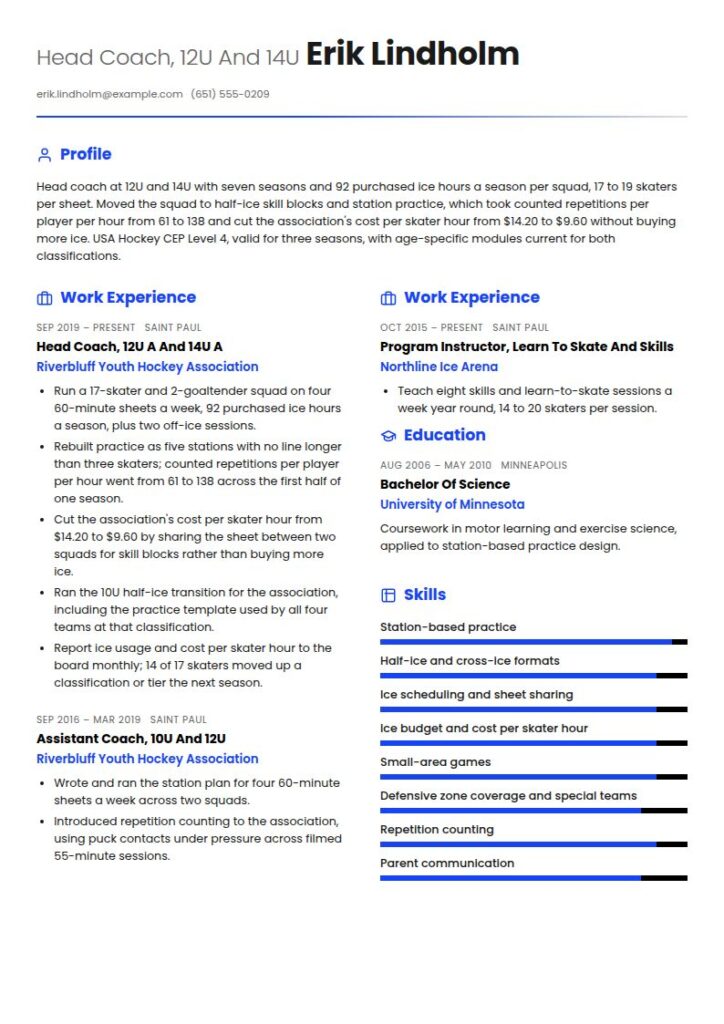
Head coach at 12U and 14U with seven seasons and 92 purchased ice hours a season per squad, 17 to 19 skaters per sheet. Moved the squad to half-ice skill blocks and station practice, which took counted repetitions per player per hour from 61 to 138 and cut the association's cost per skater hour from $14.20 to $9.60 without buying more ice. USA Hockey CEP Level 4, valid for three seasons, with age-specific modules current for both classifications.
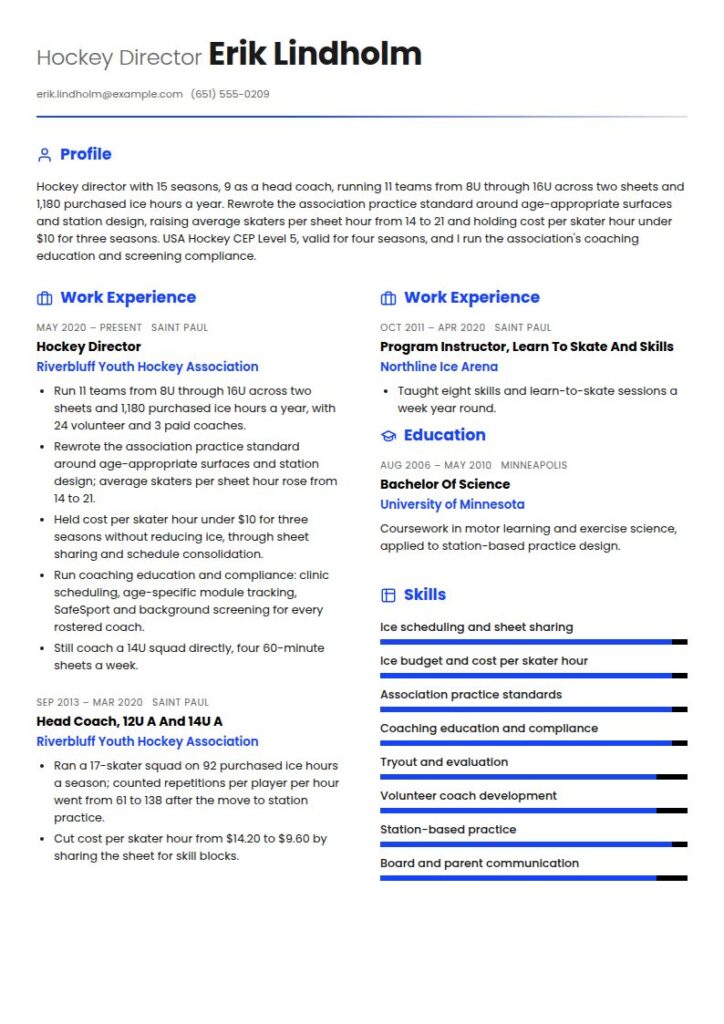
Hockey director with 15 seasons, 9 as a head coach, running 11 teams from 8U through 16U across two sheets and 1,180 purchased ice hours a year. Rewrote the association practice standard around age-appropriate surfaces and station design, raising average skaters per sheet hour from 14 to 21 and holding cost per skater hour under $10 for three seasons. USA Hockey CEP Level 5, valid for four seasons, and I run the association's coaching education and screening compliance.
Right vs wrong: the same hockey coach summary, twice
| ✅ Right | ❌ Wrong |
|---|---|
| Head coach at 12U and 14U with seven seasons and 92 purchased ice hours a season per squad. | Experienced hockey coach with a love of the game and a commitment to player growth. |
| Counted repetitions per player per hour went from 61 to 138 after moving to station practice. | Ran fast-paced, high-energy practices that kept players engaged. |
| Cut the association's cost per skater hour from $14.20 to $9.60 without buying more ice. | Made efficient use of practice time and resources. |
In other words, the right column is an argument a board can act on. By contrast, the left column is what every other file says.
Outline your coaching experience
Additionally, for each job, give association, age classification, roster size, dates and the ice you were given. Then three to five bullets, each carrying a number.
| Instead of | Use |
|---|---|
| Coached youth hockey teams | Head coach, 12U A, 17 skaters and 2 goaltenders, four 60-minute sheets a week |
| Ran effective practices | Five stations per sheet, 138 counted repetitions per player per hour |
| Developed players | 14 of 17 skaters moved up a classification or tier the following season |
| Managed the team | Ran a 92-hour ice budget and reported cost per skater hour to the board monthly |
| Worked with parents | Three parent meetings a season, with the practice plan and ice schedule published in advance |
Head Coach, 12U A and 14U A, Riverbluff Youth Hockey Association, Saint Paul, MN, September 2019 to Present
Run a 17-skater and 2-goaltender squad on four 60-minute sheets a week, 92 purchased ice hours a season, plus two off-ice sessions.
Rebuilt practice as five stations with no line longer than three skaters; counted repetitions per player per hour went from 61 to 138 across the first half of one season.
Cut the association's cost per skater hour from $14.20 to $9.60 by sharing the sheet between two squads for skill blocks rather than buying more ice.
Ran the 10U half-ice transition for the association, including the practice template used by all four teams at that classification.
Report ice usage and cost per skater hour to the board monthly; 14 of 17 skaters moved up a classification or tier the next season.
The ice a hockey coach is given, and what comes off it
In practice, this is the block almost nobody writes, and in hockey it is the argument.
For one thing, every other input in youth hockey is free or fixed. Ice is not. Programs buy it in hours, and as a result the hours a program can buy are the ceiling on everything a coach does. So the useful claim is not that you ran good practices; it is that you got more out of the same purchased hours than the program was getting before.
Still, USA Hockey's American Development Model gives you the surface progression to describe it against. For instance, USA Hockey states that players move from 8U cross-ice to "half-ice at 10U and transitioned to full-ice at the 12U level", and that the smaller surface is deliberate, because "it forces them to make constant decisions and handle the puck in traffic". Similarly, one demonstration the association reported, comparing the same teams cross-ice and full-ice, found "a 3- or 4-to-1 difference, with passes, shots on goal" (usahockey.com, retrieved 17 September 2026).
Likewise, USA Hockey publishes the ADM season structure too. USA Hockey's chart gives 6U and 8U 16 to 20 cross-ice game days against 34 to 40 quality practices, 10U 75 to 80 quality practices and 20 to 25 game days on three to four 60-minute ice sessions a week plus two off-ice, and 12U 80 to 90 quality practices and 30 to 35 game days on four weekly ice sessions of 60 minutes or more (usahockey.com, retrieved 17 September 2026). Therefore, write your own season against those numbers.
| Classification | Surface | Sheet share | Skaters | Season shape | Evidence line |
|---|---|---|---|---|---|
| 8U | Cross-ice | Three groups per sheet | 24 | 34 to 40 practices, 16 to 20 game days | 3 stations per group, 112 counted puck contacts per session |
| 10U | Half-ice | Two squads per sheet | 17 per half | 75 to 80 practices, 20 to 25 game days | Repetitions per player per hour 61 to 138 after the move |
| 12U | Full ice, half-ice for skill | One squad, shared blocks | 19 | 80 to 90 practices, 30 to 35 game days | Cost per skater hour $14.20 to $9.60 |
| 14U | Full ice | One squad | 18 | 88 practices, 34 game days | 92 purchased hours, 4 sheets a week, 2 off-ice |
Then write your own row for every classification you have coached. Most of that table is facts the association already holds, so a board can verify it in an evening, and that is exactly why the block works.
Count repetitions before you claim them
A repetition count is only useful if it was counted. Pick one definition, apply it to a filmed or tallied session, and state the definition on the page.
A practical version: one repetition is one puck contact in a drill under pressure. Count a 55-minute session in the old format, run the new format, count another session under the same definition, and write both numbers with the session length attached.
USA Hockey's own case for the small-surface formats is built on this kind of comparison, with the association reporting a three or four to one difference in passes and shots on goal between cross-ice and full-ice play with the same teams (usahockey.com, retrieved 17 September 2026).
Do not scale a counted number up to a season total. Give the session, the count and the definition.
Ice: 92 purchased hours per squad per season, four 60-minute sheets a week plus two off-ice sessions, 17 skaters and 2 goaltenders.
Surface use: full ice for team play, half-ice for all skill blocks, two squads sharing the sheet twice a week. 10U teams run half-ice in line with the USA Hockey American Development Model progression.
Density: five stations per sheet with no line longer than three skaters. Counted repetitions per player per hour moved from 61 to 138 across the first half of the 2025 to 2026 season, counted as puck contacts in a drill under pressure across two filmed 55-minute sessions.
Cost: association cost per skater hour fell from $14.20 to $9.60, reported to the board monthly, achieved by sheet sharing rather than extra purchased ice.
Build a snapshot of your key skills
Later, in skills, list twelve to fourteen entries in four groups: on-ice, practice design, program and compliance.
On-ice: Skating and edge work, Puck control under pressure, Small-area games, Defensive zone coverage, Special teams, Goaltender integration
Practice design: Station-based practice, Half-ice and cross-ice formats, Practice plan writing, Repetition counting, Off-ice conditioning
Program: Ice scheduling and sheet sharing, Ice budget and cost per skater hour, Tryout and evaluation, Parent communication, Volunteer coach development
Compliance: USA Hockey registration and rostering, Age-specific modules, SafeSport, Background screening
List your education and certifications
Certification level, module currency and screening status first, because the registrar checks them. Degree after.
USA Hockey Coaching Education Program, Level 4. USA Hockey states that all coaches enter at Level 1 and "must continue their education with a coaching clinic each year until, at a minimum, they achieve Level 4", that Level 4 certifications "are valid for three (3) seasons" and Level 5 for four, and that coaches must accumulate 5 credit hours of continuing education before expiration (usahockey.com, retrieved 17 September 2026).
Age-specific modules complete for 10U, 12U and 14U. USA Hockey requires these online modules "specific to the level of play you are coaching" at all levels, 1 through 5, before participating with a team (usahockey.com, retrieved 17 September 2026).
USA Hockey SafeSport Training complete for the current season. Background screening cleared and on file.
Bachelor of Science, Kinesiology, University of Minnesota, Minneapolis, MN, 2010
CPR and AED, American Red Cross, current through 2027
One exception matters if you coach the youngest players. USA Hockey states that coaches at the Learn to Play, Learn to Skate, 6U or 8U classification enter through the 6U and 8U clinic rather than at Level 1, and that coaches of only 8 and Under players, and of disabled hockey, "may remain at Level 1 or other certification level, even if expired", until they coach an older age level (usahockey.com, retrieved 17 September 2026). Write your actual status.
Choose the right layout and design
Lastly, use a single column, plain type at 11 or 12 point, clear headings, no photograph and no team crest. Keep the ice table simple, because portals parse resumes before a person reads them and drop nested tables and text boxes.
Name the age classification on every role. Give purchased ice hours, skaters and sheet share for each team. State the definition behind any repetition count. Give cost per skater hour only with the invoice figure. Write your certification level, module currency and screening status as USA Hockey words them. Name the surface progression you followed and the classification you ran it at.
Do not estimate a cost or a repetition count. Do not claim a certification level you have not been awarded, since the registrar checks the national record. Do not name a player, their tier placement or where they were drafted. Do not describe practices with adjectives instead of numbers. Do not present a national ADM figure as your own team's result. Do not omit the screening and SafeSport line.
Hockey coach job market and outlook
Meanwhile, hockey coaching sits inside one federal occupation. The Bureau of Labor Statistics publishes no separate profile for hockey coaches: the published occupation is coaches and scouts, covering every sport and every level, and the numbers below describe that occupation rather than hockey on its own.
| Measure | Value |
|---|---|
| Coaches and scouts jobs, 2025 | 298,800 |
| Projected change, 2025-35 | 6%, 18,100 |
| Projected annual openings | ~36,400 |
| Typical entry-level education | Bachelor's degree |
| Median annual wage, May 2025 | $47,320 |
Source: U.S. Bureau of Labor Statistics, Occupational Outlook Handbook, Coaches and Scouts, 2025-35 projections and May 2025 wage data.
Hockey coaching sits in the club sector, not the school sector
For most sports the school system is where the coaching jobs are. Hockey is the exception.
In the 2024-25 NFHS participation survey, 1,682 schools offered boys ice hockey with 32,253 participants and 904 offered girls ice hockey with 9,589, against 18,690 schools offering boys basketball (NFHS, 2024-25 High School Athletics Participation Survey, retrieved 17 September 2026). USA Hockey recorded 577,864 registered players and 67,253 registered coaches for the 2024-25 season (USA Hockey, 2024-25 Season Final Registration Report, retrieved 17 September 2026).
Set that against the employment split for coaches and scouts: 64 percent of jobs are in educational services at a median of $46,890, 22 percent in arts, entertainment and recreation at $48,440, and 8 percent self-employed (BLS Occupational Outlook Handbook, May 2025).
The large educational services share is where most coaching jobs sit, but very little of it is hockey. Almost all hockey coaching sits in the smaller arts, entertainment and recreation share, which pays the higher median, and in the self-employed share where skills coaches operate. Write your resume for a rink and an association board, not for an athletic director.
Where the jobs sit:
| Setting | Share of employment | Median annual wage (May 2025) |
|---|---|---|
| Educational services, state, local and private | 64% | $46,890 |
| Arts, entertainment and recreation | 22% | $48,440 |
| Self-employed | 8% | Not published |
| Religious, grantmaking and civic organizations | 2% | $43,870 |
| Local government, excluding education | 1% | $38,730 |
Source: U.S. Bureau of Labor Statistics, Occupational Outlook Handbook, Coaches and Scouts, May 2025.
What salary you can expect as a hockey coach
The median annual wage for coaches and scouts was $47,320 as of May 2025, with the lowest 10 percent earning less than $28,790 and the highest 10 percent more than $98,860 (BLS Occupational Outlook Handbook, May 2025).
Youth hockey complicates that picture: a large share of association coaching is unpaid or paid as a small seasonal stipend, while the paid work sits in rink employment, skills instruction, camps and program administration. Both sit in the same occupation, which is part of why the spread is so wide.
That is why the arts, entertainment and recreation median of $48,440 and the 8 percent self-employed share matter more to a hockey coach than the 64 percent educational services figure. In most cases, a career in this sport is assembled: a head coaching role that pays little, a rink programming or learn-to-skate job that pays a wage, and private skills work on top.
Write the resume so those three read together. Hours, classifications, ice managed and cost per skater hour are the language a rink manager and an association treasurer both use, and they turn a volunteer coaching record into a paid programming job.
Key takeaways for a hockey coach resume
- Above all, name the age classification on every role; readers treat it as seniority.
- Also, give purchased ice hours, skaters and sheet share for each team you ran.
- Even so, state the definition behind any repetition count and the session it came from.
- Give cost per skater hour only when you have the actual figure.
- On top of that, write the surface progression you followed and the classification you ran it at.
- Lastly, put the USA Hockey level, module currency and screening status where a registrar sees them.
- Keep it single column and parseable, because portals read it first.
Build your hockey coach resume in 15 minutes with our AI resume builder.
Related sport and fitness resume examples
- Coach resume
- Football coach resume
- Soccer coach resume
- Basketball coach resume
- Baseball coach resume
- Volleyball coach resume
- Swimming coach resume
- Rowing coach resume
- Athletic trainer resume
- Referee resume
- Student athlete resume
- Sports resume
Pair it with a matching hockey coach cover letter.
Hockey coach resume questions, answered
How long should a hockey coach resume be?
One page for an assistant or a first head coaching role. Two once you have run several classifications, managed an ice budget or held a program role. Anything longer is a portfolio, and that belongs in the interview.
What certification does USA Hockey require to coach?
Coaches enter the Coaching Education Program at Level 1, or at the 6U and 8U clinic if coaching Learn to Play, Learn to Skate, 6U or 8U, and attend a clinic each year until reaching at least Level 4. Age-specific online modules are required at every level, 1 through 5, before working with a team. Level 4 certifications last three seasons and Level 5 four, with 5 credit hours of continuing education before expiration. Screening must clear before coaching, and SafeSport training is required every year (usahockey.com, retrieved 17 September 2026).
How do I show player development without naming players?
Use counts across the squad. "14 of 17 skaters moved up a classification or tier the following season" is stronger than any individual story and does not identify a child. The same applies to junior or college placements: give the count and the season, never the name.
What if my association does not track repetitions or ice cost?
Count one session yourself and ask the registrar for the ice invoice total. If you cannot get the invoice figure, give hours and skaters and leave cost out, because an estimated cost per skater hour is worse than no figure.
Is a hockey coaching job usually paid?
Often not, or only as a small stipend, and it is worth being clear on the page. Mark which roles were volunteer and which were paid. The paid work sits in rink programming, learn-to-skate, camps and skills instruction, and a resume showing you can manage ice and a budget is what moves you from the first group to the second.