Guest Services Supervisor Omar Haddad
Guest Services Supervisor
[email protected] | (816) 555-0211 | Kansas City, United States
Profile
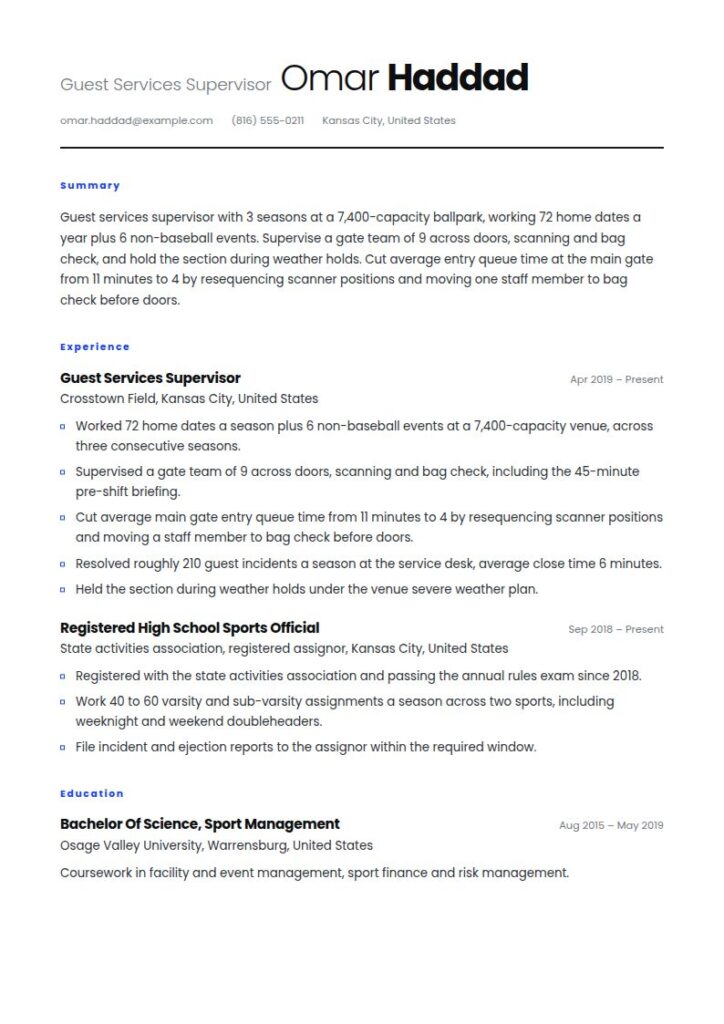
Guest services supervisor with 3 seasons at a 7,400-capacity ballpark, working 72 home dates a year plus 6 non-baseball events. Supervise a gate team of 9 across doors, scanning and bag check, and hold the section during weather holds. Cut average entry queue time at the main gate from 11 minutes to 4 by resequencing scanner positions and moving one staff member to bag check before doors.
Work Experience
04/2019 - Present, Guest Services Supervisor, Crosstown Field, Kansas City, United States
- Worked 72 home dates a season plus 6 non-baseball events at a 7,400-capacity venue, across three consecutive seasons.
- Supervised a gate team of 9 across doors, scanning and bag check, including the 45-minute pre-shift briefing.
- Cut average main gate entry queue time from 11 minutes to 4 by resequencing scanner positions and moving a staff member to bag check before doors.
- Resolved roughly 210 guest incidents a season at the service desk, average close time 6 minutes.
- Held the section during weather holds under the venue severe weather plan.
09/2018 - Present, Registered High School Sports Official, State activities association, registered assignor, Kansas City, United States
- Registered with the state activities association and passing the annual rules exam since 2018.
- Work 40 to 60 varsity and sub-varsity assignments a season across two sports, including weeknight and weekend doubleheaders.
- File incident and ejection reports to the assignor within the required window.
Education
08/2015 - 05/2019, Bachelor of Science, Sport Management, Osage Valley University, Warrensburg, United States
Coursework in facility and event management, sport finance and risk management.
Skills
Access control scanning and gate operations, 85
Crowd management and queue flow, 80
Incident reporting, 75
Event-day staff briefing, 70
Radio and event-day communications protocol, 80
Severe weather and suspension procedures, 70
Languages
English, native
Arabic, native
Certificates
02/2026, CPR, AED and First Aid, American Red Cross
Renewed on schedule; required on site at every event.
03/2025, Alcohol Server Training, State-approved program
Required for venues licensed to sell alcohol.
09/2018, Registered High School Sports Official, State activities association
Rules exam passed annually since 2018, across two sports.
Summary
A sports resume is a one to two page document naming the events you worked, what you owned in the run of show, and how many people and how much crowd you were responsible for. This guide covers coaching, officiating, operations, facilities and game-day staff, with three adaptable summaries and current Bureau of Labor Statistics pay for the sector's published occupations.
Sports resume examples by experience level
A sports resume is a one to two page document that names the events you worked, what you owned inside them, and what you did when one went wrong.
The industry looks fragmented from outside. Coaching, officiating, operations, facilities, ticketing, grounds, sponsorship and game-day staffing hire differently, ask for different credentials and pay very differently. One thing runs through all of it: the season is the organizational chart and the event is the unit of work. Everything a hiring manager wants to know is a fact about an event you have already worked.
This is a broad guide covering the whole sector. If your job has a page of its own in this category, start there and use this one for the market and salary picture.
Resume guide for a sports resume
This guide and the corresponding sports resume example will cover:
- How to write a sports resume, section by section
- Why event day is the unit of evidence across every job family in the sector
- Three adaptable summaries: game-day staff, operations coordinator and event operations lead
- What each job family in sports is actually hired on
- What the published occupations in the sector pay, and how far apart they are
How to write a sports resume
Five blocks: contact header, summary, experience written in events, credentials, and skills. One page for your first five years, two once you have run events at scale or managed staff.
The header line of every role carries the volume. Volume is the fastest available proof of competence here, because everyone in the sector knows what a 72-date home season or a 14-team weekend tournament costs to run.
| Block | What it is answering | Where it goes |
|---|---|---|
| Events a season | Have they done this at the frequency we run? | Header line of each role |
| Role in the run of show | What were they responsible for between doors and final whistle? | First bullet |
| Staff and crowd | How many people did they direct, and how many were in the building? | Second bullet |
| Credentials | Are they cleared to work here on day one? | Its own short block |
Put the event count and the attendance in the header line of every job
A reader who works in sports can size a job from two numbers. Write them into the role header rather than burying them.
For a venue: "72 home dates a season, average attendance 4,300, capacity 7,400". For a tournament operation: "26 tournaments a year across 9 venues, 140 event-day staff at peak". For officiating: "84 varsity and sub-varsity assignments a season across two sports". For coaching: "a 22-game season, 34 athletes, 3 assistants".
Those lines do work no adjective can. They tell the reader the scale you are used to and whether the step up they are hiring for is a half step or a leap.
Run the finished file through the ATS resume checker before you apply. Teams, venues, athletics departments and facility operators mostly recruit through portals that parse the file before a person opens it.
Choosing the best resume format for a sports resume
Reverse chronological, single column, plain type. Seasonal and part-time work is normal here and should be labeled rather than hidden: "five consecutive seasons, April to September" reads as a pattern, while the same seasons listed as five short jobs reads as five departures.
Do not use a functional format. A reader is checking whether you came back the next season, which is the sector's own measure of whether you were any good.
Include your contact information
| ✅ Right | ❌ Wrong |
|---|---|
| Omar Haddad | Omar Haddad |
| Event Operations, 44 events a year across 9 venues | Sports professional |
| Kansas City, MO. Available nights, weekends and holidays | Kansas City, MO |
| (816) 555-0211, [email protected] | (816) 555-0211, [email protected] |
The third line matters more here than in almost any other sector. Sports runs nights, weekends and holidays, and an applicant who states availability plainly has answered the first question the schedule poses.
Make use of a summary
Four lines: your job family, the event volume, one thing you owned, and one number that shows scale or a fix.
Guest services supervisor with 3 seasons at a 7,400-capacity ballpark, working 72 home dates a year plus 6 non-baseball events. Supervise a gate team of 9 across doors, scanning and bag check, and hold the section during weather holds. Cut average entry queue time at the main gate from 11 minutes to 4 by resequencing scanner positions and moving one staff member to bag check before doors.
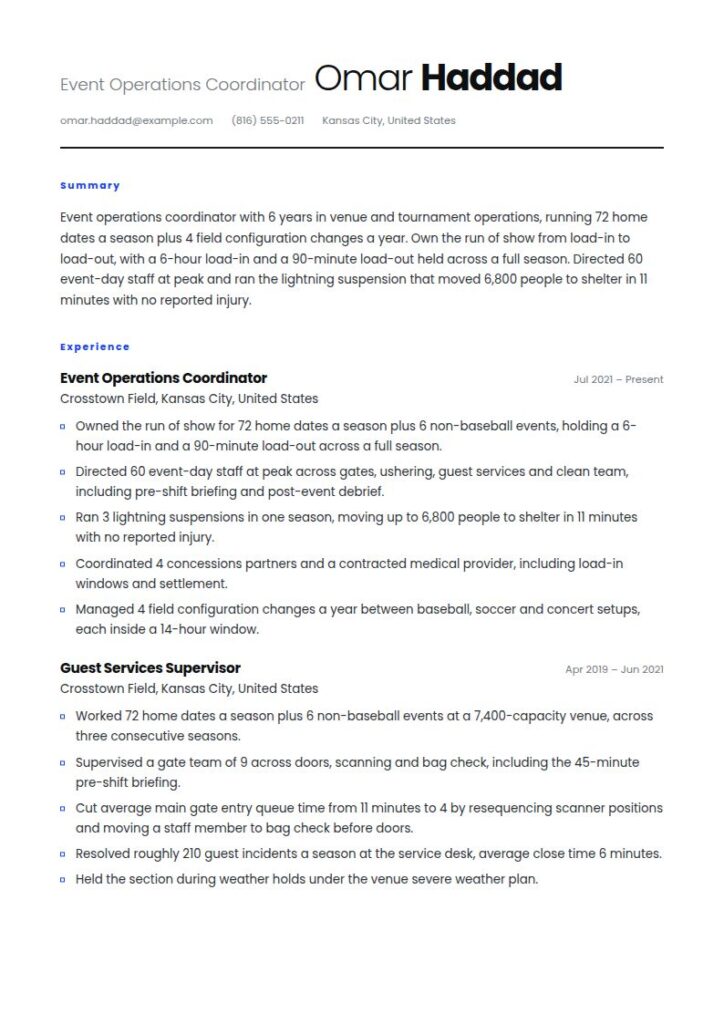
Event operations coordinator with 6 years in venue and tournament operations, running 72 home dates a season plus 4 field configuration changes a year. Own the run of show from load-in to load-out, with a 6-hour load-in and a 90-minute load-out held across a full season. Directed 60 event-day staff at peak and ran the lightning suspension that moved 6,800 people to shelter in 11 minutes with no reported injury.
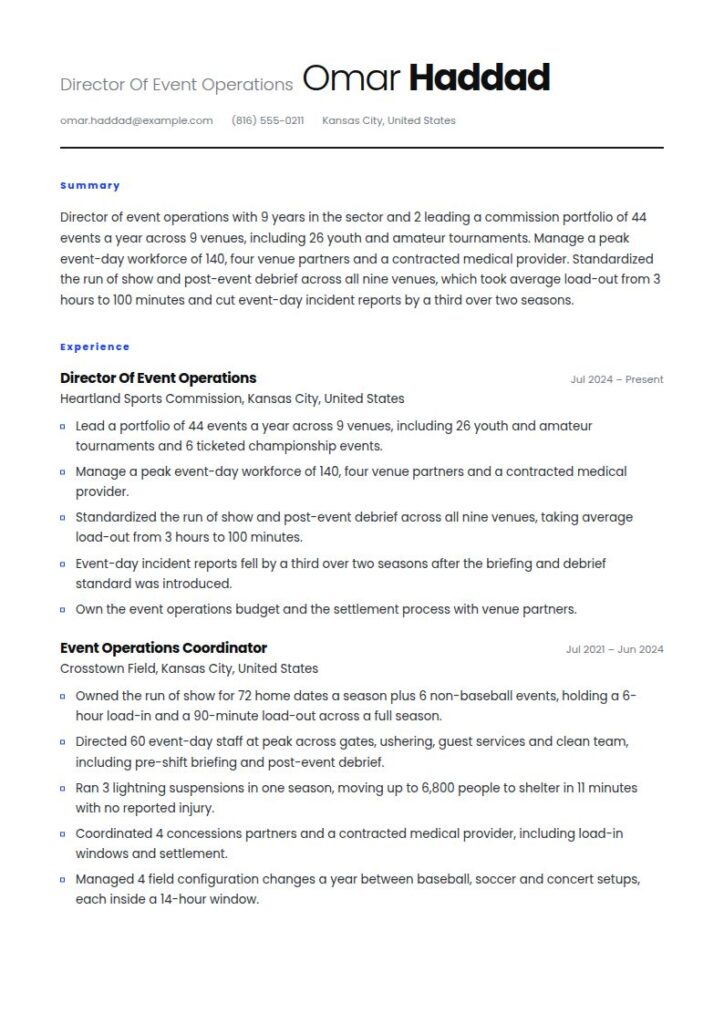
Director of event operations with 9 years in the sector and 2 leading a commission portfolio of 44 events a year across 9 venues, including 26 youth and amateur tournaments. Manage a peak event-day workforce of 140, four venue partners and a contracted medical provider. Standardized the run of show and post-event debrief across all nine venues, which took average load-out from 3 hours to 100 minutes and cut event-day incident reports by a third over two seasons.
Right vs wrong: the same sports summary, twice
| ✅ Right | ❌ Wrong |
|---|---|
| Event operations coordinator with 6 years in venue and tournament operations, running 72 home dates a season. | Sports industry professional with a lifelong love of the game. |
| Own the run of show from load-in to load-out, with a 6-hour load-in and a 90-minute load-out held across a full season. | Responsible for various event-day duties in a fast-paced environment. |
| Ran the lightning suspension that moved 6,800 people to shelter in 11 minutes with no reported injury. | Ensured a safe and enjoyable experience for all guests. |
Everyone applying for a job in sports likes sports. It is the least distinguishing thing you can put on the page, and it costs you the line that could have carried a number.
Outline your sports experience
Organization, venue, city, the volume, and dates. Then three to five bullets. Each one names a moment in the event and carries a count, a clock or a dollar figure.
| Instead of | Use |
|---|---|
| Assisted with game-day operations | Ran the run of show for 72 home dates a season, from a 6-hour load-in to a 90-minute load-out |
| Supervised staff | Directed 60 event-day staff across gates, ushering, guest services and clean team, with a 45-minute pre-shift briefing |
| Handled customer issues | Resolved 210 guest incidents a season at the service desk, with an average close time of 6 minutes |
| Worked with vendors | Coordinated 4 concessions partners and a contracted medical provider across 72 dates, including load-in windows and settlement |
| Helped during weather delays | Ran 3 lightning suspensions in one season, moving up to 6,800 people to shelter in 11 minutes with no reported injury |
| Set up and cleaned the facility | Managed 4 field configuration changes a year between baseball, soccer and concert setups, each inside a 14-hour window |
Event Operations Coordinator, Crosstown Field, Kansas City, MO, July 2021 to June 2024. 72 home dates a season, capacity 7,400, plus 6 non-baseball events a year.
Owned the run of show from load-in to load-out across a full season, holding a 6-hour load-in and a 90-minute load-out, with the written timeline distributed to every department the day before.
Directed 60 event-day staff at peak across gates, ushering, guest services and clean team, including the 45-minute pre-shift briefing and the post-event debrief.
Ran 3 lightning suspensions in one season under the venue severe weather plan, moving up to 6,800 people to shelter in 11 minutes with no reported injury.
Coordinated 4 field configuration changes a year between baseball, soccer and concert setups, each completed inside a 14-hour window.
Cut average main gate entry queue time from 11 minutes to 4 by resequencing scanner positions and moving staff to bag check before doors.
The season is the org chart: write what you owned on event day
Every job family in this sector reports to the same thing, which is the event. That is what makes a broad sports resume possible: whatever your title, the hiring manager is reading for the same six facts.
How many events a season. Your role in the run of show, named by the part of it you held. What load-in and load-out looked like, with the window. How many staff you directed on event day. How much crowd or gate you were responsible for. And what you owned when something went wrong.
The last carries the most weight and appears on the fewest resumes. Events fail in predictable ways: weather, a gate backing up, a medical incident, a timing failure, a vendor who does not arrive, a crowd that will not clear. Naming one, with what you did and how long it took, tells a reader more than an entire list of duties, because it is the part of the job that cannot be trained in a week.
| Job family | What it is hired on | The number that proves it |
|---|---|---|
| Coaching | Season structure, athlete numbers, staff supervised, program continuity | Games a season, athletes, assistants, seasons in post |
| Officiating | Registration with a state or local agency, a rules exam, and assignments completed at level | Assignments a season, by level and sport |
| Game-day and guest services | The gate, the section, the queue, the incident | Doors handled, staff on the gate, queue time, incidents closed |
| Event operations | The run of show, load-in and load-out, the vendors, the contingency | Events a season, load-out window, staff directed, delays run |
| Facility and grounds | Surfaces, changeovers, compliance and preventive maintenance | Configuration changes a year, turn time, surface tests logged |
| Ticketing and box office | Scan rate, will-call volume, comps and settlement accuracy | Tickets scanned a season, gate value, settlement variance |
| Sponsorship and marketing | Inventory delivered and proof of performance | Activations delivered, assets sold, renewal rate |
| Athletics administration | Budget, scheduling, compliance reporting | Teams supported, budget owned, reports filed on time |
Two of those families have published credential expectations worth stating precisely. For officiating, BLS reports that credentialing requirements vary by competition level and that to officiate high school events officials typically register with a state or local agency and pass a rules exam (BLS Occupational Outlook Handbook, Umpires, Referees, and Other Sports Officials, last modified 27 August 2026). For coaching, the same Handbook notes that public high school coaches may need to be certified or complete mandatory education courses (Coaches and Scouts, last modified 27 August 2026). Both are set locally, so name the body that registered or certified you rather than making a national claim.
Events: 44 a year across 9 venues, including 26 youth and amateur tournaments and 6 ticketed championship events.
Run of show: Own the written timeline from load-in to load-out and chair the pre-event coordination meeting with venue, medical, security and officiating leads.
Load-in and load-out: 6-hour standard load-in; load-out reduced from 3 hours to 100 minutes across the portfolio by standardizing the breakdown order.
Staff: Peak event-day workforce of 140 across gates, ushering, guest services, clean team and parking, plus 4 venue partners and a contracted medical provider.
Crowd and gate: Up to 7,400 per event; 312,000 total attendance across the last full season.
When it went wrong: 3 lightning suspensions in one season, up to 6,800 people to shelter in 11 minutes, no reported injury; one scoreboard failure covered by a manual timing procedure rehearsed in preseason.
Build a snapshot of your key sports skills
Ten to fourteen entries in three groups: event delivery, people and compliance, and systems. Name the thing, not the quality.
Event delivery: Run of show and event timelines, Load-in and load-out scheduling, Field and floor configuration changes, Severe weather and suspension procedures, Vendor and concessions coordination
People and compliance: Event-day staff briefing and supervision, Incident reporting and post-event debrief, Crowd management and evacuation procedure, Contractor and medical provider coordination, Volunteer scheduling
Systems: Ticketing and access control scanning, Event management and scheduling software, Radio and event-day communications protocol, Attendance and incident reporting, Budget and settlement tracking
List your education and certifications
Degree if you have one, then the credentials that let you work an event, with currency dates. The certification block here is short and it is checked, because most of it is a condition of being on site.
Bachelor of Science, Sport Management, Osage Valley University, Warrensburg, MO, 2019.
Certifications: CPR, AED and first aid, American Red Cross (2026). Alcohol server training, state-approved program (2025). Registered high school sports official, state activities association, rules exam passed annually since 2018.
Additional: Forklift and scissor lift operation. Food handler card. Valid driver's license with a clean record for shuttle and cart operation.
Choose the right layout and design
Single column, 11 or 12 point body type, no photograph, no team logos, no graphics. Keep numbers in the text rather than in a chart, because a parsed record loses charts and keeps sentences.
Put the event count and the attendance in the header line of every role. Name the part of the run of show you owned. Give load-in and load-out windows with real times. State how many event-day staff you directed. Describe one event that went wrong and what you did. Label seasonal work as seasonal, with the months.
Do not write that you are a lifelong fan of the sport; everyone in the pile is. Do not claim a coaching certification or an officiating registration you do not currently hold, because both are checked against a register. Do not hide seasonal gaps, which are normal here and look worse disguised. Do not describe a spectator's view of the event; describe your position in it. Do not name a player, an official or a patron involved in an incident.
Sports job market and outlook
There is no single "sports" occupation in federal statistics, so there is no single number for the sector. The Bureau of Labor Statistics publishes several distinct occupations that cover the competitive and coaching side, and the honest way to read the market is to put them next to each other:
| Occupation | Jobs, 2025 | Change 2025-35 | Annual openings | Median wage, May 2025 |
|---|---|---|---|---|
| Coaches and scouts | 298,800 | 6% | ~36,400 | $47,320 |
| Athletes and sports competitors | 22,900 | 6% | ~2,200 | $66,710 |
| Umpires, referees and other sports officials | 18,200 | 5% | ~4,300 | $40,710 |
Source: BLS Occupational Outlook Handbook, May 2025 wage data and 2025 to 2035 projections, last modified 27 August 2026.
Read the openings column rather than the growth column. Coaching produces about 36,400 openings a year against roughly 2,200 for athletes and 4,300 for officials, so the realistic route into paid work is the coaching and staffing side, not the competing side.
Three sports occupations, three different labor markets
Coaches and scouts held 298,800 jobs in 2025 with about 36,400 openings a year projected over the decade; athletes and sports competitors held 22,900 jobs with about 2,200; umpires, referees and other sports officials held 18,200 jobs with about 4,300 (BLS Occupational Outlook Handbook, last modified 27 August 2026).
The industry each one sits in changes the pay more than the title does. Officials in spectator sports and performing arts had a median of $52,790 in May 2025, while the 32 percent of officials working in local government excluding education and hospitals had a median of $37,440. Coaches in arts, entertainment and recreation had a median of $48,440 against $46,890 in educational services, where 64 percent of them work (BLS, May 2025).
So the two decisions that move your pay in this sector are which family you work in and which industry you work in, and a resume's job is to make you credible in both. Event volume and staff counts travel between families in a way that a sport-specific achievement does not.
What salary you can expect in sports
There is no sector median to quote, so the useful figure is the spread between the published occupations. In May 2025 the medians were $66,710 for athletes and sports competitors, $47,320 for coaches and scouts, and $40,710 for umpires, referees and other sports officials (BLS Occupational Outlook Handbook, last modified 27 August 2026).
The distributions matter more than the medians, because this sector is unusually uneven. Athletes and sports competitors run from under $26,500 at the tenth percentile to over $742,310 at the ninetieth. Coaches and scouts run from under $28,790 to over $98,860. Officials run from under $26,540 to over $82,960 (BLS, May 2025). One occupation has a top decile nearly thirty times its bottom decile; the other two are closer to three or four. That is the shape of the industry in one comparison, and it is why a career built on event delivery is a more predictable living than one built on competing.
Industry is the second lever, and often a larger one than seniority. Among officials, 17 percent work in spectator sports and performing arts at a median of $52,790 while 32 percent work in local government excluding education and hospitals at $37,440, a gap of over $15,000 for the same work at a different level of competition. Among coaches, the 22 percent in arts, entertainment and recreation earned $48,440 against $46,890 for the 64 percent in educational services, and 8 percent are self-employed (BLS, May 2025).
What a resume moves is narrower: the events you are eligible to be assigned. Premium assignments, postseason events and paid supervisory shifts are allocated on record and registration rather than negotiation. A file that shows assignments completed at a level, staff directed at scale, and one event recovered under pressure gets offered the next tier of work.
Key takeaways for a sports resume
- Put the event count and attendance in the header line of every role.
- Name the part of the run of show you owned, not the department you sat in.
- Give load-in and load-out as real windows with real times.
- State how many event-day staff you directed, at peak, by function.
- Describe one event that went wrong, what you did, and how long it took.
- Name the body that registered or certified you; these are set locally, not nationally.
- Label seasonal work as seasonal and show that you came back.
Build your sports resume in 15 minutes with our AI resume builder.
Related sport and fitness resume examples
- Coach resume
- Referee resume
- Athletic trainer resume
- Basketball coach resume
- Football coach resume
- Soccer coach resume
- Hockey coach resume
- Baseball coach resume
- Recreational facility attendant resume
- Golf instructor resume
- Lifeguard resume
- Sport and fitness resume
Pair it with a matching sports cover letter.
Sports resume questions, answered
How long should a sports resume be?
One page for your first five years, two once you have run events at scale, managed staff or held a budget. Seasonal roles at the same venue can be grouped into one entry with the seasons counted, which usually saves half a page.
I have only worked seasonal game-day jobs. Is that enough?
Yes, if you write it as operations rather than attendance. Five seasons of gate work is five seasons of crowd handling, scanning, incident resolution and pre-shift briefings, and being rehired each year is itself the strongest evidence on the page. Group the seasons, count the dates, give the queue and incident numbers.
Should I say which teams I support?
No. It is the most common line on a sports resume and it separates nobody, because every applicant is a fan. The space is better used on an event count.
What certifications are worth listing for sports jobs?
The ones that are a condition of being on site: CPR, AED and first aid, alcohol server training where the venue sells alcohol, food handler cards, equipment operation tickets, and any registration your job family requires. BLS notes that high school officials typically register with a state or local agency and pass a rules exam, and that public high school coaches may need certification or mandatory courses (BLS Occupational Outlook Handbook, last modified 27 August 2026). Both are set locally, so name the body.
How do I move from game-day staff into a full-time sports job?
Write the transferable half of what you already do. Full-time operations roles hire for run of show, staff supervision, vendor coordination and contingency handling, and each exists in a game-day job at a smaller scale. Take on the pre-shift briefing, volunteer for the weather plan, learn the load-out order, then put those on the page with numbers.
Does a sport management degree matter?
It helps for administration, operations and sponsorship roles and matters less for event-day and facility work, where the event record does more. BLS reports a bachelor's degree as typical entry-level education for coaches and scouts and a high school diploma or equivalent for umpires, referees and other sports officials (BLS Occupational Outlook Handbook, last modified 27 August 2026).