Grassroots Soccer Coach Leticia Castellanos-Reyes
Recreational Coach, U10 and U11
[email protected] | (208) 555-1900 | Boise, United States
Profile
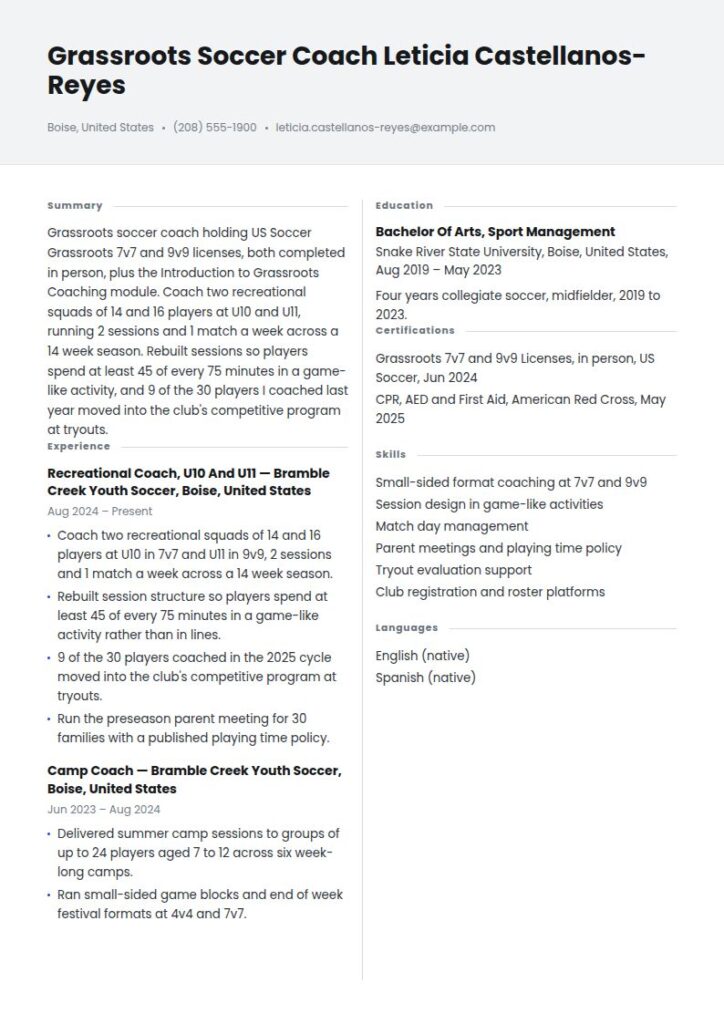
Grassroots soccer coach holding US Soccer Grassroots 7v7 and 9v9 licenses, both completed in person, plus the Introduction to Grassroots Coaching module. Coach two recreational squads of 14 and 16 players at U10 and U11, running 2 sessions and 1 match a week across a 14 week season. Rebuilt sessions so players spend at least 45 of every 75 minutes in a game-like activity, and 9 of the 30 players I coached last year moved into the club's competitive program at tryouts.
Work Experience
08/2024 - Present, Recreational Coach, U10 and U11, Bramble Creek Youth Soccer, Boise, United States
- Coach two recreational squads of 14 and 16 players at U10 in 7v7 and U11 in 9v9, 2 sessions and 1 match a week across a 14 week season.
- Rebuilt session structure so players spend at least 45 of every 75 minutes in a game-like activity rather than in lines.
- 9 of the 30 players coached in the 2025 cycle moved into the club's competitive program at tryouts.
- Run the preseason parent meeting for 30 families with a published playing time policy.
06/2023 - 08/2024, Camp Coach, Bramble Creek Youth Soccer, Boise, United States
- Delivered summer camp sessions to groups of up to 24 players aged 7 to 12 across six week-long camps.
- Ran small-sided game blocks and end of week festival formats at 4v4 and 7v7.
Education
08/2019 - 05/2023, Bachelor of Arts, Sport Management, Snake River State University, Boise, United States
Four years collegiate soccer, midfielder, 2019 to 2023.
Skills
Small-sided format coaching at 7v7 and 9v9, 80
Session design in game-like activities, 75
Match day management, 70
Parent meetings and playing time policy, 70
Tryout evaluation support, 65
Club registration and roster platforms, 75
Languages
English, native
Spanish, native
Certificates
06/2024, Grassroots 7v7 and 9v9 Licenses, in person, US Soccer
Completed alongside the Introduction to Grassroots Coaching module.
05/2025, CPR, AED and First Aid, American Red Cross
Current through May 2027. Background screening current through 2027.
Summary
A soccer coach resume is a one to two page document naming the coaching license you hold, the age groups and small-sided formats you have run, and the pathway your players moved along. This guide gives you three adaptable versions, the license and pathway block most applicants leave out, and current Bureau of Labor Statistics pay and outlook.
Soccer Coach resume examples by experience level
A soccer coach resume is a one to two page document naming the coaching license you hold, the age groups and match formats you have actually run, and what happened to the players who came through your sessions.
In practice, that second half is where most applicants lose the job. After all, a club technical director is not hiring enthusiasm. Instead, they are filling a slot on an age group chart, and the slot has a license requirement, a format, and a set of families who will ask on day one where this team goes next. As a result, the resume that answers all three beats the one that lists teams and seasons.
Resume guide for a soccer coach resume
In short, this guide and the corresponding soccer coach resume example will cover:
- How to write a soccer coach resume, section by section
- Why the license grade belongs above your playing career
- Three adaptable summaries: grassroots, club coach and director
- How to show a player pathway without naming a single player
- What the job market looks like and what you can expect to earn
How to write a soccer coach resume
Six sections: contact header, summary, licenses and certifications, coaching experience, the license and pathway block, and skills, with education and playing background last. First, keep one page as a club coach, then two once you are directing a program.
Licenses come first because they are a gate, not an achievement. Club posts, academy posts and most paid youth roles are advertised with a minimum license grade in the listing, and a technical director sorting applications checks that line before reading anything else.
| Section | What it is answering | Where it goes |
|---|---|---|
| Coaching license | Are they eligible for this post at all? | Header and its own block, with the grade and year |
| Coaching experience | Which age groups and formats have they run? | Reverse chronological, with squad size and format |
| License and pathway | Where do this coach's players go next? | Its own block, directly after experience |
| Playing background | Useful context, not the case | Last, in one or two lines |
Write the license grade the way the federation writes it
US Soccer publishes a coaching license pathway that begins with Grassroots courses named after the small-sided game models: 4v4, 7v7, 9v9 and 11v11, each offered both online, at about two hours, and in person, at about four hours, alongside a free Introduction to Grassroots Coaching module (US Soccer, ussoccer.com, retrieved 17 September 2026).
US Soccer states that "a unique combination of three of the eight Grassroots Licenses (replacing the E and F Licenses) now formally represent the prerequisite to progress to the U.S. Soccer D License", specifically a minimum of three grassroots courses in the form of two in person and one online. Above the D License the pathway continues through the C License, the B License, the A License, which US Soccer runs as separate A-Youth and A-Senior courses, and the Pro License.
Write yours exactly: "US Soccer D License (2022)", not "USSF licensed" and not "Level 3 coach". A technical director is matching a grade against a job description, and an approximation reads as a grade you do not hold.
Run the finished file through the ATS resume checker first. Club and college applications go into a system that filters on exactly these terms before a human opens anything.
Choosing the best resume format for a soccer coach resume
Reverse chronological. One page while you are coaching teams, two once you are directing a program with coaches reporting to you.
However, the one thing to arrange differently from other coaching resumes is the license block. Specifically, put it in the top third of the page, above experience, with each grade and its year. It does the work a license number does on a teaching resume: it tells the reader in two seconds whether to keep reading.
By contrast, keep your own playing career at the bottom in one or two lines. For example, a former professional with no license is not eligible for a post that a Grassroots coach with a C License can take.
Include your contact information
| ✅ Right | ❌ Wrong |
|---|---|
| Leticia Castellanos-Reyes | Leticia Castellanos-Reyes |
| Director of Coaching, US Soccer B License | Experienced soccer coach and former player |
| US Soccer B License (2024), C License (2019), Grassroots 9v9 and 11v11 | USSF certified coach |
| (208) 555-1900, [email protected], Boise, ID | (208) 555-1900, [email protected] |
Also, put the license grade and its year in the header. That is because it is the first thing the reader looks for and the one thing they cannot infer from anything else on the page.
Make use of a summary
Next, write four lines: license grade, the age groups and formats you run, squad numbers, and one pathway outcome with a number.
Grassroots soccer coach holding US Soccer Grassroots 7v7 and 9v9 licenses, both completed in person, plus the Introduction to Grassroots Coaching module. Coach two recreational squads of 14 and 16 players at U10 and U11, running 2 sessions and 1 match a week across a 14 week season. Rebuilt sessions so players spend at least 45 of every 75 minutes in a game-like activity, and 9 of the 30 players I coached last year moved into the club's competitive program at tryouts.
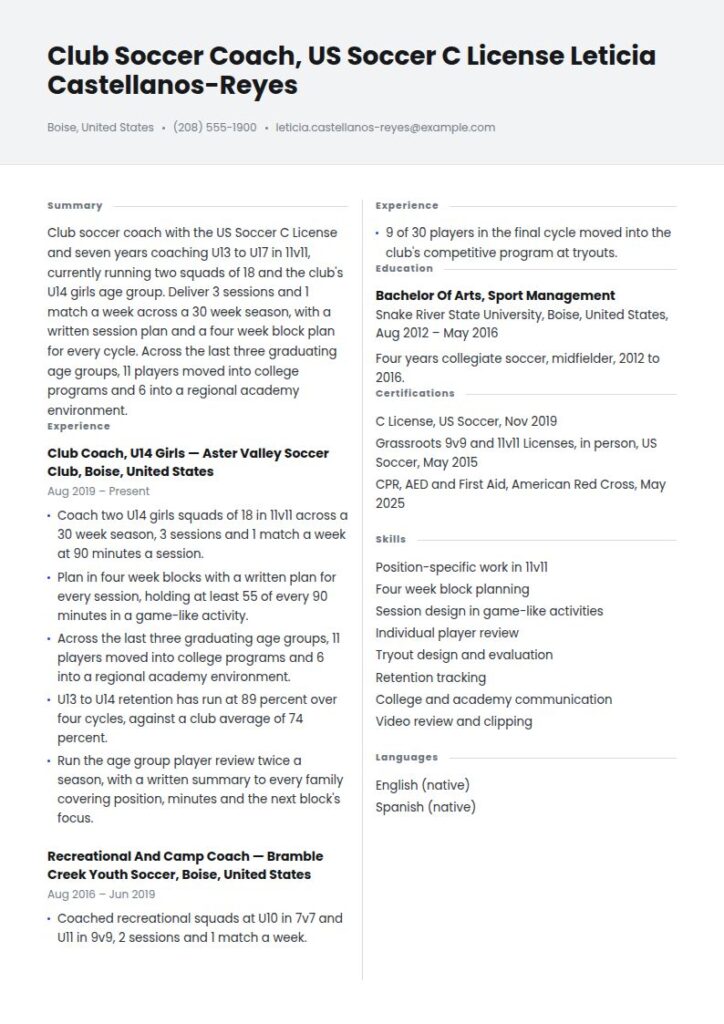
Club soccer coach with the US Soccer C License and seven years coaching U13 to U17 in 11v11, currently running two squads of 18 and the club's U14 girls age group. Deliver 3 sessions and 1 match a week across a 30 week season, with a written session plan and a four week block plan for every cycle. Across the last three graduating age groups, 11 players moved into college programs and 6 into a regional academy environment.
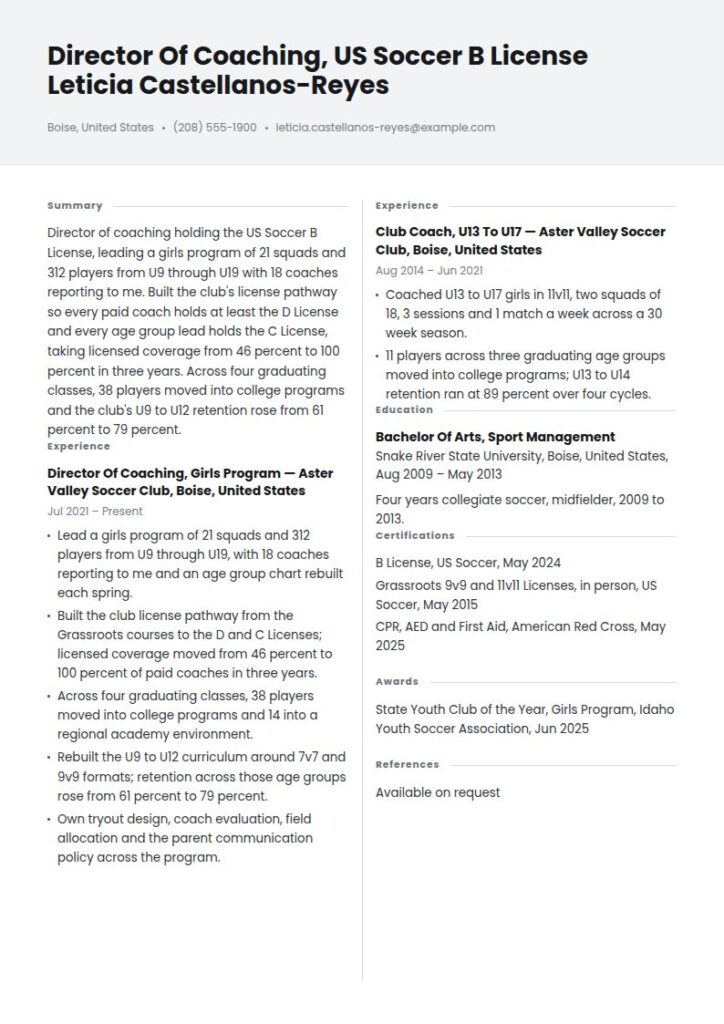
Director of coaching holding the US Soccer B License, leading a girls program of 21 squads and 312 players from U9 through U19 with 18 coaches reporting to me. Built the club's license pathway so every paid coach holds at least the D License and every age group lead holds the C License, taking licensed coverage from 46 percent to 100 percent in three years. Across four graduating classes, 38 players moved into college programs and the club's U9 to U12 retention rose from 61 percent to 79 percent.
Right vs wrong: the same soccer coach summary, twice
| ✅ Right | ❌ Wrong |
|---|---|
| Club soccer coach with the US Soccer C License and seven years coaching U13 to U17 in 11v11. | Experienced soccer coach with a deep love of the game and a passion for youth development. |
| Deliver 3 sessions and 1 match a week across a 30 week season, with a written block plan every cycle. | Responsible for planning and delivering high quality training sessions. |
| Across three graduating age groups, 11 players moved into college programs and 6 into a regional academy. | Helped many players reach the next level of their soccer journey. |
In other words, the right column tells a technical director which slot on their age group chart you fill and what families hear at the first parent meeting. On the other hand, the left column could be any of the forty other files.
Outline your coaching experience
Club, city, age group, gender, format, squad size and season years, then three to five bullets. Additionally, in experience, each bullet carries a number: sessions, minutes, squad size, retention or pathway.
| Instead of | Use |
|---|---|
| Coached a youth soccer team | Coached U14 girls, 11v11, two squads of 18 across a 30 week season |
| Ran training sessions | Delivered 3 sessions and 1 match a week, 90 minutes each, to a written four week block plan |
| Developed players | 11 players from three graduating age groups moved into college programs, 6 into a regional academy |
| Worked with parents | Ran preseason and midseason parent meetings for 36 families, with a published playing time policy |
| Helped with club activities | Built the club's grassroots to D License pathway, taking licensed coverage from 46 percent to 100 percent |
Club Coach, U14 Girls, Aster Valley Soccer Club, Boise, ID, August 2019 to Present
Coach two U14 girls squads of 18 in 11v11 across a 30 week season, with 3 sessions and 1 match a week at 90 minutes a session.
Plan in four week blocks with a written session plan for every session, and keep at least 55 of every 90 minutes in a game-like activity rather than in lines.
Run the age group's player review twice a season, with a written summary for every family covering position, minutes and the next block's focus.
Across the last three graduating age groups, 11 players moved into college programs and 6 into a regional academy environment.
Age group retention from U13 to U14 has run at 89 percent over four cycles, against a club average of 74 percent.
The license grade you hold and the pathway you coached into
This is the block almost nobody includes, and a technical director reads it first and last.
Meanwhile, soccer coaching in the United States is organized around two things a resume can state precisely and almost never does: the federation license you hold, and where the players you coached went next.
Write the license ladder in order, with your years. US Soccer's pathway runs from the Grassroots courses, named for the 4v4, 7v7, 9v9 and 11v11 game models, through the D License, the C License, the B License, the A License, which US Soccer runs as separate A-Youth and A-Senior courses, to the Pro License (US Soccer, ussoccer.com, retrieved 17 September 2026). Write every grade you hold with its year, and the next one you are booked for. A club planning next season wants to know whether its U15 coach will hold the C License by August.
Name the age groups and the formats they play. US Soccer's Player Development Initiatives tie the small-sided formats to age groups: 7v7 was created for U9 and U10, 9v9 for U11 and U12, and 11v11 for U13 and above (US Soccer, ussoccer.com, retrieved 17 September 2026). Writing "U11 9v9" rather than "youth soccer" tells the reader the size of the pitch, the problems you were teaching, and which Grassroots license the post requires.
Give the session design in numbers. Sessions a week, minutes a session, weeks in a season, and how the session is built. The most useful figure you can put on a soccer resume is how much of the session players spend in a game-like activity rather than queuing: it is the one claim about your coaching that is specific, checkable at interview, and not shared by every other file.
The player pathway you coached into
Then write the pathway, without naming anyone. Recreational to competitive at tryouts. Age group to age group, as retention. Club to college, as the number in a graduating class who went on to play in a college program. Club to academy, where that route exists. Give the number, the class and the period, and describe the group. Never name a player, describe them, or write which school recruited them. The count is the evidence, and it is stronger than a story.
Licenses: US Soccer B License (2024). US Soccer C License (2019). US Soccer D License (2016). US Soccer Grassroots 9v9 and 11v11, in person (2014 and 2015), and Grassroots 7v7, online (2014).
Age groups and formats: U9 and U10 at 7v7, U11 and U12 at 9v9, U13 through U17 at 11v11.
Session design: 3 sessions and 1 match a week, 90 minutes a session, 30 week season, four week block plan, minimum 55 of 90 minutes in a game-like activity.
Pathway, recreational to competitive: 9 of 30 recreational players moved into the competitive program at tryouts in the 2025 cycle.
Pathway, retention: U13 to U14 retention 89 percent over four cycles, against a club average of 74 percent.
Pathway, club to college and academy: 11 players across three graduating age groups moved into college programs; 6 into a regional academy environment.
Even so, one caution: do not claim a pathway outcome you did not coach. Technical directors talk to each other, and an overstated pathway is the fastest way to lose a job you would otherwise have had.
Build a snapshot of your key skills
Later, in skills, list twelve to sixteen entries in three groups: coaching, program work, and club systems.
Coaching: Session design in game-like activities, Four week block planning, Small-sided format coaching at 7v7 and 9v9, Position-specific work in 11v11, Individual player review, Match day management and substitution planning
Program: Coach license pathway planning, Age group chart and roster building, Tryout design and evaluation, Retention tracking, Parent meetings and playing time policy, College and academy communication
Systems: Club registration and roster platforms, Video review and clipping, Session planning software, Scheduling and field allocation
List your education and certifications
Licenses first with grades and years, then safety certifications, then degrees, then playing background.
US Soccer B License, 2024. US Soccer C License, 2019. US Soccer D License, 2016.
US Soccer Grassroots 9v9 and 11v11, in person, 2015 and 2014. Grassroots 7v7, online, 2014. Introduction to Grassroots Coaching, 2014.
CPR, AED and first aid, American Red Cross, current through 2027
Bachelor of Arts, Sport Management, Snake River State University, Boise, ID, 2013
Playing background: four years collegiate soccer, midfielder, 2009 to 2013
The OOH notes that certification for coaches often requires being at least 18 and trained in CPR and first aid (BLS Occupational Outlook Handbook, 2025-35 projections), and clubs almost always require background screening too. Say that your screening is current: a coach who can be on a field next week is worth more than one who cannot.
Choose the right layout and design
Lastly, use a single column, plain type at 11 or 12 point, clear headings, no photograph, no club crests. Club applicant systems parse the file before a person reads it, and two columns, logos and text boxes are where that parsing breaks.
Write age groups in one consistent style, either U13 or 2013 birth year, and do not mix them. That matters because readers scan an age group list the way a recruiter scans job titles.
Write the license grade exactly as the federation writes it, with the year. List the age groups with their formats. Give sessions a week, minutes a session and weeks a season. Put the pathway in counts: tryout movement, retention, college and academy placements by graduating class. Say whether your background screening and first aid are current. Say which license you are booked to take next.
Do not write "USSF certified" or invent a level number. Do not name a player, describe them, or write which school recruited them. Do not claim a pathway outcome for a player you coached for one season. Do not lead with your own playing career; it is context, not the case. Do not pad the file with tournament names that mean nothing outside your state.
Soccer coach job market and outlook
Overall, a growing occupation with a large club and recreation sector alongside the school system, and a real share of coaches working for themselves.
| Measure | Value |
|---|---|
| Coaches and scouts jobs, 2025 | 298,800 |
| Projected change, 2025-35 | 6% (faster than average), +18,100 |
| Projected annual openings | ~36,400 |
| Typical entry-level education | Bachelor's degree |
| Median annual wage, May 2025 | $47,320 |
Source: U.S. Bureau of Labor Statistics, Occupational Outlook Handbook, 2025-35 projections and May 2025 wage data.
Soccer coaches do not have a Handbook profile of their own; they are published inside coaches and scouts, so every figure here covers that whole occupation. The OOH notes that part-time work is common, hours are irregular including evenings, weekends and holidays, and certification often requires coaches to be at least 18 and trained in CPR and first aid.
Nearly a third of this occupation is outside the school system
BLS reports that 22 percent of coaches and scouts work in arts, entertainment and recreation, at a median of $48,440, and that 8 percent are self-employed (U.S. Bureau of Labor Statistics, May 2025). Educational services is still the largest single share at 64 percent and $46,890.
Youth soccer sits disproportionately in that 22 percent and that 8 percent: club coaching, camps, private training and academy work rather than school athletics. Note that arts, entertainment and recreation pays a higher median than educational services, which runs against the assumption that club work is the less serious option.
For the resume that means two readers. A technical director is checking your license grade against a job description and your pathway against their parent meeting. A private or camp client is checking whether you can fill a session and whether you carry your own insurance and screening. Write both.
Where the jobs sit:
| Setting | Share of employment, 2025 | Median annual wage (May 2025) |
|---|---|---|
| Educational services (state, local, private) | 64% | $46,890 |
| Arts, entertainment, and recreation | 22% | $48,440 |
| Self-employed workers | 8% | not published |
| Religious, grantmaking, civic and professional organizations | 2% | $43,870 |
| Local government (excluding education and hospitals) | 1% | $38,730 |
Source: U.S. Bureau of Labor Statistics, Occupational Outlook Handbook, 2025-35 projections and May 2025 wage data.
What salary you can expect as a soccer coach
For reference, the median annual wage for coaches and scouts was $47,320 as of May 2025. The lowest 10 percent earned less than $28,790 and the highest 10 percent more than $98,860 (BLS, May 2025).
That spread is wide because the occupation contains two working patterns. Part-time and seasonal coaching, which BLS notes is common here, therefore sits near the bottom. Similarly, full-time salaried club and college posts sit near the top, and there are far fewer of them.
Youth soccer pay is assembled rather than quoted. For instance, a club coach is often paid per team per season, with additional amounts for a second team, an age group lead role, camps, and private or small group training, which is where the 8 percent self-employed share shows up in practice. None of that is visible in a median.
Above all, what moves the number is the license grade. That is why age group lead and director posts are advertised against a minimum grade, and the step from the D License to the C License is often the step from paid-per-team to a salaried role with an age group chart attached. That is the argument for putting both your current grade and the one you are booked to take on the page.
Key takeaways for a soccer coach resume
- To start, put the license grade and its year in the header, written exactly as the federation writes it.
- Then list every grade you hold in order, and the next one you are booked to take.
- Also, name age groups with their formats: U10 at 7v7, U12 at 9v9, U14 at 11v11.
- In addition, give session design in numbers: sessions a week, minutes, weeks, block plan.
- Similarly, write the pathway as counts by graduating class, never as a story about a player.
- Say whether your background screening and first aid are current.
- Finally, keep your own playing career to one or two lines at the bottom.
- Keep it single column and parseable, because the club portal reads it first.
Build your soccer coach resume in 15 minutes with our AI resume builder.
Related sport and fitness resume examples
- Football coach resume
- Tennis coach resume
- Hockey coach resume
- Golf instructor resume
- Swimming coach resume
- Coach resume
- Sports resume
- Student athlete resume
- Athletic trainer resume
- Referee resume
- Nutritionist resume
- Rowing coach resume
Pair it with a matching soccer coach cover letter.
Soccer coach resume questions, answered
How long should a soccer coach resume be?
One page while you are coaching teams. Two once you are directing a program, because the license block, the age group chart and the coaches reporting to you need the room. Never three.
Which US Soccer license do I need for a club coaching job?
That depends on the post, and the listing normally says. What is fixed is the order: US Soccer runs Grassroots courses at 4v4, 7v7, 9v9 and 11v11, then the D License, the C License, the B License, the A License as separate A-Youth and A-Senior courses, and the Pro License (ussoccer.com, retrieved 17 September 2026). US Soccer also states that three of the eight Grassroots licenses, two in person and one online, are the prerequisite for the D License.
What do I write with no coaching experience yet?
Write the Grassroots licenses you have completed with their formats and whether they were in person or online, then any assistant, camp or recreational work as a job: age group, format, squad size, sessions a week, minutes. Add your playing background in one line and your first aid and screening status. A new coach who states a format and a schedule reads as a coach.
How do I show player development without naming players?
In counts, by group and period: the number in a graduating class who moved into college programs, the number who moved from recreational to competitive at tryouts, retention between two age groups. Describe the group and the mechanism, never an individual, their school or their recruitment. The count is also the stronger evidence, because a story about one player is a story about one player.
Does my own playing career matter on a soccer coach resume?
It is useful context in one or two lines, and it is not the case for hiring you. Club posts are filled against a license grade and a track record with an age group, and a coach with the right license and a documented pathway is read ahead of a stronger former player without one.