Registered Dietitian Nutritionist Ingrid Sorensen RDN, LD
Clinical Dietitian
[email protected] | (503) 555-0206 | Portland, United States
Profile
Registered Dietitian Nutritionist credentialed by the Commission on Dietetic Registration and licensed as a dietitian in Oregon, following an ACEND-accredited coordinated graduate program and 1,240 hours of supervised practice across acute care, community nutrition and food service management. Covered a 26-bed medical surgical unit as the sole weekday dietitian during a staffing gap, completing 340 nutrition assessments in eight months. Trained in malnutrition screening, enteral feeding calculations and electronic charting.
Work Experience
08/2012 - Present, Clinical Dietitian, Willamette Valley Health, Portland, United States
- Covered a 26-bed medical surgical unit as the sole weekday dietitian during an eight-month staffing gap, completing 340 nutrition assessments.
- Screened every admission for malnutrition risk and documented findings in the electronic record within 24 hours of referral.
- Calculated and monitored enteral feeding regimens for an average of 6 patients at a time, adjusting with the medical team at twice-weekly rounds.
- Reduced the backlog of overdue reassessments from 31 to 4 within one quarter by rebuilding the daily worklist.
09/2010 - 06/2012, Dietetic Intern, Coordinated Graduate Program, Cascadia State University and Willamette Valley Health, Portland, United States
- Completed 1,240 hours of ACEND-accredited supervised practice across acute care, community nutrition and food service management.
- Delivered 18 group nutrition education sessions in a community clinic rotation, averaging 9 attendees.
- Costed and wrote a 4-week cycle menu for a 120-resident facility as the food service management project.
Education
09/2010 - 06/2012, Master of Science, Nutrition, Cascadia State University, Corvallis, United States
ACEND-accredited coordinated graduate program. 1,240 hours of supervised practice across acute care, community nutrition and food service management.
09/2006 - 06/2010, Bachelor of Science, Nutrition and Dietetics, Cascadia State University, Corvallis, United States
Didactic program coursework in nutrition and dietetics, with a food service management minor.
Skills
Nutrition-focused physical examination, 65
Malnutrition identification, 75
Enteral nutrition calculation, 70
Nutrition Care Process documentation, 80
Epic nutrition documentation, 75
Group nutrition education, 65
Languages
English, native
Norwegian, intermediate
Spanish, beginner
Certificates
08/2012, Registered Dietitian Nutritionist (RDN), Commission on Dietetic Registration, RD-1084553
National credential awarded by the Commission on Dietetic Registration following an ACEND-accredited pathway and the registration examination for dietitians.
10/2012, Licensed Dietitian (Oregon), Oregon Health Authority Health Licensing Office, Board of Licensed Dietitians, LD-4472
State license permitting medical nutrition therapy in Oregon. Current.
01/2026, Basic Life Support, American Heart Association
Summary
A nutritionist resume is a one to two page document that names your credential, the state whose rules you practice under, and the scope of nutrition work you are allowed to do there. This guide gives you three adaptable versions, the credential and title distinctions that decide the screen, and current Bureau of Labor Statistics pay and outlook for dietitians and nutritionists.
Nutritionist resume examples by experience level
A nutritionist resume is a one to two page document that names your credential, the state whose rules you practice under, and the nutrition work you are allowed to do there.
That is a deliberate opening. "Nutritionist" is the most legally uneven job title in this field. In some states the title is protected and the work sits behind a license; in others the word is not regulated at all. A resume that writes the bare word and stops is asking a recruiter to guess, and the guess is usually no.
Resume guide for a nutritionist resume
This guide and the corresponding nutritionist resume example will cover:
- How to write a nutritionist resume, section by section
- Which credential and title you can put on the page, and who awards each one
- Three adaptable summaries: newly credentialed, practicing and specialist
- Where medical nutrition therapy sits as a scope boundary
- What the job market looks like and what you can expect to earn
How to write a nutritionist resume
Six sections: contact header, summary, credentials and state authorization, experience, education and supervised practice, and skills. One page for your first five years, two once you carry a caseload, a program or a board specialty.
Credentials go near the top, above experience, because they are a gate rather than an achievement. A recruiter screening for a clinical or outpatient post sorts files into "can be credentialed here" and "cannot" before reading a bullet.
| Section | What it is answering | Where it goes |
|---|---|---|
| Credential and state | Which title may this person lawfully use where I am hiring? | Directly under the summary |
| Scope | Medical nutrition therapy, or general nutrition education only? | Inside the credential block |
| Experience | What changed for the people they worked with? | Reverse chronological, with numbers |
| Supervised practice | An accredited pathway, and how many hours? | With education, hours named |
Write the credential and the state, never the bare word
Two nationally recognized nutrition credentials exist, from different organizations. The RDN, also written RD, is awarded by the Commission on Dietetic Registration, which states that "the RDN and RD are two credential designation options for one certification program" and that "practitioners may choose to use one or the other" (cdrnet.org, retrieved 17 September 2026). The CNS is awarded by the Board for Certification of Nutrition Specialists, established in 1993 and overseen by the American Nutrition Association, a nonprofit organization, which describes it as "an advanced certification for personalized nutrition practitioners" (theana.org, retrieved 17 September 2026).
Neither is a state license. A license comes from a state board, and the two live on different lines of your resume. Write both.
Run the finished file through the free Rezoom ATS resume checker first. Hospital portals parse before a person opens anything.
Choosing the best resume format for a nutritionist resume
Reverse chronological, single column. One page inside your first five years, two once you have a caseload, a program you built, or a board specialty.
A functional format fails here for a specific reason: nutrition employers read the timeline against your credential dates. They want to see when you were credentialed, when you were licensed in their state, and what you did in each setting afterwards.
Include your contact information
| ✅ Right | ❌ Wrong |
|---|---|
| Ingrid Sorensen, MS, RDN, LD | Ingrid Sorensen |
| Registered Dietitian Nutritionist, Licensed Dietitian (Oregon) | Certified nutritionist and wellness expert |
| CDR #RD-1084553, Oregon LD #LD-4472 | Nutrition professional |
| (503) 555-0206, [email protected], Portland, OR | (503) 555-0206, [email protected], Portland, OR |
Put both numbers on the page. Human resources verifies them anyway, and the file that lets them do it in ten seconds moves ahead of the one that does not.
Make use of a summary
Four lines: credential and state, setting and population, caseload or volume, and one outcome with a number and a time frame.
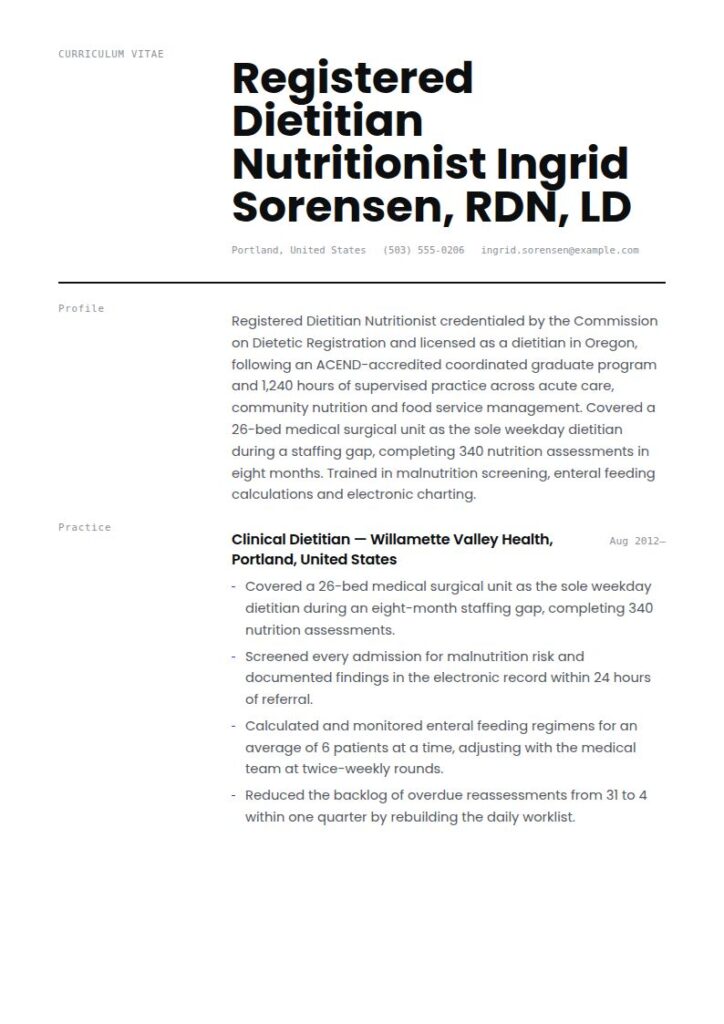
Registered Dietitian Nutritionist credentialed by the Commission on Dietetic Registration and licensed as a dietitian in Oregon, following an ACEND-accredited coordinated graduate program and 1,240 hours of supervised practice across acute care, community nutrition and food service management. Covered a 26-bed medical surgical unit as the sole weekday dietitian during a staffing gap, completing 340 nutrition assessments in eight months. Trained in malnutrition screening, enteral feeding calculations and electronic charting.
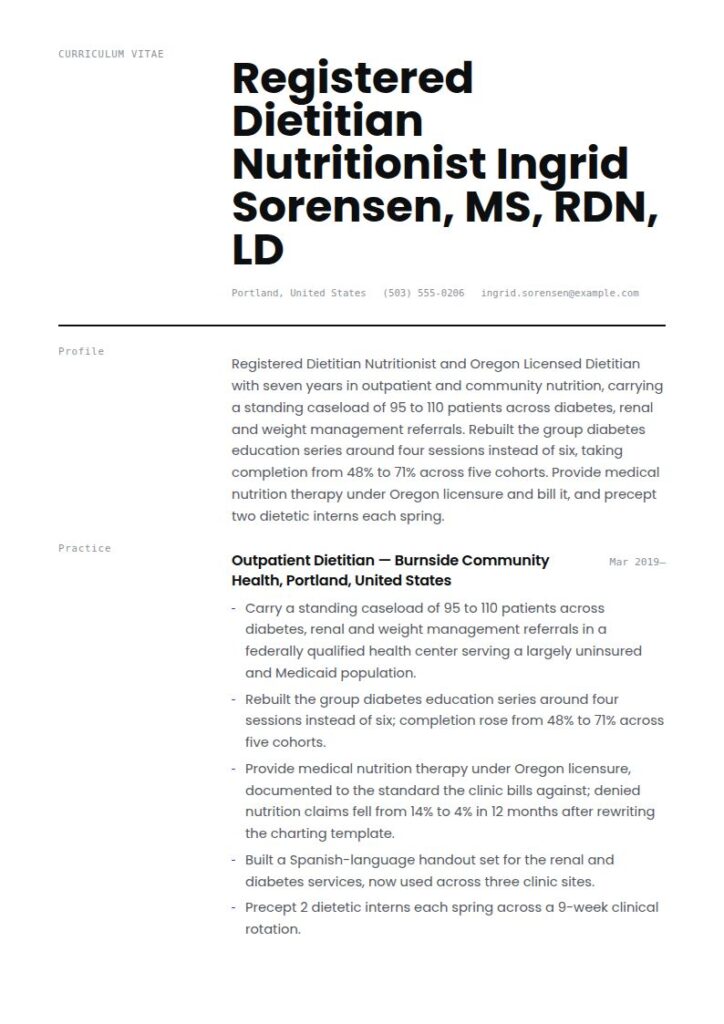
Registered Dietitian Nutritionist and Oregon Licensed Dietitian with seven years in outpatient and community nutrition, carrying a standing caseload of 95 to 110 patients across diabetes, renal and weight management referrals. Rebuilt the group diabetes education series around four sessions instead of six, taking completion from 48% to 71% across five cohorts. Provide medical nutrition therapy under Oregon licensure and bill it, and precept two dietetic interns each spring.
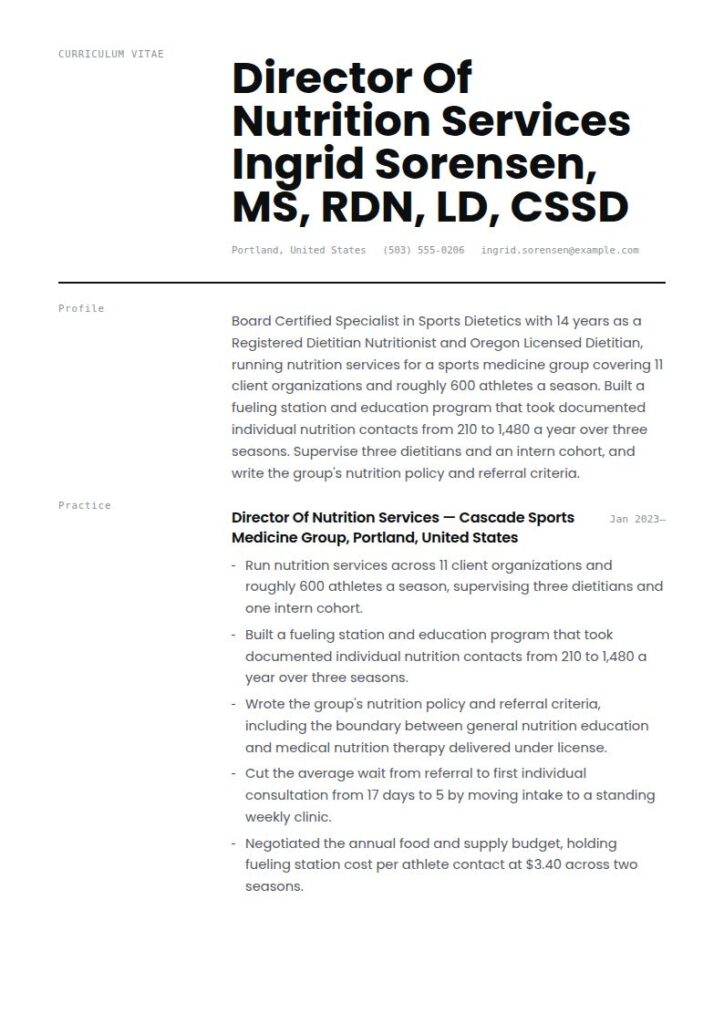
Board Certified Specialist in Sports Dietetics with 14 years as a Registered Dietitian Nutritionist and Oregon Licensed Dietitian, running nutrition services for a sports medicine group covering 11 client organizations and roughly 600 athletes a season. Built a fueling station and education program that took documented individual nutrition contacts from 210 to 1,480 a year over three seasons. Supervise three dietitians and an intern cohort, and write the group's nutrition policy and referral criteria.
Right vs wrong: the same nutritionist summary, twice
| ✅ Right | ❌ Wrong |
|---|---|
| Registered Dietitian Nutritionist and Oregon Licensed Dietitian with seven years in outpatient and community nutrition. | Certified nutritionist with years of experience helping people eat better. |
| Standing caseload of 95 to 110 patients across diabetes, renal and weight management referrals. | Works with a wide variety of clients on many different nutrition goals. |
| Took group diabetes education completion from 48% to 71% across five cohorts by cutting the series from six sessions to four. | Proven track record of improving client health outcomes. |
| Provide medical nutrition therapy under Oregon licensure and bill it. | Provide nutrition therapy and medical advice. |
The last row matters most: one version states a scope the writer can prove, the other a scope the writer may not legally hold.
Outline your nutrition experience
Employer, setting, city, population and dates, then three to five bullets, each naming a population or a program and carrying a number.
| Instead of | Use |
|---|---|
| Counseled clients on nutrition | Carried a standing outpatient caseload of 95 to 110 patients across diabetes, renal and weight management referrals |
| Provided nutrition education | Rebuilt the group diabetes education series from six sessions to four; completion rose from 48% to 71% |
| Helped improve patient outcomes | Cut average time from admission to completed nutrition assessment from 41 hours to 19 |
| Created meal plans | Wrote 8 cycle menus for a 340-resident long term care contract at a $4.18 raw food cost per resident day |
Outpatient Dietitian, Burnside Community Health, Portland, OR, March 2019 to Present
Carry a standing caseload of 95 to 110 patients across diabetes, renal and weight management referrals, in a federally qualified health center serving a largely uninsured and Medicaid population.
Rebuilt the group diabetes education series around four sessions instead of six; completion rose from 48% to 71% across five cohorts.
Provide medical nutrition therapy under Oregon licensure, documented to the standard the clinic bills against; denied nutrition claims fell from 14% to 4% in 12 months after I rewrote the charting template.
Built a Spanish-language handout set for the renal and diabetes services, now used across three sites, and precept 2 dietetic interns each spring.
Which nutritionist title you may lawfully use, and where your scope stops
This is the section that decides a nutritionist resume, and almost nobody writes it. Two things go on the page: the credential you hold, and the state authorization that lets you use a title and do the work where you are applying. Start with the credentials, which are national and are not licenses.
| Credential | Awarded by | The pathway, per the awarding body |
|---|---|---|
| RDN or RD | Commission on Dietetic Registration | Graduate degree, ACEND-accredited coursework and supervised practice, then the CDR registration examination |
| CNS | Board for Certification of Nutrition Specialists, overseen by the American Nutrition Association | Master's or doctoral degree, 36 semester credit hours of coursework, 1,000 hours of supervised practice, then the Certification Examination for Nutrition Specialists |
| NDTR or DTR | Commission on Dietetic Registration | A separate technician-level registration from the same commission |
The RDN pathway, as the Academy of Nutrition and Dietetics states it, requires "a minimum of a master's degree", coursework "through an Accreditation Council for Education in Nutrition and Dietetics accredited Didactic, Coordinated, Graduate or International program", supervised practice through an ACEND-accredited route, and passing "a national examination administered by the Commission on Dietetic Registration" (eatright.org, retrieved 17 September 2026). CDR words the degree rule precisely: "Effective January 1, 2024, the minimum degree requirement for eligibility to take the registration examination for dietitians changed from a bachelor's degree to a graduate degree", applying to first-time eligibility from that date rather than to those already registered (cdrnet.org, retrieved 17 September 2026).
ACEND is the accreditor behind that pathway. It describes itself as "the accrediting agency for education programs preparing students for careers as registered dietitian nutritionists or nutrition and dietetics technicians, registered" and reports more than 600 accredited programs (eatrightpro.org, retrieved 17 September 2026). Naming your program as ACEND-accredited is a checkable fact, not a flourish.
The CNS pathway is set out just as precisely by the BCNS: a "Master of Science or Doctoral degree in a field of nutrition or a related field", 36 semester credit hours across graduate nutrition science, biochemistry, physiology and anatomy, clinical and life sciences and behavioral science, and "1,000 hours of supervised practice experience" with a minimum of 200 hours each in assessment, intervention and education, and monitoring and evaluation. The examination is the "Certification Examination for Nutrition Specialists", 200 multiple-choice questions offered twice a year (theana.org, retrieved 17 September 2026).
Now the state layer, where "nutritionist" stops behaving like a job title and starts behaving like a legal category.
| Regulatory category | What it means | What you can write |
|---|---|---|
| Licensure | The state restricts the practice itself to licensed people | "Licensed Dietitian, Oregon, #LD-4472", board named |
| Statutory certification | The state controls a title by statute, awarding it to people meeting set criteria | The certified title exactly as the statute words it |
| Title protection | Per the BCNS, "unlicensed individuals cannot use a protected title, but the practice itself is not restricted" | Only the title you hold; otherwise describe the work plainly |
| Exclusive scope | Per the BCNS, "a legal designation meaning only licensed professionals may perform the defined practice" | Nothing beyond what your license covers |
Those definitions come from the BCNS state-by-state practice rights document (theana.org, CNS State-By-State Practice Rights, May 2026, retrieved 17 September 2026), which also reports that 24 jurisdictions formally recognize CNSs and 51 of the 53 it covers permit CNSs to practice some level of personalized nutrition counseling.
Medical nutrition therapy is the boundary most often crossed on a resume. The BCNS defines MNT as "nutrition services provided for managing diseases or medical conditions". CDR is blunter about the consequence: "some states specify that only licensed practitioners may provide medical nutrition therapy (MNT), but general nutrition education can be provided by those without a state license", and "most states require nutrition and dietetics practitioners (RDs or others) to hold a state license or certification to legally practice or utilize a protected title within that state" (cdrnet.org practice tips, retrieved 17 September 2026).
So write your own state, not a national rule. The Occupational Outlook Handbook says the same: many states require licensure, others registration or certification, requirements vary by state, and it points readers to CareerOneStop to find the state board (BLS Occupational Outlook Handbook, dietitians and nutritionists, last modified 27 August 2026). Oregon, as one worked example, runs a Board of Licensed Dietitians under the Health Licensing Office: a license requires "at least a bachelor's degree from a regionally accredited college or university" with a board-approved course of study, "900 hours" of board-approved supervised experience, and passing the CDR examination, which the board may waive on evidence of current CDR registration (oregon.gov, retrieved 17 September 2026). Your state's rule will differ. Look it up and write that one.
Write the credential with its awarding organization, then the state authorization with its board and number, on separate lines. Name the states you are authorized in and any application pending. Describe your scope in the words your license uses. If you are not licensed, say what you do provide: general nutrition education, food service management, community program delivery or wellness coaching.
Do not use a protected title you do not hold in the state you are applying to, even if you hold it elsewhere. Do not write "certified nutritionist" without naming the certifying body. Do not imply medical nutrition therapy, disease management or clinical treatment your credential and state authorization do not cover. Do not carry an expired registration or license without marking it expired.
Build a snapshot of your key skills
Ten to fourteen entries in three groups: clinical and assessment, population and program, and the systems your setting runs on.
Clinical and assessment: Nutrition-focused physical examination, Malnutrition identification, Enteral and parenteral nutrition calculation, Renal and diabetes medical nutrition therapy, Nutrition Care Process documentation
Population and program: Group education design, Motivational interviewing, Community nutrition program delivery, Food service menu and cost management
Systems and tools: Epic and Cerner nutrition documentation, Nutrition analysis software, Medicare and Medicaid nutrition billing documentation, Excel for caseload and cost reporting
List your education and certifications
Credential first with its number, then state licensure with its board and number, then degrees with the accreditor and the supervised practice hours, then specialty certification.
Registered Dietitian Nutritionist, Commission on Dietetic Registration, #RD-1084553, since 2012
Licensed Dietitian, Oregon Health Authority Health Licensing Office, Board of Licensed Dietitians, #LD-4472, current
Board Certified Specialist in Sports Dietetics, Commission on Dietetic Registration, 2023
Master of Science, Nutrition, Cascadia State University, Corvallis, OR, 2012. ACEND-accredited coordinated graduate program, 1,240 hours of supervised practice across acute care, community nutrition and food service.
Bachelor of Science, Nutrition and Dietetics, Cascadia State University, Corvallis, OR, 2010
Certificate of Training in Adult Weight Management, Commission on Dietetic Registration, 2022. Basic Life Support, American Heart Association, 2026.
Give the supervised practice hours as a number. Both national pathways are built on supervised hours, and a reader who has to work out whether you completed an accredited route will often not bother.
Choose the right layout and design
Single column, plain type at 11 or 12 point, clear headings, no photograph, no skill rating bars. Health systems parse applications into structured records before a human opens them, and columns and graphics are where that fails.
Keep the credential string in the header exactly as you use it professionally: name, degree, credential, state designation. "Ingrid Sorensen, MS, RDN, LD" is one searchable string a recruiter can paste into a verification page. "Ingrid Sorensen, Nutrition Expert" is not.
Nutritionist job market and outlook
A mid-sized occupation with steady growth, high credential density and a large self-employed share.
| Measure | Value |
|---|---|
| Dietitian and nutritionist jobs, 2025 | 86,300 |
| Projected change, 2025-35 | 8%, +6,700 |
| Projected annual openings | ~5,700 |
| Typical entry-level education (Quick Facts) | Bachelor's degree |
| Typical on-the-job training | Internship or residency |
| Median annual wage, May 2025 | $76,400, or $36.73 an hour |
Source: U.S. Bureau of Labor Statistics, Occupational Outlook Handbook, dietitians and nutritionists, May 2025 wage data and 2025 to 2035 projections, published 27 August 2026.
Read the education row carefully, because it is the most misquoted fact in this field. The Handbook's Quick Facts table records typical entry-level education for the occupation as a bachelor's degree. That describes the occupation as a whole, which includes nutrition roles that are not RDN roles. It is not the RDN requirement, which is set by CDR and is a graduate degree for anyone first establishing examination eligibility on or after 1 January 2024 (cdrnet.org, retrieved 17 September 2026). Both are true, they come from different bodies, and blurring them looks uninformed.
The self-employed share is nine percent, and it changes what the page has to prove
Where dietitians and nutritionists work, with the May 2025 median for each: hospitals, state, local and private, $78,180 and 27 percent of employment; government excluding education and hospitals, $78,070 and 11 percent; nursing and residential care facilities, $75,670 and 9 percent; outpatient care centers, $80,790 and 8 percent. Self-employed workers make up 9 percent (BLS Occupational Outlook Handbook, May 2025, published 27 August 2026).
Those four employed settings all verify credentials formally. The self-employed ninth has nobody doing that for them, which is why private-practice nutrition is where title and scope claims go wrong most often. In a hospital or a government program the credential block is a gate you pass; in private practice or a wellness employer it is the only thing separating you from a competitor whose certificate came from a weekend course.
What salary you can expect as a nutritionist
The median annual wage for dietitians and nutritionists was $76,400 in May 2025, or $36.73 an hour; the lowest 10 percent earned less than $49,090 and the highest 10 percent more than $103,720 (BLS Occupational Outlook Handbook, published 27 August 2026).
The spread between settings is narrow. Outpatient care centers led at $80,790, hospitals were at $78,180, government excluding education and hospitals at $78,070, and nursing and residential care facilities at $75,670, all May 2025 medians. A move across those four is worth about $5,000.
What moves pay further is scope and specialization, both documentable. A board specialty is one lever: CDR's sports dietetics certification requires current registration, maintenance of it for at least two years from the original examination date, and "documentation of 2,000 hours of sports dietetics practice experience as an RD within the past five years" (cdrnet.org, retrieved 17 September 2026). The other is billing: a licensed practitioner who can deliver and document medical nutrition therapy to a payer's standard generates revenue a general nutrition educator does not.
Key takeaways for a nutritionist resume
- Name the credential and its awarding organization, never the bare word "nutritionist".
- Put the state authorization on its own line, with the board and the number.
- Say plainly whether your scope includes medical nutrition therapy, and never imply it if it does not.
- Give your supervised practice hours and name the program's accreditor.
- Keep the Quick Facts bachelor's degree and the RDN graduate requirement as two separate facts.
- Put a number in every experience bullet: caseload, cohort, completion rate, cost, hours.
- Keep it single column and parseable; health system portals read it before a person does.
Build your nutritionist resume in 15 minutes with our AI resume builder.
Related sport and fitness resume examples
- Athletic trainer resume
- Personal trainer resume
- Fitness instructor resume
- Yoga instructor resume
- Sports and fitness resume
- Sports resume
- Coach resume
- Student athlete resume
- Swimming coach resume
- Golf instructor resume
- Lifeguard resume
- Recreational facility attendant resume
Pair it with a matching nutritionist cover letter.
Nutritionist resume questions, answered
Can I call myself a nutritionist on my resume?
It depends on the state you are applying into. The BCNS definition of title protection is that "unlicensed individuals cannot use a protected title, but the practice itself is not restricted" (theana.org, retrieved 17 September 2026), and states differ on whether the word is protected. The safe construction everywhere is the credential plus the state: "Registered Dietitian Nutritionist, Licensed Dietitian (Oregon)". If you hold neither, describe the work rather than claim a title.
What is the difference between an RDN and a CNS?
Different organizations, different pathways, both national. The RDN comes from the Commission on Dietetic Registration, through ACEND-accredited education and supervised practice to the CDR examination. The CNS comes from the Board for Certification of Nutrition Specialists and requires a master's or doctoral degree, 36 semester credit hours of prescribed coursework, 1,000 hours of supervised practice and the Certification Examination for Nutrition Specialists (cdrnet.org and theana.org, retrieved 17 September 2026). Which one a state recognizes for licensure varies, so check before you assume.
Do I need a graduate degree to become a nutritionist?
For the RDN credential, yes, if you are establishing examination eligibility for the first time on or after 1 January 2024: CDR raised the minimum from a bachelor's to a graduate degree on that date (cdrnet.org, retrieved 17 September 2026). For the occupation as BLS counts it, the Handbook records typical entry-level education as a bachelor's degree (BLS, published 27 August 2026). Two bodies, two statements.
What do I put on a nutritionist resume with no paid experience?
Your supervised practice, written as a job: the setting, the rotation, the population, the hours and anything you measured. Then your program's accreditor, your credential or examination date, and any pending state application. A newly credentialed candidate with 1,240 documented hours across three settings beats a vague file with two years of unspecified "wellness" work.
How do I show results when my work is counseling?
Use what your setting already counts. Caseload size and mix, completion rates for a group series, time from referral to first appointment, no-show rate, claim denial rates, cost per resident day in food service, or the number of people a program reached before and after you changed it. Give the before, the after and the period. The number does not have to be a clinical outcome to be evidence.