Teaching Professional Lucia Bernal
Teaching Professional
[email protected] | (941) 555-0207 | Sarasota, United States
Profile
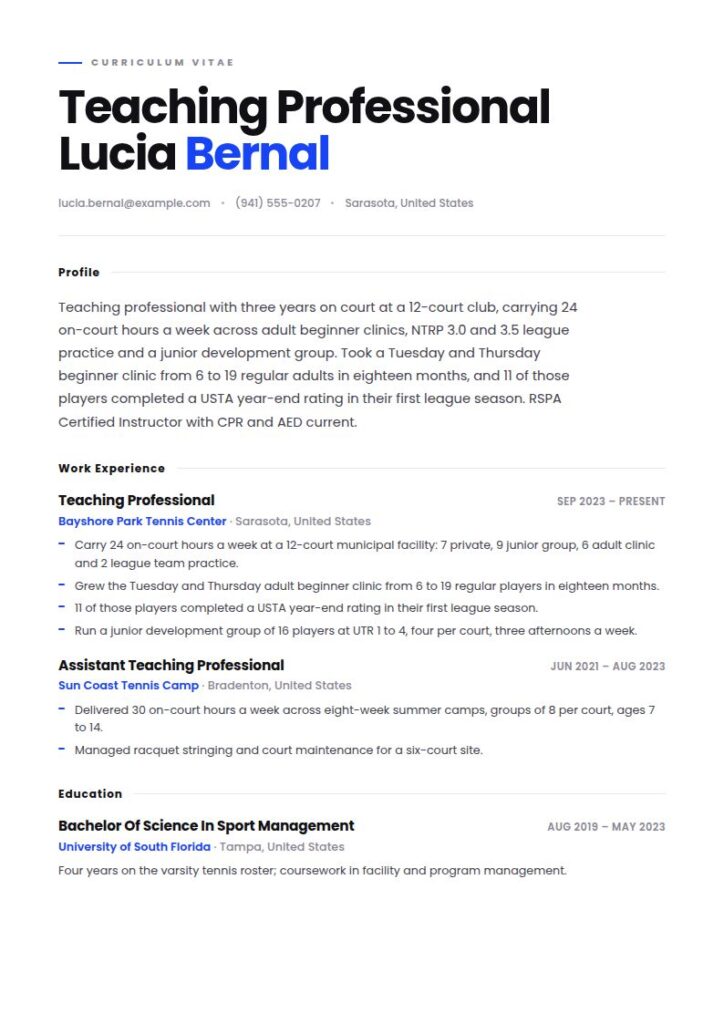
Teaching professional with three years on court at a 12-court club, carrying 24 on-court hours a week across adult beginner clinics, NTRP 3.0 and 3.5 league practice and a junior development group. Took a Tuesday and Thursday beginner clinic from 6 to 19 regular adults in eighteen months, and 11 of those players completed a USTA year-end rating in their first league season. RSPA Certified Instructor with CPR and AED current.
Work Experience
09/2023 - Present, Teaching Professional, Bayshore Park Tennis Center, Sarasota, United States
- Carry 24 on-court hours a week at a 12-court municipal facility: 7 private, 9 junior group, 6 adult clinic and 2 league team practice.
- Grew the Tuesday and Thursday adult beginner clinic from 6 to 19 regular players in eighteen months.
- 11 of those players completed a USTA year-end rating in their first league season.
- Run a junior development group of 16 players at UTR 1 to 4, four per court, three afternoons a week.
06/2021 - 08/2023, Assistant Teaching Professional, Sun Coast Tennis Camp, Bradenton, United States
- Delivered 30 on-court hours a week across eight-week summer camps, groups of 8 per court, ages 7 to 14.
- Managed racquet stringing and court maintenance for a six-court site.
Education
08/2019 - 05/2023, Bachelor of Science, Sport Management, University of South Florida, Tampa, United States
Four years on the varsity tennis roster; coursework in facility and program management.
Skills
Group clinic management at six per court, 80
Beginner adult onboarding, 85
Stroke and serve mechanics, 75
Junior development groups, 75
USTA TennisLink and Universal Tennis, 70
Racquet stringing, 85
Languages
English, native
Spanish, native
Certificates
08/2023, Certified Instructor, Racquet Sports Professionals Association
Tennis certification. The RSPA describes itself as formerly the United States Professional Tennis Association and names four tennis levels: Instructor, Professional, Elite Professional and Master Professional.
06/2025, CPR and AED, American Red Cross
Current through 2027.
01/2026, Safe Play approval, United States Tennis Association
Background screening and training current.
Summary
A tennis coach resume is a one to two page document naming the rating bands you teach, the court hours you carry in each, and what happened to your players' ratings. This guide gives you three adaptable versions, the rating band table most applicants leave out, and current Bureau of Labor Statistics pay and outlook for coaches and scouts.
Tennis Coach resume examples by experience level
In short, a tennis coach resume is a one to two page document naming the rating bands you teach, the court hours you carry in each, and what happened to the ratings of the players you taught.
However, tennis is unusual among coaching jobs in that player strength is a published, portable number. As a result, a director of racquets does not have to take your word for who you can teach. Instead, they can ask what bands are on your court sheet and what those players' ratings did, and a coach with the answer ready is a different candidate from one who describes their teaching style.
Resume guide for a tennis coach resume
Specifically, this guide and the corresponding tennis coach resume example will cover:
- First, how to write a tennis coach resume, section by section
- Then why a rating band table belongs on the page
- Also, three adaptable summaries: teaching pro, senior pro and director
- Next, how NTRP and UTR work, and what you can honestly claim
- Finally, what the job market looks like and what you can expect to earn
How to write a tennis coach resume
To start, plan six sections: contact header, summary, the rating bands you teach, teaching experience, education and certifications, and skills.
The rating band block goes high, because it answers the question a club actually has. After all, a club is not hiring "a tennis coach". Rather, it is filling gaps on a court sheet: a Tuesday morning beginner clinic, three afternoon junior groups, a high-performance block at 4pm, and the league teams that go with them.
| Section | What it is answering | Where it goes |
|---|---|---|
| Rating bands taught | Which slots on our court sheet can this person cover? | Directly under the summary |
| Court hours | Can they carry a full teaching week? | Inside the band table |
| Rating movement | Do players get better with them? | One evidence line per band |
| Certification | Which level do they hold, and with which body? | Education and certifications |
Write your book as court hours, not as job titles
Teaching professionals are paid by the court hour more often than by salary, and a club reads a resume for capacity before anything else.
Give the weekly total and break it down: "28 on-court hours a week in season: 9 private, 11 junior group, 6 adult clinic, 2 league team practice." That tells a director whether you can fill their gap without a second hire.
Then say what the shoulder season looks like, because Florida, Arizona and the northern club markets have opposite calendars.
Run the finished file through the ATS resume checker before you submit. Club groups and municipal park departments both push applications through applicant systems.
Choosing the best resume format for a tennis coach resume
Reverse chronological. Keep one page for your first few years on court, then two once you run programming, supervise other pros or carry a high-performance group.
In practice, tennis coaching resumes fail most often by being written as a playing record. By contrast, your junior results and college record are one line, not a section. That is because what a club buys is teaching hours delivered, players retained and ratings moved.
Include your contact information
| ✅ Right | ❌ Wrong |
|---|---|
| Lucia Bernal | Lucia Bernal |
| Teaching Professional, NTRP 2.5 to 4.5 and junior UTR 3 to 9 | Tennis coach and lifelong student of the game |
| RSPA Certified Professional, current | USPTA certified |
| (941) 555-0207, [email protected], Sarasota, FL | (941) 555-0207, [email protected] |
Write the certifying body's current name. Note that the United States Professional Tennis Association now operates as the Racquet Sports Professionals Association, whose own site carries the line "formerly the United States Professional Tennis Association, trusted since 1927" (rspa.net, retrieved 17 September 2026). A file that still says USPTA is not wrong in spirit, but the current name is what a director will search.
Make use of a summary
Next, write four lines: the bands you teach, your weekly court hours, one piece of rating evidence, and your certification level.
Teaching professional with three years on court at a 12-court club, carrying 24 on-court hours a week across adult beginner clinics, NTRP 3.0 and 3.5 league practice and a junior development group. Took a Tuesday and Thursday beginner clinic from 6 to 19 regular adults in eighteen months, and 11 of those players completed a USTA year-end rating in their first league season. RSPA Certified Instructor with CPR and AED current.
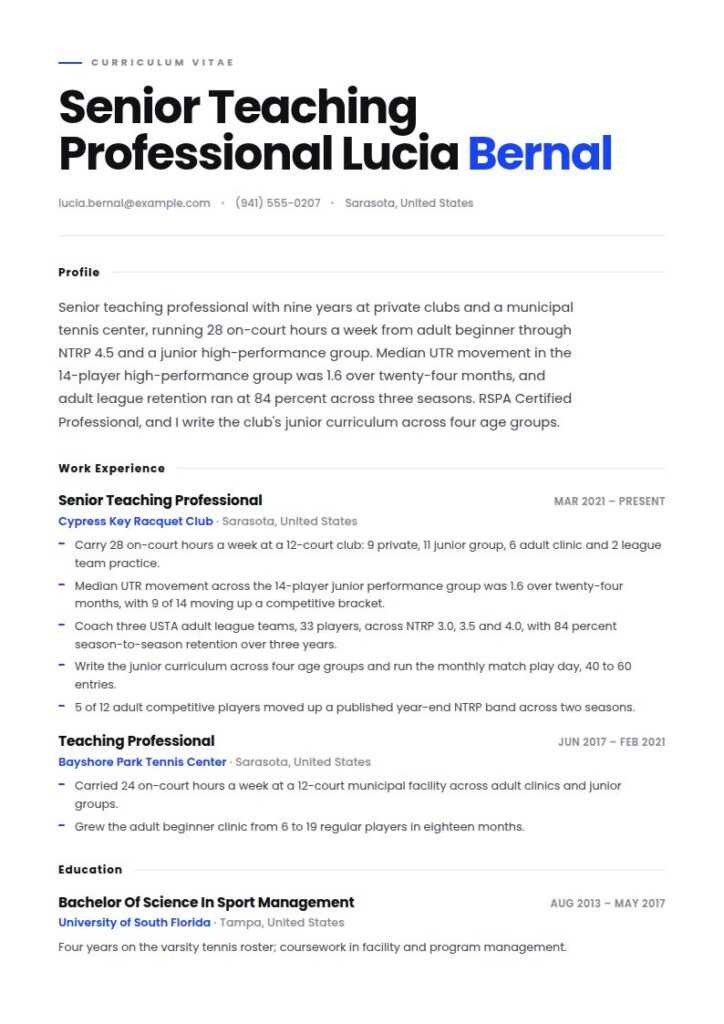
Senior teaching professional with nine years at private clubs and a municipal tennis center, running 28 on-court hours a week from adult beginner through NTRP 4.5 and a junior high-performance group. Median UTR movement in the 14-player high-performance group was 1.6 over twenty-four months, and adult league retention ran at 84 percent across three seasons. RSPA Certified Professional, and I write the club's junior curriculum across four age groups.
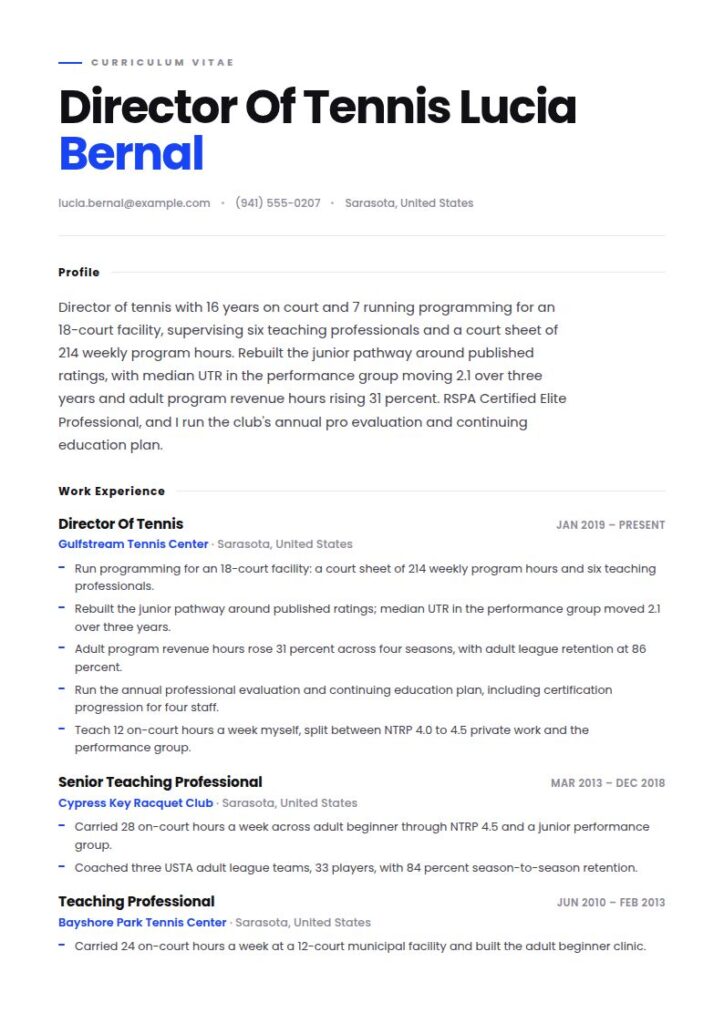
Director of tennis with 16 years on court and 7 running programming for an 18-court facility, supervising six teaching professionals and a court sheet of 214 weekly program hours. Rebuilt the junior pathway around published ratings, with median UTR in the performance group moving 2.1 over three years and adult program revenue hours rising 31 percent. RSPA Certified Elite Professional, and I run the club's annual pro evaluation and continuing education plan.
Right vs wrong: the same tennis coach summary, twice
| ✅ Right | ❌ Wrong |
|---|---|
| Carrying 28 on-court hours a week from adult beginner through NTRP 4.5 and a junior high-performance group. | Experienced tennis coach comfortable with players of all levels and ages. |
| Median UTR movement in the 14-player high-performance group was 1.6 over twenty-four months. | Helped many juniors improve and reach their potential. |
| Adult league retention ran at 84 percent across three seasons. | Built strong relationships with members and their families. |
In other words, a director can schedule and check the right column. A director can put those hours on a court sheet before the interview is over.
Outline your teaching and coaching experience
Additionally, for each job, give club or facility, court count, your title, dates and the size of the book you carried. Then three to five bullets, each with a number.
| Instead of | Use |
|---|---|
| Taught tennis lessons to players of all levels | Carried 28 on-court hours a week: 9 private, 11 junior group, 6 adult clinic, 2 league practice |
| Helped students improve their game | Median UTR in the 14-player performance group moved 1.6 over twenty-four months |
| Ran group classes | Grew a Tuesday and Thursday adult beginner clinic from 6 to 19 regular players in eighteen months |
| Coached league teams | Coached three USTA adult league teams, 33 players, across NTRP 3.0, 3.5 and 4.0 |
| Organized tournaments | Ran a monthly junior match play day, 40 to 60 entries, and entered players in 22 sanctioned events a year |
Senior Teaching Professional, Cypress Key Racquet Club, Sarasota, FL, March 2021 to Present
Carry 28 on-court hours a week at a 12-court club: 9 private, 11 junior group, 6 adult clinic and 2 league team practice.
Median UTR movement across the 14-player junior performance group was 1.6 over twenty-four months, with 9 of 14 players moving up a competitive bracket.
Grew the Tuesday and Thursday adult beginner clinic from 6 to 19 regular players in eighteen months; 11 completed a USTA year-end rating in their first league season.
Coach three USTA adult league teams, 33 players, across NTRP 3.0, 3.5 and 4.0, with 84 percent season-to-season retention over three years.
Write the junior curriculum across four age groups and run the monthly match play day, 40 to 60 entries.
The rating bands a tennis coach teaches, and what those players' ratings did
This is the block almost nobody writes, and in tennis it is available to everyone, because player strength is published. Meanwhile, two systems matter in the United States, they are not interchangeable, and you should say which one you are quoting every time.
For example, the USTA describes the National Tennis Rating Program as a classification system that "identifies and describes general characteristics of tennis-playing ability", running from 1.5 through 7.0 "in 0.5 increments". Players new to USTA League complete "the USTA Self-Rate Questionnaire" before entering competitive play; a player "receives a Year-End Rating by playing at least three valid matches in Leagues or NTRP Tournaments", published annually in December; and dynamic ratings are "calculated to the one-hundredth of a point", updated nightly, and "are not disclosed to players" (usta.com, retrieved 17 September 2026).
On the other hand, Universal Tennis publishes a separate, single scale. Its own description is that "all players regardless of age, gender, geography or skill level, are rated on the same scale from 1.00 and 16.50 based on daily match results", that a UTR Rating "is the weighted average of up to 30 of their most recent match ratings", that "only matches within the last 12 months count", and that "after approximately five matches, your rating becomes reliable" (utrsports.net, retrieved 17 September 2026).
What tennis coach rating evidence to show
Two consequences for your resume. Because NTRP dynamic ratings are not disclosed, the only NTRP movement you can honestly claim is between published year-end ratings, and only for players who played enough matches to get one. Because UTR is a rolling twelve-month weighted average, UTR movement needs a stated window or it means nothing.
| Rating band | Format | Court hours a week | Evidence |
|---|---|---|---|
| Adult beginner, NTRP 2.0 to 2.5 | Group clinic, 6 per court | 6 | Clinic grew from 6 to 19 regular players in 18 months |
| Adult league, NTRP 3.0 to 3.5 | Team practice and private | 8 | 3 teams, 33 players, 84 percent season-to-season retention |
| Adult competitive, NTRP 4.0 to 4.5 | Private and match play | 3 | 5 of 12 players moved up a year-end rating band across two seasons |
| Junior development, UTR 1 to 4 | Small group, 4 per court | 7 | 22 players, median UTR movement 0.9 over 12 months |
| Junior performance, UTR 5 to 9 | Individual and tournament travel | 4 | 14 players, median UTR movement 1.6 over 24 months |
In the end, four columns is the whole differentiating section. It tells a director which slots you cover, whether you can fill a week, and whether players get better with you, at a glance.
Say which rating you are quoting, and over what window
The fastest way to lose credibility with a director of racquets is to write a rating claim that the system does not support.
Three rules keep you safe. Quote NTRP movement only between published year-end ratings, because the dynamic rating that moves week to week is not disclosed to players (usta.com, retrieved 17 September 2026). Quote UTR movement with a window attached, because the rating is a rolling weighted average of up to 30 matches within the last 12 months (utrsports.net, retrieved 17 September 2026). And quote a median across a named group rather than the best result in it.
If a group is too small for a median, give the count instead: "4 of 6 players moved up a band" is honest and still useful.
Bands taught, 2025 to 2026 season: adult beginner NTRP 2.0 to 2.5, adult league NTRP 3.0 to 3.5, adult competitive NTRP 4.0 to 4.5, junior development UTR 1 to 4, junior performance UTR 5 to 9.
Court hours: 28 a week in season, 21 in shoulder season. Private 9, junior group 11, adult clinic 6, league practice 2.
Rating evidence: junior performance group, 14 players, median UTR movement 1.6 over 24 months. Junior development group, 22 players, median UTR movement 0.9 over 12 months. Adult competitive, 5 of 12 players moved up a published year-end NTRP band across two seasons.
Not yet taught but available for: wheelchair tennis group programming, adult cardio tennis.
Add the last line. A director choosing between two similar files takes the one that can also cover the format they have been trying to start.
Build a snapshot of your key skills
Later, in skills, list twelve to fourteen entries in four groups: teaching, competition, programming and systems.
Teaching: Group clinic management at six per court, Private lesson structure, Stroke and serve mechanics, Movement and footwork, Beginner adult onboarding
Competition: USTA league team coaching, Tournament scheduling and entry, Match play day format, Rating-appropriate match arrangement
Programming: Junior curriculum by age group, Court sheet and scheduling, Pro supervision and evaluation, Member communication, Retention tracking
Systems: USTA TennisLink, Universal Tennis, Club booking and billing platforms, Racquet stringing
List your education and certifications
Certification and its status first, then degree, then safety currency. Also, name the certifying body as it names itself today.
Racquet Sports Professionals Association, Certified Professional. The RSPA, which describes itself as "formerly the United States Professional Tennis Association, trusted since 1927", names four tennis certification levels: Instructor, Professional, Elite Professional and Master Professional (rspa.net, retrieved 17 September 2026).
Bachelor of Science, Sport Management, University of South Florida, Tampa, FL, 2016
CPR and AED, American Red Cross, current through 2027
Additional: USTA Safe Play approval current. Racquet stringing and customization, 9 years.
Certification is a signal here rather than a legal gate. Club tennis teaching is not licensed by a state, so the value of a level is that clubs recognize it and insurers ask for it. Name the level you hold and nothing above it, and if you are working toward the next one, write the level and the expected date rather than implying you hold it.
Choose the right layout and design
Lastly, use a single column, plain type at 11 or 12 point, clear headings, no photograph. Put the rating band table on page one, because it is the reason a director keeps reading. In addition, if the file is going through a club group's portal, keep tables simple and avoid text boxes, which parsers drop.
Give weekly court hours and break them down by format. Name the rating bands with the system attached, NTRP or UTR. Quote a median across a named group with a stated window. Use published year-end ratings for NTRP claims. Name the certifying body by its current name and the exact level you hold. Say which formats you would take on but have not yet run. Put retention numbers next to growth numbers.
Do not claim NTRP dynamic rating movement; those figures are not disclosed to players. Do not quote a UTR change without the window it happened over. Do not name a junior player, their tournament results or the college that recruited them, since the athlete is an identifiable individual. Do not write a playing record as a section. Do not list a certification level you have not been awarded. Do not describe yourself as teaching all levels, which reads as teaching none of them in particular.
Tennis coach job market and outlook
Meanwhile, tennis teaching sits inside one federal occupation. The Bureau of Labor Statistics publishes no separate profile for tennis coaches: the published occupation is coaches and scouts, covering every sport and every level, and the numbers below describe that occupation rather than tennis on its own. The part that matters most to a teaching professional is the club and recreation sector rather than schools.
| Measure | Value |
|---|---|
| Coaches and scouts jobs, 2025 | 298,800 |
| Projected change, 2025-35 | 6%, 18,100 |
| Projected annual openings | ~36,400 |
| Typical entry-level education | Bachelor's degree |
| Median annual wage, May 2025 | $47,320 |
Source: U.S. Bureau of Labor Statistics, Occupational Outlook Handbook, Coaches and Scouts, 2025-35 projections and May 2025 wage data.
The player base a teaching pro sells into keeps growing
The USTA reported 27.3 million tennis players in the United States in 2025, up 1.6 million on the previous year, with core players, defined as those playing ten or more times a year, at 14.5 million, or 53 percent of all players. Participation has grown 54 percent since 2019 (usta.com, 18 February 2026, retrieved 17 September 2026).
Core players are the part that matters to a teaching professional: they buy lessons, join leagues and fill a court sheet.
Set that against where coaching jobs sit. Of the 298,800 coaches and scouts jobs BLS counted in 2025, 22 percent are in arts, entertainment and recreation at a median of $48,440 and another 8 percent are self-employed, against 64 percent in educational services at $46,890 (BLS Occupational Outlook Handbook, May 2025). Club and academy work sits in the higher-paying minority of the occupation, and the self-employed share is where most independent teaching pros count themselves.
Where the jobs sit:
| Setting | Share of employment | Median annual wage (May 2025) |
|---|---|---|
| Educational services, state, local and private | 64% | $46,890 |
| Arts, entertainment and recreation | 22% | $48,440 |
| Self-employed | 8% | Not published |
| Religious, grantmaking and civic organizations | 2% | $43,870 |
| Local government, excluding education | 1% | $38,730 |
Source: U.S. Bureau of Labor Statistics, Occupational Outlook Handbook, Coaches and Scouts, May 2025.
What salary you can expect as a tennis coach
The median annual wage for coaches and scouts was $47,320 as of May 2025, with the lowest 10 percent earning less than $28,790 and the highest 10 percent more than $98,860 (BLS Occupational Outlook Handbook, May 2025).
For a teaching professional, that spread is mostly about how your hours are sold rather than about seniority. For instance, club pros are often paid a base plus a court-hour rate, with a different split on private lessons, group clinics and club-run programs. Similarly, an independent pro pays their own court fee and keeps the rest. Therefore, two coaches with identical skill can sit at opposite ends of that range depending on the split and the hours the facility can fill.
Which is why the rating band table is also a pay argument. Above all, a coach who can cover beginner clinics, league practice and a performance group can be given a full week, and a full week at a modest rate beats a high rate on fifteen. That is why, once you write the hours, the formats and the retention, you are negotiating from the club's own capacity numbers.
Key takeaways for a tennis coach resume
- To sum up, put a rating band table on page one, with the system named on every band.
- Give weekly court hours and break them down by format.
- Then quote NTRP movement only between published year-end ratings.
- Likewise, quote UTR movement with the window it happened over.
- Even so, use a median across a named group, not your best single result.
- Lastly, name the certifying body as it names itself today and the exact level you hold.
- Add the format you would take on but have not yet run; it breaks ties.
Build your tennis coach resume in 15 minutes with our AI resume builder.
Related sport and fitness resume examples
- Coach resume
- Golf instructor resume
- Swimming coach resume
- Soccer coach resume
- Basketball coach resume
- Volleyball coach resume
- Track coach resume
- Personal trainer resume
- Fitness instructor resume
- Athletic trainer resume
- Student athlete resume
- Sports resume
Pair it with a matching tennis coach cover letter.
Tennis coach resume questions, answered
How long should a tennis coach resume be?
One page for your first few years on court. Two once you run programming, supervise other professionals, or carry a high-performance group with rating evidence behind it. A director reads for court hours and bands first, so anything that delays those two facts costs you.
Should I put NTRP or UTR on my tennis coach resume?
Both, labeled. They measure different things and clubs use both. NTRP is the USTA classification used for adult league play, running 1.5 to 7.0 in 0.5 increments, with year-end ratings published in December (usta.com, retrieved 17 September 2026). UTR is a single 1.00 to 16.50 scale based on the weighted average of up to 30 matches in the last 12 months (utrsports.net, retrieved 17 September 2026). Name the system every time.
What do I put on a tennis coach resume with no paid teaching experience?
Court hours, however they were earned. Summer camp work, a municipal park program, high school assistant coaching, a college hitting role or volunteer junior sessions all count if you write them as hours with a format and a group size. Add your certification or its scheduled date, CPR currency, and any stringing skills. A first-year pro who can carry 15 hours across two formats is worth scheduling.
Do I need a certification to be hired as a tennis coach?
It is not a state license, but most clubs ask for one and many insurers expect it. The Racquet Sports Professionals Association, formerly the United States Professional Tennis Association, names four tennis certification levels: Instructor, Professional, Elite Professional and Master Professional (rspa.net, retrieved 17 September 2026). Write the level you hold today and the one you are working toward, with its date.
How do I show results without naming players?
Use counts and medians across a named group. "Fourteen-player performance group, median UTR movement 1.6 over twenty-four months" says more than any individual story and does not identify a junior athlete. The same rule applies to college placements: give the count, not the names.
Is high school tennis coaching a different job?
Largely, yes, and the resume changes with it. School coaching is seasonal, usually attached to a stipend, and in most states requires a coaching permit or approved coursework. For scale, the 2024-25 NFHS participation survey counted 10,373 schools offering boys tennis with 158,667 participants and 12,175 offering girls tennis with 204,721 (NFHS, retrieved 17 September 2026). Applying to a school, lead with the season record and the permit; applying to a club, lead with the bands and the court hours.