Protective Services Candidate Mateo Villarreal
Security Officer, Contract Posts
[email protected] | (505) 555-0724 | Albuquerque, United States
Profile
Protective services candidate with two years on contract security posts across three client sites in Albuquerque and an application in progress for county detention officer. Have covered lobby, console and patrol posts on rotating 12-hour shifts, filed every daily activity log before end of shift, and passed a full pre-employment background investigation. Hold CPR, first aid and AED, and completed a criminal justice certificate at Central New Mexico Community College while working nights.
Work Experience
07/2020 - Present, Security Officer, Contract Posts, Sandia Mesa Protective Services, Albuquerque, United States
- Cover lobby, console and patrol posts across three client sites on rotating 12-hour shifts, including a hospital campus and a logistics yard.
- File the daily activity log and any incident report before end of shift; no entry has been carried into a following shift.
- Run the after-hours access list and reconcile contractor passes against the site appointment record.
- Cleared a full pre-employment background investigation and hold a current state guard registration.
09/2018 - 06/2020, Overnight Shift Lead, Jemez Road Fuel and Convenience, Albuquerque, United States
- Ran the overnight shift alone, including cash controls, closing counts and incident logging.
- Completed conflict de-escalation training after a run of late-night disturbances; police call-outs on my shift fell over the following year.
Education
08/2018 - 05/2020, Certificate, Criminal Justice, Central New Mexico Community College, Albuquerque, United States
Coursework in criminal procedure, corrections practice and report writing, completed while working night shifts.
Skills
Post orders and patrol routes, 80
Daily activity logging, 85
Access control and visitor management, 75
De-escalation, 75
Alarm response, 70
CPR, first aid and AED, 70
Languages
English, native
Spanish, native
Certificates
07/2020, New Mexico Security Guard Registration, New Mexico Regulation and Licensing Department
Unarmed registration, current.
04/2021, CPR, First Aid and AED, American Heart Association
Summary
Protective services is not one job. It is seven published occupations with different gates, different credentials and medians running from $33,580 to $77,310. This guide shows you how to write one resume and rebuild it for the branch you are applying to, with three adaptable versions and current Bureau of Labor Statistics group pay and openings.
Security and Protective Services resume examples by experience level
In practice, a security and protective services resume is a one to two page document written for one branch of the sector at a time.
Protective services is a group, not a job, and that is the whole difficulty. The Bureau of Labor Statistics publishes it as a set of occupations with a group median wage of $50,080 as of May 2025 and about 414,200 openings projected each year over the 2025 to 2035 decade, with employment growth slower than the average for all occupations (U.S. Bureau of Labor Statistics, Occupational Outlook Handbook, Protective Service Occupations, last modified 27 August 2026).
Inside that group, for example, the medians run from $33,580 for recreational protective service workers to $77,310 for police and detectives, all May 2025. The same candidate, with the same history, is a strong applicant to one branch and an unreadable one to another, and the difference is made on the page rather than in the career.
Resume guide for a security and protective services resume
To start, this guide and the corresponding security and protective services resume example will cover:
- First, how to write a protective services resume, section by section
- Then, the branch decision, and what it changes about every section
- Also, three adaptable summaries: entry, practicing officer and protective services manager
- Finally, which credential is the gate in each branch, and who issues it
- What the sector pays and where the openings actually sit
How to write a security and protective services resume
Overall, use six sections: contact header, summary, credentials and clearances, operational experience, training and certifications, and skills. One page until you supervise a function rather than a shift.
Credentials come before experience in every branch of this sector, and for the same reason: they are gates. A police file without a state certification, a fire file without Firefighter I and II, an investigations file without a state license and a guard file without a registration all fail before anybody reads the experience under them.
| Section | What it is answering | Where it goes |
|---|---|---|
| Summary | Which branch is this person writing for? | Top, four lines |
| Credentials and clearances | Do they clear the gate for this branch? | Directly under the summary |
| Operational experience | What have they actually held, and at what scale? | Reverse chronological, with volumes |
| Training and certifications | What can this employer put on file for them? | After experience, with issuing bodies and dates |
One resume, five versions, and the difference is the top third
You do not need five careers to apply across branches. You need one history and five front pages.
The bottom two thirds of a protective services resume barely change between a corrections application and a corporate security application: the same posts, the same volumes, the same training. What changes is the top third, which is the summary, the credential block and the order of the first two experience bullets.
Rewrite those three things and leave the rest. It takes twenty minutes, and it is the difference between a file a hiring sergeant reads and one they set aside.
Run the finished file through the ATS resume checker before you send it. Government and municipal portals are among the strictest parsers in any sector, and a credential number inside a header graphic is a credential number that never reaches the record.
Choosing the best resume format for a protective services resume
Reverse chronological, single column, no photograph. Two pages are normal once you supervise, because a background investigation will reconstruct your timeline anyway and gaps invite questions you would rather answer on the page.
However, one format rule is specific to this sector. In particular, public safety agencies frequently require an unbroken employment history with months, not years, and some ask for addresses and supervisors. Write your resume in that format from the start if you are applying to any government branch; it saves you rewriting under deadline, and a file that already matches the background packet reads as somebody who has done this before.
Include your contact information
| ✅ Right | ❌ Wrong |
|---|---|
| Mateo Villarreal | Mateo Villarreal |
| Detention Officer, New Mexico Corrections Certification #NM-DO-31840 | Protective services professional |
| Applying: Protective Services Supervisor, corporate security | Seeking a challenging position in the security field |
| (505) 555-0724, [email protected], Albuquerque, NM | (505) 555-0724, [email protected] |
Notably, the third line is the one most applicants omit. That is why naming the branch and the post at the top of the page stops a corporate security manager reading a corrections resume as a corrections resume.
Make use of a summary
Next, write four lines: branch and credential, years and setting, the scale you have operated at, and one measured outcome.
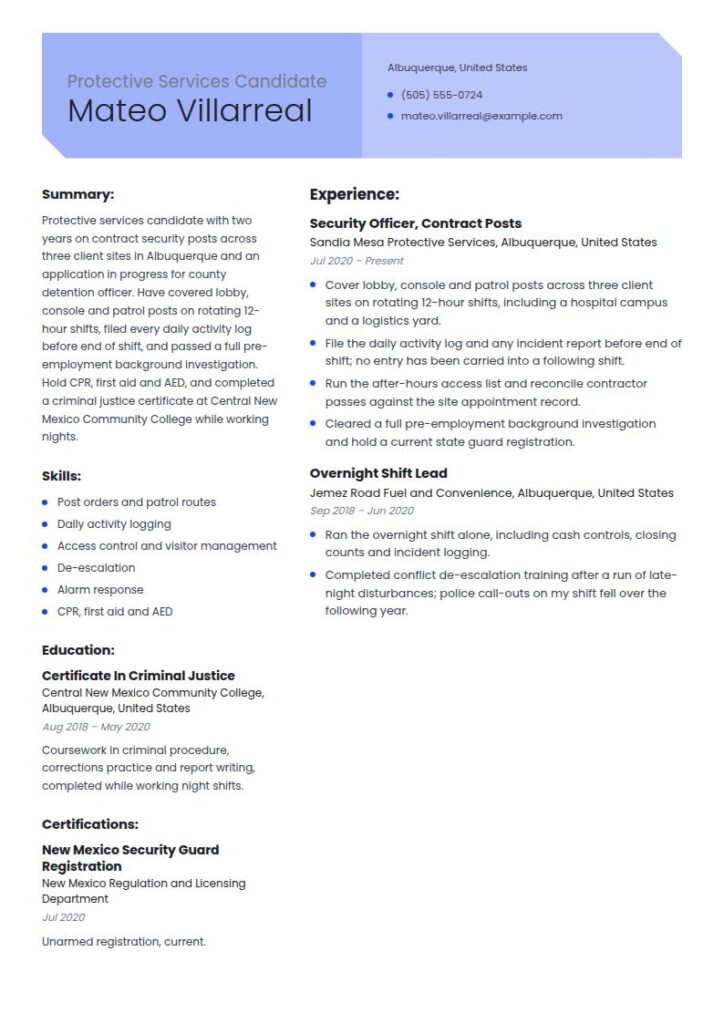
Protective services candidate with two years on contract security posts across three client sites in Albuquerque and an application in progress for county detention officer. Have covered lobby, console and patrol posts on rotating 12-hour shifts, filed every daily activity log before end of shift, and passed a full pre-employment background investigation. Hold CPR, first aid and AED, and completed a criminal justice certificate at Central New Mexico Community College while working nights.
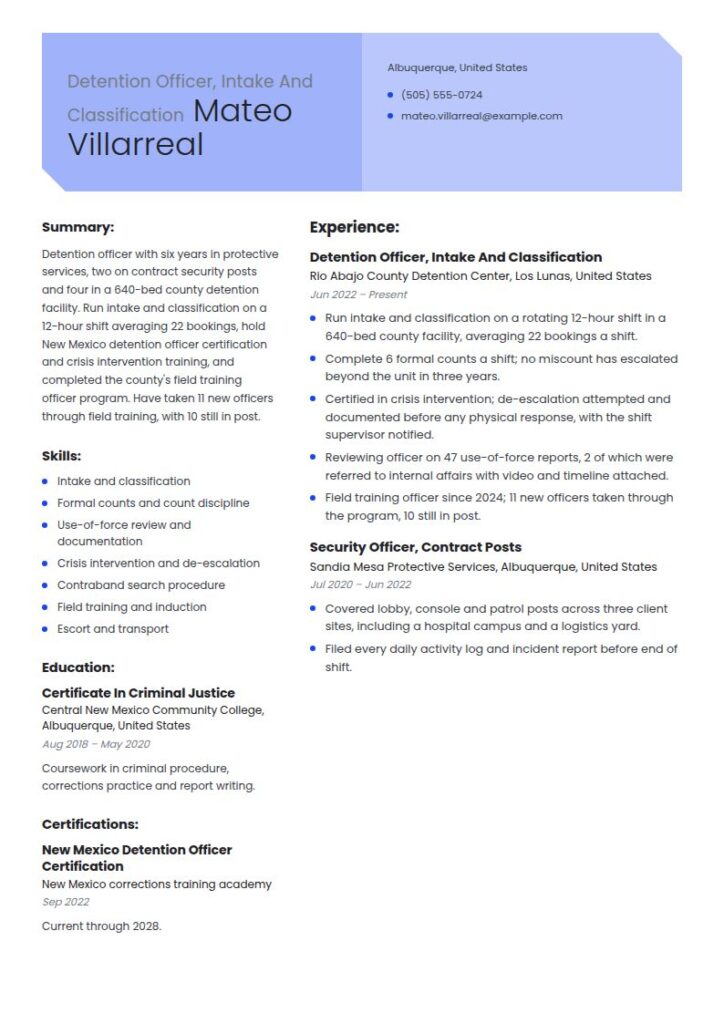
Detention officer with six years in protective services, two on contract security posts and four in a 640-bed county detention facility. Run intake and classification on a 12-hour shift averaging 22 bookings, hold New Mexico detention officer certification and crisis intervention training, and completed the county's field training officer program. Have taken 11 new officers through field training, with 10 still in post.
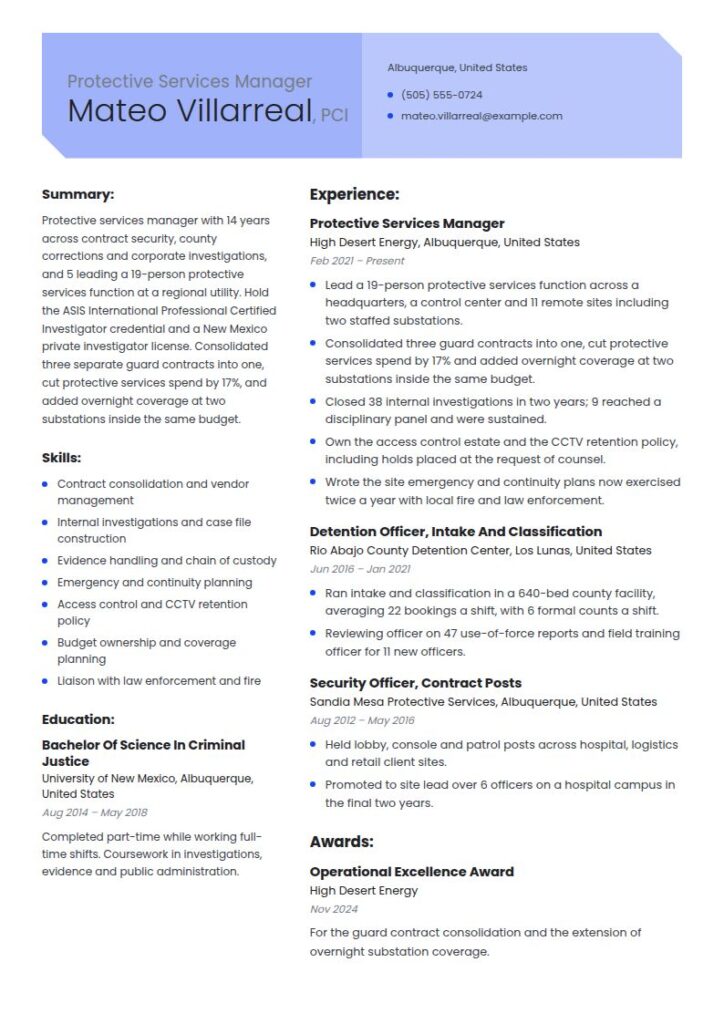
Protective services manager with 14 years across contract security, county corrections and corporate investigations, and 5 leading a 19-person protective services function at a regional utility. Hold the ASIS International Professional Certified Investigator credential and a New Mexico private investigator license. Consolidated three separate guard contracts into one, cut protective services spend by 17%, and added overnight coverage at two substations inside the same budget.
Right vs wrong: the same protective services summary, twice
| ✅ Right | ❌ Wrong |
|---|---|
| Detention officer with four years in a 640-bed county facility, intake and classification. | Protective services professional with a strong background in security. |
| Run a 12-hour shift averaging 22 bookings, with New Mexico detention officer certification. | Experienced in a wide range of law enforcement and security environments. |
| Took 11 new officers through the county field training program; 10 are still in post. | A proven leader who trains and develops staff. |
The right column names a branch, a certification and a facility size, which tells a reader in three seconds whether the file belongs in their pile. By contrast, the left column asks them to work it out, and at 414,200 openings a year across this sector they are not short of files that do the work for them.
Outline your protective services experience
Then give agency or employer, facility or site type, its scale, your post, shift pattern and dates. Then three to five bullets carrying a volume, a system or a measured change.
| Instead of | Use |
|---|---|
| Supervised inmates in a correctional facility | Ran intake and classification on a 12-hour shift in a 640-bed county facility, averaging 22 bookings a shift |
| Maintained safety and security of the facility | Completed 6 formal counts a shift with no miscount escalation in three years |
| Responded to incidents as needed | Logged 47 use-of-force reviews as the reviewing officer, with 2 referred to internal affairs |
| Trained new staff | Took 11 new officers through the county field training program; 10 are still in post |
| Managed security contracts | Consolidated three guard contracts into one, cut spend by 17% and added overnight coverage at two substations |
| Conducted investigations | Closed 38 internal investigations in two years, 9 of which reached a disciplinary panel and were sustained |
Detention Officer, Intake and Classification, Rio Abajo County Detention Center, Los Lunas, NM, June 2022 to Present
Run intake and classification on a rotating 12-hour shift in a 640-bed county facility, averaging 22 bookings a shift.
Complete 6 formal counts a shift; no miscount has escalated beyond the unit in three years.
Certified in crisis intervention; de-escalation attempted and documented before any physical response, with the shift supervisor notified.
Reviewing officer on 47 use-of-force reports, 2 of which were referred to internal affairs with the video and timeline attached.
Field training officer since 2024; 11 new officers taken through the program, 10 still in post.
Decide which of the protective service branches you are applying to, and rebuild the page for it
In fact, five branches hire out of this sector, and each one screens on a different gate. As a result, writing a general protective services resume means failing all five gently.
| Branch | The gate that decides the file | What the top third has to lead with | Median annual wage, May 2025 |
|---|---|---|---|
| Municipal or county police | State Peace Officer Standards and Training certification, and an academy place | Certification status, whether you are lateral or entry, background packet readiness | $77,310, police and detectives |
| Fire inspection and code enforcement | Inspector certification | Code familiarity, inspection volume, plan review experience | $73,680, fire inspectors |
| Fire service | NFPA 1001 Firefighter I and II, plus CPAT and often EMT or Paramedic | The certification stack with its accrediting body and dates | $59,280, firefighters |
| Corrections | A state corrections academy and a cleared background investigation | Facility size and classification level, count and incident record, use-of-force documentation | $58,850, correctional officers and bailiffs |
| Private investigation | A state license | License number, case types, evidence handling and testimony | $51,220, private detectives and investigators |
| Contract and in-house security | A state guard registration, armed or unarmed | Registration and endorsement, post types, systems run | $38,050, security guards and gambling surveillance officers |
Source: U.S. Bureau of Labor Statistics, Occupational Outlook Handbook, Protective Service Occupations, May 2025 wage data, last modified 27 August 2026.
Protective services credentials by issuing body
Name the issuing body in every case, because none of these credentials is national. For example, police certification is issued by each state's own Peace Officer Standards and Training commission, and there is no single national standard to appeal to. Fire service certification runs against NFPA 1001, the National Fire Protection Association's Standard for Fire Fighter Professional Qualifications, with certifying entities accredited by the Pro Board or by IFSAC; emergency medical certification is registered by the National Registry of Emergency Medical Technicians; and the Candidate Physical Ability Test is administered under the IAFF and IAFC Fire Service Joint Labor Management Wellness-Fitness Initiative.
Similarly, private investigation is licensed state by state, and in New Mexico it is overseen by the Private Investigations Advisory Board under the state Regulation and Licensing Department (accessed September 2026). Security guard registration is likewise a state matter, handled by boards such as the California Bureau of Security and Investigative Services.
Here is what actually changes on the page when you switch branch:
For corrections: lead with facility size, classification level, count discipline and use-of-force documentation. Put the certification number in the header. Move field training officer experience into the first three bullets.
For corporate or in-house security: lead with contract value, headcount supervised, systems run by product name and the reporting you own. Move anything about restraint and use of force down the page and describe it as de-escalation and documented escalation.
For police: lead with your certification status and whether you are a lateral or an entry applicant, then the background packet facts. Give an unbroken timeline with months.
For private investigation: lead with the license, then case types, evidence handling, surveillance hours and any testimony given.
For fire: lead with the certification stack, each line carrying the standard, the accrediting body and the date, with the medical certification first.
Otherwise, everything below that block stays where it is. In other words, the branch decision is a rewrite of the first third of one page, not a new career.
Build a snapshot of your key skills
Generally, list twelve to fourteen entries in four groups, with the group that matches your target branch listed first.
Custody and control: Intake and classification, Formal counts, Contraband search procedure, Escort and transport, Use-of-force review and documentation
Investigation and evidence: Interview and statement taking, Chain of custody, CCTV review and retention holds, Case file construction, Report writing to an evidential standard
Security operations: Contract and vendor management, Post orders and coverage planning, Access control administration, Alarm response, Emergency and continuity planning
Response and people: Crisis intervention and de-escalation, CPR, first aid and AED, Field training and induction, Shift scheduling, Liaison with law enforcement
List your education and certifications
Also put certification first with its issuing body, number and expiry; education after. Entry education across this sector is low by design: correctional officers, private detectives and security guards typically need a high school diploma or equivalent, firefighters a postsecondary nondegree award, and recreational protective service workers no formal educational credential, while police and detectives and fire inspectors vary by agency (BLS Occupational Outlook Handbook, Protective Service Occupations, last modified 27 August 2026).
New Mexico Detention Officer Certification #NM-DO-31840, current through 2028
Professional Certified Investigator (PCI), ASIS International, 2025
New Mexico private investigator license, issued 2024
Crisis Intervention Team training, 40 hours, 2023 and refreshed 2026
Field Training Officer certification, county program, 2024
CPR, first aid and AED, American Heart Association, 2026
Certificate in Criminal Justice, Central New Mexico Community College, Albuquerque, NM, 2020
In addition, ASIS International awards three credentials that move a protective services file into management: the Certified Protection Professional for security management, the Physical Security Professional for systems and countermeasures, and the Professional Certified Investigator for investigative work. The CPP asks for five to seven years of related security experience with at least three in responsible charge of a security function, full-time employment in a security role, and no disqualifying criminal convictions, and its exam runs 200 scored and 25 unscored multiple choice questions across seven domains (ASIS International, accessed September 2026).
Choose the right layout and design
Above all, keep a single column, 11 or 12 point, plain headings, no photograph, no icons, no shading. This matters because government and municipal portals are unforgiving parsers, and a two-column file is where a certification number disappears.
Name the branch and the post you are applying to at the top of the page. Give every credential its issuing body, number and expiry. Use months, not years, in your dates if any government branch is in scope. State facility size, site count or contract value, since scale is how this sector compares people. Keep one master file and rebuild the top third per branch.
Do not write one general protective services resume and send it everywhere. Do not describe restraint or force in narrative detail; give the review and documentation instead. Do not name an individual in custody, a patient, a student or a member of the public. Do not claim a certification as current when it has lapsed, because every branch here verifies. Do not leave an employment gap unexplained where a background investigation is coming.
Security and protective services job market and outlook
In general, the group is large, slow growing and dominated by replacement demand. Employment growth across protective service occupations is projected to be slower than the average for all occupations from 2025 to 2035, and about 414,200 openings are projected each year over the decade, against a group median wage of $50,080 as of May 2025 (U.S. Bureau of Labor Statistics, Occupational Outlook Handbook, Protective Service Occupations, last modified 27 August 2026).
| Occupation in the group | Median annual wage, May 2025 | Typical entry-level education |
|---|---|---|
| Police and detectives | $77,310 | See how to become one |
| Fire inspectors | $73,680 | See how to become one |
| Firefighters | $59,280 | Postsecondary nondegree award |
| Correctional officers and bailiffs | $58,850 | High school diploma or equivalent |
| Private detectives and investigators | $51,220 | High school diploma or equivalent |
| Security guards and gambling surveillance officers | $38,050 | High school diploma or equivalent |
| Recreational protective service workers | $33,580 | No formal educational credential |
Source: U.S. Bureau of Labor Statistics, Occupational Outlook Handbook, Protective Service Occupations, May 2025 wage data, last modified 27 August 2026.
Most of the openings sit at the bottom of the pay table
The three largest branches show where the volume is. Security guards and gambling surveillance officers held 1,304,000 jobs in 2025 with about 157,200 openings projected a year; police and detectives held 824,200 jobs with about 60,100 openings a year; firefighters held 355,300 jobs with about 26,800 openings a year (BLS Occupational Outlook Handbook, 2025-35 projections, last modified 27 August 2026).
Set that against the medians. The branch with the most openings pays $38,050 and the branch with the second most pays $77,310, both May 2025 figures.
So the sector is easy to enter and difficult to move within, and the movement is gated by credentials rather than by years. That is why a protective services resume is worth rewriting per branch. You are not competing for scarce jobs. You are competing for the branch that will not read a general file.
What salary you can expect in protective services
The group median wage was $50,080 as of May 2025 (BLS Occupational Outlook Handbook, Protective Service Occupations, last modified 27 August 2026). That single figure describes almost nobody, because the group spans $33,580 for recreational protective service workers to $77,310 for police and detectives.
Movement inside the range is credential-led. For instance, a guard registration is a few weeks of state-mandated training; a police certification is an academy; a fire file needs NFPA 1001 Firefighter I and II plus the physical ability test and usually a medical certification; an investigator needs a state license. Moreover, each is a discrete, datable item, which is why the credential block belongs above experience in this sector.
The second lever is scale. Likewise, facility bed count, number of sites, contract value, headcount supervised and case volume are how protective services employers compare candidates who all hold the same certification. Therefore, put those numbers in the first two bullets of every entry.
Key takeaways for a security and protective services resume
- First, pick one branch per application and rewrite the top third of the page for it.
- Then put credentials above experience; in every branch here they are gates.
- Give each credential its issuing body, number and expiry, because none is national.
- Also name the branch and post you are applying to in the contact block.
- Next, lead every entry with scale: beds, sites, headcount, contract value, case volume.
- Use months in your dates if a background investigation is coming.
- Finally, keep force and restraint as review and documentation, never as narrative.
Build your protective services resume in 15 minutes with our AI resume builder.
Related security and protective service resume examples
- Security guard resume
- Security officer resume
- Police officer resume
- Correctional officer resume
- Firefighter resume
- Volunteer firefighter resume
- EMT resume
- Paramedic resume
- Criminology resume
- Lifeguard resume
- Cyber security resume
- Federal resume
Pair it with a matching security and protective services cover letter.
Security and protective services resume questions, answered
Should I write one protective services resume or several?
Keep one master file and rebuild its top third for each branch. The summary, the credential block and the order of your first two bullets are what change; the history underneath does not. Sending the same general file to a sheriff's office, a fire district and a corporate security department means none of the three sees an applicant written for them.
How do I move from security guarding into a better-paid branch?
Through a credential, not through years. Guarding is the largest branch and the lowest paid, at a $38,050 median against a $50,080 group median as of May 2025 (BLS Occupational Outlook Handbook, last modified 27 August 2026). The next step up is a specific, datable qualification: a corrections academy, a state POST certification, an investigator license, or Firefighter I and II. Put the date you start it on the page even before you finish it.
Do I need a criminal justice degree?
Not for entry. Correctional officers, private detectives and security guards typically enter with a high school diploma or equivalent, and firefighters with a postsecondary nondegree award (BLS Occupational Outlook Handbook, Protective Service Occupations, last modified 27 August 2026). A degree matters where an agency sets it as a condition, and at the point you move into management, where an ASIS credential usually does more for an operating candidate.
How should I write about use of force?
As review and documentation, never as a story. "Reviewing officer on 47 use-of-force reports, 2 referred to internal affairs with video and timeline attached" tells a reader that you understand the process. A paragraph describing an incident tells them you may describe the next one the same way, in a document their counsel will read.
What if my history crosses several branches already?
Say so, and use it. A candidate who has worked contract security, corrections and corporate investigations can write credibly about all three, provided the file is pointed at one of them at a time. Put the branch you are applying to first in every list, and leave the others visible underneath as range rather than as the subject.
How far back should the employment history go?
All of it, if a government branch is in scope. Background investigations reconstruct the full timeline, and a resume that already matches the packet saves a round of questions. For a corporate security post, ten to fifteen years is enough.