Crime Analysis Assistant Jolene Okoro-Banks
Crime Analysis Assistant
[email protected] | (850) 555-0136 | Tallahassee, United States
Profile
Criminology graduate with a statistics and research methods concentration, working as a crime analysis assistant in a sheriff's office. Compile the weekly crime bulletin covering about 410 reported incidents, maintain the mapping layer used at patrol briefings and run the monthly quality check on incident coding. Trained in SPSS and Excel.
Work Experience
06/2020 - Present, Crime Analysis Assistant, Leon County Sheriff's Office, Tallahassee, United States
- Compile the weekly crime bulletin covering about 410 reported incidents, 40 hours a week.
- Maintain the mapping layer used at patrol briefings and update it daily from the records management system.
- Run the monthly quality check on incident coding, correcting an average of 70 records a month against NIBRS rules.
- Pull and format records queries for investigators, about 25 requests a month.
01/2020 - 05/2020, Victim Services Intern, Second Judicial Circuit State Attorney's Office, Tallahassee, United States
- Supported an advocate caseload of 45 to 60 active clients with notifications, scheduling and compensation paperwork.
- Prepared 52 victim compensation applications for review over a single semester.
Education
08/2016 - 05/2020, Bachelor of Science, Criminology, Florida State University, Tallahassee, United States
Statistics and research methods concentration. Coursework: Statistical Methods in Criminology, Research Design, Crime Mapping. Independent project: a repeat-address analysis of 9,400 calls for service.
Skills
SPSS, 70
Excel pivot tables and Power Query, 75
Records management system queries, 70
NIBRS coding and quality control, 65
Crime mapping, 60
Bulletin and report writing, 70
Languages
English, native
Spanish, intermediate
Certificates
07/2020, Florida Criminal Justice Information Services Certification, Florida Department of Law Enforcement
Required for access to criminal justice information systems.
Summary
Criminology is a field of study, not a job, so a criminology resume has to be written for a destination. This guide covers the six the degree actually leads to, the statistics skills most graduates undersell, what a background investigation does with your resume, and current cited Bureau of Labor Statistics pay and outlook for each destination occupation.
Criminology resume examples by experience level
Criminology is a field of study, not an occupation. Nobody is hired as a criminologist outside a university, so a criminology resume only works once you have picked a destination.
Six account for most graduates: law enforcement and the federal agencies, corrections and community supervision, victim services, crime analysis and intelligence, research and policy, and private-sector investigation and corporate security. Each screens for something different.
Two things are common to all: your resume is the opening page of a vetting file rather than a marketing document, and the statistics training inside the degree is what graduates undersell most.
Resume guide for a criminology resume
This guide and the corresponding criminology resume example will cover:
- What a criminology degree leads to, destination by destination
- How the resume changes for each
- What a background investigation does with what you wrote
- The data skills most criminology graduates leave off
- Three adaptable summaries, and what each destination pays
How to write a criminology resume
Six sections: contact header, summary, experience, analytical and technical skills, education, certifications. One page until you have five years behind you.
| Section | What it answers | Where it goes |
|---|---|---|
| Summary | Which destination is this written for? | First, naming the destination |
| Experience | What volume, what systems, what outcome? | Reverse chronological, with numbers |
| Analytical and technical skills | Can they work with data, or only talk about it? | High; it is the rarest thing on the pile |
| Education and certifications | Degree, methods coursework, credentials | Named courses, issuing bodies, dates |
Write one resume per destination, not one resume for the field
A criminology degree qualifies you to apply in six directions at once, which is why so many graduates send one general resume to all of them and get nothing back. A police department screens for reliability, a clean record and the ability to write; a fusion center for SQL, mapping and written products; a victim services agency for trauma-informed practice and training hours; a corporate investigations team for interviewing and case volume.
Keep one master file and cut a version for each: the summary changes, the skills block reorders, the bullets get rewritten around volume, analysis or client contact. Run each through the free Rezoom ATS resume checker first, because government and large private employers both parse before a human reads.
Choosing the best resume format for a criminology resume
Reverse chronological, single column, no graphics, no photograph. Functional formats fail here specifically: several of these destinations verify your history year by year, and hiding the timeline makes work for an investigator already looking for gaps.
Federal applications are the exception to the one-page rule. USAJOBS advises that a federal resume include the employer name, job title, start and end dates with month and year, hours worked per week, and the series and grade for federal positions (USAJOBS help center, accessed September 2026). That rarely fits one page, so keep a long federal version and a short one for everything else.
Include your contact information
| ✅ Right | ❌ Wrong |
|---|---|
| Crime and Intelligence Analyst | Criminology graduate seeking criminal justice opportunities |
| Tallahassee, FL | 4417 Mission Ridge Road, Apt 12, Tallahassee, FL 32304 |
| (850) 555-0136, [email protected] | (850) 555-0136, [email protected] |
Use your full legal name, exactly as it appears on your identification. Every destination here runs a records check, and a name that does not match your application form is a delay you created.
Make use of a summary
Three or four lines: the destination, your years, the volume you have handled, one result.
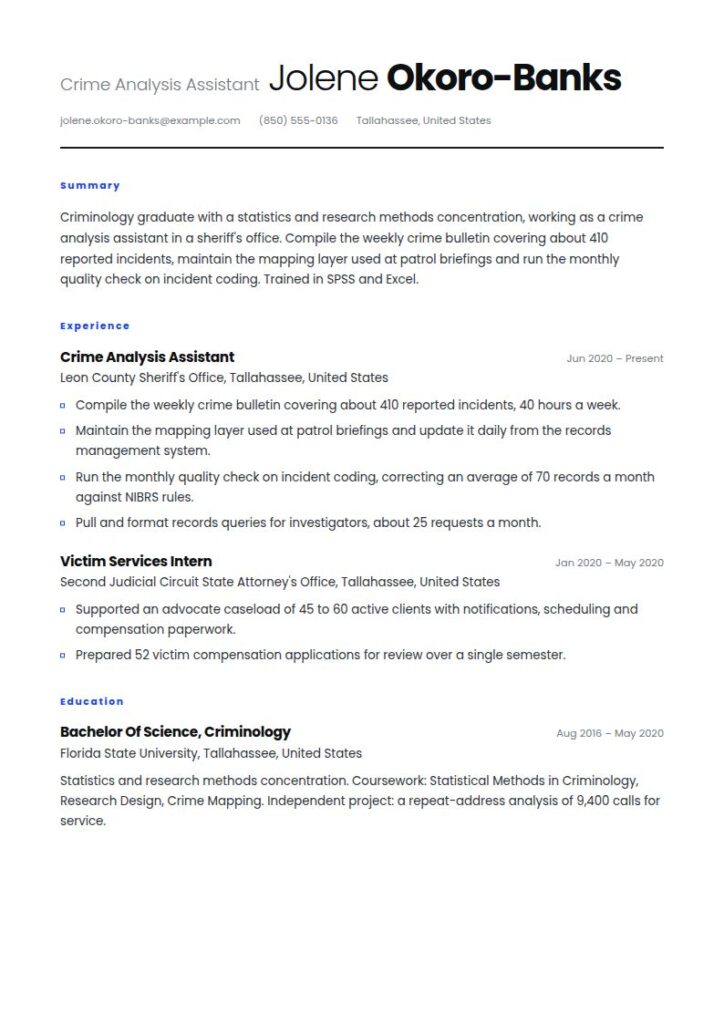
Criminology graduate with a statistics and research methods concentration, working as a crime analysis assistant in a sheriff's office. Compile the weekly crime bulletin covering about 410 reported incidents, maintain the mapping layer used at patrol briefings and run the monthly quality check on incident coding. Trained in SPSS and Excel.
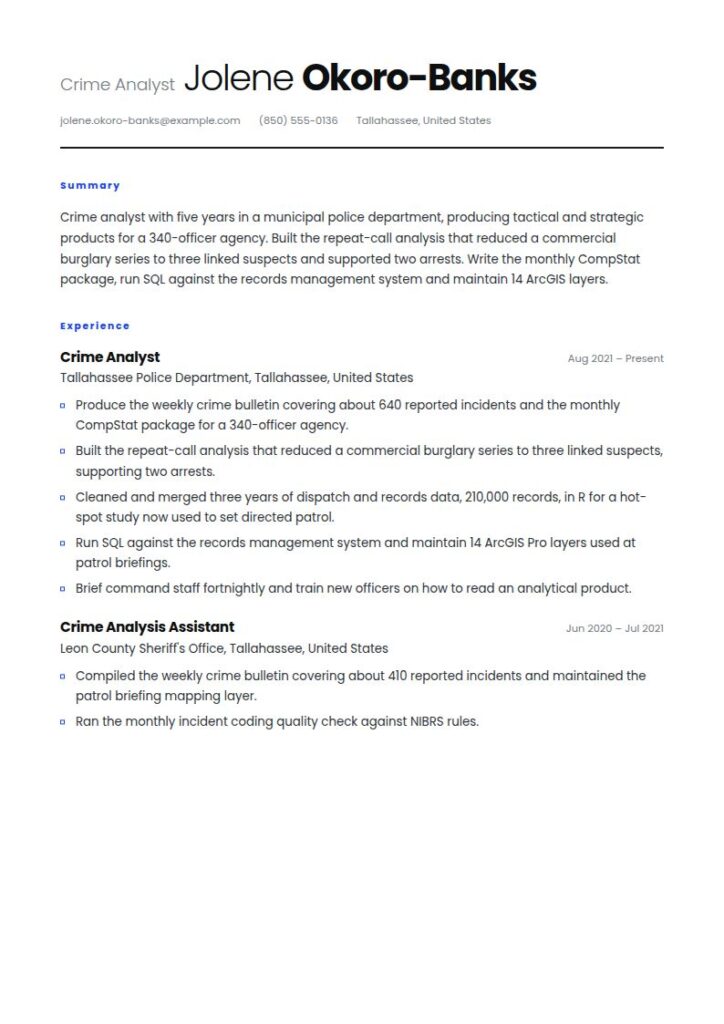
Crime analyst with five years in a municipal police department, producing tactical and strategic products for a 340-officer agency. Built the repeat-call analysis that reduced a commercial burglary series to three linked suspects and supported two arrests. Write the monthly CompStat package, run SQL against the records management system and maintain 14 ArcGIS layers.
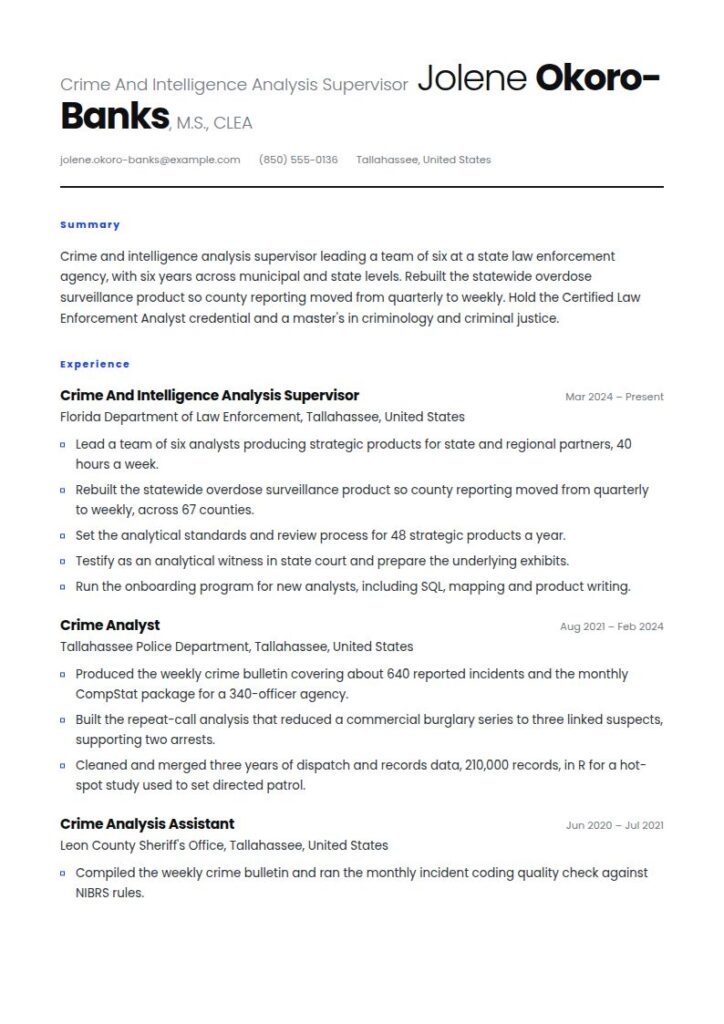
Crime and intelligence analysis supervisor leading a team of six at a state law enforcement agency, with six years across municipal and state levels. Rebuilt the statewide overdose surveillance product so county reporting moved from quarterly to weekly. Hold the Certified Law Enforcement Analyst credential and a master's in criminology and criminal justice.
Right vs wrong: the same criminology summary, twice
| ✅ Right | ❌ Wrong |
|---|---|
| Crime analyst with five years in a municipal police department, 340 officers served. | Criminal justice professional with a strong interest in law enforcement. |
| Built the repeat-call analysis that linked a burglary series to three suspects. | Experienced in analyzing crime data and identifying patterns. |
| Write the monthly CompStat package and run SQL against the records system. | Proficient with various law enforcement databases and software. |
The right column names a system, a volume and a result. The left could be written by anyone who has watched a police drama.
Outline your experience
Employer, role, city, dates, then three to five bullets, each with a system, a volume or an outcome.
| Instead of | Use |
|---|---|
| Analyzed crime data for the department | Produced the weekly bulletin covering about 640 reported incidents and the monthly CompStat package for a 340-officer agency |
| Worked with victims of crime | Carried 45 to 60 active clients, accompanied 38 to court and filed 52 compensation applications in a year |
| Familiar with statistical software | Cleaned and merged three years of dispatch and records data, 210,000 records, in R for a hot-spot study |
Crime Analyst, Tallahassee Police Department, Tallahassee, FL, August 2021 to Present
Produce the weekly crime bulletin covering about 640 reported incidents and the monthly CompStat package for a 340-officer agency.
Built the repeat-call analysis that reduced a commercial burglary series to three linked suspects, supporting two arrests.
Cleaned and merged three years of dispatch and records data, 210,000 records, in R for a hot-spot study now used to set directed patrol.
Run SQL against the records management system and maintain 14 ArcGIS Pro layers used at patrol briefings.
What a criminology degree actually leads to
Six destinations carry most graduates. Entry education across them runs from a high school diploma to a doctorate (BLS Occupational Outlook Handbook, 2025-35 edition).
Law enforcement and federal agencies
Municipal and county policing hires on a record and an academy; detective and federal investigative work is where the degree pays.
Federal agencies publish their bars openly. The FBI requires special agent applicants to be at least 23 and to apply before their 38th birthday, to hold a bachelor's degree with two years of professional work experience, an advanced degree, or a bachelor's degree with one year of sworn law enforcement experience, and to be able to obtain a Top Secret Sensitive Compartmented Information clearance through a background investigation including a personnel security interview, a polygraph, a drug test and fingerprinting (FBI, special agent application and evaluation process, accessed September 2026). Write to that list: degree, years of professional experience and clearance status belong where a screener finds them fast.
Corrections and community supervision
Probation officers and correctional treatment specialists typically need a bachelor's degree, and criminology is the standard one (BLS Occupational Outlook Handbook, 2025-35 edition). Write that resume around caseload size, the assessment instruments you are trained on, court report writing and referral networks. A correctional officer resume is built on housing unit size, shift documentation, classification and de-escalation training. In both, documentation quality is the work, so a resume that shows you write clearly is itself the evidence.
Victim services
Victim advocacy sits inside prosecutors' offices, police departments, hospitals, shelters and nonprofits, and it is where a credential is easiest to name and most often omitted. The National Organization for Victim Advocacy issues the National Advocate Credentialing Program credential at four levels, requiring about 3,900 hours of direct victim services experience at Basic, 7,800 at Intermediate and 15,600 at Advanced, each with pre-approved training and 32 continuing education hours every two years (NOVA, accessed September 2026).
Put your training hours, credential level and renewal date on the page, then quantify the work: caseload, court accompaniments, compensation applications, crisis line shifts. Describe the work and the group, never an individual client.
Crime analysis and intelligence
This is where a criminology degree with real quantitative training goes furthest, and it is the most undersold path in the field.
Analysts sit in police departments, sheriff's offices, state agencies, fusion centers and federal task forces, producing tactical products for patrol, strategic products for command and case support for investigators. What gets hired is a stack: SQL against a records management system, ArcGIS or a comparable mapping tool, Excel at a level most people overstate, and R or Python for anything repeated. The International Association of Crime Analysts issues the Certified Law Enforcement Analyst credential, requiring at least three years of full-time analytical experience, 100 points from combined work and education, membership and an examination (IACA, CLEA certification, accessed September 2026).
The destinations are moving in opposite directions
Between 2025 and 2035 the Bureau of Labor Statistics projects forensic science technician employment to grow 13 percent and social and human service assistants 7 percent, while correctional officers and bailiffs decline 7 percent, a loss of 29,900 positions, and claims adjusters and investigators decline 6 percent (BLS Occupational Outlook Handbook, 2025-35 projections). Police and detectives sit in the middle at 3 percent growth on 824,200 jobs in 2025, with about 60,100 openings a year from replacement alone.
Against that, 56,901 bachelor's degrees were conferred in homeland security, law enforcement and firefighting in 2021-22 (National Center for Education Statistics, Digest of Education Statistics, table 322.10). Supply is concentrated on the destinations that are shrinking, which is the argument for making the analytical half of the degree visible.
Research, policy and graduate study
Research and policy work sits in universities, state statistical analysis centers, federal agencies, think tanks and evaluation firms, and most is gated behind a master's degree. Sociologists, the closest occupation the Occupational Outlook Handbook publishes, typically need one to enter (BLS, 2025-35 edition). Name the methods rather than the topics: regression, survival analysis, spatial statistics, quasi-experimental designs, survey construction. Name the data: the National Crime Victimization Survey, the National Incident-Based Reporting System, agency administrative records. Then list reports, publications and grant-funded projects with their funder.
Private-sector investigation and corporate security
Corporate investigations, insurance fraud units, retail loss prevention, compliance and background screening firms all hire criminology graduates, and this is the destination people overlook. Write it around case volume, interview counts, recovery figures, report quality and licensing. Most states license private investigators, with requirements varying by jurisdiction (BLS Occupational Outlook Handbook, 2025-35 edition), so name your license, its state and its number. Fraud and special investigations units also value statistics: anomaly detection in claims data is pattern analysis in a different vocabulary.
Your resume is the opening page of a vetting file
This is the difference between a criminology resume and almost any other, and it changes how you write.
For positions requiring a national security clearance, the Questionnaire for National Security Positions asks for ten years of where you have lived, with residences for the entire period accounted for without breaks, a ten-year employment history, and people who knew you at each address in the last three years (U.S. Office of Personnel Management, Standard Form 86).
So account for your whole timeline: a six-month gap you smoothed over becomes an inconsistency in a file. Keep dates exact and consistent across every document, because your resume, application form, questionnaire and references are read together. And write nothing you cannot substantiate: titles, dates, supervisors, clearance level and certification numbers are all verified here.
Build a snapshot of your key skills
Ten to fourteen entries in three groups. Put the analytical group first, because it is the rarest.
Analytical and technical: SQL, ArcGIS Pro, R, SPSS, Excel pivot tables and Power Query, Tableau, i2 Analyst's Notebook
Operational: Records management queries, dispatch data analysis, open-source research, NIBRS coding and quality control
Communication: Tactical and strategic product writing, command briefings, court testimony, training delivery
Choose the right layout and design
Single column, plain type at 11 or 12 point, clear headings, dates as month and year, no photograph, no graphics. Export as PDF unless the portal says otherwise.
Pick a destination and write to it. Name the systems: records management system, ArcGIS, SQL, SPSS, R. Put volumes on every bullet. State your clearance level and its investigation date. List credential hours and renewal dates. Account for every month of the last ten years.
Do not describe an individual victim, offender or case in identifying detail. Do not claim a clearance you no longer hold without saying when it lapsed. Do not write "familiar with" about software you cannot open. Do not dramatize the work; the reader does it daily.
List your education and certifications
Degree, institution, year, then methods coursework by name, then credentials with the issuing body and date.
Master of Science, Criminology and Criminal Justice, Florida State University, Tallahassee, FL, 2023. Coursework: Advanced Statistics, Spatial Analysis of Crime, Research Design and Program Evaluation.
Bachelor of Science, Criminology, Florida State University, Tallahassee, FL, 2020. Statistics and research methods concentration.
Certified Law Enforcement Analyst, International Association of Crime Analysts, 2024. Top Secret clearance, investigation completed 2024.
Criminology job market and outlook
There is no single criminology occupation, so the market is the sum of its destinations. The largest is policing.
| Measure | Value |
|---|---|
| Police and detective jobs, 2025 | 824,200 |
| Projected change, 2025-35 | +3% |
| Projected annual openings | ~60,100 |
| Median annual wage, May 2025 | $77,310 |
| Detectives and criminal investigators, median | $93,790 |
| Typical entry-level education | High school diploma, agencies often requiring more |
Source: U.S. Bureau of Labor Statistics, Occupational Outlook Handbook, police and detectives, May 2025 wages and 2025-35 projections.
What salary you can expect across criminology destinations
Because criminology is a field rather than an occupation, the honest answer is a comparison of the destinations.
| Destination occupation | Median annual wage, May 2025 | Jobs, 2025 | Projected change, 2025-35 |
|---|---|---|---|
| Sociologists | $106,030 | 2,700 | +4% |
| Detectives and criminal investigators | $93,790 | 120,500 | +3% with police and detectives |
| Claims adjusters, appraisers, examiners and investigators | $78,020 | 389,700 | -6% |
| Police and detectives, all | $77,310 | 824,200 | +3% |
| Forensic science technicians | $72,060 | 20,100 | +13% |
| Probation officers and correctional treatment specialists | $66,270 | 93,700 | +3% |
| Correctional officers and jailers | $58,940 | 397,800 | -7% with bailiffs |
| Private detectives and investigators | $51,220 | 39,500 | +5% |
| Social and human service assistants | $45,930 | 463,400 | +7% |
Source: U.S. Bureau of Labor Statistics, Occupational Outlook Handbook, May 2025 wages and 2025-35 projections.
The top of that table is more than twice the bottom, and the biggest lever on where you land is whether your resume shows you can work with data. Sociologists, the highest-paid line, typically require a master's degree (BLS, 2025-35 edition); the analytical roles below reward the same skills at a lower bar.
Key takeaways for a criminology resume
- Pick a destination before you write; there is no general criminology resume.
- Put analytical and technical skills first, named as systems rather than adjectives.
- Quantify everything: incidents, records, caseload, court accompaniments, shifts.
- Account for every month of the last ten years, because these destinations verify.
- Name credentials with the issuing body, level, hours and renewal date.
- Keep a long federal version and a short one for everything else.
- Write about the work and the data, never an identifiable victim, offender or case.
Build your criminology resume in 15 minutes.
Related legal resume examples
- Lawyer resume
- Attorney resume
- Paralegal resume
- Legal assistant resume
- Immigration lawyer resume
- Claims adjuster resume
- Law school resume
- Executive assistant resume
- Notary resume
- Legal resume
- Research assistant resume
- Academic resume
Pair it with a matching criminology cover letter.
Criminology resume questions, answered
What jobs can you get with a criminology degree?
Six destinations account for most graduates: law enforcement and federal agencies, corrections and community supervision, victim services, crime analysis and intelligence, research and policy, and private investigation and corporate security. Median annual wages across those occupations ran from $45,930 for social and human service assistants to $106,030 for sociologists in May 2025 (BLS Occupational Outlook Handbook).
Do I need a master's degree in criminology?
For research and policy work, usually yes: sociologists typically need a master's degree to enter (BLS, 2025-35 edition). For crime analysis, corrections, victim services and most investigative work, a bachelor's plus demonstrable data skills and a credential does more.
What should I put on a criminology resume with no experience?
Name the methods and statistics courses and what you did in them, including any independent analysis with its data source and sample size. Then add internships, volunteer hours, campus safety work and any job involving records or public contact, with volumes attached.
How does a background investigation affect my resume?
It makes accuracy the priority. The Standard Form 86 asks for ten years of residences with no breaks, ten years of employment, and people who knew you at each address in the last three years (U.S. Office of Personnel Management). Your resume is read alongside it, so dates, titles and employers must match exactly, and gaps are better stated than smoothed.
Is a criminology degree a statistics degree?
Not formally, but a good one contains a research methods and statistics sequence, and that sequence is the most marketable part of the degree. Name the courses, the software and the analyses you have run; crime analysis, intelligence, research and fraud work all hire on them.