Commercial Litigation Associate Adaeze Nwankwo
Associate, Business Disputes Group
[email protected] | (312) 555-0148 | Chicago, United States
Profile
Commercial litigation associate admitted in Illinois in 2024, with two years in the business disputes group of a 240-lawyer firm. Work on contract and business tort matters with amounts in controversy from $250,000 to $12M, defense side, in Illinois state courts and the Northern District of Illinois. Drafted 14 dispositive and discovery motions in the last year, took 3 fact depositions, and ran document review protocols across a 400,000-document production.
Work Experience
10/2024 - Present, Associate, Business Disputes Group, Marchetti & Okoye LLP, Chicago, United States
- Carry 6 to 8 active commercial litigation matters, amounts in controversy from $250,000 to $12M, defense side, in Illinois state courts and the Northern District of Illinois.
- Drafted 14 dispositive and discovery motions in the last year, 9 filed substantially as drafted.
- Took 3 fact depositions and defended 5, including one corporate designee witness.
- Built the review protocol and search terms for a 400,000-document production, supervising 6 contract reviewers.
- Billed 1,880 hours in 2025 against a 1,850 target, plus 64 pro bono hours on housing matters.
05/2023 - 08/2023, Summer Associate, Marchetti & Okoye LLP, Chicago, United States
- Rotated through the business disputes and employment groups, completing 11 research memoranda.
- Drafted a motion to dismiss section adopted into the filed brief in a contract dispute.
Education
08/2021 - 05/2024, Juris Doctor, Law, Northwestern University Pritzker School of Law, Chicago, United States
Senior editor, Journal of Criminal Law and Criminology. Moot court quarterfinalist. Civil litigation clinic, 2 landlord and tenant matters to hearing.
08/2017 - 05/2021, Bachelor of Arts, Political Science, University of Illinois Urbana-Champaign, Champaign, United States
Skills
Dispositive motion practice, 70
Fact discovery and document review, 85
Legal research and brief writing, 85
Depositions, 60
Relativity and Everlaw, 80
Westlaw and Lexis, 90
CM/ECF and Illinois e-filing, 85
Languages
English, native
Igbo, native
Certificates
11/2024, Admitted to the Illinois Bar, Supreme Court of Illinois, Attorney Registration and Disciplinary Commission
In good standing. Current on Illinois MCLE including professional responsibility credit.
12/2024, Admitted, U.S. District Court for the Northern District of Illinois, United States District Court, Northern District of Illinois
Summary
A lawyer resume is a one to two page document naming your practice area, your bar admissions and the matters you have actually run, described by type and size rather than by client. This guide gives you three adaptable versions, the matters list that most applicants leave out, and current Bureau of Labor Statistics pay and outlook for the occupation.
Lawyer resume examples by experience level
A lawyer resume is a one to two page document that names your practice area, your bar admissions, and the matters you have personally worked on, described by type, size and your role in them.
Nobody hires a lawyer. They hire a commercial litigator, a bankruptcy associate, a securities lawyer, a public defender, a transactional generalist for a fifteen-person company. The word on the door is the same and the job is not, which is why "attorney experienced in a variety of legal matters" reads as a candidate who cannot name what they do.
This page covers the practice-area side of the job. Lawyer and attorney are the same role under two words, and the credential side, meaning which bars you are admitted to and how admission moves between states, is covered on the attorney resume guide.
Resume guide for a lawyer resume
This guide and the corresponding lawyer resume example will cover:
- How to write a lawyer resume, section by section
- How to name your practice area and sub-speciality so a hiring partner can place you
- The representative matters list, and how to write one without breaching confidentiality
- Three adaptable summaries: junior associate, mid-level associate and partner
- What changes between big firm, mid-size, boutique, in-house and government
- What the job market looks like and what you can expect to earn
How to write a lawyer resume
Six sections: contact header with bar admissions, summary, experience, representative matters, education, and skills. One page through your first several years, two once you have a matters list and a practice worth describing.
Admissions go in the header, not in an education block at the bottom. A candidate not admitted where the job sits is a different conversation, and the reader wants it in the first four seconds.
| Section | What it is answering | Where it goes |
|---|---|---|
| Bar admissions | Can this person appear, sign and advise here? | Contact header, with the year of each |
| Summary | What kind of lawyer is this, and at what level? | Four lines under the header |
| Experience | What did they run, and what was their actual role? | Reverse chronological, with scale |
| Representative matters | Have they done work like the work we have? | Its own block, by type and size |
| Education | Law school, degree, year, and anything selective | Near the bottom after your second year |
Write your practice area to two levels, not one
"Litigation" tells a hiring partner almost nothing. There are commercial litigators who have never seen a jury, employment litigators who live in administrative agencies, and appellate specialists who do not take depositions at all.
Write the area, then the sub-speciality, then the posture you usually occupy. "Commercial litigation, contract and business tort disputes, defense side, state and federal trial courts." "Transactional, middle-market mergers and acquisitions, buy side, deals from $5M to $60M." "Bankruptcy, chapter 11 debtor representation."
Three phrases is enough, and a reader can then decide in one line whether your experience maps onto their open matter. A vaguer line does not protect your options; it moves you to the bottom of the pile.
Run the finished file through the free Rezoom ATS resume checker before you submit. Firms and legal departments parse applications into a system before a hiring partner opens them.
Choosing the best resume format for a lawyer resume
Reverse chronological, single column. One page until you have roughly five years and a matters list, two pages after that, and two is the ceiling for everyone below general counsel.
Functional formats fail here. Legal hiring reads for a sequence: which school, which clerkship if any, which firm, which practice group, how long, and why you left. A format that hides the sequence reads as a sequence you would rather not explain.
Include your contact information
| ✅ Right | ❌ Wrong |
|---|---|
| Adaeze Nwankwo | Adaeze Nwankwo, Esq. |
| Commercial Litigation Associate | Attorney at Law |
| Admitted: Illinois (2019), N.D. Ill. trial bar (2022) | Licensed attorney in good standing |
| (312) 555-0148, [email protected], Chicago, IL | (312) 555-0148, [email protected] |
Put each admission with the year it was granted. Federal district and circuit admissions belong there too, because they are what let you appear rather than merely advise, and most applicants leave them off. Drop "Esq." from your own name; it is a courtesy other people extend to you.
Make use of a summary
Four lines: practice area and sub-speciality, years admitted, the scale and posture of your work, and one thing you carried yourself.
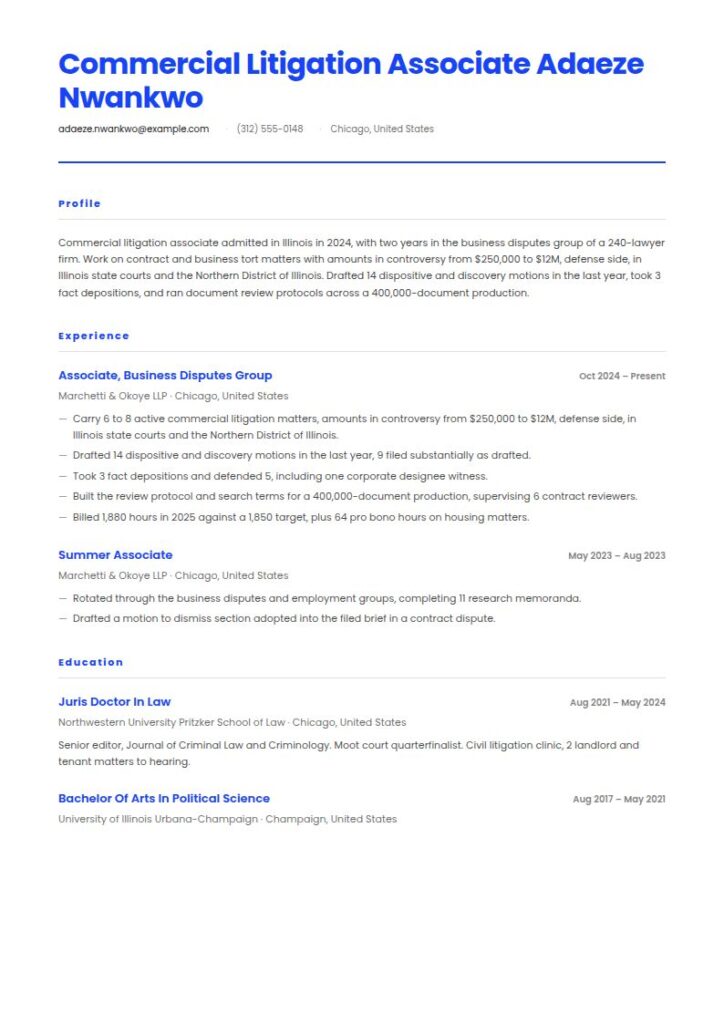
Commercial litigation associate admitted in Illinois in 2024, with two years in the business disputes group of a 240-lawyer firm. Work on contract and business tort matters with amounts in controversy from $250,000 to $12M, defense side, in Illinois state courts and the Northern District of Illinois. Drafted 14 dispositive and discovery motions in the last year, took 3 fact depositions, and ran document review protocols across a 400,000-document production.
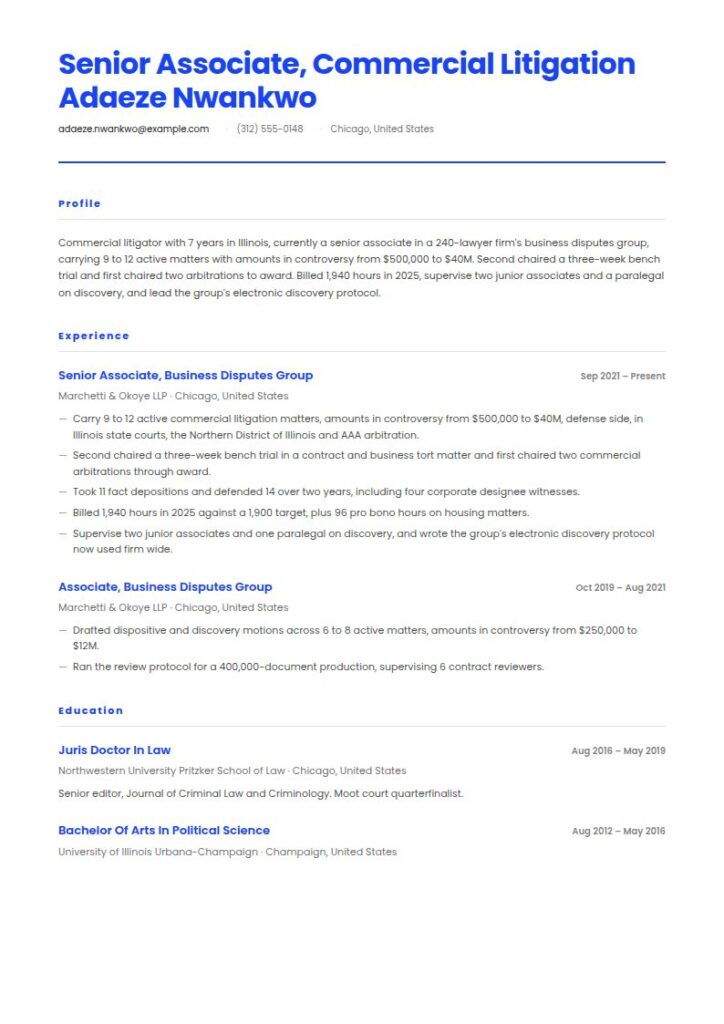
Commercial litigator with 7 years in Illinois, currently a senior associate in a 240-lawyer firm's business disputes group, carrying 9 to 12 active matters with amounts in controversy from $500,000 to $40M. Second chaired a three-week bench trial and first chaired two arbitrations to award. Billed 1,940 hours in 2025, supervise two junior associates and a paralegal on discovery, and lead the group's electronic discovery protocol.
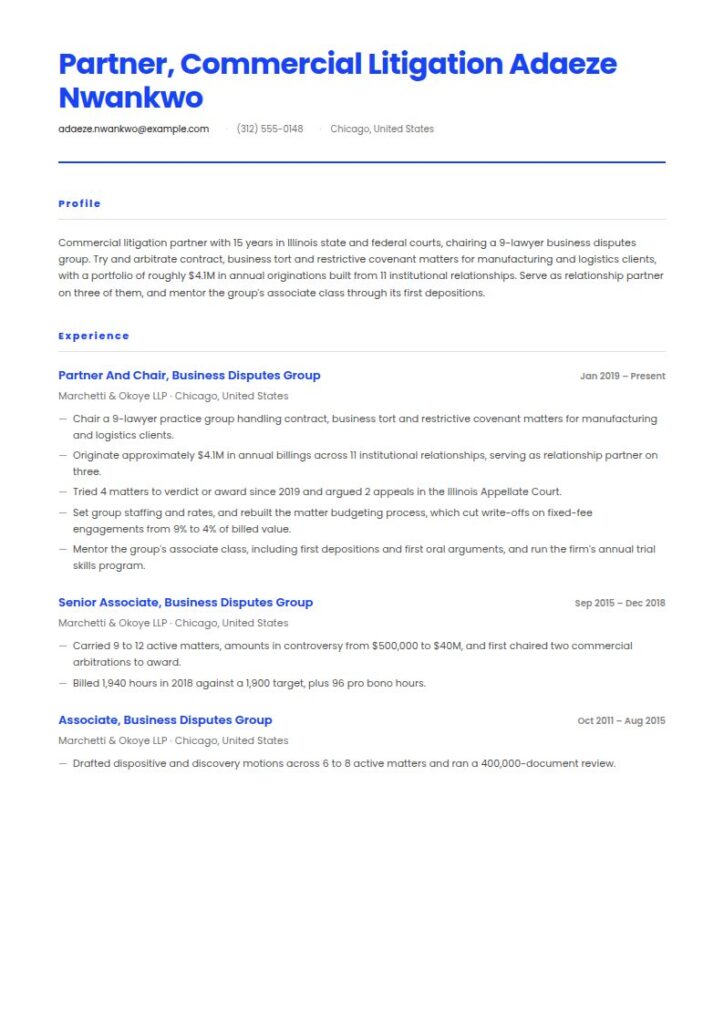
Commercial litigation partner with 15 years in Illinois state and federal courts, chairing a 9-lawyer business disputes group. Try and arbitrate contract, business tort and restrictive covenant matters for manufacturing and logistics clients, with a portfolio of roughly $4.1M in annual originations built from 11 institutional relationships. Serve as relationship partner on three of them, and mentor the group's associate class through its first depositions.
Right vs wrong: the same lawyer summary, twice
| ✅ Right | ❌ Wrong |
|---|---|
| Commercial litigator with 7 years in Illinois, business disputes group of a 240-lawyer firm. | Experienced attorney with a strong record in litigation. |
| Carries 9 to 12 active matters, amounts in controversy from $500,000 to $40M. | Handles a wide range of complex legal matters. |
| Second chaired a three-week bench trial; first chaired two arbitrations to award. | Extensive courtroom and trial experience. |
The right column tells a hiring partner which matters they could hand you on Monday. The left column asks them to guess, and in a pile of eighty files nobody guesses.
Outline your experience
Firm or employer, city, practice group, title, dates. Then three to five bullets, each one naming what you did rather than what the team did. "Assisted with" is the most expensive phrase on a legal resume, because it means the reader cannot tell whether you drafted the brief or proofread it.
| Instead of | Use |
|---|---|
| Assisted with litigation matters | Drafted 14 dispositive and discovery motions, 9 filed as drafted, across 11 active matters |
| Participated in depositions | Took 3 fact depositions and defended 5, including two corporate designees |
| Conducted legal research | Researched and wrote the summary judgment brief in a $12M breach of contract defense, granted in part |
| Managed document review | Built the review protocol and search terms for a 400,000-document production, supervising 6 contract reviewers |
| Worked on transactional matters | Ran diligence and drafted ancillary documents on 7 buy-side acquisitions, $5M to $60M enterprise value |
Senior Associate, Business Disputes Group, Marchetti & Okoye LLP, Chicago, IL, September 2021 to Present
Carry 9 to 12 active commercial litigation matters at a time, amounts in controversy from $500,000 to $40M, defense side, in Illinois state courts, the Northern District of Illinois and AAA arbitration.
Second chaired a three-week bench trial in a contract and business tort matter and first chaired two commercial arbitrations through award.
Took 11 fact depositions and defended 14 across the last two years, including four corporate designee witnesses.
Billed 1,940 hours in 2025 against a 1,900 target, plus 96 pro bono hours on housing matters.
Supervise two junior associates and one paralegal on discovery, and wrote the group's electronic discovery protocol now used firm wide.
Name your practice area, then prove it with a matters list
This is the block that decides legal hiring, and the one most applicants skip because they are unsure what they are allowed to write.
You are allowed to write a great deal. What you cannot do is identify the client or the matter. Under ABA Model Rule 1.6(a) a lawyer must not reveal information relating to the representation of a client without informed consent, and that rule is broader than the attorney-client privilege: it covers everything you learned in the course of the work, not only confidential communications (American Bar Association, Model Rules of Professional Conduct, Rule 1.6). Party names, deal code names, docket numbers and anything that makes a matter identifiable stay off the page.
What survives is what a reader needs: the type of matter, its size, the forum, and what you personally did.
Representative matters, described by type and role. Client identities withheld under Rule 1.6.
Breach of contract and business tort defense, manufacturing client, approximately $12M in controversy, N.D. Ill. Drafted the summary judgment brief; motion granted as to three of five counts.
Restrictive covenant and trade secret dispute, logistics sector, emergency injunction posture, Cook County Chancery. Second chaired the two-day preliminary injunction hearing and examined two witnesses.
Commercial arbitration, distribution agreement termination, roughly $3.5M claimed, AAA. First chaired through award for the respondent.
Multi-party construction defect litigation, approximately $40M in controversy. Ran discovery for one defendant, including a 400,000-document production and 9 depositions.
Four to six entries is the right length. Order them so the first two look like the work the employer has, not the work you found most interesting.
Follow your firm's policy on matter descriptions where it has one. If a matter is public record and you were counsel of record, the case name is usually fair to use. When in doubt, describe and do not name.
What changes between big firm, boutique, in-house and government
The same practice area is a different resume in each setting, and sending one version everywhere is why strong candidates get filtered out.
| Setting | What the reader is checking | What to move up the page |
|---|---|---|
| Large firm | Depth in one practice group, hours, pedigree, whether you can be staffed on a big matter | Practice group, matter size, billable hours, clerkship |
| Mid-size and boutique | Whether you can run a matter with less support | Matters you led, client contact, breadth inside the area |
| In-house | Business judgment, volume, whether you can advise without billing | Contract volume and cycle time, risk calls made, cross-functional work |
| Government | Public service motivation, caseload, courtroom time, security clearance if relevant | Caseload numbers, hearings and trials, agency experience |
In-house is the transition most lawyers misjudge. A legal department is a cost center with a queue, and it hires on throughput and judgement rather than on the sophistication of the matters you touched. Write contract volume, turnaround times, the policies you own and the business units you advise, and cut the billable hours line entirely.
Hours are a fact, and originations are a number you should own
Billable hours belong on a law firm resume from your second year onward, written against a target: "billed 1,940 hours in 2025 against a 1,900 target." That is a fact about your reliability, not a boast, and the firm will ask for it anyway.
Keep pro bono hours on a separate line. Most firms count some pro bono toward the target and the reader wants both numbers.
From roughly senior associate onward, add what you originate. Partnership decisions turn on a book of business, and "approximately $4.1M in annual originations across 11 institutional relationships, relationship partner on three" answers the question the hiring committee would have asked in the second interview. If your originations are modest, write the number anyway next to the relationships you service but do not own. A small honest figure with a trajectory reads better than silence.
Build a snapshot of your key skills
Ten to fourteen entries in three groups: substantive, procedural, and the systems a legal employer runs.
Substantive: Commercial contract disputes, Business torts, Restrictive covenants and trade secrets, Uniform Commercial Code Article 2, Construction defect litigation
Procedural: Dispositive motion practice, Fact and expert discovery, Depositions, Commercial arbitration under AAA rules, Preliminary injunction practice, Trial support and examination
Systems: Relativity, Everlaw, Westlaw and Lexis, iManage, Aderant time and billing, CM/ECF and state e-filing
Name the electronic discovery platform. Firms buy those by license, and a candidate already fluent in the one they run saves weeks.
List your education, bar admission and certifications
Law school, degree, year, then anything selective: law review, moot court, order of the coif, a clerkship. Keep class rank only if it helps and only in your first few years.
Bar admissions: Illinois, 2019. United States District Court for the Northern District of Illinois, 2019, trial bar 2022. United States Court of Appeals for the Seventh Circuit, 2023.
Juris Doctor, Northwestern University Pritzker School of Law, Chicago, IL, 2019. Senior editor, Journal of Criminal Law and Criminology. Moot court quarterfinalist.
Bachelor of Arts, Political Science, University of Illinois Urbana-Champaign, 2016.
Continuing legal education: current on Illinois MCLE, including professional responsibility credit, through the 2026 to 2028 reporting period.
Once you are past about eight years, education drops to two lines near the bottom and the matters list carries the page.
Choose the right layout and design
Single column, plain type at 11 or 12 point, generous margins, no photograph, no graphics, no skill bars. Legal hiring is conservative about documents, and the parsing systems firms use break on two-column layouts.
Put bar admissions with their years in the header, including federal courts. Name your practice area to two levels of specificity. Give a representative matters list by type, size, forum and your role. Write your billable hours against the target, with pro bono on its own line. Say what you personally did in each bullet. Rewrite the page for in-house, government and firm applications rather than sending one version everywhere.
Do not name clients, parties, deal names or docket numbers on a matter that is not public record. Do not write "assisted with" when you drafted, took or argued something. Do not describe yourself as Esq. Do not list every case you touched; four to six representative matters beat twenty. Do not send a firm resume to a legal department with the hours still on it. Do not run past two pages below general counsel.
Lawyer job market and outlook
A large, steady occupation with a high entry bar and a hiring market that is local to practice area and geography.
| Measure | Value |
|---|---|
| Lawyer jobs, 2025 | 863,700 |
| Projected change, 2025-35 | +5% (+40,600) |
| Projected annual openings | ~28,700 |
| Typical entry-level education | Doctoral or professional degree |
| Median annual wage, May 2025 | $159,670 |
Source: U.S. Bureau of Labor Statistics, Occupational Outlook Handbook, 2025-35 projections and May 2025 wage data.
Most graduates go to private practice, and most of those go to small firms
For the class of 2024, 93.4% of law graduates were employed ten months after graduation and 84.3% held jobs requiring bar admission, both records. Private practice took 58.9% of the class, which was 20,810 jobs, the highest number NALP has recorded (National Association for Law Placement, Class of 2024 Selected Findings, March 2025).
Inside private practice the distribution is wider than the headlines suggest: 34.2% of those firm jobs were in firms of 501 or more lawyers, 32.4% in firms of 11 to 250, and 25.6% in firms of 1 to 10 (NALP, March 2025). The median private practice starting salary was $160,000 against $95,000 across all sectors.
That spread is why the practice area line matters more than the school line after your third year. In a firm of nine lawyers nobody is staffing you on a matter; they are handing you one.
Where lawyers work, and what each setting pays:
| Setting | Share of employment | Median annual wage (May 2025) |
|---|---|---|
| Legal services | 52% | $157,870 |
| Self-employed | 11% | Not reported |
| Local government | 8% | $131,390 |
| State government | 7% | $115,330 |
| Federal government | 5% | $178,380 |
Source: U.S. Bureau of Labor Statistics, Occupational Outlook Handbook, May 2025.
What salary you can expect as a lawyer
The median annual wage for lawyers was $159,670 as of May 2025, with the lowest 10 percent under $78,360 and the highest 10 percent over $351,600 (BLS Occupational Outlook Handbook, May 2025). That is one of the widest spreads in any licensed occupation, and practice area and setting explain most of it.
At entry, large-firm pay is set by scale rather than performance. The median first-year associate salary was $200,000 as of 1 January 2025, rising to $215,000 in firms of 701 or more lawyers, and only 32% of offices had moved to the $225,000 figure often quoted as standard (NALP, 2025 US Associate Salary Survey, 28 May 2025).
Federal government work pays a median of $178,380, above the legal services median of $157,870, while state government sits at $115,330 (BLS, May 2025). The trade is hours and autonomy rather than money.
What a resume moves is lateral placement. A clear practice-area line and a matters list that maps onto the group's caseload is how a firm decides which class year to slot you into, and a class year is worth more than any negotiating phrase.
Key takeaways for a lawyer resume
- Name your practice area to two levels, plus the posture you usually occupy.
- Put bar admissions with years in the header, federal courts included.
- Give four to six representative matters by type, size, forum and your role.
- Describe matters without naming clients or parties; Rule 1.6 is broader than privilege.
- Say what you personally did, never what the team did.
- Put billable hours against the target, with pro bono on its own line, and cut them for in-house.
- From senior associate onward, put your originations and relationships on the page.
Build your lawyer resume in 15 minutes.
Related legal resume examples
- Attorney resume
- Paralegal resume
- Legal assistant resume
- Immigration lawyer resume
- Claims adjuster resume
- Law school resume
- Criminology resume
- Notary resume
- Legal sector resume
- Compliance officer resume
- Administrative assistant resume
- Executive assistant resume
Pair it with a matching lawyer cover letter.
Lawyer resume questions, answered
How long should a lawyer resume be?
One page for your first five years or so, two once you have a representative matters list and a practice group role. Two is the ceiling below general counsel, and a three-page associate resume reads as a candidate who cannot prioritize.
Can I put client names or case names on a lawyer resume?
No, unless the matter is public record and you were counsel of record, and even then check your firm's policy first. ABA Model Rule 1.6(a) bars revealing information relating to a representation without informed consent, and it covers more than privileged communications. Describe matters by type, amount in controversy, forum and your role instead.
Should I include my billable hours?
Yes, on a law firm resume from your second year onward, written against the target so the number means something. Keep pro bono on a separate line. Leave hours off for in-house and government applications, where they signal that you have not adjusted to how that employer measures work.
What do I put on a lawyer resume with no experience?
Your admission or expected admission date, then law school work written as work: the clinic, its caseload and what you did in it, the journal and your editorial role, moot court results, and each summer or term-time position with its practice group and assignments. A summer associate memo that was used is a real fact.
How much do lawyers earn?
The median annual wage was $159,670 as of May 2025, with the lowest 10 percent under $78,360 and the highest 10 percent over $351,600 (BLS Occupational Outlook Handbook, May 2025). At entry the median first-year associate salary was $200,000 as of 1 January 2025, though the median across all class of 2024 graduates in all sectors was $95,000 (NALP, May 2025 and March 2025).