Administrative Assistant and Notary Public Gail Lindqvist-Moore
Administrative Assistant and Notary Public
[email protected] | (208) 555-0187 | Boise, United States
Profile
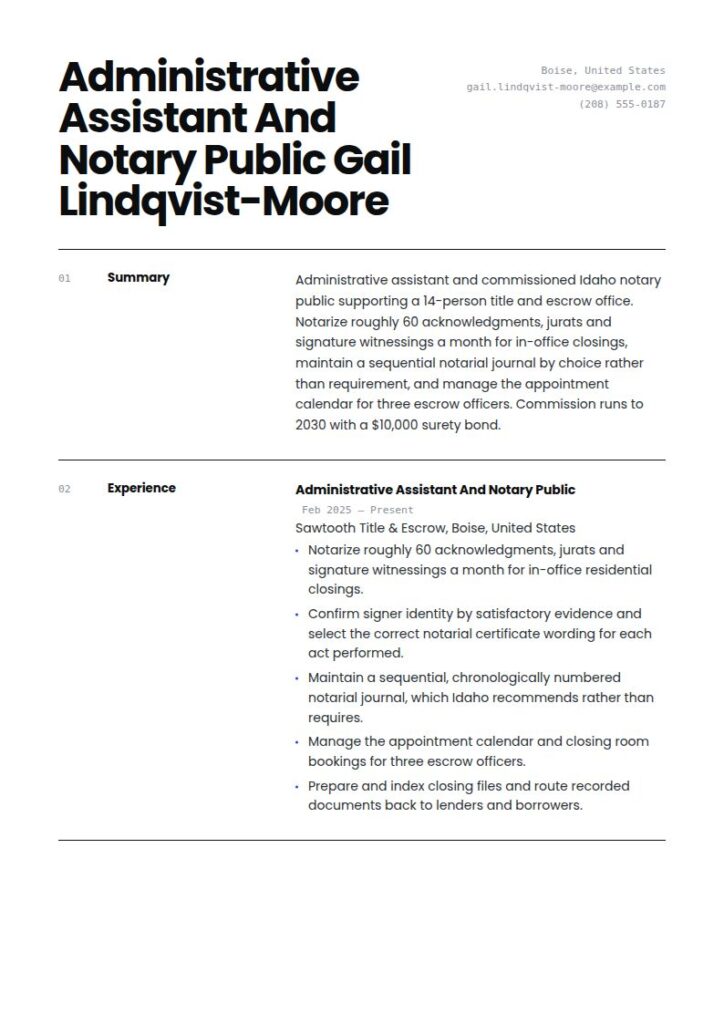
Administrative assistant and commissioned Idaho notary public supporting a 14-person title and escrow office. Notarize roughly 60 acknowledgments, jurats and signature witnessings a month for in-office closings, maintain a sequential notarial journal by choice rather than requirement, and manage the appointment calendar for three escrow officers. Commission runs to 2030 with a $10,000 surety bond.
Work Experience
02/2025 - Present, Administrative Assistant and Notary Public, Sawtooth Title & Escrow, Boise, United States
- Notarize roughly 60 acknowledgments, jurats and signature witnessings a month for in-office residential closings.
- Confirm signer identity by satisfactory evidence and select the correct notarial certificate wording for each act performed.
- Maintain a sequential, chronologically numbered notarial journal, which Idaho recommends rather than requires.
- Manage the appointment calendar and closing room bookings for three escrow officers.
- Prepare and index closing files and route recorded documents back to lenders and borrowers.
06/2022 - 01/2025, Front Office Coordinator, Bench Street Family Dentistry, Boise, United States
- Ran patient scheduling and records for a four-chair practice under a written confidentiality protocol.
- Handled insurance verification, billing entry and daily reconciliation.
Education
08/2020 - 05/2022, Associate of Applied Science, Business Administration, College of Western Idaho, Nampa, United States
Coursework in business law, records management and office administration.
Skills
Acknowledgments, jurats and signature witnessing, 85
Identity verification by satisfactory evidence, 85
Notarial certificate wording selection, 80
Sequential journal maintenance, 90
Closing file preparation and indexing, 75
Calendar and appointment management, 85
Languages
English, native
Swedish, conversational
Certificates
05/2024, Notary Public, State of Idaho, Idaho Secretary of State, 20240817
Six-year commission expiring 14 May 2030, with a $10,000 surety bond.
Summary
A notary commission is a state credential rather than a job, which is why a notary resume has to say what you do with it. This guide gives you three adaptable versions, the commission and journal detail employers check, what remote online notarization requires, and how the notary signing agent work at loan closings is actually hired and paid.
Notary resume examples by experience level
A notary resume is a document that has to answer a question most applicants never notice: a notary commission is a credential, not an occupation, so what exactly do you do with yours?
A commission appoints you, in the words of the National Notary Association, as "an official appointed by a state government to serve the public as an impartial witness in administering oaths and performing other official acts" (National Notary Association, 2026). It is a public office held part-time by millions of people who are all doing something else as well: the NNA's 2022 Notary Census counted 4.44 million notaries in the United States, down slightly from 4.48 million in 2017.
So the resume's job is to place the commission. Is it a credential attached to an administrative job, a small business you run, or specialist work at loan closings? Those are three different resumes, and this page covers all three.
Resume guide for a notary resume
This guide and the corresponding notary resume example will cover:
- How to write a notary resume, section by section
- What a commission is, and why the rules vary by state
- The journal and the acts you may and may not perform
- Remote online notarization, where it is allowed and what it requires
- The notary signing agent role, its screening, its insurance and its pay
- What the market looks like and what you can expect to earn
How to write a notary resume
Five or six sections: contact header, summary, commission and credentials, experience, volume and specializations, and skills. One page in almost every case. The commission block goes high, because it is verified first: give the state, the commission number, the expiry date, the bond if your state requires one, and any electronic or remote endorsement.
| Section | What it is answering | Where it goes |
|---|---|---|
| Commission | Is this person currently commissioned, and where? | Directly under the summary |
| Endorsements | Can they notarize electronically or remotely? | With the commission |
| Screening and insurance | Will a signing service accept them? | With the commission for signing agents |
| Experience | What do they actually do with the commission? | Reverse chronological, with volumes |
Write the commission line so it can be verified in ten seconds
State commissions are public records and the person reading your resume can look yours up, so make it easy. A complete line reads: "Notary Public, State of Idaho, commission number 20240817, expires 14 May 2030. $10,000 surety bond. Registered with the Secretary of State to perform remote online notarizations."
Requirements genuinely vary by state, so do not borrow another state's wording. Idaho commissions run for six years, carry a $30 filing fee, and require a $10,000 bond or a functional equivalent, with no mandatory course or examination (Idaho Secretary of State notary instructions, 2026; American Society of Notaries, Idaho state requirements, 2026). California requires an approved course of study, a written examination prescribed by the Secretary of State, and fingerprinting for a background check (California Secretary of State, Government Code section 8201).
Run the finished file through the free Rezoom ATS resume checker before you send it, particularly for employer roles where the commission is one requirement among many.
Choosing the best resume format for a notary resume
Reverse chronological, one page. Two only if you run a notary business with staff. If the commission supports another job, write that job's resume and treat the commission as a credential. If notarial work is the business, write it as a business: entity, years, volume, client types and specializations. A functional format helps neither case, because both readers want dates.
Include your contact information
| ✅ Right | ❌ Wrong |
|---|---|
| Gail Lindqvist-Moore | Gail Lindqvist-Moore |
| Notary Public and Certified Notary Signing Agent, Boise, ID | Notary and business owner |
| Idaho commission 20240817, expires May 2030. RON registered | Licensed notary |
| (208) 555-0187, [email protected] | (208) 555-0187, [email protected] |
Two corrections there matter. A notary is commissioned, not licensed, and a title company or law firm will notice. And "RON registered" earns its three words, because a notary who can close remotely is useful in a way one who cannot is not.
Make use of a summary
Four lines: commission and state, what you use it for, volume, and the endorsement or specialization that makes you different.
Administrative assistant and commissioned Idaho notary public supporting a 14-person title and escrow office. Notarize roughly 60 acknowledgments, jurats and signature witnessings a month for in-office closings, maintain a sequential notarial journal by choice rather than requirement, and manage the appointment calendar for three escrow officers. Commission runs to 2030 with a $10,000 surety bond.
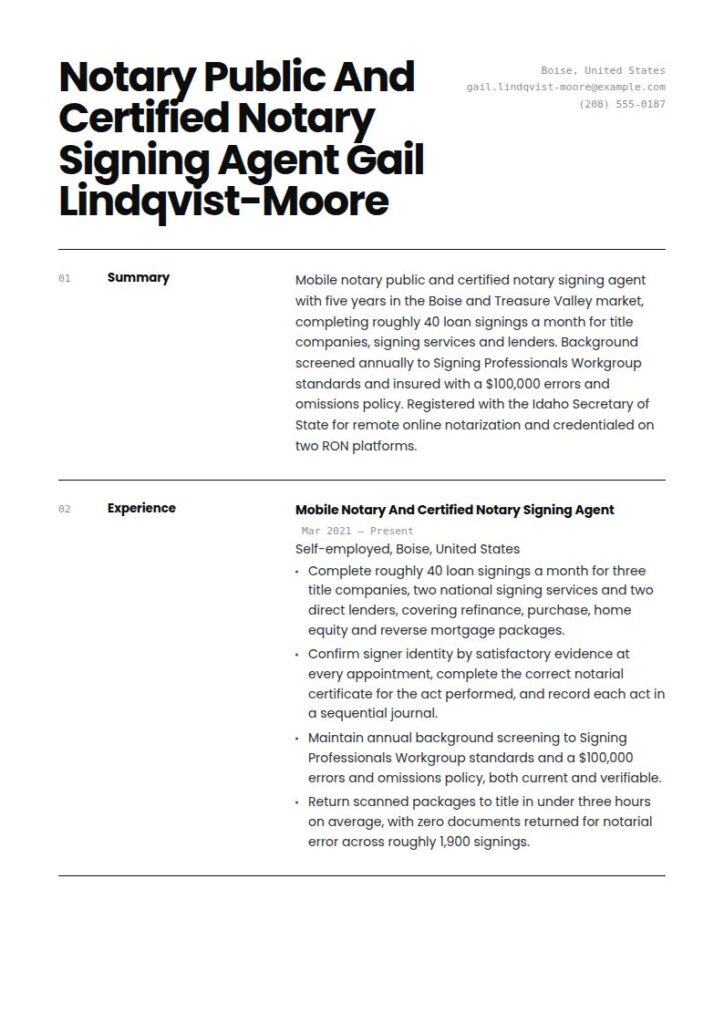
Mobile notary public and certified notary signing agent with five years in the Boise and Treasure Valley market, completing roughly 40 loan signings a month for title companies, signing services and lenders. Background screened annually to Signing Professionals Workgroup standards and insured with a $100,000 errors and omissions policy. Registered with the Idaho Secretary of State for remote online notarization and credentialed on two RON platforms.
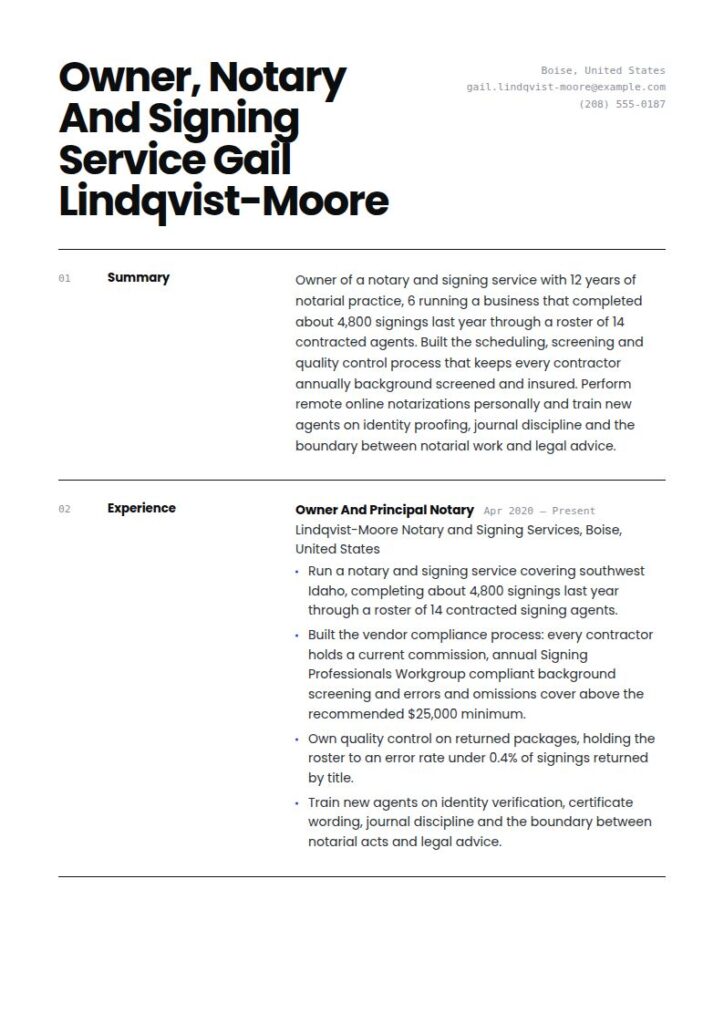
Owner of a notary and signing service with 12 years of notarial practice, 6 running a business that completed about 4,800 signings last year through a roster of 14 contracted agents. Built the scheduling, screening and quality control process that keeps every contractor annually background screened and insured. Perform remote online notarizations personally and train new agents on identity proofing, journal discipline and the boundary between notarial work and legal advice.
Right vs wrong: the same notary summary, twice
| ✅ Right | ❌ Wrong |
|---|---|
| Mobile notary and certified signing agent completing roughly 40 loan signings a month. | Licensed notary available for all your notary needs. |
| Background screened annually to Signing Professionals Workgroup standards, $100,000 E&O policy. | Trustworthy, reliable and professional. |
| Registered with the Idaho Secretary of State for remote online notarization. | Able to help clients with legal documents. |
The third wrong line is dangerous, not merely weak. Helping with legal documents is not something a notary may offer, and a title company reading it will assume you do not know that.
Outline your experience
Employer or business name, city, dates, and then bullets that carry volume, document type and the conditions you worked under.
| Instead of | Use |
|---|---|
| Notarized documents for clients | Performed roughly 60 acknowledgments, jurats and signature witnessings a month for in-office real estate closings |
| Worked as a mobile notary | Completed about 40 loan signings a month across the Treasure Valley, averaging 55 minutes per appointment at the signing table |
| Kept records of notarizations | Maintained a sequential, tamper-evident notarial journal with 100% completion on signer identification entries |
| Experienced with online notarization | Registered with the Idaho Secretary of State for remote online notarization and credentialed on two approved platforms |
What goes on the page, and what stays in the journal
A notarial journal records who appeared before you, what they signed and how they proved identity, and it sits alongside loan documents containing Social Security numbers and account details. None of that belongs on a resume. Never name a signer, a borrower, a property address, a lender or a title company's client, and never reproduce a journal entry as a work sample. Describe the work by type and volume instead: "roughly 40 loan signings a month, refinance and purchase, for three title companies and two signing services."
Inside a law firm the bar is higher again, because client information there is confidential and often privileged. Describe matters by type, size and your role, never by party. Our legal assistant resume example covers that side of the work.
Mobile Notary and Certified Notary Signing Agent, self-employed, Boise, ID, March 2021 to Present
Complete roughly 40 loan signings a month for three title companies, two national signing services and two direct lenders, covering refinances, purchases, home equity lines and reverse mortgages.
Confirm signer identity by satisfactory evidence at every appointment, complete the correct notarial certificate for the act performed, and record each act in a sequential journal.
Maintain annual background screening to Signing Professionals Workgroup standards and a $100,000 errors and omissions policy, both current and verifiable, and return scanned packages to title in under three hours on average with zero documents returned for notarial error across roughly 1,900 signings.
Perform remote online notarizations under Idaho registration on two approved platforms, retaining the audio and video recording of every session as required.
A commission is not a job: the three ways a notary gets paid
This is the decision the whole resume rests on, and it is why two notary resumes can look nothing alike.
One: the commission inside another job. Most of the 4.44 million commissioned notaries are here. A legal assistant, bank employee, escrow assistant, human resources administrator or medical records clerk holds a commission because the employer needs one on site, and usually pays the filing fee and the bond. The resume is the other job's resume; the commission goes in the header and credentials block with a volume figure and the document types.
Two: the notary signing agent. This is the one genuine career built on the commission. A signing agent is an independent contractor who conducts the signing of mortgage loan documents at closing: presenting each document, confirming identity, notarizing what requires it, and returning the package. The mortgage industry expects signing agents to pass an annual background check compliant with Signing Professionals Workgroup standards, covering a Social Security number trace, county criminal court search, motor vehicle records, the national sex offender registry, a nationwide criminal database, a federal district court search and USA Patriot Act watch lists, renewed every 12 months. The SPW also recommends a minimum errors and omissions policy of $25,000, against claims averaging around $14,000 (National Notary Association, 2026).
Where you live decides whether this is open to you. Nineteen states limit signing agent activity: an attorney is required at closing in Connecticut, Delaware, Georgia, Massachusetts, South Carolina, Vermont and West Virginia; an attorney is customary in New Jersey, New York, North Carolina and Ohio; a professional license is required in Indiana, Maryland, Minnesota and Virginia; and Nebraska, Nevada and Texas impose fee or loan limits (National Notary Association, 2026).
Three: the general notary business. Mobile and remote general notary work for hospitals, care homes, jails, estate planning clients and small businesses. Pay is per notarial act, capped by a state fee schedule, plus a travel fee that usually is not capped. Volume is lower than loan signings and the work is steadier, and the resume is a small business resume: entity, years, client types, volume, availability and specializations.
Remote online notarization, and what registration actually requires
Remote online notarization has moved from emergency measure to normal practice. The American Land Title Association reports that 48 states and the District of Columbia have either passed a RON law or issued an executive order on remotely notarizing documents (American Land Title Association, digital closings page, accessed September 2026). The National Notary Association lists Alabama, Connecticut, Georgia, Mississippi and South Carolina as prohibiting it, with California and Massachusetts scheduled to allow it in future (National Notary Association, updated 1 July 2026).
Being registered is not the same as being commissioned. The NNA's steps are: qualify as a traditional notary, register with the state, pay the fees, complete RON training and an examination where required, obtain an electronic seal and digital certificate, choose a state-approved vendor, obtain any additional bond, and carry an E&O policy covering RON (National Notary Association, 2026).
Idaho shows what that means on the page. A notary files an "Addition of Electronic or Remote Online Notary" amendment with the Secretary of State and selects a tamper-evident technology complying with the National Electronic Notarization Standards and IDAPA 34.07.01. The session requires audio and video of sufficient quality, identity proofing by knowledge-based authentication and credential analysis unless the signer is personally known, retention of the recording for at least ten years, and a certificate stating that "This notarial act involved the use of communication technology" (Idaho Secretary of State, notary training, 2026).
So the resume line is not "experienced with online notarization". It is the registration, the platforms, and the retention practice.
Build a snapshot of your key skills
Ten to fourteen entries in three groups: notarial practice, loan signing, and business and compliance. Keep every claim inside what a notary may do.
Notarial practice: Acknowledgments, Jurats and verifications on oath, Signature witnessing, Copy certification, Identity verification by satisfactory evidence, Sequential journal maintenance, Certificate wording selection
Loan signing: Refinance, purchase, home equity and reverse mortgage packages, Document walkthrough without explanation of terms, Scan-back and package return, Signing platform scheduling
Business and compliance: Annual SPW-compliant background screening, Errors and omissions insurance, Fee schedule compliance, Recordkeeping and retention, RON platforms and identity proofing
Notice what is absent: no "document preparation", no "legal forms assistance", no "contract advice". Those are not notarial acts.
List your education, commission and certifications
Commission first, then endorsements, then certifications and screening, then education. Most notary roles ask for a high school diploma, so the commission is the credential that matters.
Notary Public, State of Idaho, commission number 20240817, expires 14 May 2030. $10,000 surety bond. Registered with the Idaho Secretary of State for remote online notarization.
Certified Notary Signing Agent, National Notary Association, 2021, renewed annually. Background screening to Signing Professionals Workgroup standards, most recent February 2026. Errors and omissions insurance, $100,000, current to December 2026.
Platform credentials: two state-approved remote online notarization platforms, 2023 and 2024.
Associate of Applied Science, Business Administration, College of Western Idaho, Nampa, ID, 2013.
Choose the right layout and design
Single column, one page, plain type, no photograph, no graphics. If you run a notary business, resist the urge to make the resume a brochure: a title company vendor manager is checking screening, insurance, coverage area and availability, and a design that buries those under a logo works against you.
Write commissioned, not licensed. Give the commission number, state and expiry. State the bond if your state requires one. Say whether you are registered for remote online notarization and name the platforms. Give monthly or annual signing volume. State your background screening date and your E&O coverage amount. Keep a journal even where your state does not require one, and say that you do.
Do not name a signer, a borrower, a property or a lender's client. Do not offer document preparation, form completion or any explanation of what a document means. Do not describe yourself as able to help with legal matters. Do not list an expired commission without marking it expired. Do not claim RON capability without state registration and an approved platform.
Notary job market and outlook
There is no Bureau of Labor Statistics occupational projection for notaries, because the commission is a credential rather than an occupation. What can be measured is the population of notaries and the pay of the occupations that hold them.
| Measure | Value |
|---|---|
| Commissioned notaries in the United States, 2022 | 4.44 million |
| Commissioned notaries, 2017 | 4.48 million |
| States and territories with a RON law or executive order | 48 states and the District of Columbia |
| States listed as prohibiting RON | Alabama, Connecticut, Georgia, Mississippi, South Carolina |
| States limiting signing agent activity | 19 |
Sources: National Notary Association 2022 Notary Census; American Land Title Association digital closings page, accessed September 2026; National Notary Association, updated 1 July 2026.
The occupations that commonly carry a commission give a better picture of paid demand:
| Host occupation | Jobs, 2025 | Projected change, 2025-35 | Median annual wage, May 2025 |
|---|---|---|---|
| Paralegals and legal assistants | 404,900 | 0% (little or no change) | $62,890 |
| Legal secretaries and administrative assistants | 157,600 | -5% (decline) | $55,570 |
| Loan officers | 283,000 | 1% (slower than average) | $76,690 |
Source: U.S. Bureau of Labor Statistics, Occupational Outlook Handbook, May 2025 wage data and 2025-35 projections.
The signing agent market moves with mortgage volume rather than with any of those lines, which is the most important thing to understand before treating it as a full-time income. It is cyclical, and the notaries who ride out the low years are the ones who also hold general notary work, RON registration and relationships with more than one title company.
What salary you can expect as a notary
There is no median wage for notaries, because notarial work is either a duty inside a paid job or self-employed income paid per act.
Inside a job, the commission is a differentiator rather than a pay grade. The occupations that most often carry one had median annual wages of $62,890 for paralegals and legal assistants, $76,690 for loan officers and $55,570 for legal secretaries and administrative assistants as of May 2025 (BLS Occupational Outlook Handbook, May 2025). A commission rarely moves those numbers on its own, but it does decide which candidate is hired when the employer needs a notary on site, and employers commonly pay the filing fee and the bond.
As a signing agent, income is per signing and negotiated. The National Notary Association states plainly that "there is no set fee schedule for Notary Signing Agents," with individuals setting fees against expenses, travel, time and local demand (National Notary Association, 2026). Three things decide whether it adds up: volume, which follows mortgage activity; coverage area, which decides how much unpaid driving sits between appointments; and error rate, because a package returned for a notarial error costs a title company money and costs you the next assignment.
For general notary work the fee per act is capped by state law and the travel fee usually is not, which makes route density the real economics of the business. That is why a resume aimed at a signing service should state coverage radius and availability windows explicitly.
Key takeaways for a notary resume
- Decide first which of the three resumes you are writing: employed, signing agent, or business owner.
- Put the commission state, number and expiry in a verifiable line near the top, and write commissioned, never licensed.
- Name your RON registration and the platforms you are credentialed on.
- Give volume: notarizations a month, signings a month, or signings a year.
- State your background screening date and E&O coverage amount if you take signing work.
- Never name a signer, borrower, property or client, and never reproduce a journal entry.
- Keep every skill claim inside what a notary may do, with no drafting and no advice.
Build your notary resume in 15 minutes.
Related legal resume examples
- Lawyer resume
- Attorney resume
- Paralegal resume
- Legal assistant resume
- Immigration lawyer resume
- Claims adjuster resume
- Law school resume
- Criminology resume
- Legal resume
- Administrative assistant resume
- Executive assistant resume
- Compliance officer resume
Pair it with a matching notary cover letter.
Notary resume questions, answered
Is being a notary a job?
Not usually. A commission is a state appointment, held by about 4.44 million people as of the 2022 NNA Notary Census, and most hold it alongside another job. The one substantial career built on the commission is the notary signing agent, who conducts mortgage loan closings as an independent contractor. Decide which you are before you write, because the two documents share almost nothing.
What can a notary never do?
Give legal advice, prepare or draft legal documents, or explain what a document means, unless separately licensed to practice law. Idaho's notary training states that notaries may not "assist persons in drafting legal records, give legal advice or otherwise practice law." A notary also may not notarize a record in which the notary or the notary's spouse is a party or has a direct beneficial interest, and may not notarize for a signer who is not personally present where the act requires presence (Idaho Secretary of State, notary training, 2026). States word these rules differently, so check your own.
Do I need a journal, and should the resume mention it?
It depends on the state, and yes, mention it either way. Idaho does not require a journal but calls it a best practice and a defense against negligence claims, specifying a chronologically numbered format that deters deletion or alteration rather than a loose-leaf notebook (Idaho Secretary of State, 2026). A notary who keeps a journal where it is optional tells an employer something useful about how they work.
How do I become a notary signing agent?
Hold an active commission, pass an annual background check compliant with Signing Professionals Workgroup standards, complete a loan signing course and certification examination, and carry errors and omissions insurance, which the SPW recommends at a minimum of $25,000 (National Notary Association, 2026). Then check your state: nineteen states limit signing agent activity, with seven requiring an attorney at closing and four requiring a separate professional license.
What does remote online notarization add to a resume?
Reach, and evidence of currency. With 48 states and the District of Columbia having passed a RON law or issued an executive order (American Land Title Association, accessed September 2026), a registered remote notary can serve clients who are not in the room. Put the state registration, the approved platforms and your recording retention practice on the page, because those are what a title company verifies.