Claims Adjuster, All-Lines Roland Beauchêne
Claims Representative, Auto
[email protected] | (813) 555-0182 | Tampa, United States
Profile
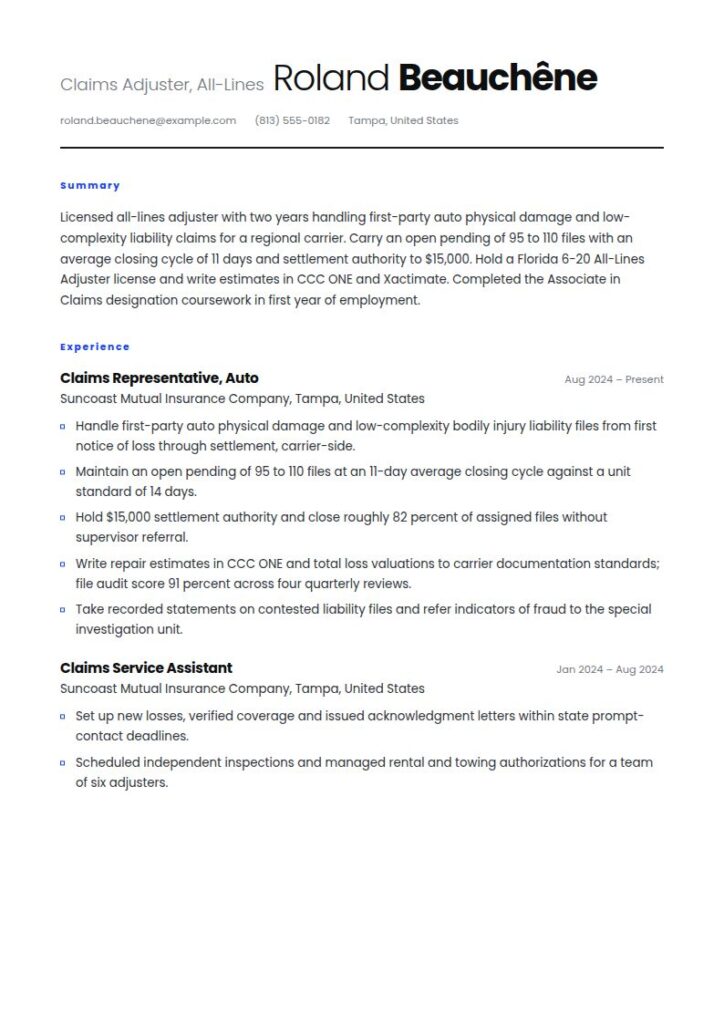
Licensed all-lines adjuster with two years handling first-party auto physical damage and low-complexity liability claims for a regional carrier. Carry an open pending of 95 to 110 files with an average closing cycle of 11 days and settlement authority to $15,000. Hold a Florida 6-20 All-Lines Adjuster license and write estimates in CCC ONE and Xactimate. Completed the Associate in Claims designation coursework in first year of employment.
Work Experience
08/2024 - Present, Claims Representative, Auto, Suncoast Mutual Insurance Company, Tampa, United States
- Handle first-party auto physical damage and low-complexity bodily injury liability files from first notice of loss through settlement, carrier-side.
- Maintain an open pending of 95 to 110 files at an 11-day average closing cycle against a unit standard of 14 days.
- Hold $15,000 settlement authority and close roughly 82 percent of assigned files without supervisor referral.
- Write repair estimates in CCC ONE and total loss valuations to carrier documentation standards; file audit score 91 percent across four quarterly reviews.
- Take recorded statements on contested liability files and refer indicators of fraud to the special investigation unit.
01/2024 - 08/2024, Claims Service Assistant, Suncoast Mutual Insurance Company, Tampa, United States
- Set up new losses, verified coverage and issued acknowledgment letters within state prompt-contact deadlines.
- Scheduled independent inspections and managed rental and towing authorizations for a team of six adjusters.
Education
08/2020 - 05/2024, Bachelor of Science, Risk Management and Insurance, Florida State University, Tallahassee, United States
Coursework in property and liability insurance, insurance law and regulation, and loss adjusting. Florida 6-20 All-Lines Adjuster license obtained on graduation.
Skills
Coverage verification and policy interpretation, 70
Auto physical damage estimating, 75
CCC ONE, 80
Xactimate, 60
Recorded statements, 70
Reserve setting, 65
Unfair claims settlement practices compliance, 70
Languages
English, native
French, native
Spanish, intermediate
Certificates
06/2024, Florida All-Lines Adjuster License 6-20, Florida Department of Financial Services, A1258043
All-lines authority. Continuing education current at 24 hours per cycle including 3 hours ethics.
03/2026, Associate in Claims (AIC), The Institutes
Four-course designation covering claims handling, investigation and specialty evaluation.
Summary
A claims adjuster resume is a one to two page document naming your adjuster license and its lines of authority, the party you adjust for, the coverages you handle, and the caseload numbers behind your work. This guide gives you three adaptable versions, the volume and severity figures hiring managers look for, and current Bureau of Labor Statistics pay and outlook.
Claims Adjuster resume examples by experience level
A claims adjuster resume is a one to two page document that names your adjuster license, the lines of authority on it, the party you adjust for, and the volume and severity of the files you have actually closed.
That last part separates a shortlist from a pile. Claims runs on published internal numbers: every adjuster knows their open pending, their cycle time and their average severity, because a supervisor reviews all three every month.
Resume guide for a claims adjuster resume
This guide and the corresponding claims adjuster resume example will cover:
- How to write a claims adjuster resume, section by section
- Why the party you represent belongs in the first line, not the third paragraph
- Three adaptable summaries: new adjuster, field adjuster and claims supervisor
- The caseload, cycle time and severity figures that carry a claims file
- What the job market looks like and what you can expect to earn
How to write a claims adjuster resume
Six sections: contact header, summary, licensing and designations, claims experience, systems and skills, and education.
Licensing sits above experience because it is a gate. In most of the country an adjuster cannot touch a file without the right license in the right state, and a recruiter checks that before reading anything else.
| Section | What it is answering | Where it goes |
|---|---|---|
| License and lines of authority | Can this person legally handle my claims, in my states? | Directly under the summary |
| Side and lines of business | Whose interest do they represent, in what coverages? | First line of the summary |
| Claims experience | What volume, at what severity, closed how fast? | Reverse chronological, with numbers |
| Systems | Can they write an estimate on day one? | Its own block, named platforms |
Your license is a gate, so put its number and its lines on the page
Adjuster licensing is not uniform, which is why stating yours plainly is worth doing. The NAIC State Licensing Handbook, Chapter 18, records that 40 states license public adjusters, 33 license independent adjusters, and only 15 require company adjusters to be licensed, with roughly 18 states requiring continuing education and a model guideline of 24 hours every two years including three hours of ethics.
Adjusters in a non-licensing state can qualify through an Adjuster Designated Home State, sitting the exam and fingerprinting as a resident would, then working outward through non-resident licenses.
Write it the way a compliance team reads it: issuing state, license type and code, number, expiry, then every non-resident state you hold. An independent firm staffing a deployment wants adjusters who can already be deployed.
Run the finished file through the free Rezoom ATS resume checker before you submit. Carriers parse your file before a person opens it.
Choosing the best resume format for a claims adjuster resume
Reverse chronological, every time. One page for your first five years, two once you have catastrophe deployments, large loss authority or a team.
A functional format fails here, because a claims resume is read for progression of authority: how much money were you allowed to commit without a signature, and how did that number grow?
Include your contact information
| ✅ Right | ❌ Wrong |
|---|---|
| Roland Beauchêne | Roland Beauchêne |
| Property Field Adjuster, All-Lines | Insurance professional with claims background |
| Florida 6-20 All-Lines Adjuster, #A1258043, plus GA, SC, TX, LA non-resident | Licensed adjuster |
| (813) 555-0182, [email protected], Tampa, FL | (813) 555-0182, [email protected] |
Make use of a summary
Four lines: the side you work for, your lines of business, your license footprint, and one volume or severity number.
Licensed all-lines adjuster with two years handling first-party auto physical damage and low-complexity liability claims for a regional carrier. Carry an open pending of 95 to 110 files with an average closing cycle of 11 days and settlement authority to $15,000. Hold a Florida 6-20 All-Lines Adjuster license and write estimates in CCC ONE and Xactimate. Completed the Associate in Claims designation coursework in first year of employment.
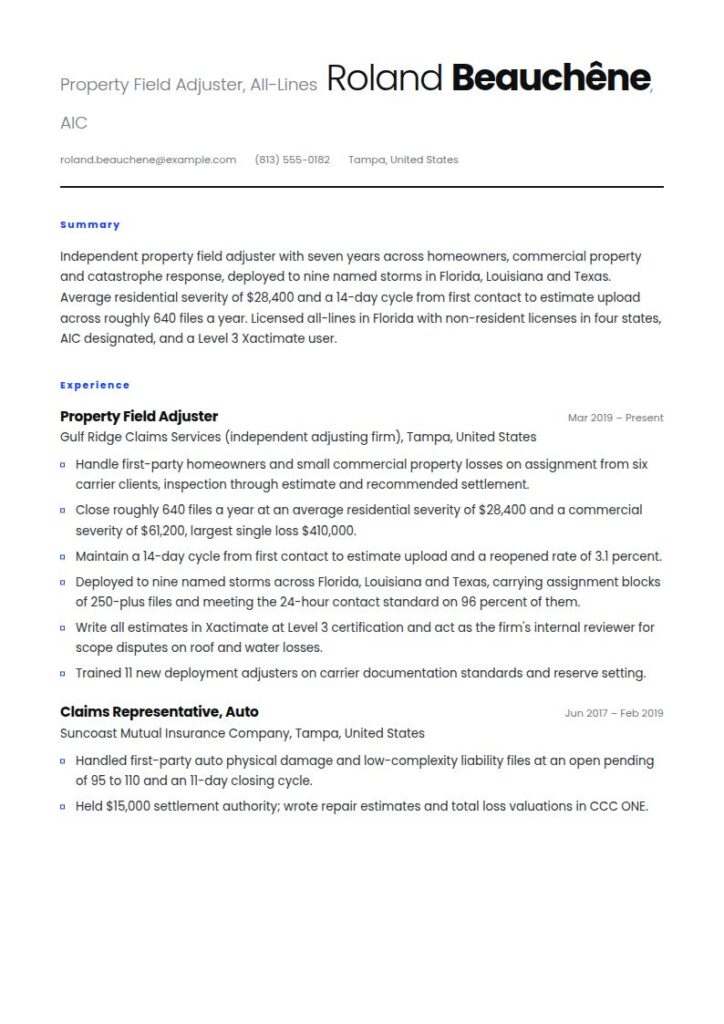
Independent property field adjuster with seven years across homeowners, commercial property and catastrophe response, deployed to nine named storms in Florida, Louisiana and Texas. Average residential severity of $28,400 and a 14-day cycle from first contact to estimate upload across roughly 640 files a year. Licensed all-lines in Florida with non-resident licenses in four states, AIC designated, and a Level 3 Xactimate user.
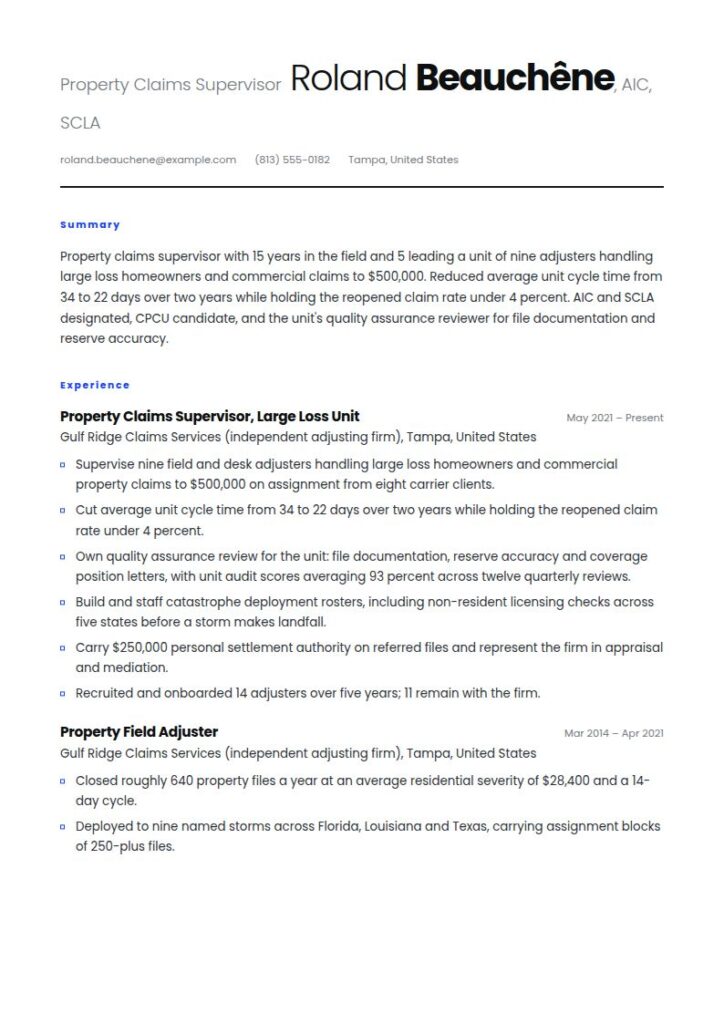
Property claims supervisor with 15 years in the field and 5 leading a unit of nine adjusters handling large loss homeowners and commercial claims to $500,000. Reduced average unit cycle time from 34 to 22 days over two years while holding the reopened claim rate under 4 percent. AIC and SCLA designated, CPCU candidate, and the unit's quality assurance reviewer for file documentation and reserve accuracy.
Right vs wrong: the same claims adjuster summary, twice
| ✅ Right | ❌ Wrong |
|---|---|
| Independent property field adjuster with seven years across homeowners, commercial property and catastrophe response. | Insurance professional with extensive experience in the claims industry. |
| Average residential severity of $28,400 and a 14-day cycle across roughly 640 files a year. | Handled a high volume of claims in a fast-paced environment. |
| Licensed all-lines in Florida with non-resident licenses in four states, AIC designated, Level 3 Xactimate. | Strong knowledge of insurance policies and excellent customer service skills. |
The right column can be staffed onto a storm next week. The left column cannot, and a deployment coordinator is staffing, not admiring.
Outline your claims experience
Employer, the type of employer, city, dates. Then three to five bullets, each naming a coverage, a volume, a dollar figure or a cycle time.
| Instead of | Use |
|---|---|
| Handled insurance claims from start to finish | Managed an open pending of 120 to 140 first-party property files, coverage through settlement |
| Investigated claims for accuracy | Took recorded statements on 180 contested liability files a year and referred 22 to the special investigation unit |
| Wrote estimates using industry software | Wrote 640 Xactimate estimates a year at an average residential severity of $28,400 |
| Settled claims within authority | Held $50,000 settlement authority and closed 88 percent of files without a supervisor referral |
Property Field Adjuster, Gulf Ridge Claims Services (independent adjusting firm), Tampa, FL, March 2019 to Present
Handle first-party homeowners and small commercial property losses on assignment from six carrier clients, inspection through estimate and recommended settlement.
Close roughly 640 files a year at an average residential severity of $28,400, with a 14-day cycle from first contact to estimate upload.
Deployed to nine named storms in Florida, Louisiana and Texas, carrying assignment blocks of 250-plus files and clearing initial contact inside 24 hours on 96 percent of them.
Write all estimates in Xactimate at Level 3 certification; act as the firm's internal reviewer for scope disputes on roof and water losses.
Trained 11 new deployment adjusters on carrier documentation standards and reserve setting.
Name the side you adjust for, the lines you carry and your open pending
This is the block that decides the read, and most claims resumes leave all three parts implicit.
The first is whose interest you represent. Staff adjusters are salaried employees of the insurer. Independent adjusters are self-employed or work for an independent firm and take assignments from carriers, which makes them contractors to the same side. Public adjusters are the opposite: the NAIC State Licensing Handbook defines a public adjuster as a person who, for compensation, acts on behalf of an insured in negotiating or effecting the settlement of a first-party claim. Staff and independent work is carrier-side; public adjusting is policyholder-side. Moving between them is a career change, not a lateral step, and a resume that blurs the line reads as one written by someone outside the business.
The second is lines of business. Auto, property, commercial, workers compensation and general liability are close to separate occupations. A workers compensation examiner managing indemnity and medical on a multi-year file and an auto appraiser writing a repair estimate share almost nothing day to day.
The third is your numbers. Open pending is the files assigned to you at a point in time; cycle time is days from first notice of loss to closure; severity is average paid per closed claim; leakage is money paid above what the policy and the facts required, found in file audit.
Side: Carrier-side. Independent adjuster on assignment from six carrier clients; no public adjusting engagements.
Lines handled: Homeowners HO-3 and HO-5, dwelling fire, small commercial property, additional living expense, limited auto physical damage.
Volume and severity: 640 closed files a year, average residential severity $28,400, average commercial severity $61,200, largest single loss $410,000.
Performance: 14-day average cycle, 24-hour contact standard met on 96 percent of catastrophe assignments, reopened rate 3.1 percent, file audit score 94 percent.
Authority: $50,000 settlement authority, $100,000 reserve authority.
State whether you are staff, independent or public in the first line. List every state license with its type code and number. Give open pending, cycle time and severity as real figures from your own reviews. Name your estimating platform and your certification level on it. Show how your settlement authority grew across roles.
Do not name a claimant, an insured, a policy number or a claim number anywhere on the resume or in an interview; those belong to the file and the carrier, and using them is a confidentiality breach that will cost you the offer. Do not write "all lines" without saying which lines you have genuinely worked. Do not list an estimating platform you have only watched someone else use.
Build a snapshot of your key skills
Twelve to sixteen entries in four groups: coverage and investigation, estimating and systems, negotiation, and compliance.
Coverage and investigation: Policy interpretation and coverage analysis, Cause and origin assessment, Recorded statements, Subrogation identification, Reserve setting
Estimating and systems: Xactimate Level 3, Symbility, CCC ONE, Guidewire ClaimCenter, EagleView aerial measurement, Matterport and photo documentation
Negotiation and resolution: Settlement negotiation, Appraisal and umpire process, Mediation, Contractor scope disputes
Compliance and quality: Unfair claims settlement practices rules, State prompt-pay deadlines, File documentation standards, Quality assurance audit
Xactimate is the platform most carriers and independent firms write to, with Symbility and CCC ONE common alongside it, and a named certification level beats a mention.
List your education, licenses and designations
License first with the state, code, number and expiry. Then non-resident licenses, then designations, then the degree, which matters least of the four.
Florida All-Lines Adjuster License 6-20, #A1258043, Florida Department of Financial Services, valid through 2028
Non-resident all-lines adjuster licenses: Georgia, South Carolina, Texas, Louisiana. Continuing education current, 24 hours per cycle including 3 hours ethics.
Associate in Claims (AIC), The Institutes, 2021. Four-course designation covering claims handling, investigation and specialty evaluation.
Senior Claim Law Associate (SCLA), American Educational Institute, 2024. Legal Principles plus Property, Liability and Claims Fraud Investigation and Defense.
Chartered Property Casualty Underwriter (CPCU), The Institutes, in progress, four of eight courses complete.
Bachelor of Science, Risk Management and Insurance, Florida State University, Tallahassee, FL, 2017
Xactimate Level 3 Certification, Verisk, 2022
Choose the right layout and design
Single column, 11 or 12 point, no photograph, no graphics. Carrier applicant systems parse the file into a structured record, and two-column templates, icons and text boxes are where parsing fails.
Claims adjuster job market and outlook
A large occupation in measured decline, where automation is removing the simple files and leaving the complex ones.
| Measure | Value |
|---|---|
| Claims adjusters, examiners and investigators, 2025 | 376,100 |
| Insurance appraisers, auto damage, 2025 | 13,500 |
| Projected change, 2025-35 (all four titles) | -6 percent, -21,800 |
| Projected annual openings | ~21,600 |
| Typical entry-level education | High school diploma or equivalent |
| Median annual wage, May 2025 | $78,000 |
Source: U.S. Bureau of Labor Statistics, Occupational Outlook Handbook, claims adjusters, appraisers, examiners and investigators, 2025-35 projections and May 2025 wage data.
The work is shrinking and concentrating at the same time
Employment of claims adjusters, appraisers, examiners and investigators is projected to decline 6 percent from 2025 to 2035, a loss of 21,800 jobs, while still generating about 21,600 openings a year from replacement need (BLS Occupational Outlook Handbook, 2025-35 projections).
The volume side has not gone away. Twenty-three separate weather and climate disasters in the United States crossed one billion dollars in damage during 2025, at a combined cost of roughly $115 billion (Climate Central, January 2026, continuing the NOAA billion-dollar disaster series).
Read together, the picture is clear. Straight-through processing is absorbing low-severity auto and simple property files, so the roles that remain are the ones a model will not close by itself: large loss, complex coverage, commercial, litigated liability and catastrophe field work. Write your resume toward the complex end of your own caseload.
Where the jobs sit:
| Setting | Share of employment | Median annual wage (May 2025) |
|---|---|---|
| Direct insurance carriers, except life, health and medical | 35 percent | $79,280 |
| Agencies, brokerages and other insurance activities | 29 percent | $76,130 |
| Federal government | 13 percent | $93,660 |
| Direct health and medical insurance carriers | 7 percent | $59,800 |
| State government | 3 percent | $74,440 |
Source: U.S. Bureau of Labor Statistics, Occupational Outlook Handbook, May 2025.
What salary you can expect as a claims adjuster
The median annual wage for claims adjusters, examiners and investigators was $78,000 in May 2025, with insurance appraisers of auto damage at $78,240. The lowest 10 percent earned less than $48,850 and the highest 10 percent more than $117,040 (BLS, May 2025).
The spread is wide because the title covers an inside auto representative on a phone queue and a commercial large loss examiner. Federal government adjusting carries the highest industry median at $93,660, ahead of carriers at $79,280, while health and medical claims work sits at $59,800 (BLS, May 2025).
Three things move an individual offer and all three belong on the resume: settlement authority, because it is shorthand for trust; multi-state licensing, because a deployable adjuster is worth more than a licensed one; and designations, because AIC, SCLA and CPCU are the ladder the industry recognizes. Catastrophe work is often paid per file rather than by salary, which is why deployment counts and file volumes belong on the page.
Key takeaways for a claims adjuster resume
- Say whether you are staff, independent or public in the first line; they serve opposite parties.
- List every license with its state, code and number, and every non-resident state.
- Name your lines of business: auto, property, commercial, workers compensation, liability.
- Give open pending, cycle time and severity as real numbers from your own reviews.
- Name your estimating platform and your certification level on it.
- Show settlement authority growing across roles; it is the clearest proof of progression.
- Keep every claimant name, policy number and claim number off the document.
Build your claims adjuster resume in 15 minutes.
Related legal resume examples
- Lawyer resume
- Attorney resume
- Paralegal resume
- Legal assistant resume
- Immigration lawyer resume
- Law school resume
- Criminology resume
- Notary resume
- Legal resume
- Administrative assistant resume
- Insurance agent resume
- Compliance officer resume
Pair it with a matching claims adjuster cover letter.
Claims adjuster resume questions, answered
Do I have to be licensed to work as a claims adjuster?
It depends on the state and on which kind of adjuster you are. The NAIC State Licensing Handbook records 40 states licensing public adjusters, 33 licensing independent adjusters, and 15 requiring company adjusters to be licensed. If you live in a non-licensing state, you can qualify through an Adjuster Designated Home State and build non-resident licenses from there. Check your own state insurance department, because lines of authority and continuing education rules vary.
What is the difference between a staff, independent and public adjuster on a resume?
Staff adjusters are employees of the insurer. Independent adjusters take assignments from carriers, usually through an adjusting firm. Public adjusters represent the policyholder against the insurer. The first two are carrier-side and the third is not, so a resume that does not say which one you are forces the reader to guess.
What numbers should go on a claims adjuster resume?
Open pending, average cycle time to close, average severity, files closed per year, settlement and reserve authority, and reopened rate. Pick four you can defend and attach a period to each. If your employer measures leakage and yours is strong, that is one of the most persuasive figures in the occupation.
Can I put claim details on my resume?
No. Claimant and insured names, policy numbers, claim numbers and identifiable loss descriptions stay in the claim file. Describe your work by claim type, coverage, volume, severity band and your own role. A large loss can be written as "a $410,000 commercial fire" without naming anything, and that is the correct level of detail.
Which designations are worth doing?
The Associate in Claims from The Institutes is the usual first step, four courses over roughly six to nine months, and it credits toward CPCU. The Senior Claim Law Associate from the American Educational Institute is Legal Principles plus three of five specialty programs. For property field work, a named Xactimate certification level often matters more to a hiring firm than any of them.