Roland Beauchêne Property Field Adjuster, All-Lines Tampa, 33607, United States [email protected] · (813) 555-0182
11 September 2026
Ms. Adaeze Okonjo Property Claims Anclote Mutual Insurance Clearwater, United States
Application for Property Field Adjuster, Anclote Mutual Insurance
Dear Ms. Okonjo,
I am applying for the Property Field Adjuster post at Anclote Mutual. I hold a Florida 6-20 all-lines adjuster license with current non-resident licenses in Georgia, South Carolina, Texas and Louisiana, and I have spent seven years carrier-side as an independent adjuster on homeowners, dwelling fire and small commercial property losses.
My numbers are steady rather than dramatic, which is the point in this work. I close roughly 640 files a year at an average residential severity of $28,400 and a 14-day cycle from first contact to estimate upload, with a reopened rate of 3.1 percent and file audit scores averaging 94 percent. Across nine named storm deployments I have met the 24-hour contact standard on 96 percent of assignments, usually while carrying blocks of more than 250 files.
Anclote writes a coastal homeowners book, and I read that you brought severe weather claims back in house last year. The part I would want to work on is the handoff between the field and the desk, because that is where cycle time is won or lost. I also review scope disputes on roof and water losses for my current firm, and I would be glad to keep doing that.
I am AIC designated, SCLA designated, and certified to Xactimate Level 3. I can start within four weeks and I am available for catastrophe deployment. Thank you for your time.
Sincerely, Roland Beauchêne, AIC, SCLA
Summary
A claims adjuster cover letter names the adjuster license you hold and the states it reaches, whether you work carrier-side or policyholder-side, the lines of business you handle, and one caseload figure you can defend. This guide gives you a full adaptable letter, the openings that work, and the confidentiality rule that decides whether a hiring manager trusts you.
Claims Adjuster cover letter examples by experience level
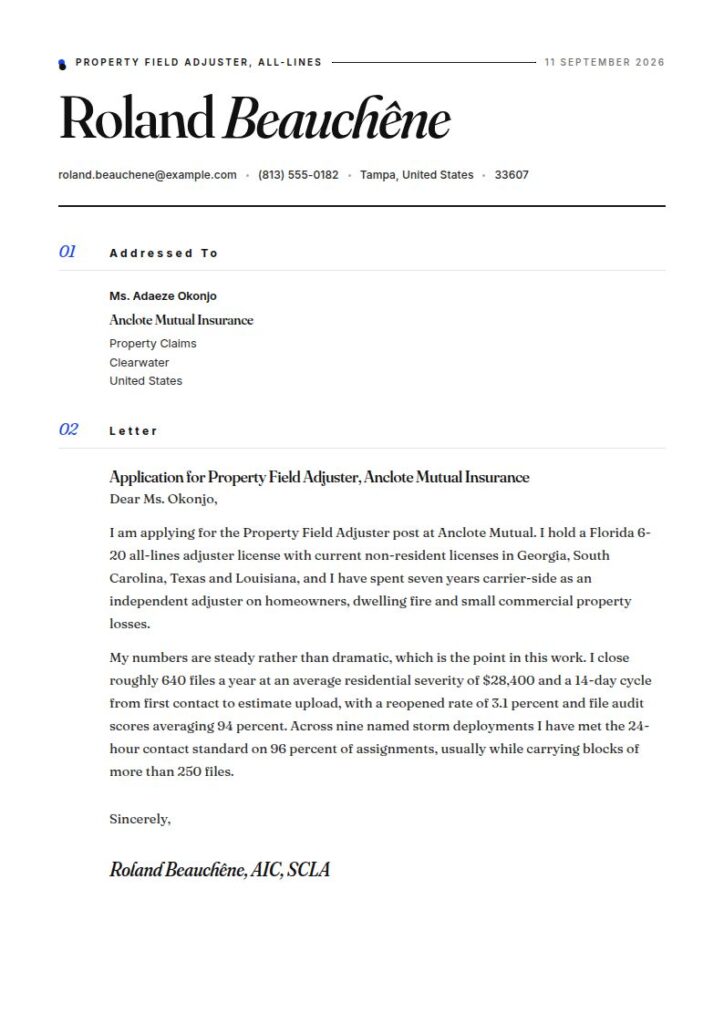
A claims adjuster cover letter is a one-page letter telling a claims manager which license you hold, which states it reaches, which lines of business you carry, and what your caseload numbers look like.
Claims hiring is a staffing decision before it is a talent decision. A manager with an open desk is asking whether you can be assigned files in their jurisdiction next month.
Guide to a claims adjuster cover letter
This guide and the corresponding claims adjuster cover letter example will cover:
- How to structure the letter, paragraph by paragraph
- Why your license and its states belong in the opening line
- What a defensible caseload number looks like
- The confidentiality rule that separates professionals from applicants
- How the letter changes for staff, independent and public roles
How to write a claims adjuster cover letter
| Paragraph | Its job | Length |
|---|---|---|
| Opening | The role, your license and states, the lines you carry | 2 to 3 sentences |
| Evidence | One volume figure, one severity or cycle figure, one period | 4 to 5 sentences |
| Fit | Something specific about their book, and what you would take on | 3 to 4 sentences |
| Close | Designations, availability, thank you | 2 sentences |
Put the license footprint in the first line
Adjuster licensing is uneven across the country, and that unevenness is the hiring constraint. The NAIC State Licensing Handbook, Chapter 18, records 40 states licensing public adjusters, 33 licensing independent adjusters, and 15 requiring company adjusters to hold a license.
A manager staffing a Gulf Coast desk has to know whether you can work Louisiana and Texas files without a six-week licensing delay. Write it plainly: "Florida 6-20 all-lines, with non-resident licenses in Georgia, South Carolina, Texas and Louisiana, all current."
If you are licensed through an Adjuster Designated Home State rather than by residency, say so. A compliance team would rather read it than discover it.
A claims adjuster cover letter example you can adapt
Dear Ms. Okonjo,
I am applying for the Property Field Adjuster post at Anclote Mutual. I hold a Florida 6-20 all-lines adjuster license with current non-resident licenses in Georgia, South Carolina, Texas and Louisiana, and I have spent seven years carrier-side as an independent adjuster on homeowners, dwelling fire and small commercial property losses.
My numbers are steady rather than dramatic, which is the point in this work. I close roughly 640 files a year at an average residential severity of $28,400 and a 14-day cycle from first contact to estimate upload, with a reopened rate of 3.1 percent and file audit scores averaging 94 percent. Across nine named storm deployments I have met the 24-hour contact standard on 96 percent of assignments, usually while carrying blocks of more than 250 files.
Anclote writes a coastal homeowners book, and I read that you brought severe weather claims back in house last year. The part I would want to work on is the handoff between the field and the desk, because that is where cycle time is won or lost. I also review scope disputes on roof and water losses for my current firm, and I would be glad to keep doing that.
I am AIC designated, SCLA designated, and certified to Xactimate Level 3. I can start within four weeks and I am available for catastrophe deployment. Thank you for your time.
Sincerely, Roland Beauchêne, AIC, SCLA
Openings that work
| Instead of | Use |
|---|---|
| I am writing to express my interest in your claims adjuster position | I am applying for the Property Field Adjuster post and hold current all-lines licenses in five states |
| I have extensive experience in the insurance industry | Seven years carrier-side on homeowners, dwelling fire and small commercial property |
| I have a proven track record of settling claims efficiently | 640 files a year at a 14-day cycle and a 3.1 percent reopened rate |
| I would be a valuable asset to your team | You brought severe weather claims back in house last year, and the field-to-desk handoff is where cycle time is won |
Numbers you can defend
Every adjuster is measured, so every adjuster has figures. The question is which ones you can explain under a follow-up question.
| Metric | What it means | How it reads in a sentence |
|---|---|---|
| Cycle time | Days from first notice of loss to closure | Closed at a 14-day average against a 21-day standard |
| Severity | Average paid per closed claim | Average residential severity of $28,400 |
| Reopened rate | Share of closed files that come back | Held reopened files under 4 percent |
| Authority | Money you can commit without a signature | $50,000 settlement and $100,000 reserve authority |
Pick three. A letter with seven numbers in it reads like a dashboard.
Confidentiality is part of the audition
Claim files contain names, addresses, policy numbers, claim numbers, medical records, financial records and recorded statements. None of it belongs in a job application. A candidate who writes "I handled the Delacroix fire loss on policy HO-4418823" has told the reader one thing: that they will do the same with this employer's files.
Describe the work at the level of claim type, coverage, dollar band and your own role. "A $410,000 commercial fire with a business interruption component and a disputed scope" is specific, useful and names nothing. That is the register for the interview as well as the letter.
Name the license, the code and every state in the first paragraph. Say whether the role is staff, independent or public, and which of those you have done. Give three numbers you can explain. Name the estimating platform and your certification level. Say whether you are available for catastrophe deployment, because for many employers that is the whole question.
Do not name a claimant, an insured, a policy number or a claim number. Do not carry a public adjusting pitch into a carrier application, or the reverse, without addressing the change of side directly. Do not quote a metric you cannot reconstruct from your own reviews. Do not describe yourself as detail-oriented in a letter that reports no details.
A declining occupation with steady replacement hiring
Employment of claims adjusters, appraisers, examiners and investigators is projected to decline 6 percent from 2025 to 2035, a loss of 21,800 jobs, while still generating about 21,600 openings a year, almost all replacements. The median annual wage was $78,000 in May 2025 (BLS Occupational Outlook Handbook, 2025-35 projections and May 2025 wage data).
Loss volume is not falling with it. Twenty-three United States weather and climate disasters crossed one billion dollars in damage during 2025, costing roughly $115 billion in total (Climate Central, January 2026, continuing the NOAA billion-dollar disaster series).
Automation is taking the simple files. The work left on the desk is complex coverage, large loss, commercial, litigated liability and catastrophe response, so your letter should point at the hardest thing you do, not the most common.
Staff, independent and public roles need different letters
The NAIC State Licensing Handbook defines a public adjuster as someone who, for compensation, acts on behalf of an insured in negotiating or effecting the settlement of a first-party claim. Staff and independent adjusters work the other side of that table.
For a staff role, emphasize file ownership, cycle discipline and working inside one carrier's guidelines. For an independent role, emphasize deployability: licensing footprint, storm history and turnaround under assignment volume. For a public adjusting role, emphasize documentation, policy reading and negotiation.
If you are crossing between them, address it in one sentence. A manager will ask anyway.
Length, format and sending it
One page, four paragraphs, 250 to 400 words. PDF unless the portal insists otherwise, named for yourself and the role: roland-beauchene-property-field-adjuster-cover-letter.pdf.
Address a person. Claims leadership is usually visible on a carrier or firm website, and a generic salutation on an otherwise precise letter suggests the precision was recycled.
Keep the figures identical to your resume. Our claims adjuster resume example uses the same numbers as the letter above.
Key takeaways
- Open with the license, its code and every state it reaches.
- Say whether you work carrier-side or policyholder-side, and name the lines you carry.
- Give three caseload numbers you can explain under questioning.
- Name your estimating platform and certification level.
- Say whether you are available for catastrophe deployment.
- Keep every claimant name, policy number and claim number out of the letter.
- Address a named person and stay on one page.
Write your claims adjuster cover letter in 10 minutes.
Claims adjuster cover letter questions, answered
How long should a claims adjuster cover letter be?
One page, four paragraphs, 250 to 400 words. Claims managers read applications between file reviews, and length does not read as effort.
Do I need a cover letter if I am applying to an independent adjusting firm?
Yes, and it is arguably more useful there. Firm rosters are built around licensing and availability, and the letter is the only place you can state your states, your storm history and your deployment availability in a form a coordinator can act on.
What if I have no claims experience yet?
Lead with the license, because it takes months to get and most applicants do not have it. Then give adjacent evidence: construction or auto body knowledge, customer contact volume, estimating coursework, or any role where you documented facts under a deadline.
Can I mention a specific claim I handled?
Describe it, never identify it. Claim type, coverage, dollar band, the complication and what you did is the right level. Names, policy numbers, claim numbers and identifiable loss descriptions are confidential and belong nowhere near an application.
How do I write for a carrier I do not know?
Spend fifteen minutes on their own material first: what lines they write, which states they are admitted in, whether they use independent firms or staff adjusters. One accurate sentence about their book is worth more than a paragraph of admiration.