Marisol Trevino Litigation Legal Assistant San Antonio, 78212, United States [email protected] · (210) 555-0184
11 September 2026
Ms. Adaeze Okonkwo Firm Administrator Barrow Keene LLP San Antonio, United States
Application for Litigation Legal Assistant, Barrow Keene LLP
Dear Ms. Okonkwo,
I am applying for the Litigation Legal Assistant post at Barrow Keene LLP. I have run the docket for a five-attorney civil defense group for six years, e-file in CM/ECF for the Western District of Texas and the Fifth Circuit and through eFileTexas in three counties, and I hold a current Texas notary commission.
The part of the job I would bring is the calendar. I calculate deadlines from the triggering event under Federal Rule of Civil Procedure 6 and the applicable local rules rather than waiting to be handed a date, enter each one with reminders at 30, 14 and 3 days, and check my entries against the court's own docket every week. Across six years and roughly 220 open matters, no filing deadline has been missed.
Your posting mentions a move to NetDocuments this year. I took our practice group through an iManage rollout in 2023, including the naming convention and the closed-file retention schedule, so I have done the unglamorous half of that work: the back-file cleanup and the six weeks of correcting people. I would also be glad to pick up trust deposit entry and monthly reconciliation support, which I do now alongside the firm administrator.
I can describe my experience in as much detail as you need without naming a client or a matter, which I mention because it is part of the job. I am available for interview at any time and could start on four weeks' notice. Thank you for your time.
Sincerely, Marisol Trevino
Summary
A legal assistant cover letter tells a firm administrator which docket you can take over, which courts you can file in, and what has not gone wrong on your watch. This guide gives you a full adaptable letter, the openings that work, what counts as evidence in a support role, and the confidentiality rule that governs every sentence you write.
Legal Assistant cover letter examples by experience level
A legal assistant cover letter is a one-page letter that tells a firm which docket you could take over, which courts you can file in on your first Monday, and what has not gone wrong while you were responsible for it.
The person reading it is usually a firm administrator or an office manager who is short-staffed right now. They are not looking for eloquence. They are looking for someone who will not need six weeks of supervision.
Guide to a legal assistant cover letter
This guide and the corresponding legal assistant cover letter example will cover:
- How to structure the letter, paragraph by paragraph
- Why the docket and the courts belong in the first paragraph
- What counts as evidence when your job is that nothing goes wrong
- How to write about your matters without breaching confidentiality
- The openings that get a support letter read to the end
How to write a legal assistant cover letter
| Paragraph | Its job | Length |
|---|---|---|
| Opening | The post, the docket size you carry, the courts you file in | 2 to 3 sentences |
| Evidence | One system you own, one volume, one reliability figure | 4 to 5 sentences |
| Fit | Something specific about the firm, and what you would take on | 3 to 4 sentences |
| Close | Confidentiality, availability, thank you | 2 sentences |
Open with the docket, not with your interest in the law
Nearly every legal assistant cover letter opens by expressing interest in the firm and enthusiasm for the legal field. It is the least informative sentence available and it is in most of the stack. Replace it with what the reader is short of: "I have run the docket for a five-attorney civil defense group for six years and e-file in CM/ECF for the Western District of Texas and the Fifth Circuit."
That sentence tells the administrator the practice area, the scale, the level of independence, and the two court systems you can use tomorrow. It is one line and it does the work of a paragraph.
A legal assistant cover letter example you can adapt
Dear Ms. Okonkwo,
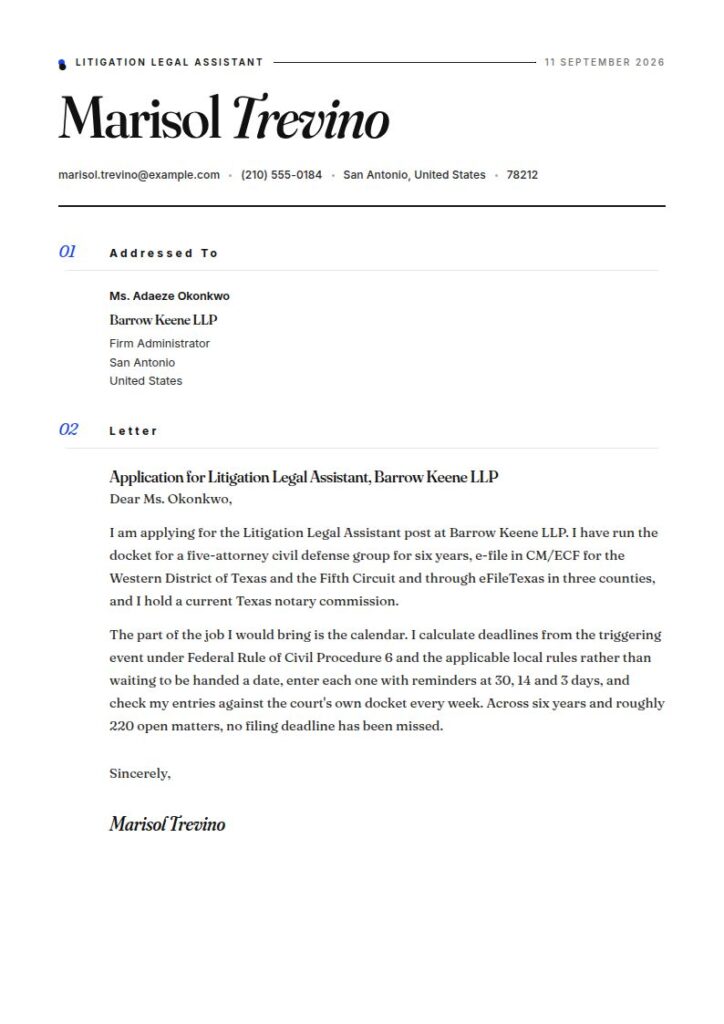
I am applying for the Litigation Legal Assistant post at Barrow Keene LLP. I have run the docket for a five-attorney civil defense group for six years, e-file in CM/ECF for the Western District of Texas and the Fifth Circuit and through eFileTexas in three counties, and I hold a current Texas notary commission.
The part of the job I would bring is the calendar. I calculate deadlines from the triggering event under Federal Rule of Civil Procedure 6 and the applicable local rules rather than waiting to be handed a date, enter each one with reminders at 30, 14 and 3 days, and check my entries against the court's own docket every week. Across six years and roughly 220 open matters, no filing deadline has been missed.
Your posting mentions a move to NetDocuments this year. I took our practice group through an iManage rollout in 2023, including the naming convention and the closed-file retention schedule, so I have done the unglamorous half of that work: the back-file cleanup and the six weeks of correcting people. I would also be glad to pick up trust deposit entry and monthly reconciliation support, which I do now alongside the firm administrator.
I can describe my experience in as much detail as you need without naming a client or a matter, which I mention because it is part of the job. I am available for interview at any time and could start on four weeks' notice. Thank you for your time.
Sincerely, Marisol Trevino
Openings that work
| Instead of | Use |
|---|---|
| I am writing to express my interest in the Legal Assistant position | I have run the docket for a five-attorney civil defense group for six years |
| I am a detail-oriented professional with strong organizational skills | No filing deadline has been missed across roughly 220 open matters in six years |
| I have experience with electronic filing systems | I e-file in CM/ECF for the Western District of Texas and the Fifth Circuit, and through eFileTexas in three counties |
| I thrive in a fast-paced environment | I carry 400 to 500 time entries a month and prepare pre-bills for five attorneys |
| I would be a valuable asset to your team | Your posting mentions a move to NetDocuments this year, and I have run a document management rollout |
What counts as evidence when nothing going wrong is the job
Support roles have a measurement problem. When the work is done well the visible output is an absence: no missed date, no rejected filing, no bill reissued. That absence is the achievement, and it has to be stated as one.
| Kind of evidence | What it looks like in a sentence |
|---|---|
| Reliability | No missed filing deadline across six years and roughly 220 open matters |
| Volume | Docket for five attorneys, 400 to 500 time entries a month, 60 to 80 depositions a year |
| Independence | Deadlines calculated from the triggering event, not from attorney instruction |
| Systems | Took a practice group through an iManage rollout, including the retention schedule |
| Money | Cut pre-bill write-downs by tightening time entry narratives before review |
| Scope | Administer client trust deposits and monthly reconciliation with the firm administrator |
Why the calendar line carries so much weight
The American Bar Association's Profile of Legal Malpractice Claims, covering 2016 to 2019 and published in September 2020, found that substantive legal errors made up roughly half of reported claims, and that more than a third came from either administrative errors, such as the failure to properly calendar key deadlines, or client relations failures.
A firm administrator reading "no missed filing deadline in six years" is reading the one sentence in the letter that speaks to the firm's insurance exposure.
The occupation itself is stable rather than growing: the Bureau of Labor Statistics counts 404,900 paralegals and legal assistants in 2025, projects no change through 2035, and still expects about 40,800 openings a year, almost all replacements (BLS Occupational Outlook Handbook, 2025-35 projections). Hiring here is about filling a seat that emptied, which is why the letter saying "I can take this over" wins.
Confidentiality, and why it belongs in the letter
Everything you have worked on is confidential and much of it is privileged. Client names, matter names, party names and settlement figures do not go in a cover letter under any circumstances, including when the detail would impress.
Describe matters by type, size and your role: "a multi-plaintiff premises liability matter with 14 depositions and roughly 40,000 pages of production." That is specific, useful and identifies nobody. One short sentence near the close saying you can go into detail without naming anyone turns a rule you were going to follow silently into evidence of judgement, which is what the reader is trying to assess.
Open with the docket size and the courts. Give one reliability figure with a time frame attached. Name the case management, document management and billing systems you have actually used. Read the posting for the system the firm runs and address it. Say plainly that you can describe your work without naming clients. Address a named person, usually the firm administrator or office manager.
Do not name a client, a matter, a party or a figure tied to an identifiable case. Do not call yourself detail-oriented in a letter that then contains a typo. Do not describe paralegal duties you have not performed, because the interview will test them. Do not send the same letter to a litigation boutique and a transactional firm; the procedures are not the same. Do not exceed one page.
Length, format and sending it
One page, four paragraphs, 250 to 400 words. PDF unless the firm's portal specifies otherwise, named for yourself and the post: marisol-trevino-legal-assistant-cover-letter.pdf.
Address a person. Firm administrators and office managers are usually named on the firm's own site or on the job posting, and "To Whom It May Concern" on a letter that is otherwise precise undercuts the whole point you are making.
Use the same figures as your resume so the two documents agree. Our legal assistant resume example is written with the numbers used here. If the posting you are answering describes document review, cite-checking and drafting, write to our paralegal resume example instead, because that is a different job with different evidence.
Key takeaways
- Open with the docket size, the practice area and the courts you file in.
- Give one reliability figure with a volume and a time frame attached.
- Name the systems by product, because firms hire for the stack they run.
- Address one specific thing in the posting, such as a software migration.
- Offer the next piece of scope: trust entry, reconciliation, supervision.
- Never name a client or a matter, and say once that you can be detailed without doing so.
- One page, addressed to a named administrator, proofread three times.
Write your legal assistant cover letter in 10 minutes.
Legal assistant cover letter questions, answered
How long should a legal assistant cover letter be?
One page, four paragraphs, 250 to 400 words. Firm administrators read these between other tasks, and length reads as a lack of judgement rather than as effort.
Do I need a cover letter if the firm uses an application portal?
Attach one wherever there is a field for it. The portal collects the same structured fields from everyone. The letter is the only place you can say which docket you could take over, which court systems you already file in, and what you would pick up beyond the job description.
What do I write with no law firm experience?
Write the transferable machinery precisely: calendar and deadline management with a volume, records handling under a confidentiality rule, billing with numbers, scheduling with a count. Then say what you have done to close the gap, such as an ABA-approved paralegal program, a notary commission or e-filing training. A medical records clerk who has handled protected information under HIPAA and calendared for six providers is closer to this job than the letter usually admits.
Should I mention my notary commission?
Yes, in the first paragraph if you have one, with the state and the expiry. Firms need affidavits, verifications and acknowledgements constantly, and an in-house notary removes a standing errand. It is a small credential that is disproportionately useful to the reader.
Who should I address the letter to?
The firm administrator, office manager or hiring coordinator, by name, from the firm's website or the posting. In a small practice it may be the managing partner. If you genuinely cannot find a name, address the role rather than nobody: "Dear Firm Administrator" is weak but better than "To Whom It May Concern".