Jolene Okoro-Banks Crime Analyst, M.S. Tallahassee, 32301, United States [email protected] · (850) 555-0136
11 September 2026
Ms. Ingrid Halvorsen Analysis Unit Regional Intelligence Center Tallahassee, United States
Application for Crime and Intelligence Analyst, Regional Intelligence Center
Dear Ms. Halvorsen,
I am applying for the Crime and Intelligence Analyst position with the Regional Intelligence Center, advertised on the state careers portal. I have spent five years as a crime analyst at the Tallahassee Police Department, producing tactical and strategic products for a 340-officer agency, and I hold a master's degree in criminology and criminal justice.
The work I would point to is a commercial burglary series last year. I built a repeat-call analysis across three years of dispatch and records data, about 210,000 records cleaned and merged in R, which reduced the series to three linked suspects and supported two arrests. The same dataset became a hot-spot study that the department now uses to set directed patrol assignments. Day to day I run SQL against the records management system, maintain 14 ArcGIS Pro layers used at patrol briefings, and write the weekly bulletin and the monthly CompStat package.
I am applying to the Regional Intelligence Center specifically because of the multi-agency data sharing work, which is the part of analysis I have had least access to from inside one department. I have written products for two partner agencies and would want to keep building in that direction, including the overdose surveillance reporting your office publishes.
I hold a current Florida Criminal Justice Information Services certification and can complete a background investigation and polygraph on your timetable. I am available with three weeks' notice. Thank you for your time.
Sincerely, Jolene Okoro-Banks, M.S.
Summary
A criminology cover letter names one destination, the systems you work in and one analytical or operational result. This guide gives you a full adaptable letter, how the letter changes across policing, corrections, victim services, analysis and private investigation, and the confidentiality and vetting rules that make a criminology letter different from any other.
Criminology cover letter examples by experience level
A criminology cover letter is a one-page letter written for one destination, naming the systems you work in, the volume you handle and one result somebody else can verify.
The reason it has to name a destination is that criminology is a field of study rather than a job. A letter that says you are interested in criminal justice tells a reader nothing, because the six places the degree leads have almost nothing in common at the point of hiring.
The second thing that makes this letter unusual is who reads it. Most of these employers run a background investigation, so anything you write becomes part of a file that gets checked.
Guide to a criminology cover letter
This guide and the corresponding criminology cover letter example will cover:
- The four-paragraph structure and what each paragraph is for
- How the letter changes across the destinations a criminology degree leads to
- Writing about cases and victims without disclosing anything
- What a background investigation does with the claims in your letter
- Openings and closings that get a file read
How to write a criminology cover letter
| Paragraph | Its job | Length |
|---|---|---|
| Opening | The post, the agency, your current role and destination | 2 to 3 sentences |
| Evidence | One product or case, with a system, a volume and an outcome | 4 to 5 sentences |
| Fit | Something specific about this agency and what you would bring to it | 3 to 4 sentences |
| Close | Clearance, credential, availability, thank you | 2 sentences |
Name the stack in the first two paragraphs
Analytical hiring in this field runs on tools, and the letters that get read say which ones early.
Write the specific ones: SQL against a records management system, ArcGIS Pro, R, SPSS, i2 Analyst's Notebook, Tableau, the dispatch system you query. A reader who runs a unit knows exactly what each of those means about what you can do on day one, and nobody who writes "proficient in law enforcement software" gets that benefit.
Then attach a volume to one of them. "Cleaned and merged three years of dispatch and records data, 210,000 records, in R" is a sentence that cannot be written by someone who has not done it.
Check the resume you are attaching through the free Rezoom ATS resume checker first, because government portals parse before a human reads.
A criminology cover letter example you can adapt
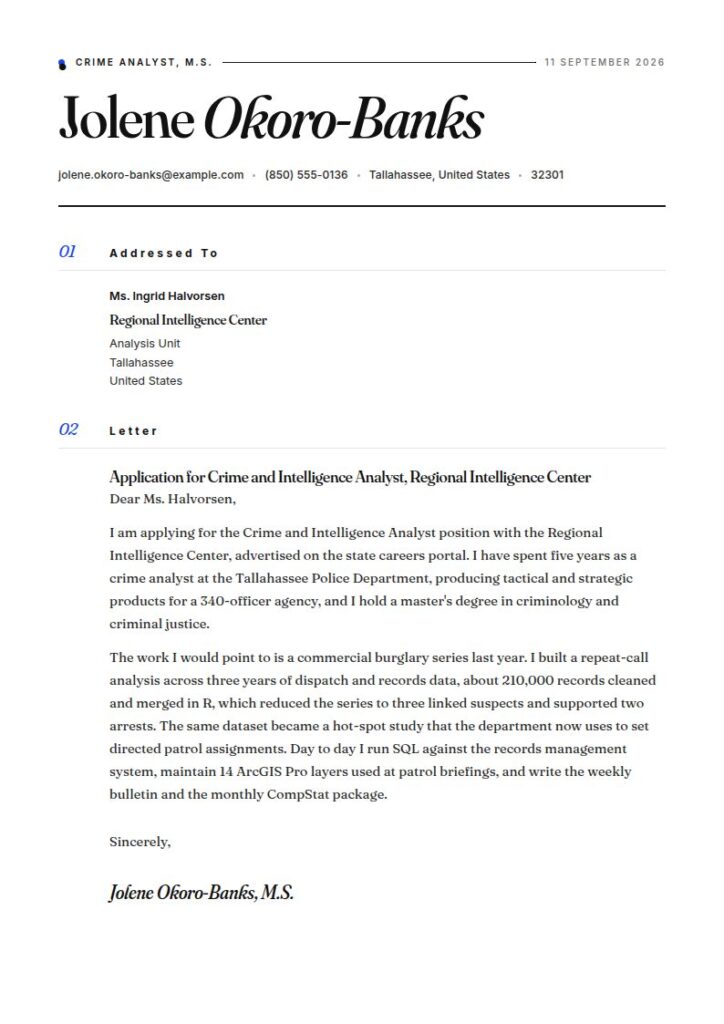
Dear Ms. Halvorsen,
I am applying for the Crime and Intelligence Analyst position with the Regional Intelligence Center, advertised on the state careers portal. I have spent five years as a crime analyst at the Tallahassee Police Department, producing tactical and strategic products for a 340-officer agency, and I hold a master's degree in criminology and criminal justice.
The work I would point to is a commercial burglary series last year. I built a repeat-call analysis across three years of dispatch and records data, about 210,000 records cleaned and merged in R, which reduced the series to three linked suspects and supported two arrests. The same dataset became a hot-spot study that the department now uses to set directed patrol assignments. Day to day I run SQL against the records management system, maintain 14 ArcGIS Pro layers used at patrol briefings, and write the weekly bulletin and the monthly CompStat package.
I am applying to the Regional Intelligence Center specifically because of the multi-agency data sharing work, which is the part of analysis I have had least access to from inside one department. I have written products for two partner agencies and would want to keep building in that direction, including the overdose surveillance reporting your office publishes.
I hold a current Florida Criminal Justice Information Services certification and can complete a background investigation and polygraph on your timetable. I am available with three weeks' notice. Thank you for your time.
Openings that work
Name the post, where you saw it, your current role and the destination in the first two sentences.
| Instead of | Use |
|---|---|
| I am writing to express my interest in a career in criminal justice | I am applying for the Crime and Intelligence Analyst position advertised on the state careers portal |
| I recently graduated with a degree in criminology | I have spent five years as a crime analyst producing tactical and strategic products for a 340-officer agency |
| I am passionate about helping victims of crime | I have carried a victim services caseload of 45 to 60 active clients and filed 52 compensation applications in the past year |
How the letter changes by destination
The structure holds across all six; the evidence paragraph is what changes.
| Destination | What the evidence paragraph should carry |
|---|---|
| Law enforcement and federal agencies | Eligibility facts, writing ability, any prior sworn or military service, clearance |
| Corrections and community supervision | Caseload size, assessment instruments, court reports, de-escalation training |
| Victim services | Caseload, court accompaniments, crisis shifts, credential level and training hours |
| Crime analysis and intelligence | Systems, data volumes, products a year, one linked case or series |
| Research and policy | Methods, datasets, reports or publications, funded projects |
| Private investigation and corporate security | Case volume, interviews, recovery figures, license and state |
Pick one destination per letter. Name the systems. Attach a volume to at least one claim. Say something specific about this agency. State your clearance, credential and certification status. Give your availability and your willingness to complete the background process.
Do not describe an individual victim, offender or case in identifying detail. Do not name a case that is not public. Do not claim a clearance you no longer hold. Do not dramatize the work; the person reading does it every day. Do not send the same letter to a police department and a research institute.
Writing about cases without disclosing anything
Almost everything you have worked on is restricted in some way: criminal justice information systems, sealed records, active investigations, victim identities.
The safe version describes the shape of the work and never the person. "A commercial burglary series" is fine. The address, the business name, the suspect and anything about a victim are not, even where a case is closed. For victim services, describe caseload and process rather than any individual circumstance.
Public information is the exception, and it is narrower than people think: a case that reached a published court decision or an agency press release can normally be named. When you are unsure, describe the analysis rather than the case, because the analysis is what you are being hired for anyway.
What the background investigation does with your letter
Everything in the letter is checkable, and in these destinations it gets checked. Titles, dates, degrees, certifications and clearance status are verified against your application, your references and, for national security positions, the Standard Form 86, which asks for a ten-year employment history and ten years of residences accounted for without breaks (U.S. Office of Personnel Management).
So the letter and the resume must agree with each other exactly: the same job titles, the same months, the same employers. A promotion described loosely in a letter and precisely on a resume reads as an inconsistency to an investigator, and inconsistency costs more than a modest record does.
Length, format and sending it
One page, four paragraphs, the same header and typeface as your resume, sent as PDF unless the portal specifies otherwise. Address a named person where the posting gives one.
For federal applications, follow the posting exactly on which documents to attach and in what format. Federal hiring is rule-bound, and an application that ignores an instruction is often screened out before anyone reads the writing.
Key takeaways for a criminology cover letter
- Write one letter per destination; there is no general criminology letter.
- Name the systems in the first two paragraphs, not the adjectives.
- Attach a volume to at least one claim: records, incidents, clients, cases.
- Say something specific and true about this agency.
- Describe the shape of the work, never an identifiable victim, offender or case.
- Make the letter and the resume agree exactly on titles, months and employers.
- Close with clearance, credential and your availability for the vetting process.
Build the matching resume in 15 minutes, and read the full criminology resume guide.
Criminology cover letter questions, answered
How long should a criminology cover letter be?
One page, four paragraphs, roughly 300 to 400 words. Federal postings sometimes ask for a longer statement addressing specific criteria, in which case answer each criterion in order under its own heading rather than writing a longer letter.
What do I write with no experience in the field?
Name the destination you want and why, then use what you have: methods and statistics coursework with the analysis you ran and its sample size, internships, volunteer hours, and any job that involved records, reporting or public contact, each with a volume attached.
Can I mention cases I worked on?
Describe the shape of the work rather than the case: "a commercial burglary series", "a repeat-address analysis". Never include anything that identifies a victim, an offender or an address, even in a closed matter. Cases that reached a published decision or an agency press release can normally be named.
Should I mention my clearance in the letter?
Yes, if you hold one, with the level and the year the investigation was completed. If it has lapsed, say so and give the date. If you do not hold one, say you are able to complete a background investigation and polygraph, since that is the question the reader has.
Does a cover letter matter for a government application?
It matters where the posting asks for one, and it is screened out where it does not. Federal and state hiring is rule-bound, so send exactly the documents requested in exactly the format requested. Where a letter is optional, include it: analytical and investigative roles are writing jobs, and this is your first sample.