Adaeze Nwankwo Senior Associate, Commercial Litigation Chicago, 60607, United States [email protected] · (312) 555-0148
11 September 2026
Ms. Diane Fairbanks Commercial Litigation Hiring Partner Lindqvist Rowe LLP Chicago, United States
Application for Senior Commercial Litigation Associate, Lindqvist Rowe LLP
Dear Ms. Fairbanks,
I am applying for the senior commercial litigation associate post in your Chicago office. I have seven years in Illinois business disputes, defense side, in state court, the Northern District of Illinois and AAA arbitration, and I am admitted in Illinois and to the Northern District trial bar.
The work I would most want to bring across is the injunction practice. Last year I second chaired a two-day preliminary injunction hearing in a trade secret and restrictive covenant dispute in the logistics sector, examining two witnesses, after drafting the motion and the supporting declarations over a nine-day turnaround. The court granted the injunction in part, and the matter resolved four months later without further motion practice. I currently carry between nine and twelve active matters with amounts in controversy from $500,000 to $40M, and I billed 1,940 hours in 2025 against a 1,900 target, plus 96 pro bono hours in eviction defense.
I am approaching your group rather than the market generally because of its manufacturing and distribution client base. My last four years have been almost entirely contract, supply and restrictive covenant matters for manufacturers, and I wrote my current firm's electronic discovery protocol after a production in that sector went badly for us. That is a specific thing I could hand your group in the first month.
I can give six weeks' notice, and I am glad to run a conflicts check at whatever stage suits you. References from my practice group chair and from two institutional client contacts are available once the process is far enough along. Thank you for your time.
Sincerely, Adaeze Nwankwo
Summary
A lawyer cover letter is a one page letter that says which practice area you work in, why this firm or department, and what you have personally run. This guide gives you a four-paragraph adaptable letter, the rule for writing about matters without breaching confidentiality, and what hiring partners read for.
Lawyer cover letter examples by experience level
A lawyer cover letter is a one page letter that answers three questions a hiring partner has before they open your resume: what kind of lawyer are you, why this firm, and what have you actually run on your own.
It is a shorter document than most applicants write. Four paragraphs, under 400 words, and every sentence either names your practice area, gives evidence, or explains the move.
Why a lawyer cover letter still matters
Legal hiring is one of the few areas where the letter is read. A resume gives a hiring partner your class year, your school, your firm and your practice group. It does not tell them why you are leaving a group you have been in for four years, why you want their sector, or what you would bring on day one.
The letter is also a writing sample by accident. A brief-writing job evaluated on a letter with a loose second paragraph is a difficult position to recover from, so treat it as the first piece of work the firm sees from you.
How to structure a lawyer cover letter
Four paragraphs.
| Paragraph | What it does |
|---|---|
| One | The post, your practice area to two levels, your admissions and years |
| Two | One matter described by type, size, forum and your role, with the outcome |
| Three | Why this firm or department specifically, tied to something real about them |
| Four | Availability, a note on references and conflicts, and a close |
Name the practice area in the first two lines
"I am writing to express my interest in opportunities at your firm" tells a reader nothing and costs you the only sentence they are guaranteed to read.
Write instead: "I am applying for the commercial litigation associate post. I have seven years in Illinois business disputes, defense side, in state court, the Northern District and AAA arbitration."
Match the letter to the posting’s practice group, not to the firm
Firms advertise by group, and the person reading is almost always the group's hiring partner rather than a general recruiter. A letter addressed to the firm's reputation reads as a mass mailing.
Find the group's recent public work: a reported decision, a published deal, a practice note one of the partners wrote, an area they have just started hiring into. Name one specific thing and say what it has to do with your own experience. One sentence of genuine specificity outperforms a paragraph of praise.
For in-house applications the equivalent is the company's business, not its legal department. Say what you know about the products, the regulatory position or the contracting model, and what part of that you have handled before.
Write about a matter without naming the client
This is where legal cover letters most often go wrong, and it is worth being precise about the rule. ABA Model Rule 1.6(a) says a lawyer must not reveal information relating to the representation of a client without informed consent, and it is broader than the attorney-client privilege: it reaches everything you learned during the work, not only confidential communications (American Bar Association, Model Rules of Professional Conduct, Rule 1.6).
So no party names, no deal names, no docket numbers on anything that is not public record. What you can write is the type of matter, the amount in controversy, the forum, what you did, and how it ended.
| Instead of | Use |
|---|---|
| I represented Acme Logistics in a trade secret case | I second chaired a two-day preliminary injunction hearing in a trade secret and restrictive covenant dispute in the logistics sector |
| I worked on a major $40M construction case | I ran discovery for one defendant in a multi-party construction defect matter of approximately $40M, including a 400,000-document production |
| I have extensive arbitration experience | I first chaired two AAA commercial arbitrations to award, the larger claiming roughly $3.5M |
Name the practice area and sub-speciality in the first two lines. State where and when you were admitted. Describe one matter by type, size, forum and your role. Name something specific about the firm or the company. Keep the letter to one page and under 400 words. Say when you can start and note that conflicts can be run on request.
Do not name clients, parties or deal names on anything that is not public record. Do not restate your resume in prose. Do not open with "I am writing to express my interest". Do not call yourself passionate about the law. Do not send the same letter to a firm and to a legal department, because they are buying different things. Do not attach a writing sample containing client-identifying material without redacting it.
The adaptable lawyer cover letter example
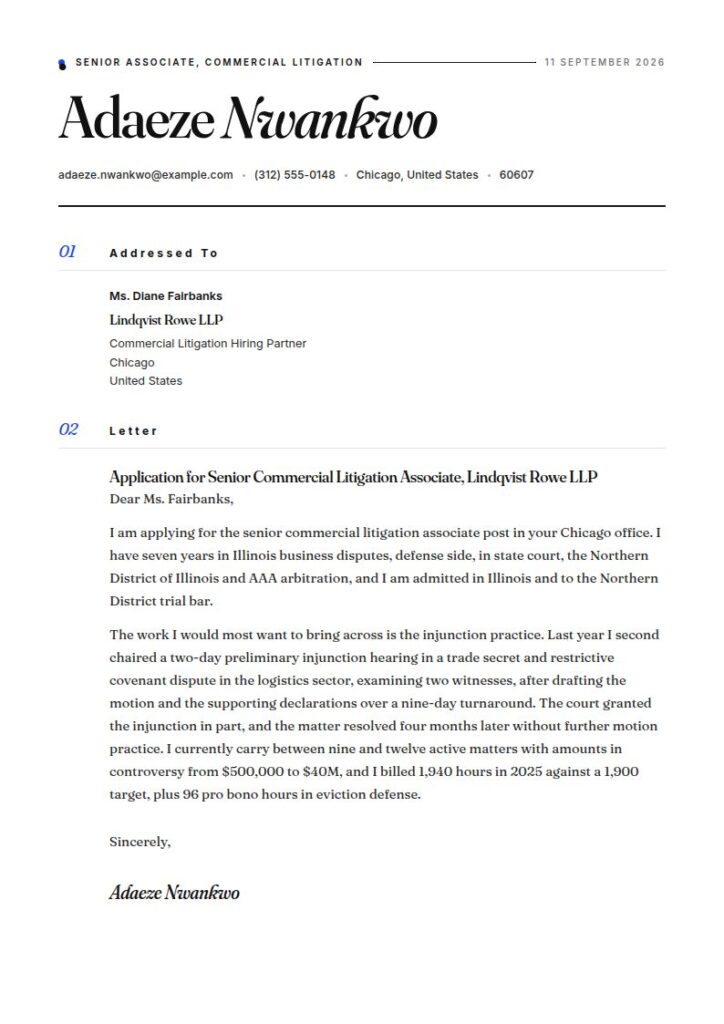
Dear Ms. Fairbanks,
I am applying for the senior commercial litigation associate post in your Chicago office. I have seven years in Illinois business disputes, defense side, in state court, the Northern District of Illinois and AAA arbitration, and I am admitted in Illinois and to the Northern District trial bar.
The work I would most want to bring across is the injunction practice. Last year I second chaired a two-day preliminary injunction hearing in a trade secret and restrictive covenant dispute in the logistics sector, examining two witnesses, after drafting the motion and the supporting declarations over a nine-day turnaround. The court granted the injunction in part, and the matter resolved four months later without further motion practice. I currently carry between nine and twelve active matters with amounts in controversy from $500,000 to $40M, and I billed 1,940 hours in 2025 against a 1,900 target, plus 96 pro bono hours in eviction defense.
I am approaching your group rather than the market generally because of its manufacturing and distribution client base. My last four years have been almost entirely contract, supply and restrictive covenant matters for manufacturers, and I wrote my current firm's electronic discovery protocol after a production in that sector went badly for us. That is a specific thing I could hand your group in the first month.
I can give six weeks' notice, and I am glad to run a conflicts check at whatever stage suits you. References from my practice group chair and from two institutional client contacts are available once the process is far enough along. Thank you for your time.
Sincerely, Adaeze Nwankwo
What to change for in-house and government applications
The second paragraph is the one that moves. A legal department wants throughput and judgement, so replace the matter narrative with volume and cycle time: how many contracts a quarter, what you turn around in what time, which business units you advise, what you decide without escalating.
A government or public defender application wants caseload and courtroom time. Give the number of open matters, the hearings and trials, and the reason you want public work, plainly and without varnish.
Most graduates go into private practice, but not into large firms
For the class of 2024, 93.4% of law graduates were employed ten months out and 84.3% held jobs requiring bar admission, both records. Private practice took 58.9% of the class (National Association for Law Placement, Class of 2024 Selected Findings, March 2025).
Within private practice, 34.2% of those jobs were in firms of 501 or more lawyers while 25.6% were in firms of 1 to 10 and 32.4% in firms of 11 to 250 (NALP, March 2025). Government took 12.9%, judicial clerkships 10.0% and public interest 9.7%.
The practical point for a letter is that most legal employers are small. A small firm or a five-lawyer department reads a cover letter far more closely than a large firm does, and it is looking for evidence that you can run a matter without a team behind you. Write the letter for that reader unless you know the firm is large.
Key takeaways for a lawyer cover letter
- One page, four paragraphs, under 400 words.
- Practice area to two levels in the first two lines, with your admissions.
- One matter, described by type, size, forum and your role, with an outcome.
- No client or party names on anything that is not public record.
- One specific, verifiable thing about the firm or the company.
- Availability, conflicts and references in the closing paragraph.
Build the matching document with the Rezoom AI resume builder, and check the resume it produces with the free ATS resume checker.
Read the full lawyer resume guide for the practice area and matters list sections, and the attorney resume guide for bar admission and jurisdiction.
Related legal cover letter examples
- Attorney cover letter
- Paralegal cover letter
- Legal assistant cover letter
- Immigration lawyer cover letter
- Claims adjuster cover letter
- Law school cover letter
- Criminology cover letter
- Notary cover letter
- Legal sector cover letter
- Compliance officer cover letter
- Administrative assistant cover letter
- Executive assistant cover letter
Lawyer cover letter questions, answered
How long should a lawyer cover letter be?
One page, four paragraphs, under 400 words. Hiring partners read a great deal of writing and a long letter is read as a first sign that you cannot cut your own drafts.
Can I name cases I worked on in a cover letter?
Only if the matter is public record and you were counsel of record, and only if your firm's policy allows it. Otherwise describe it by type, amount, forum and your role. Rule 1.6(a) covers information relating to a representation, which is broader than privileged communications, so the safe default is to describe rather than name.
Should I attach a writing sample?
Send one if the posting asks, and redact it first. Remove party names, addresses, account numbers and anything identifying, and say at the top that it has been redacted and, where relevant, that permission was obtained. An unredacted brief from a live matter is a hiring problem rather than a writing sample.
What do I write in a lawyer cover letter with no experience?
Write clinic and journal work as work. The clinic is a caseload: say how many matters, what kind, what you did and what happened. Add moot court results, the practice group of each summer position, and your admission or expected admission date. Then name one specific thing about the firm and say what drew you to that practice area rather than to law generally.
How do I explain leaving my current firm?
In one clause, forward-looking, and without criticism. "I am looking for a group with more first-chair opportunity at my level" or "I want to move from defense-side insurance work to commercial disputes" is enough. A candidate who explains the move in a line reads as settled; one who explains it in a paragraph reads as unhappy.