Theo Marchetti-Ade Third-Year Law Student, J.D. expected 2027 New Haven, 06511, United States [email protected] · (203) 555-0148
11 September 2026
Ms. Adaeze Okonkwo Legal Recruiting Harrow & Lindqvist LLP Hartford, United States
Application for 2027 Litigation Associate, Harrow & Lindqvist LLP
Dear Ms. Okonkwo,
I am applying for the 2027 litigation associate position at Harrow & Lindqvist, advertised through the University of Connecticut School of Law career office. I am a third-year student, Articles Editor of the Connecticut Law Review, and I spent the 2026 summer in your litigation group.
The work I would point to is the choice-of-law question I researched in June for the Delcorte matter. It ran across three jurisdictions, and the memorandum I produced changed the team's forum recommendation. In the same summer I drafted two sections of a summary judgment motion that were filed with light revision. Before law school I spent three years as a housing case manager, carrying an intake list of about 340 households a year and preparing the documentation used in eviction defense hearings, which is where I learned to get a file ready before anyone asks for it.
I am applying to your office rather than a list of firms because of the commercial litigation caseload I saw from the inside and the way the team handles junior drafting: I was given real sections, and I was edited carefully. I would also want to keep a housing docket through your pro bono program, having represented eight clients in administrative hearings through the law school clinic this year.
My resume and a writing sample are attached, and my transcript is available on request. I am available to start after the July 2027 bar examination. Thank you for your time.
Sincerely, Theo Marchetti-Ade
Summary
A law school cover letter is a one-page letter that names the post, the practice area, the writing you have done and why this employer specifically. This guide gives you a full adaptable letter, the paragraph structure legal employers expect, how the 1L version differs from the 3L version, and what to do when the application is an addendum rather than a letter.
Law School cover letter examples by experience level
A law school cover letter is a one-page letter addressed to a named person, naming the post, the practice area and the writing you have already done.
Legal employers use it differently from most industries. The resume gets four seconds; the letter gets read if the resume survives, and it is read as a writing sample. Grammar, structure and citation habits are assessed whether or not anyone says so.
Note the split. If you are applying to law school, most applications ask for a personal statement rather than a cover letter, and that is a different document. This guide is for the employer letter: the one a 1L sends in January, and the one a 3L sends with a resume and a writing sample.
Guide to a law school cover letter
This guide and the corresponding law school cover letter example will cover:
- The four-paragraph structure legal employers expect
- Why the letter is read as a writing sample
- How the 1L letter differs from the 2L and 3L letter
- What to write when you have no legal experience at all
- The closing that gets a file moved to the interview pile
How to write a law school cover letter
| Paragraph | Its job | Length |
|---|---|---|
| Opening | The post, where you saw it, your year and school, and the practice area | 2 to 3 sentences |
| Why you | One piece of work, described concretely, with an outcome | 4 to 5 sentences |
| Why them | Something specific and true about this employer and this office | 3 to 4 sentences |
| Close | Availability, attached documents, thank you | 2 sentences |
The letter is the writing sample nobody calls a writing sample
Legal hiring is a profession that produces documents for a living, so a hiring attorney reads a cover letter the way they read a memo from an associate: for structure, precision and whether the writer buried the point.
Three habits do most of the work: put the ask in the first sentence, use one concrete example rather than three abstract claims, and cut every sentence that could appear in any other applicant's letter.
Proofread it twice, then have someone else read it. A typographical error in a letter to a law firm is a preview of what your work product will look like.
Run the resume that goes with it through the free Rezoom ATS resume checker first, since recruiting portals parse before anyone reads.
A law school cover letter example you can adapt
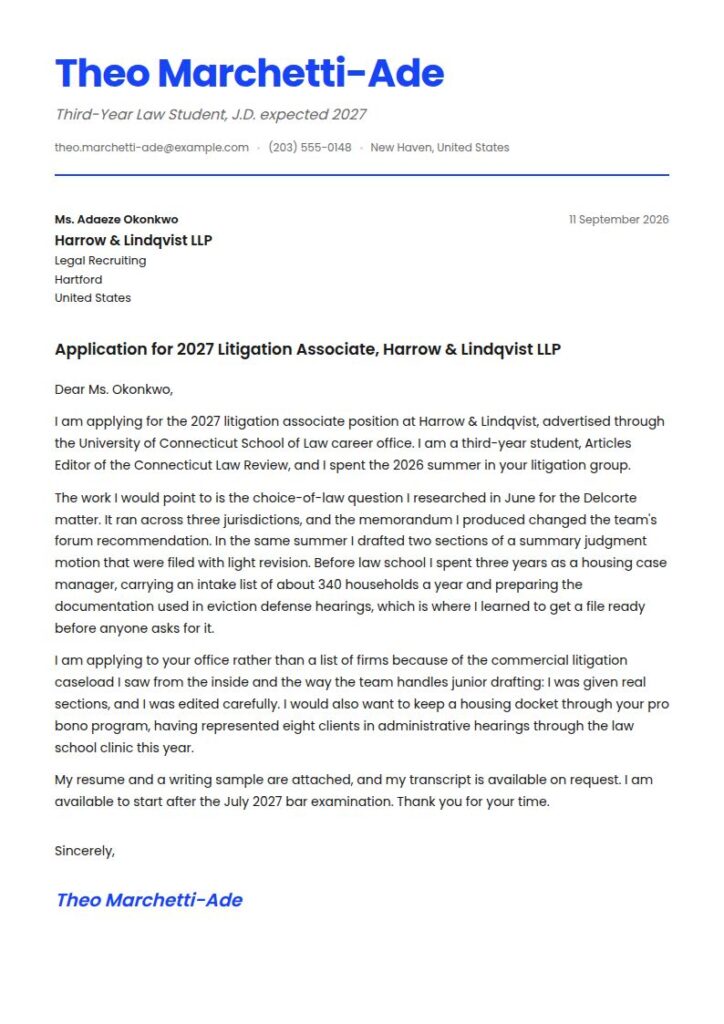
Dear Ms. Okonkwo,
I am applying for the 2027 litigation associate position at Harrow & Lindqvist, advertised through the University of Connecticut School of Law career office. I am a third-year student, Articles Editor of the Connecticut Law Review, and I spent the 2026 summer in your litigation group.
The work I would point to is the choice-of-law question I researched in June for the Delcorte matter. It ran across three jurisdictions, and the memorandum I produced changed the team's forum recommendation. In the same summer I drafted two sections of a summary judgment motion that were filed with light revision. Before law school I spent three years as a housing case manager, carrying an intake list of about 340 households a year and preparing the documentation used in eviction defense hearings, which is where I learned to get a file ready before anyone asks for it.
I am applying to your office rather than a list of firms because of the commercial litigation caseload I saw from the inside and the way the team handles junior drafting: I was given real sections, and I was edited carefully. I would also want to keep a housing docket through your pro bono program, having represented eight clients in administrative hearings through the law school clinic this year.
My resume and a writing sample are attached, and my transcript is available on request. I am available to start after the July 2027 bar examination. Thank you for your time.
Openings that work
Name the post and where you saw it in the first sentence, then your year, school and the practice area you want. That is all an opening needs.
| Instead of | Use |
|---|---|
| I am writing to express my strong interest in opportunities at your firm | I am applying for the 2027 litigation associate position advertised through the UConn Law career office |
| I have always been passionate about the law | I am a third-year student and Articles Editor of the Connecticut Law Review, applying to your commercial litigation group |
| I believe I would be a great fit for your team | I spent the 2026 summer in your litigation group and want to return to the same practice |
What changes between the 1L letter and the 3L letter
The 1L letter is written for a reader who knows you have no legal experience, and pretending otherwise is the main failure mode.
A 1L letter does three things. It names the type of employer and why: government, judicial, public interest or a research assistantship, not "any opportunity". It describes the legal writing course as work, because a trial brief and an appellate brief are the only legal documents you have produced and they are real ones. And it converts a previous job into legal skills honestly, in terms of research, drafting, client contact and volume rather than by calling a case manager role a paralegal role.
A 3L letter has more to choose from, so the discipline is subtraction. One matter, described concretely, beats a summary of everything. If you had a 2L summer with the employer you are writing to, say so in the first paragraph and make the letter about what you would come back to.
Address a named person and check the spelling of their name and the firm's. Put the post and your year in the first sentence. Use one concrete matter with an outcome. Say something true and specific about this employer. Name your bar examination timing and availability. Keep it to one page, three or four paragraphs.
Do not restate the resume in prose. Do not describe a case in a way that discloses client confidences or names a matter you were not told was public. Do not claim an interest in a practice area you cannot discuss for two minutes. Do not send the same letter to twelve firms with the name changed. Do not open with "I am writing to express my interest".
Writing about matters without disclosing anything
Everything you worked on as a summer associate, an intern or a clinic student belongs to a client, and the duty of confidentiality does not lapse because you are job hunting.
The safe version describes the work and its shape rather than the party and the facts: "a choice-of-law question across three jurisdictions in a commercial dispute" rather than the client, the industry and the amount. Filed public documents are a different matter, and a docketed brief you helped draft can usually be named. When in doubt, ask the supervising attorney before you send, and describe the task rather than the case.
Clinic work is the same: say the forum, the number of matters and the outcome, and nothing that identifies a client.
Length, format and sending it
One page, three or four paragraphs, the same typeface and header as your resume, and a PDF named with your surname. Address it to a named hiring attorney or recruiting manager, not "To whom it may concern". Send the resume, letter, transcript and writing sample in the order and format the posting asks for; following the instruction exactly is the first test.
Key takeaways for a law school cover letter
- It is read as a writing sample, so structure and precision are being assessed.
- Post, year, school and practice area in the first sentence.
- One matter, described concretely, with an outcome, beats three general claims.
- Say something specific and true about this employer, or leave the paragraph out.
- A 1L letter is built on legal writing assignments and pre-law work rewritten honestly.
- Describe work without disclosing client confidences: the task, not the party.
- One page, named addressee, PDF, and exactly the documents the posting asked for.
Build the matching resume in 15 minutes, and read the full law school resume guide.
Law school cover letter questions, answered
Do law school applications need a cover letter?
Usually not. Most JD applications ask for a personal statement, and some accept optional essays or addenda instead. A cover letter in an admissions file is normally either a letter of continued interest sent after a waitlist decision or a short note attached to supplementary materials. Read each school's instructions and send what is asked for.
How long should a law school cover letter be?
One page, three or four paragraphs, about 300 to 400 words. Legal employers read these in volume during a compressed recruiting window, and a second page is usually the first thing that gets skipped.
What do I write as a 1L with no legal experience?
Name the type of employer and why you want that work. Describe your legal writing assignments as work, since a trial brief and an appellate brief are real legal documents. Then convert your pre-law jobs into research, drafting, client contact and volume, without inflating the title you held.
Can I mention matters I worked on as a summer associate?
Describe the task and its shape, not the client or the facts: "a choice-of-law question across three jurisdictions in a commercial dispute". Publicly filed documents are usually safe to name. If you are not sure, ask the supervising attorney before you send the letter.
Should I send a cover letter if the portal does not ask for one?
Attach it where there is a field for additional documents, and skip it where the portal explicitly says not to. On-campus interviewing bid systems often take a resume alone, in which case the letter becomes the follow-up email you send after the screening interview.