Program Analyst, GS-0343-07 Marguerite Thibodeaux
Program Analyst, GS-0343-07
[email protected] | (703) 555-0157 | Arlington, United States
Profile
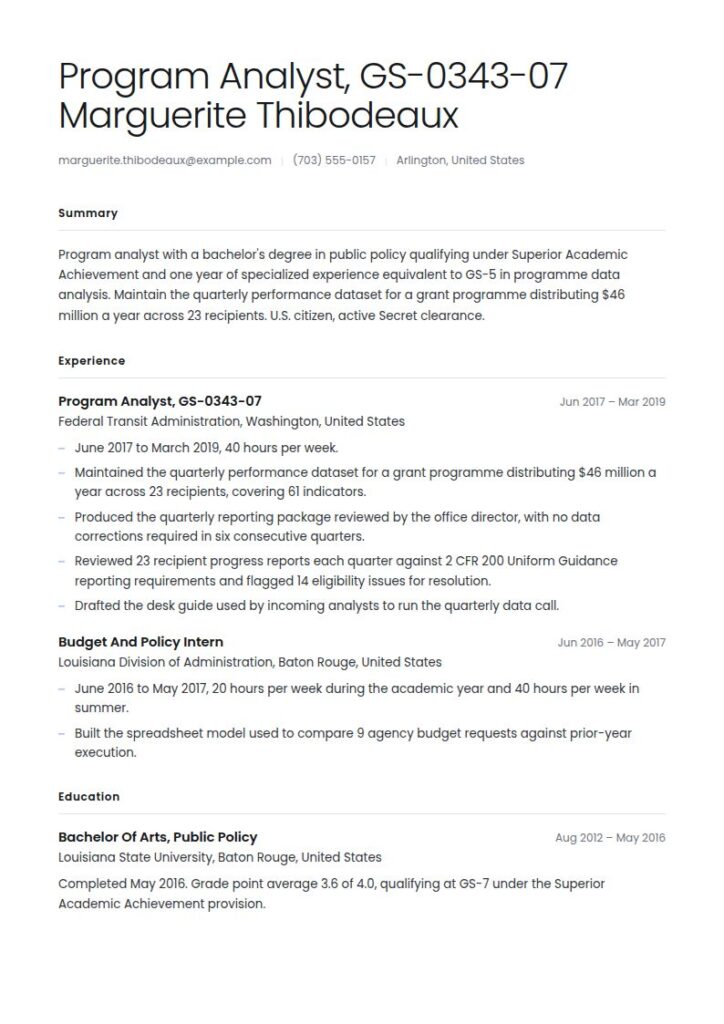
Program analyst with a bachelor's degree in public policy qualifying under Superior Academic Achievement and one year of specialized experience equivalent to GS-5 in programme data analysis. Maintain the quarterly performance dataset for a grant programme distributing $46 million a year across 23 recipients. U.S. citizen, active Secret clearance.
Work Experience
06/2017 - 03/2019, Program Analyst, GS-0343-07, Federal Transit Administration, Washington, United States
- June 2017 to March 2019, 40 hours per week.
- Maintained the quarterly performance dataset for a grant programme distributing $46 million a year across 23 recipients, covering 61 indicators.
- Produced the quarterly reporting package reviewed by the office director, with no data corrections required in six consecutive quarters.
- Reviewed 23 recipient progress reports each quarter against 2 CFR 200 Uniform Guidance reporting requirements and flagged 14 eligibility issues for resolution.
- Drafted the desk guide used by incoming analysts to run the quarterly data call.
06/2016 - 05/2017, Budget and Policy Intern, Louisiana Division of Administration, Baton Rouge, United States
- June 2016 to May 2017, 20 hours per week during the academic year and 40 hours per week in summer.
- Built the spreadsheet model used to compare 9 agency budget requests against prior-year execution.
Education
08/2012 - 05/2016, Bachelor of Arts, Public Policy, Louisiana State University, Baton Rouge, United States
Completed May 2016. Grade point average 3.6 of 4.0, qualifying at GS-7 under the Superior Academic Achievement provision.
Skills
Performance data analysis and reporting, 70
2 CFR 200 Uniform Guidance, 65
Excel modelling, 80
Grant progress report review, 70
Written briefing and desk guide drafting, 70
SQL, 55
Languages
English, native
French, intermediate
Certificates
05/2017, Secret Security Clearance, U.S. Government
Active. Granted on entry on duty.
Summary
A federal resume is a two-page USAJOBS document carrying month and year dates, hours per week, series and grade, and a specialized experience paragraph that proves one year at the next lower grade. This guide gives you three adaptable versions at GS-7, GS-11 and GS-13, the required elements, and what changed when OPM capped resume length in September 2025.
Federal resume examples by experience level
A federal resume is a two-page document written to a specific rule set: month and year for every position, hours per week, series and grade for federal roles, and enough detail to prove the specialized experience the announcement asks for.
The two-page part is new, and it is the most important thing here. Federal resumes were famously long, five pages and often more, and most advice online still says so. That advice is now wrong. Everything below is written for the rules as they stand, sourced to opm.gov and usajobs.gov.
Resume guide for a federal resume
This guide and the corresponding federal resume example will cover:
- The two-page limit and what happens if you exceed it
- Every element USAJOBS requires, and why omitting one is fatal
- Three adaptable summaries at GS-7, GS-11 and GS-13
- Specialized experience and the one-grade-lower rule
- The questionnaire, veterans' preference and what the GS scale pays
How to write a federal resume
Five sections: contact header, specialized experience summary, work experience, education, and a block for certifications, clearance and eligibility. Two pages.
The required elements are not stylistic. A human resources specialist screens for them before anyone assesses your qualifications, and a missing one ends the application. USAJOBS requires your name, email and phone number, and for each position the employer, job title, start and end dates including month and year, hours per week, descriptions showing you can perform the tasks at the required level, and series and grade for federal jobs.
| Required element | Example | Why it is there |
|---|---|---|
| Month and year | January 2023 to March 2026 | Years alone cannot be converted into months |
| Hours per week | 40 hours per week | Part-time is prorated: 20 hours is half credit |
| Series and grade | Program Analyst, GS-0343-11 | Sets the grade your experience equals |
| Description at the required level | Duties written to the announcement | The qualification decision |
USAJOBS gives the format as "Program Analyst GS-343-11 / January 2009-present / 40 Hours/week". Copy it exactly. Supervisor contact details and salary, which most people expect to be mandatory, are not on the USAJOBS required list, though the builder offers fields for them and some announcements ask directly.
The two-page limit is a hard eligibility screen, not a suggestion
OPM announced the standard on 2 September 2025 and USAJOBS began restricting all resumes to two pages on 27 September 2025. The scope is broad: the limit "applies to all competitive service and excepted service announcements under Title 5, internal and external, posted on USAJOBS or another platform". The consequence is blunt: "If the only resume received by an applicant is longer than two pages, the applicant is ineligible for further consideration" (OPM, agency guidance on the two-page limit on resume length, 12 September 2025).
The same guidance recommends a sans-serif face such as Lato, Calibri, Arial, Open Sans or Roboto, margins of 0.5 inches, and roughly 14-point titles with 10-point body text. One carve-out: where a curriculum vitae is required, typically in medical and research fields, agencies may ask for it under "other documents", and non-Title 5, judicial and legislative agencies may accept longer resumes if their announcement says so.
Run the finished file through the free Rezoom ATS resume checker before uploading.
Choosing the best resume format for a federal resume
Reverse chronological, two pages, plain single column. Then one real decision: the USAJOBS resume builder or an uploaded document.
The builder walks you through structured fields and will not let you skip a required one, which makes it the safer first choice; OPM has confirmed that "USAJOBS will enforce the resume being no longer than 2 pages and provide guidance on recommended font types, sizes, and margins".
An uploaded resume gives you control of emphasis, which matters at GS-12 and above, but you carry the burden of completeness. Strong candidates are found not qualified for a missing hours-per-week line more often than for a weak record.
Include your contact information
| ✅ Right | ❌ Wrong |
|---|---|
| Marguerite Thibodeaux | Marguerite Thibodeaux |
| Arlington, VA | 1408 Quincy Street North, Arlington, VA 22201 |
| (703) 555-0157, [email protected] | (703) 555-0157, [email protected] |
| U.S. Citizen. Active Secret clearance. GS-0343-12 | Photograph, date of birth, marital status |
Keep the header to four lines; every line costs experience space under a two-page cap. Citizenship, clearance and current grade earn their place, a street address and a photograph do not.
The documents that travel with the resume are listed in each announcement: transcripts where education is qualifying, an SF-50 for federal status, a DD-214 for veterans' preference, an SF-15 for 10-point preference. None count against the two pages.
Make use of a summary
Three or four lines, written for the grade you are applying to, not the one you hold. Name the series, the specialized experience area, the scale you handle and the clearance.
Program analyst with a bachelor's degree in public policy qualifying under Superior Academic Achievement and one year of specialized experience equivalent to GS-5 in programme data analysis. Maintain the quarterly performance dataset for a grant programme distributing $46 million a year across 23 recipients. U.S. citizen, active Secret clearance.
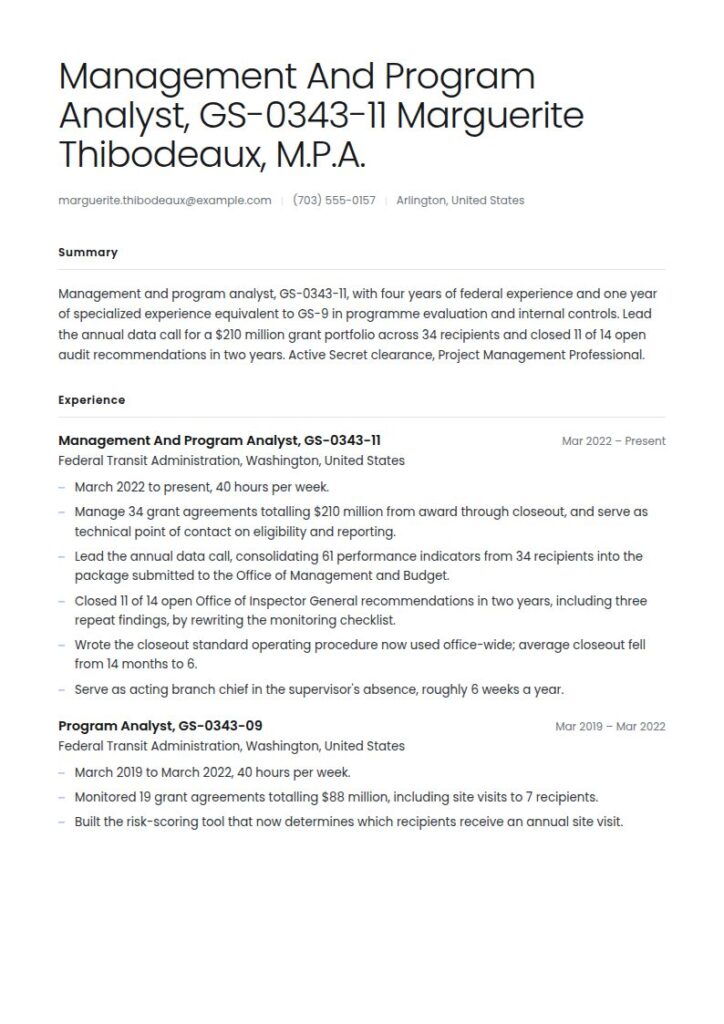
Management and program analyst, GS-0343-11, with four years of federal experience and one year of specialized experience equivalent to GS-9 in programme evaluation and internal controls. Lead the annual data call for a $210 million grant portfolio across 34 recipients and closed 11 of 14 open audit recommendations in two years. Active Secret clearance, Project Management Professional.
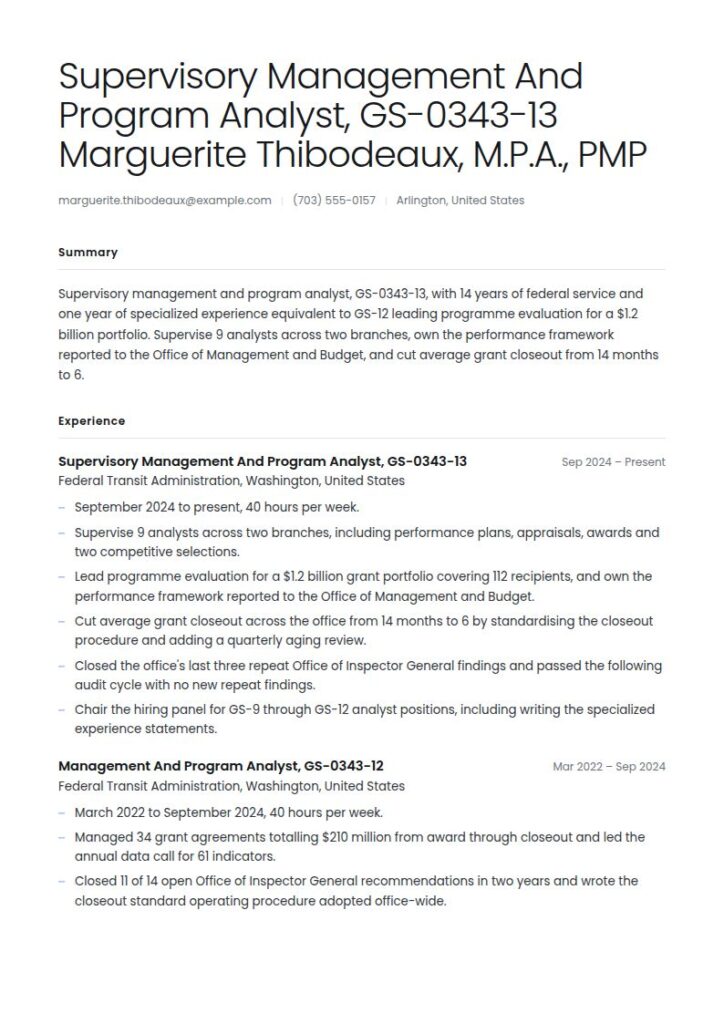
Supervisory management and program analyst, GS-0343-13, with 14 years of federal service and one year of specialized experience equivalent to GS-12 leading programme evaluation for a $1.2 billion portfolio. Supervise 9 analysts across two branches, own the performance framework reported to the Office of Management and Budget, and cut average grant closeout from 14 months to 6.
Right vs wrong: the same federal resume summary, twice
| ✅ Right | ❌ Wrong |
|---|---|
| Management and program analyst, GS-0343-11, four years of federal experience. | Experienced analyst with a strong background in government programmes. |
| One year of specialized experience equivalent to GS-9 in programme evaluation. | Familiar with evaluation, compliance and reporting. |
| Lead the annual data call for a $210 million grant portfolio across 34 recipients. | Responsible for supporting grant programme activities. |
The right column uses the announcement's own language and states the equivalence the decision needs. The left makes a specialist guess, and a guess is a rejection.
Outline your experience
Job title, series and grade, employer, city, month and year dates, hours per week. Then four to six lines carrying the specialized experience, each with a number or named authority.
| Instead of | Use |
|---|---|
| Assisted with grant management | Managed 34 grant agreements totalling $210 million from award to closeout |
| Analysed data for the programme | Built the quarterly dataset of 61 indicators reported to the Office of Management and Budget |
| Helped with audits | Closed 11 of 14 open Office of Inspector General recommendations in two years |
| Worked on process improvement | Rewrote the closeout procedure, cutting average closeout from 14 months to 6 |
Management and Program Analyst, GS-0343-11, Federal Transit Administration, Washington, DC, March 2022 to Present, 40 hours per week
Manage 34 grant agreements totalling $210 million from award through closeout, and serve as technical point of contact on eligibility and reporting.
Lead the annual data call, consolidating 61 performance indicators from 34 recipients into the package submitted to the Office of Management and Budget.
Closed 11 of 14 open Office of Inspector General recommendations in two years, including three repeat findings, by rewriting the monitoring checklist.
Wrote the closeout standard operating procedure now used office-wide; average closeout fell from 14 months to 6.
Specialized experience and the one-grade-lower rule
This is the paragraph the whole application turns on, and where most non-federal applicants lose without knowing why. For most series at GS-5 and above, OPM's qualification standards "call for 1 year of specialized experience equivalent to at least the next lower grade level" in the normal line of progression, where specialized experience is experience "that has equipped the applicant with the particular knowledge, skills, and abilities/competencies to perform successfully the duties" of the position (OPM, General Schedule Qualification Policies). No cumulative years requirement sits on top of that year.
The consequences are exact:
| Applying for | One year equivalent to |
|---|---|
| GS-7 | GS-5 |
| GS-9 | GS-7 |
| GS-11 | GS-9 |
| GS-12 | GS-11 |
| GS-13 | GS-12 |
Three things follow. First, the specialized experience paragraph is a checklist and your resume must satisfy every clause. Copy the clauses out and answer each in your work history, in language a specialist can match without inferring.
Second, "one year" is measured in months at the hours you actually worked, which is why the hours-per-week line is required: twenty hours a week for two years is one year of credit, not two.
Third, equivalence is about the level of the work, not the title. A private-sector analyst who owned a $200 million portfolio, briefed executives and wrote policy is arguing GS-12 equivalence, and should say so.
Put month, year and hours per week on every position. Give series and grade for federal roles. Mirror the announcement's specialized experience wording. Say which grade your experience is equivalent to if you are coming from outside government. Cut the oldest roles first. Submit every document the announcement lists.
Do not submit a five-page resume; since 27 September 2025 it makes you ineligible. Do not write duties in the passive voice or copy a position description. Do not leave hours per week off a part-time or seasonal role. Do not answer the questionnaire at a level your resume does not support. Do not assume a private-sector title translates by itself.
Build a snapshot of your key skills
Group the competencies the announcement names, in its own words. Federal announcements come from a job analysis producing knowledge, skills and abilities, and those KSAs drive the questionnaire and the rating.
Programme management: Grant lifecycle from award to closeout, Programme evaluation, Performance measurement, Internal controls and audit response
Analysis: Quantitative analysis, Data quality review, Cost and budget analysis, Excel modelling, Tableau, SQL
Federal systems and authorities: 2 CFR 200 Uniform Guidance, GrantSolutions, USASpending reporting, Office of Management and Budget performance reporting
Leadership: Supervision of 9 staff, Performance plans, Hiring panels
How you are rated has changed. Agencies had until 30 September 2025 to stop using self-assessments as the basis for rating applicants, though they may still screen minimum qualifications with them, and USA Hire assessments "are not self-assessments". Answer any questionnaire at the level your resume can evidence.
Most public-facing competitive announcements also carry four short free-response questions, whose answers OPM says "are not scored or rated" and which do not disqualify an applicant who leaves them blank (OPM, Merit Hiring Plan frequently asked questions).
List your education and certifications
Institution, completion date and degree type, plus grade point average where the position has an education requirement.
Education can also substitute for experience. For administrative and management positions a bachelor's degree qualifies at GS-5, and Superior Academic Achievement raises that to GS-7. It is met by graduating in the upper third of your class, a grade point average of 3.0 or higher out of 4.0 across four years or the final two, 3.5 or higher in the major or major courses in the final two years, or a national scholastic honor society membership (freshman societies excluded).
Master of Public Administration, George Mason University, Arlington, VA, completed May 2021. Grade point average 3.8 of 4.0.
Bachelor of Arts, Public Policy, Louisiana State University, Baton Rouge, LA, completed May 2016. Grade point average 3.6 of 4.0. Qualified at GS-7 under Superior Academic Achievement.
Certifications: Project Management Professional, Project Management Institute, 2023. Lean Six Sigma Green Belt, 2022.
Eligibility: U.S. citizen. Active Secret clearance, last investigation 2024. SF-50 attached.
Choose the right layout and design
Two pages, single column, one of OPM's recommended sans-serif faces, 0.5 inch margins, roughly 10-point body text and 14-point headings. No columns, no graphics, no photograph.
Cut from the bottom: OPM's applicant guidance says plainly to remove outdated or unrelated experience. A role from fifteen years ago that does not support the specialized experience statement is costing you the space that decides the application.
Federal job market and outlook
Federal hiring is one market with one published rule set, which is why format matters here more than anywhere else.
| Measure | Value |
|---|---|
| Federal civilian employees, July 2026 | 2,020,230 |
| Share in the competitive service | 67.5% |
| General Schedule grades | 15, GS-1 to GS-15 |
| Steps within each grade | 10, each worth about 3% |
| Locality pay areas | 47 |
Sources: OPM Federal Workforce Data, July 2026; OPM, General Schedule pay systems.
Veterans’ preference is applied inside the category, not on top of the score
Under category rating, which most agencies now use, applicants are assessed into quality categories defined through job analysis, and "preference eligibles receive veterans' preference by being listed ahead of non-preference eligibles within the same quality category" (OPM, competitive hiring). Preference does not lift you into a higher category; it orders you within the one your assessment puts you in.
The categories are set by statute. Five-point preference (TP) covers qualifying service periods and campaign medal recipients. Ten-point preference splits into CP for a service-connected disability rated 10 to 29 percent, CPS for 30 percent or more, and XP for a present service-connected disability, a Purple Heart, or derived preference for certain spouses, widows and mothers. Claiming it requires a DD-214, and 10-point preference an SF-15 with supporting documentation (OPM, VetGuide). Make the claim in the questionnaire and attach the documents.
What salary you can expect on the GS scale
Federal pay is published, so you can calculate the offer before you apply. The 2026 base table incorporates a 1 percent increase, effective January 2026.
| Grade | Base, step 1 | Base, step 10 |
|---|---|---|
| GS-5 | $34,799 | $45,239 |
| GS-7 | $43,106 | $56,039 |
| GS-9 | $52,727 | $68,549 |
| GS-11 | $63,795 | $82,938 |
| GS-12 | $76,463 | $99,404 |
| GS-13 | $90,925 | $118,204 |
| GS-15 | $126,384 | $164,301 |
Source: OPM, Salary Table 2026-GS, incorporating the 1% General Schedule increase, effective January 2026.
Locality pay sits on top and is large. In the Washington-Baltimore-Arlington area, where the 2026 locality payment is 33.94 percent, GS-7 step 1 is $57,736, GS-11 step 1 is $85,447, and GS-13 runs from $121,785 at step 1 to $158,322 at step 10 (OPM, Salary Table 2026-DCB).
Steps advance on time in grade rather than negotiation: one year at steps 1 to 3, two at steps 4 to 6, three at steps 7 to 9, each worth roughly 3 percent (OPM). Because grade dominates step, the resume's job is not to argue for a step but to make the specialized experience for the next grade unmistakable.
Key takeaways for a federal resume
- Two pages, enforced since 27 September 2025; longer makes you ineligible.
- Month and year, hours per week, series and grade on every position.
- Write against the announcement's specialized experience paragraph, clause by clause.
- One year at the next lower grade is the whole qualification test.
- Mirror the announcement's language; a specialist matches rather than infers.
- Use the USAJOBS builder first, upload once you know the rules.
- Claim veterans' preference in the questionnaire and attach the DD-214 or SF-15.
Build your federal resume in 15 minutes.
Related government resume examples
- Government resume
- City manager resume
- Postal service worker resume
- Correctional officer resume
- Police officer resume
- Firefighter resume
- Military resume
- Security officer resume
- Compliance officer resume
- Program manager resume
- Business analyst resume
- Auditor resume
Pair it with a matching federal cover letter.
Federal resume questions, answered
How long should a federal resume be in 2026?
Two pages. USAJOBS has restricted all resumes to two pages since 27 September 2025, across competitive and excepted service announcements under Title 5. OPM's guidance states that if the only resume received is longer than two pages, the applicant is ineligible for further consideration. Advice telling you to write five pages predates the standard.
What has to be on a federal resume?
Name, email and phone number, and for every position the employer, job title, start and end dates including month and year, hours per week, and a description showing you can perform the tasks at the required level, plus series and grade for federal positions. Education needs the institution, completion date and degree type (USAJOBS).
How do I know which GS grade to apply for?
Read the specialized experience paragraph, then check whether you have one full year equivalent to the next lower grade: GS-9 level for a GS-11 post, GS-12 for a GS-13. Education substitutes at lower grades, where a bachelor's degree qualifies at GS-5 and Superior Academic Achievement takes that to GS-7.
Should I use the USAJOBS resume builder or upload my own?
Use the builder for your first application: it prompts every required field, so you cannot omit hours per week, and USAJOBS enforces the two-page limit inside it. Upload once you know the rules.
Does the occupational questionnaire still decide who gets referred?
Less than it used to. Agencies had to stop using self-assessments to rate applicants by 30 September 2025, though they may still screen minimum qualifications with them. Answer any questionnaire at the level your resume evidences; an unsupported answer is how strong candidates are rated ineligible.