Nursing Resume Summary: 8 RN Examples by Situation and Unit
Nursing resume summary examples for new grad, ICU, ER, travel and returning RNs, plus a fill-in formula, what to include, and when to use an objective.

On this pageWhat is a nursing resume summary?
- What is a nursing resume summary?
- What should an RN resume summary include?
- How do you write a nursing resume summary?
- Nursing resume summary examples by situation
- Should you use a summary or an objective on a nursing resume?
- What mistakes weaken an RN resume summary?
- How do you tailor your nursing resume summary to each job?
- FAQ
- Sources
A strong nursing resume summary is two to four lines at the top of your resume. It names your RN license and state, your specialty and years, the units and patient loads you handle, your EHR, and your BLS or ACLS certifications. Then it adds one result. New grads swap years for clinical hours and their preceptorship unit.
A nursing resume summary is a two to four line pitch at the top of your resume. It states your RN license, specialty, years, unit and one result. If you write it well, a nurse recruiter knows in seconds where you fit.
The trick is to match the summary to your situation. A new grad, an ICU nurse and a travel nurse each lead with a different strength. So below you get a formula, eight examples by situation and the mistakes to skip.
Quick answers by situation
| Your situation | What to say/do | Example line |
|---|---|---|
| New grad RN | Lead with license status and your preceptorship unit | "New BSN grad, RN (NY), 200-hour med-surg practicum" |
| Experienced med-surg, ICU or ER nurse | Lead with years, unit and patient load | "ICU RN, 6 years, 1:2 ratio, CCRN" |
| Travel nurse | Lead with compact license and how fast you onboard | "Multistate RN, 9 contracts, ready in 2 shifts" |
| Charge nurse | Lead with staff you lead and the result | "Charge RN for 32-bed unit, 14 staff per shift" |
| Career changer | Lead with the RN license, then the skill you carry over | "New RN with 8 years in EMS" |
| Returning nurse | Lead with an active license and a recent refresher | "Active RN (OH), finished refresher course in 2026" |
What is a nursing resume summary?
A nursing resume summary is a short block of two to four lines under your name. It tells a hiring manager your license, specialty, experience and best result before they read any job. It replaces the old objective for most RNs, because it shows what you offer instead of what you want.
Think of it as your shift report, but about you. It answers what a nurse manager asks first: your license, your unit, your years and the load you can handle.
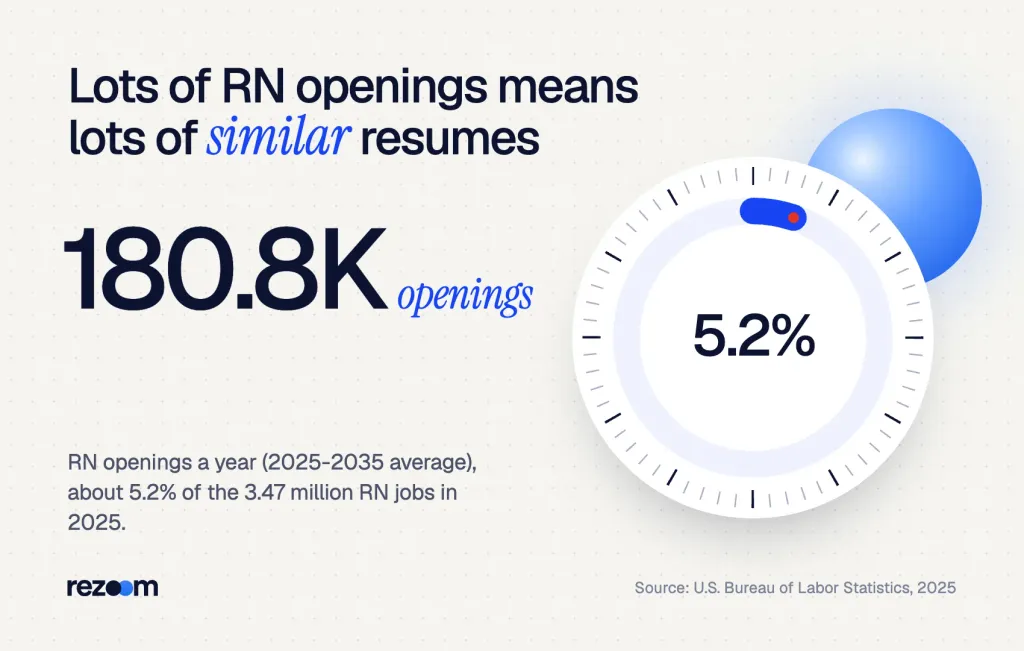
Most hospitals get many applications for each RN role. The Bureau of Labor Statistics1 counts about 3.5 million RN jobs in 2025 and about 180,800 openings each year. That means a lot of resumes look alike, so the summary is where you stand out.
Where it goes on the page
Put it right under your name and contact line. Then follow it with your license and certifications section, your experience and your education. If you are a new grad, put education and clinical rotations above work history.
What should an RN resume summary include?
An RN resume summary should include your license type and state, your specialty and years, the units and patient ratios you handle, your EHR system, and your certifications such as BLS, ACLS or PALS. Then add one result with a number, like falls cut or patients served, that you can back up in an interview.
Each item answers a screening question. If you leave one out, the reader has to hunt for it. These are the parts that matter most:
- License and state: Write "RN" and the state, or "multistate RN" if you hold a compact license.
- Specialty and years: Say "med-surg RN, 4 years," not "experienced nurse."
- Unit and patient load: Name the unit type, bed count or ratio, like "1:5 on a 30-bed tele floor."
- EHR system: Name it, such as Epic or Cerner, since many postings list one.
- Certifications: List BLS, ACLS, PALS, NIHSS or a specialty cert like CCRN or CEN.
- One result: Add one number you can prove, like "cut CAUTI rates" or "precepted 6 new grads."
The BLS handbook1 notes that many RN jobs require CPR, basic life support or advanced cardiac life support certification. So put those letters in your summary, not only at the bottom. Recruiters and applicant tracking systems scan for them first.
Your full license line, with number and expiry, belongs in its own section. Our guide on how to list an RN license on a resume shows the exact format.
How to list an RN license on a resume: RN after your name, a Licensure section with state and expiry, compact (NLC) wording and lines for a pending NCLEX.
If the job post says "telemetry," don't write "cardiac step-down." Copy the unit name, the EHR and the cert letters the way the post spells them. That small change helps both the software and the human reader match you fast.
How do you write a nursing resume summary?
Use a simple formula: license and specialty, years and unit, patient load and tools, certifications, then one result. Write two to four short lines with no "I." Start from the job post, pick its top three needs, and make sure each one shows up in your summary in the same words.
A good nursing resume summary follows the same order every time. Then you only swap the details for each job.
- Pick the top three needsRead the job post and circle the unit, the shift and the must-have certs.
- Lead with license and specialtyStart with "RN" or "BSN, RN" and your unit, like "ER RN" or "PCU RN."
- Add years and loadGive your years, the ratio or bed count, and your EHR.
- Stack your certsList the cert letters the post asks for, such as BLS, ACLS or TNCC.
- Close with one resultEnd with one number you can explain, like a quality score, a project or staff you trained.
[Credential, e.g. BSN, RN] with [X] years in [specialty/unit] at a [bed count or Level] [facility type].
Manage [ratio, e.g. 1:4] patients using [EHR, e.g. Epic]. Certified in [BLS, ACLS, specialty cert].
[Action verb] [result with a number], and seeking to bring [skill] to [hospital name]'s [unit].
A quick before and after
Here is a weak line and a fix. The fix names the unit, the load and a result.
Before: Caring, hard-working nurse seeking a position where I can grow. After: Med-surg RN, 4 years, 1:5 ratio on a 32-bed unit, Epic and ACLS. After (result): Led a fall-prevention huddle that cut unit falls by 30% in one year.
If a number like that is not yours, don't use it. Pick a real one, even a small one. You will get asked about it in the interview.
Nursing resume summary examples by situation
Your situation decides what leads. New grads lead with license status and clinical hours. Experienced nurses lead with unit, years and acuity. Travel nurses lead with a compact license and fast onboarding. Charge nurses lead with staff and outcomes. Career changers and returning nurses lead with an active license, then the skills they bring back.
Each example below runs two to three lines. Swap in your own license state, unit and numbers. All names and numbers are examples.
New grad RN
As a new grad, you don't have years to show. So lead with your degree, your license status and your preceptorship unit.
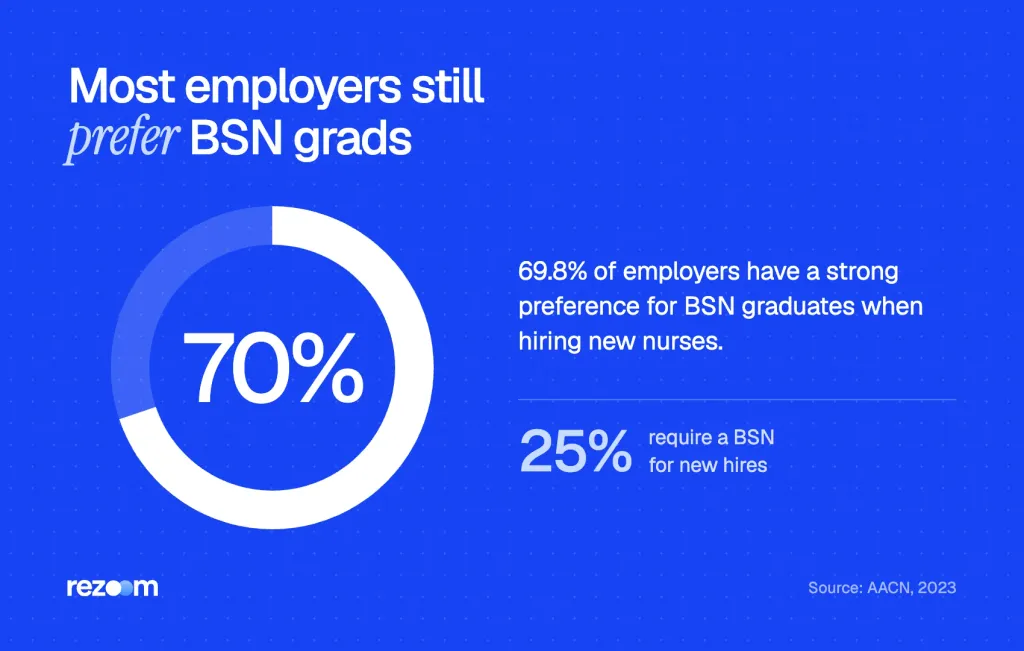
Hospitals still lean toward BSN grads. In a 2023 AACN survey2, 69.8% of employers said they strongly prefer BSN grads, and 25.0% require a BSN for new hires.
BSN, RN (Texas) with a 240-hour capstone on a 28-bed med-surg unit. Cared for 4 to 5 patients per shift under a preceptor, charting in Epic. BLS and ACLS certified, and bilingual in English and Spanish.
If you are still waiting on the NCLEX, write "NCLEX-RN scheduled for [month]." For more starter lines, see our student nurse resume objective guide.
Experienced med-surg, ICU and ER nurses
Experienced nurses should lead with unit and acuity. Then add one number that proves you handle the load.
CCRN-certified ICU RN with 6 years in a 24-bed Level I trauma ICU. Manage 1:2 vented and post-op patients, titrate drips and run CRRT. Precepted 8 new nurses, and served on the unit's sepsis bundle team.
An ER summary works the same way. But it names triage, trauma level and your ESI comfort.
Emergency RN, 5 years in a 60-bed Level II trauma ED seeing high volume. Skilled in ESI triage, trauma bays and rapid response. TNCC, ACLS and PALS. Charge backup on nights, and super user for the Epic ASAP module.
Travel nurse
Travel managers want proof you can start fast. So lead with your license reach, your contract count and how quickly you onboard. The NCSBN3 said in January 2025 that 43 jurisdictions belong to the Nurse Licensure Compact.
Nurses holding a multistate license are allowed to practice across state lines in other NLC states.
Nurse Licensure Compact, 2025 Employer Fact Sheet
Multistate RN (compact license, Florida home state) with 9 travel contracts in 5 states. Tele and step-down nurse, comfortable on Epic, Cerner and Meditech. Orients in 1 to 2 shifts, and extended on 6 of 9 contracts.
Charge nurse
A charge nurse summary should show scope. Name the unit size, the staff you lead and one outcome.
Charge RN with 10 years in med-surg, leading 12 to 14 staff per shift on a 36-bed unit. Run bed flow, staffing and daily safety huddles with the house supervisor. Helped raise HCAHPS nurse communication scores two quarters in a row.
Career changer and returning nurse
If nursing is a second career, lead with the RN license. Then name the skill your old job gave you, like EMS calm or teaching skills. If you are coming back after a break, lead with an active license and a recent refresher.
Active RN (Ohio) with 7 years in labor and delivery, returning after a family care break. Finished a state-approved RN refresher course and clinical practicum in 2026. Current BLS, ACLS and NRP. Ready for days, nights or weekends.
Free ATS score, the text the software extracts and your missing keywords. No sign-up.
Should you use a summary or an objective on a nursing resume?
Most RNs should use a summary, because it shows proof instead of goals. Use an objective only if you are a student, a new grad with no paid nursing work, or a nurse changing specialty. Even then, keep it to one or two lines and name the exact unit you want.
The University of Maryland School of Nursing guide says an objective is only worth adding if "you are seeking a specific care area." That matches what most nurse recruiters want. They care more about what you have done than what you hope to do.
| Use a summary if | Use an objective if |
|---|---|
| You have paid RN experience | You are a nursing student |
| You want to show specialty depth | You are a new grad with no RN job yet |
| You hold specialty certs | You are moving into a new specialty |
| You are a travel or charge nurse | You want a set unit, like "RN, Psych Unit" |
For a side-by-side breakdown, read our guide to resume objective vs summary. And if an objective fits you better, our nurse resume objective guide has ready lines.
Nursing resume objective examples for RN, LPN, new grad and student nurses: copy a one-line objective by unit, use the 4-part formula and skip weak phrases.
If you are a licensed practical nurse, the rules shift a bit. Our LPN resume summary guide covers LPN scope and wording.
What mistakes weaken an RN resume summary?
The biggest mistakes are vague words, no license or state, missing cert letters, and numbers you can't explain. Long paragraphs hurt too, since recruiters skim. Cut "caring" and "hard-working," name your unit and ratio instead, and keep the whole summary under about 60 words.
Most weak summaries use soft words with no proof. "Compassionate" is fine, but only if a fact backs it up. If your summary would fit any nurse in any unit, rewrite it.
Do
- Name your license, state and specialty in line one.
- Give your ratio, bed count or trauma level.
- Use the cert letters the job post uses.
- Add one result you can talk about for two minutes.
Don’t
- Write "I am a caring nurse who loves patients."
- List every skill you have ever used.
- Use a number you can't back up.
- Copy the same summary to every job.
Keep it scannable
Short lines win, so aim for two to four lines and stop. If you need more room, move details into your experience bullets. A quick scan of medical resume examples shows how short, dense summaries look on real pages.
Read your summary like a shift handoff. If you run out of breath or stumble, the line is too long. Cut it until each line says one clear thing.
How do you tailor your nursing resume summary to each job?
Keep one master summary, then change three things per job: the unit name, the top certs and the one result. Match the post's words exactly. Check that your cover letter tells the same story, and prep to explain every number in your summary during the interview.
The best nursing resume summary for a job matches its post. So keep a master version and edit three spots each time.
Match your resume to the role
Before you send, compare your page with strong nurse resume examples. Look at how they pair the summary with a short license and cert section.
Nurse resume example
See how an RN summary, license and certs fit on one page.
Your letter should echo your summary, not repeat it. This nurse cover letter example shows how to expand one result into a short story. New grads can also use our new graduate nurse cover letter examples.
Nurse cover letter example
A short RN letter that builds on one result from the summary.
Build and check it fast
A tool can speed up the swaps. Rezoom's AI resume builder drafts a summary from your license, unit and certs, and you edit the result. Then prep for the follow-up with our list of nurse interview questions.
Before you send your resume
Tailored to the job post, checked against ATS.
Frequently asked questions
How long should a nursing resume summary be?
Keep it to two to four lines, or about 40 to 60 words. If it runs longer, move details into your experience bullets.
What should a new grad nurse put in a resume summary?
Lead with your degree, license status and preceptorship unit. Then add clinical hours, your EHR and your BLS or ACLS certs.
Should I put my RN license number in my summary?
No. Put "RN" and the state in the summary, and list the license number and expiry in a separate licenses section.
Is a summary or an objective better for a nursing resume?
A summary works better for most RNs because it shows proof. An objective fits students, new grads with no RN job, and nurses changing specialty.
What is the difference between an RN resume summary and a registered nurse resume summary?
They are the same thing. Both mean a short block at the top of an RN resume that lists license, specialty, years, certs and one result.
Should a travel nurse mention a compact license?
Yes. A multistate license lets you work in other compact states, so lead with it. Name your home state too.
Sources
We opened and read each page below. The small numbers in the text point here. Pages that carry no publication date show n.d.
- U.S. Bureau of Labor Statistics2025
Registered nurses held about 3.5 million jobs in 2025, with about 180,800 openings a year, and many roles require CPR, BLS or ACLS certification.
- American Association of Colleges of Nursing2023
In 2023, 69.8% of employers strongly preferred BSN graduates and 25.0% required a BSN for new hires.
- NCSBN2025
As of January 2025, 43 jurisdictions belong to the Nurse Licensure Compact.
- Nurse Licensure Compact2025
Nurses with a multistate license can practice across state lines in other compact states.
- University of Maryland School of Nursingn.d.
An objective is only needed if you are seeking a specific care area, and new grads can list clinical rotations under education.
- UCSF Career Centern.d.
A sample nursing resume lists the RN license and BLS certification with issuing body and expiry date in their own section.
Mohammad has spent more than ten years designing consumer products and leads product at Rezoom, deciding what gets built and what gets left out. His guides cover the whole job search, from resume sections and cover letters to interview answers and career moves.
Goodi, M. (2026, November 17). Nursing Resume Summary: 8 RN Examples by Situation and Unit. Rezoom. https://rezoom.io/nursing-resume-summary/