

Summary
Put US citizen on a resume only when citizenship is a real hiring requirement: federal jobs, roles that need a security clearance, and export-controlled work that the posting limits to citizens or US persons. For most private-sector jobs, leave it off, because employers generally cannot restrict hiring to citizens unless the law requires it. When you do include it, use one plain line such as "US Citizen" in your header or at the end of the resume.
Should you put US citizen on a resume? Only when the job actually requires citizenship. That means federal positions, roles that need a security clearance, and export-controlled work where the posting says citizens or US persons only.
For most private-sector jobs, you can leave it off. Employers generally cannot limit hiring to US citizens unless a law, regulation, or government contract requires it, so the line usually adds nothing a recruiter needs.
Most guides give you a vague "it depends." This one gives you a decision rule by job type, the exact wording for each work status, and the placement that keeps an ATS and a recruiter happy.
When should you put US citizen on a resume?
List US citizenship when the job requires it or the posting asks about it. That covers federal civilian jobs, positions needing a security clearance, and defense or export-controlled roles restricted to citizens or US persons. It can also help when your name, degree, or work history abroad might make a recruiter wonder about sponsorship.
Start with the posting. If it says "US citizenship required," "must be able to obtain a clearance," or "US person as defined by ITAR," put your status on the resume. It is a screening requirement, and a recruiter should not have to guess.
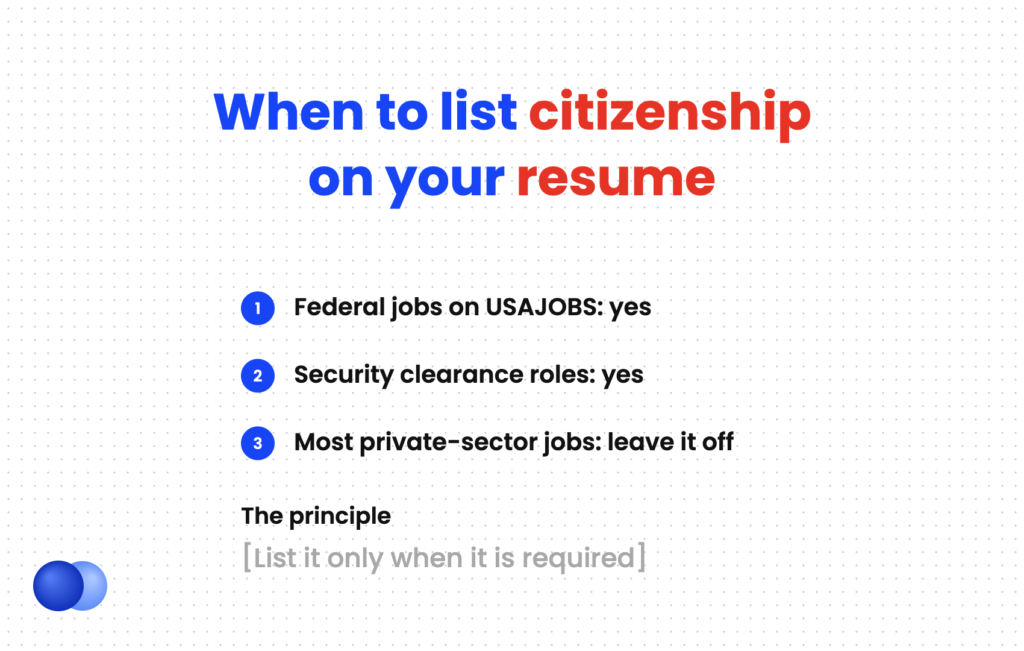
Here is the rule by situation:
| Your situation | Include citizenship? | Why |
|---|---|---|
| Federal civilian job on USAJOBS | Yes | Most federal jobs are open only to citizens or nationals |
| Job requiring a security clearance | Yes | Clearances generally require US citizenship |
| Defense or export-controlled role | Yes, if the posting asks | ITAR access is limited to "US persons" |
| You studied or worked abroad | Optional, often helpful | Removes a sponsorship question before it forms |
| Typical private-sector job | No | Not a legal requirement, and it takes up space |
The federal case is the clearest. The Office of Personnel Management says a job open to the public means anyone with US citizenship, or who is a national, may apply. Clearance roles are similar. The Defense Intelligence Agency states plainly that you must be a US citizen for its clearance process, though dual citizens may be eligible.
If the role needs a clearance, list that too. Our sibling guide on how to list security clearance on a resume covers the format.
Why do most private-sector resumes leave citizenship off?
Most private employers are not allowed to require citizenship. Federal law bars citizenship status discrimination in hiring, and the Justice Department says employers may restrict jobs to US citizens only when a law, regulation, executive order, or government contract requires it. Without that requirement, the line does not affect the decision.
The Immigration and Nationality Act prohibits citizenship status discrimination in hiring, firing, or recruitment, enforced by the Justice Department's Immigrant and Employee Rights Section (IER).
IER's best-practices flyer is specific. Employers may require citizenship only when it is "required by law, regulation, executive order, government contract, or determination by the Attorney General." It lists "Only US Citizens" and "Only US Citizens or Green Card Holders" as examples of language employers should not use without that legal basis.
So for a marketing, retail, or software role at a private company, listing US citizen on a resume does not change the hiring decision. Employers verify work authorization after hire, not by reading your resume. The space is better spent on skills and results.
There is also a style reason. US resumes leave out personal details that do not prove you can do the job. USAJOBS itself tells applicants not to include personal information such as age, sex, or religious affiliation. Citizenship is different on federal resumes, but on private-sector ones it falls into that same "not needed" group.
When can listing citizenship still help?
Listing citizenship can help when something on your resume might lead a recruiter to assume you need visa sponsorship. Common triggers include a degree from a foreign university, recent jobs abroad, or a phone number with a foreign country code. One short line removes the doubt before the recruiter moves on.
Recruiters screen fast. If your last two jobs were in Toronto and London, some may assume sponsorship and skip you, even though they are not allowed to require citizenship.
A short line answers the question they did not ask. This is a practical move, not a requirement. It is most useful when:
- Your degree or recent experience is from outside the US.
- You are applying from abroad and plan to move back.
- The company says it does not sponsor visas, and your background might suggest you need one.
- You are a green card holder or have other permanent work authorization and want to say "no sponsorship needed."
Many applications also ask directly whether you need sponsorship now or in the future. The University at Buffalo's career office advises applicants to be honest and transparent and never give false information on those forms. Your resume line should match what you answer there.
How do you write US citizen on a resume?
Keep it to one plain line. Write "US Citizen" or "US Citizen, eligible for security clearance." Green card holders can write "Permanent Resident, authorized to work in the US without sponsorship." Never add a passport number, Social Security number, or birthplace. Match the wording the posting uses when you can.
The wording depends on your status. Use the line that is accurate for you and nothing more.
US Citizen
US Citizen | Eligible for Security Clearance
US Citizen | Active Secret Clearance
Permanent Resident | Authorized to work in the US without sponsorship
Authorized to work in the US for any employer
If a defense or export-controlled posting uses the phrase "US person," you can mirror it. Under the ITAR, a US person includes a lawful permanent resident or a protected individual as defined in federal immigration law. That means green card holders may qualify for roles where citizenship alone is not required. Read the posting carefully and do not claim a status you do not hold.
Dual citizens can write "US Citizen." You do not need to list your other citizenship on a private-sector resume. A clearance application will ask about it separately.
Where does US citizen go on a resume?
Put it in one of two places. Place it in your contact header when citizenship is a stated requirement, so a recruiter sees it in the first seconds. Otherwise, put it in an "Additional Information" line at the bottom. Do not give it its own section, a bold headline, or a spot in your summary.
Placement signals importance. Where you put US citizen on a resume should depend on how much the posting cares.
In the header when the job requires citizenship or a clearance. Recruiters scan the top first, and this is a pass-or-fail item. Our resume header guide shows how to keep that line clean.
At the bottom when it is a helpful extra, such as clearing up a sponsorship question. A single "Additional Information" line works well.
Header version (clearance or federal role) Jordan Reyes Arlington, VA | (571) 555-0142 | [email protected] US Citizen | Active Secret Clearance
Bottom-line version (private-sector role) Additional Information: US Citizen, no sponsorship required | Fluent in Spanish
Write it in plain text, not inside a graphic or text box. Applicant tracking systems read plain text reliably. See how ATS works if you are unsure what gets parsed.
Mirror the posting’s exact phrase
If the posting says "must be a US citizen," write "US Citizen." If it says "US person," write "US Person (US Citizen)." Recruiters and ATS filters often search for the posting's exact words. Matching them costs you nothing and removes any doubt about whether you qualify.
Do federal resumes need citizenship listed?
Federal applications capture citizenship during the USAJOBS application, and most federal jobs require it. Some agencies, such as NIH, ask you to list citizenship status on the resume if you are not a US citizen. Adding "US Citizen" under your contact details is still a common, harmless choice that saves the reviewer a step.
USAJOBS guidance, updated in June 2026, says federal resumes must include your full name, email address, and phone number and must be two pages or less. It tells you to read each job announcement for any other required details.
Agencies can add their own rules. The National Institutes of Health tells applicants to include citizenship status if not a US citizen on the resume. Always check the "Requirements" and "How to Apply" sections of the announcement before you submit.
Veterans moving into federal or contractor roles face the same question. Our military to civilian resume guide covers clearance and status lines alongside translated military experience.
What should you never include with your citizenship?
Never add your Social Security number, passport number, visa or green card number, date of birth, or place of birth. Employers collect identity documents after an offer through official forms. Putting them on a resume exposes you to identity theft, since resumes get forwarded, stored, and posted widely.
A resume travels. It sits in databases, email threads, and job boards for years. Anything on it should be safe to share with strangers.
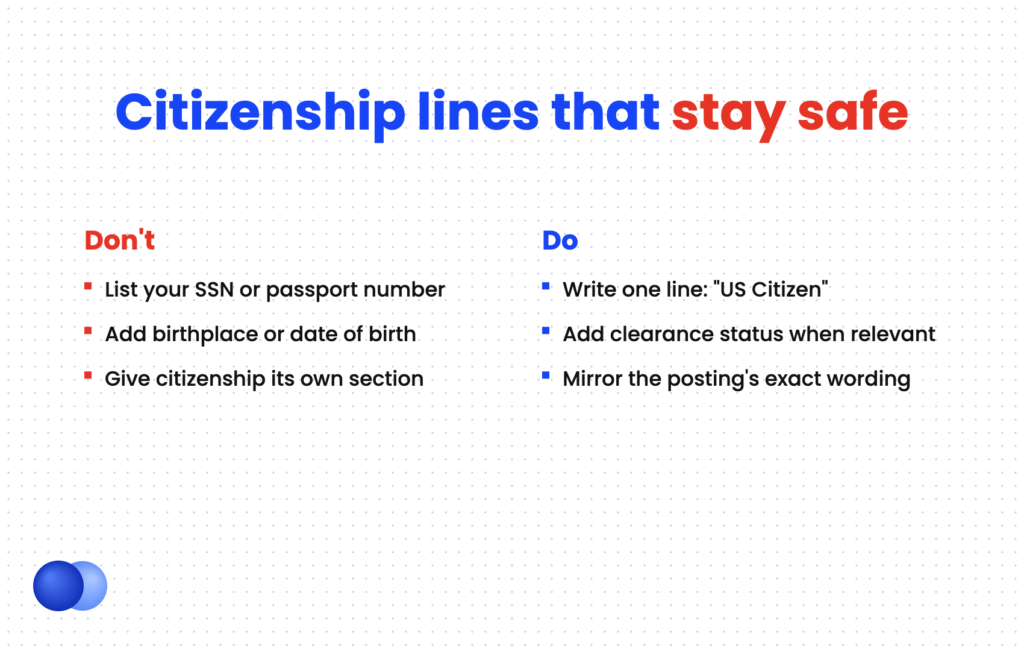
Write one short line such as "US Citizen" do: Mention clearance status next to citizenship when relevant do: Mirror the posting's wording, such as "US person" do: Keep your resume line consistent with your application answers
List your SSN, passport number, or visa number dont: Add your birthplace, date of birth, or ethnicity dont: Give citizenship its own section or a bold headline dont: Claim citizenship or a status you do not hold
USAJOBS specifically warns applicants never to include a Social Security Number on a federal resume. The same logic applies to every private-sector resume. For more details that quietly hurt applications, see our list of resume red flags.
Your home address raises a similar privacy question. Our sibling guide on whether to put your address on your resume covers what to show instead.
Once your citizenship line is set, run the full resume through Rezoom's ATS resume checker to confirm the header and keywords parse cleanly.

Frequently asked questions
Should I put US citizen on my resume for a tech job?
Usually no. Most private tech employers cannot require citizenship, so it does not help. Add it only if the role involves government contracts, export-controlled technology, or a clearance, or if your background suggests you might need sponsorship.
Is it illegal for employers to ask if I am a US citizen?
Employers can ask whether you are authorized to work in the US and whether you need sponsorship. They generally cannot restrict hiring to citizens unless a law, regulation, executive order, or government contract requires it.
Should green card holders put citizenship on a resume?
No, because you are not a citizen. Instead, write "Permanent Resident, authorized to work in the US without sponsorship" if you want to address the question.
Where do I put US citizen on a resume?
Put it in your contact header when the job requires citizenship or a clearance. Otherwise, put it in a short "Additional Information" line at the bottom of the resume.
Does listing US citizenship help you get hired?
It helps only when citizenship is a real requirement or when it clears up a sponsorship assumption. For most private-sector roles, it neither helps nor hurts, so your skills and results matter far more.
Should dual citizens list both citizenships?
On a US resume, "US Citizen" is enough. A security clearance application will ask about other citizenships separately, and you should answer those questions fully.



Comments