

Summary
Resume Genius's 2026 survey of 1,500 hiring managers puts job-hopping (65%), heavily AI-generated materials (49%), long or unexplained gaps (43%) and vague job descriptions (42%) at the top of the list. But a flag is not a rejection: only 12% treat an unexplained gap as a significant negative. What turns a flag into a rejection is a resume that seems to hide something — a functional format, year-only dates, generic bullets. Explain your history; never blur it.
Most lists of resume red flags treat your history as the problem: too many jobs, a gap, a career change. The 2026 data says the history rarely sinks you. The attempt to disguise it does.
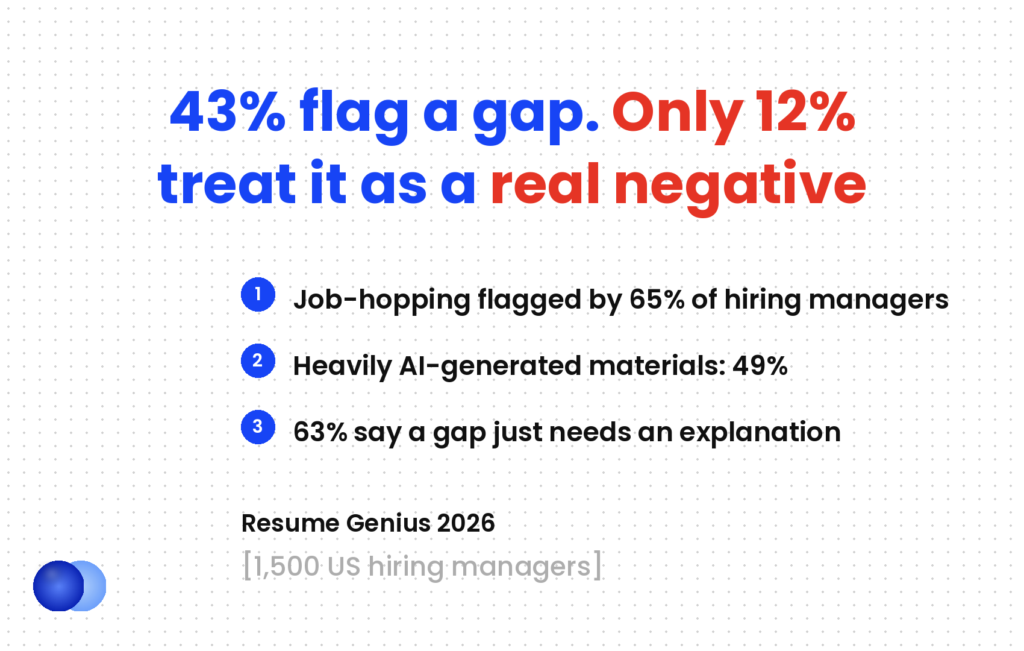
In Resume Genius's 2026 hiring trends survey of 1,500 US hiring managers, 43% named a long or unexplained employment gap as a red flag. Yet in the same survey, only 12% treat an unexplained gap as a significant negative, and 63% say it simply warrants an explanation. A flag starts a question. It does not end the application.
So the useful distinction is between flags that raise a question you can answer and flags that suggest you are dodging one. Recruiters forgive the first kind every day. The second kind — a functional layout, year-only dates, bullets that could belong to anyone — reads as concealment, and concealment is the one thing a six-second scan never gives the benefit of the doubt.
What resume red flags do recruiters look for in 2026?
In Resume Genius's 2026 survey, hiring managers most often flagged job-hopping (65%), heavily AI-generated materials (49%), long or unexplained gaps (43%) and vague job descriptions (42%). These resume red flags prompt questions; far fewer hiring managers treat any single one as an automatic rejection.
Here is the list, with what each flag actually asks and what answers it. Resume Genius is a resume vendor and ran the survey through Pollfish, so treat the figures as one well-sized survey rather than settled fact.
| Red flag | Share of hiring managers citing it | The question it raises | What answers it |
|---|---|---|---|
| Job-hopping | 65% | Will you stay long enough to pay back onboarding? | A visible reason on each short role |
| Heavily AI-generated materials | 49% | Did you do any of this work yourself? | Specific numbers, names and scope |
| Long or unexplained gap | 43% | What happened, and are you current? | Honest month-and-year dates; a dated entry if long |
| Vague or generic job descriptions | 42% | What did you personally do? | One measurable result per bullet |
Two things stand out. First, every item on the list is a reading of the resume, not a fact on it. A two-year contract role and a two-year role you quit look identical until the page says which one it was.
Second, the flags have shifted. In the same publisher's 2024 survey, the deal-breakers were measured differently — suspected AI content 20%, job-hopping 17%, typos 15%, poor formatting 13% — so the numbers do not compare directly. The direction does: AI and genericness now sit near the top, where formatting mistakes used to be.
Is job hopping still one of the resume red flags that matter?
Yes, in perception: 65% of hiring managers in one 2026 vendor survey flag it. But research on 8,693 fund managers found frequent movers recovered to full performance in about two months versus five. The flag is about an unexplained pattern, so explain each short stint on the page.
Job-hopping tops the list, yet recent research questions what it predicts. In a study summarised in Harvard Business Review, Rebecca Kehoe (Cornell) and F. Scott Bentley (Rutgers) tracked 8,693 US hedge fund managers across 2,129 firms over 15 years. Most people dipped in performance after a move. Those with four or more prior moves recovered to baseline in about two months, against five months for less mobile peers.
That is one industry and one outcome, so it does not prove job-hoppers make better hires everywhere. It does show the assumption behind the flag — that frequent movers cost more to onboard — is not a law.
What actually reads as job-hopping
Resume Genius did not define the term for respondents, which matters. A recruiter seeing four roles in four years is really asking whether you leave when things get hard. Three patterns answer that before anyone asks:
Label contracts and fixed-term roles. "Contract, 12 months" beside a short stint converts a departure into a completion.
Group acquisitions and restructures. If one employer became another, show one company block with both names, not two short jobs.
Show progression. Short tenures with rising titles read as growth. Short tenures at the same level read as restlessness.
Their edge is not superior technical skill, but practiced adaptability: quickly reading culture, forming relationships, and navigating unwritten rules.
Do employment gaps count as resume red flags?
Only when they are long or unexplained. The penalty tracks the gap's duration, not its cause: under six months needs no explanation at all, and recently laid-off candidates interview at slightly higher rates than employed ones. An ATS does not detect gaps; the human reader notices them.
The survey split is the clearest evidence in this article that a flag and a rejection are different things. 43% flag a long or unexplained gap; 12% treat an unexplained gap as a significant negative. Meanwhile 63% say an unexplained gap simply warrants a sentence of context.
Duration is the variable. Huntr's Q1 2026 data showed candidates under three months out from a layoff interviewing at 5.74%, against 4.97% for the currently employed. The penalty appears around month six and grows from there. A gap under six months needs no explanation on the resume.
No software is counting. A common fear is that an applicant tracking system calculates your gaps and marks you down. It does not: parsers extract fields such as titles and dates, and nothing in them computes the space between roles.
Past six months, fill the period with a dated entry. "Professional Development | Nov 2025 – Present" with a named certificate or project occupies the gap honestly. The full scripts are in how to explain an employment gap.
Do not trade a gap for a parsing failure
The instinct to write "2021 – 2025" instead of "Mar 2021 – Jun 2025" to make a short gap vanish backfires twice. Year-only date ranges fail on at least three of eight major parsers, so your employment history can arrive in the recruiter's system garbled. And anyone who checks LinkedIn sees the real months, which turns a gap nobody cared about into a question about honesty. Use month and year on every role.
Why is a functional resume one of the worst resume red flags?
Because it looks like hiding. A functional resume groups skills and strips out the timeline, which is exactly what someone with a gap or short stints would want. Recruiters read it as concealment, and it also parses worse than any other format. A hybrid format solves the same problem honestly.
Of all the resume red flags, this is the one people add to their own resume on purpose, usually on advice meant to help. Career changers, returners and candidates over 50 reach for the functional format to lead with skills. The recruiter sees something else.
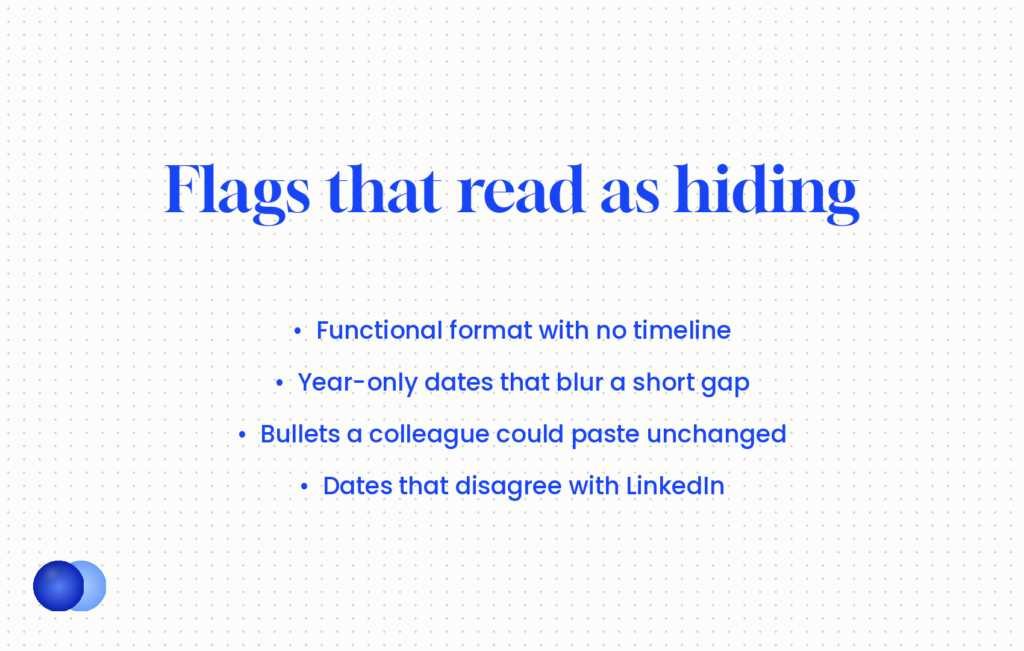
Alison Green of Ask a Manager put the reaction bluntly: the first question a hiring manager asks of a functional resume is what the candidate is trying to hide. It makes the reader's job harder by obscuring "what they've done where and when", so the one thing the document was meant to soften becomes the first thing on the reader's mind.
The machines are no kinder. Functional resumes parse at roughly 70–85%, against 92–97% for chronological and hybrid formats, and carry auto-reject risk on Workday and legacy Taleo configurations.
Use a hybrid instead. A short skills summary at the top, then a normal reverse-chronological work history with month-and-year dates. You still lead with what you can do, and the timeline stays in plain sight. Resume format types walks through the layout.
Functional: "Core skills: Project management · Stakeholder engagement · Budget ownership." Then a list of three employers with no dates, and an 11-month gap nowhere to be seen — until the recruiter asks.
Hybrid: "Operations lead moving into programme management; ran £2.4m of vendor contracts." Then: "Operations Lead, Harbour Freight Ltd · Mar 2021 – Apr 2025", followed by "Career break, family care · May 2025 – Mar 2026".
The hybrid shows the same gap and wins the read, because the reader never has to wonder what else is missing.
Does using AI make your resume a red flag?
Not by itself. Recruiters detect genericness, not authorship: 49% of hiring managers in one 2026 vendor survey flag heavily AI-generated materials, but the tell is interchangeable wording and missing specifics. A resume with real numbers, names and scope reads as yours.
Heavily AI-generated materials came second in the 2026 survey at 49%. It is tempting to read that as "recruiters can spot AI". They mostly cannot. Plenty of recruiters claim they can, yet blind tests show most fail to tell AI-written documents from human ones, which can employers detect an AI resume covers in detail.
What they do spot is the output of a lazy prompt: "results-driven professional", "leveraged cross-functional synergies", a summary that fits any applicant for any job. One vendor survey reported by KraftCV found 62% of employers reject AI-generated resumes that lack personalisation, which points at the real trigger.
The test is interchangeability. Read each bullet and ask whether a colleague in the same role could paste it onto their resume unchanged. If yes, it is generic, whoever wrote it. Add the number, the tool, the team size or the outcome that only you can claim.
Which small resume red flags add up?
The quiet ones a recruiter notices in the first few seconds: dates that don't match LinkedIn, a two-column layout that scrambles in the ATS, filler lines, and typos. None is fatal alone, but each spends a scan that lasts only a few seconds.
Recruiters give a first pass seconds, not minutes — how long recruiters look at a resume sets out the eye-tracking data. In that window, small flags stack:
Dates that disagree with LinkedIn. Recruiters cross-check. A mismatch in months reads as carelessness at best.
Two-column or graphic layouts. Multi-column designs scramble text extraction, so the recruiter may see your skills merged into your job titles.
Filler lines. "References available upon request" takes a line and tells the reader nothing — references available upon request explains why to delete it.
Typos in the top third. In the 2024 Resume Genius data, 15% called typos a deal-breaker. The top third gets read; errors there get noticed.
Put a one-line reason next to every role under a year, such as "Contract", "Acquired by Northwind" or "Team dissolved in restructure".
Blur the timeline with a functional layout or year-only dates, because a visible gap costs less than a reader wondering what else you have hidden.
How do you check your own resume for red flags?
Read it the way a sceptical recruiter would. Mark every short role, every gap over six months and every bullet a colleague could copy, then give each one a visible answer. Finally, confirm the file parses cleanly, because an honest resume that extracts badly still looks broken.
A five-minute audit catches most resume red flags before a recruiter does:
- Scan the dates. Month and year on every role, matching LinkedIn exactly.
- Mark every role under 12 months. Add a reason in a few words, or group it with its successor company.
- Mark every gap over six months. Add a dated entry that says what you did.
- Check the format. Single column, reverse-chronological or hybrid, never functional.
- Run the copy test. Any bullet a colleague could paste unchanged gets a number or a name.
- Parse it. An AI resume checker run against a real posting shows whether your dates and titles survive extraction.
What this cannot fix. An audit removes the flags you create; it cannot remove the history itself. If you have five roles in five years, a hiring manager for a role that needs long tenure may still pass, however well you explain them. The goal is not a resume with nothing to question. It is a resume where every question already has an answer on the page, so the reader spends the six seconds on your results instead of your gaps.
Frequently asked questions
What are the biggest resume red flags in 2026?
In Resume Genius's 2026 survey of 1,500 hiring managers, job-hopping (65%), heavily AI-generated materials (49%), long or unexplained gaps (43%) and vague job descriptions (42%) topped the list. It is a vendor survey, so treat the figures as indicative.
Is job hopping a red flag on a resume?
Many hiring managers flag it, but research on 8,693 fund managers found frequent movers recovered to full performance faster than others. Label contracts, group acquisitions and show progression so each short role has a visible reason.
Is an employment gap a red flag?
Only a long or unexplained one. The penalty tracks duration rather than cause, and a gap under six months needs no explanation. Only 12% of hiring managers in the 2026 survey treat an unexplained gap as a significant negative.
Does an ATS detect employment gaps?
No. Parsers extract fields such as titles and dates; nothing in them computes the gap between roles. The human reader notices gaps, which is why honest month-and-year dates and a dated entry for long breaks matter.
Is a functional resume a red flag?
Yes. Recruiters read it as an attempt to hide the timeline, and it parses worse than chronological or hybrid formats. A hybrid resume leads with skills while keeping dated work history visible.
Can recruiters tell if AI wrote my resume?
Not reliably. They detect generic wording, not authorship. A resume with specific numbers, named tools and real scope reads as yours regardless of how you drafted it.
Should I use year-only dates to hide a short gap?
No. Year-only ranges fail on several major parsers and look evasive once someone checks LinkedIn. A short gap under six months rarely draws comment anyway.
How do I explain short job stints on my resume?
Add a few words beside each role under a year: "Contract", "Company acquired", "Team dissolved". Save the fuller story for the interview, where one factual sentence is enough.


Comments