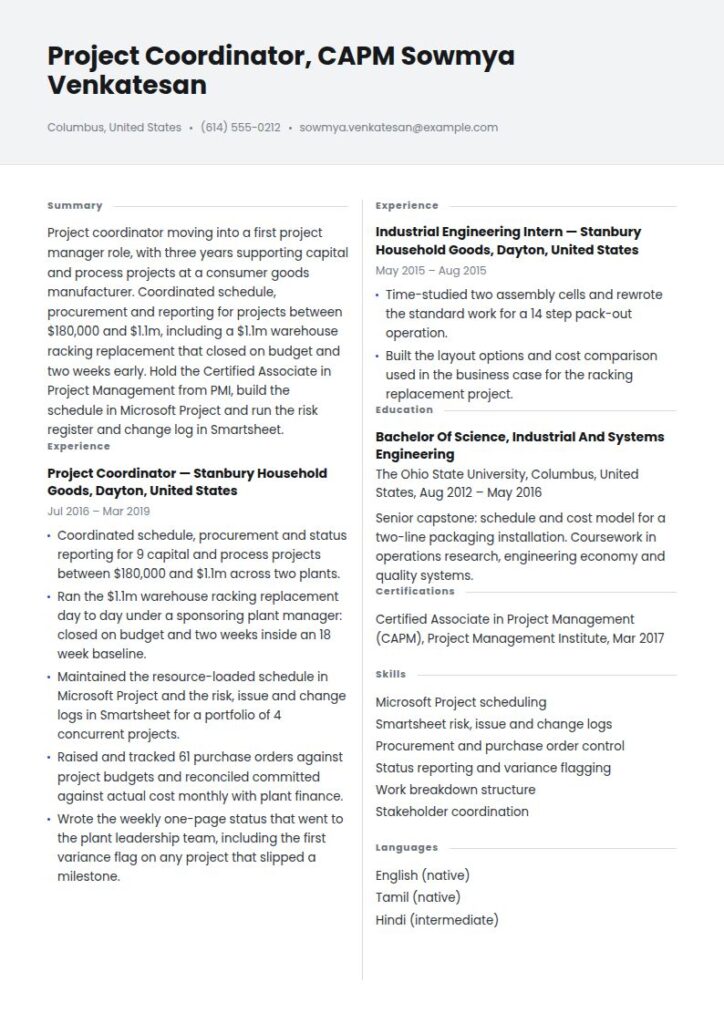
Project Coordinator, CAPM Sowmya Venkatesan
Project Coordinator
[email protected] | (614) 555-0212 | Columbus, United States
Profile
Project coordinator moving into a first project manager role, with three years supporting capital and process projects at a consumer goods manufacturer. Coordinated schedule, procurement and reporting for projects between $180,000 and $1.1m, including a $1.1m warehouse racking replacement that closed on budget and two weeks early. Hold the Certified Associate in Project Management from PMI, build the schedule in Microsoft Project and run the risk register and change log in Smartsheet.
Work Experience
07/2016 - 03/2019, Project Coordinator, Stanbury Household Goods, Dayton, United States
- Coordinated schedule, procurement and status reporting for 9 capital and process projects between $180,000 and $1.1m across two plants.
- Ran the $1.1m warehouse racking replacement day to day under a sponsoring plant manager: closed on budget and two weeks inside an 18 week baseline.
- Maintained the resource-loaded schedule in Microsoft Project and the risk, issue and change logs in Smartsheet for a portfolio of 4 concurrent projects.
- Raised and tracked 61 purchase orders against project budgets and reconciled committed against actual cost monthly with plant finance.
- Wrote the weekly one-page status that went to the plant leadership team, including the first variance flag on any project that slipped a milestone.
05/2015 - 08/2015, Industrial Engineering Intern, Stanbury Household Goods, Dayton, United States
- Time-studied two assembly cells and rewrote the standard work for a 14 step pack-out operation.
- Built the layout options and cost comparison used in the business case for the racking replacement project.
Education
08/2012 - 05/2016, Bachelor of Science, Industrial and Systems Engineering, The Ohio State University, Columbus, United States
Senior capstone: schedule and cost model for a two-line packaging installation. Coursework in operations research, engineering economy and quality systems.
Skills
Microsoft Project scheduling, 75
Smartsheet risk, issue and change logs, 80
Procurement and purchase order control, 75
Status reporting and variance flagging, 70
Work breakdown structure, 65
Stakeholder coordination, 70
Languages
English, native
Tamil, native
Hindi, intermediate
Certificates
03/2017, Certified Associate in Project Management (CAPM), Project Management Institute, PMI-1846210
23 hours of project management education completed before the exam.
Summary
A project manager resume is a one to two page document listing the projects you closed and, for each one, the scope, schedule and budget you were held to and the variance against them. This guide gives you three adaptable versions, the project record block most applicants leave out, and current Bureau of Labor Statistics pay and outlook for project management specialists.
Project Manager resume examples by experience level
A project manager resume is a one to two page document that lists the projects you have closed and, for each one, the three things you were actually held to: scope, schedule and budget.
Most project manager resumes describe activity instead. They say the candidate ran stand-ups, managed stakeholders and tracked risks. Every project manager does those things, which is exactly why saying so separates nobody from anybody. What does separate two files is whether the reader can see a project with a start date, a finish date, an agreed baseline, and an honest account of what moved against it.
Resume guide for a project manager resume
This guide and the corresponding project manager resume example will cover:
- How to write a project manager resume section by section
- Why the baseline and the variance belong on the page, not the meeting cadence
- Three adaptable summaries: first project manager role, practicing, and senior
- How to write about the project that went wrong without hiding it
- What the job market looks like and what you can expect to earn
How to write a project manager resume
Six sections: contact header, summary, project experience, a project record, skills, and education and certifications. One page for your first five years, two once you have closed enough projects that the record is the point of the document.
The order matters because a project manager is hired against a specific gap. Somebody has a project that is starting, or a project that is already late, and they are reading for evidence that you have run something of that size before.
| Section | What it is answering | Where it goes |
|---|---|---|
| Summary | What size of project does this person carry, and in what setting? | Top, four lines |
| Project experience | Who employed them, for how long, and over what kind of work? | Reverse chronological |
| Project record | What did they baseline, what did they close at, and why the difference? | Its own block, with numbers |
| Skills | Which methods and which tools, so I know what handover looks like | Grouped, not a wall |
| Certifications | PMP, CAPM, or none, and whether it is current | With the issuing body and the year |
Give the size of the project before you describe the work on it
A hiring manager reading a project manager resume is doing one calculation over and over: is this person's largest project bigger or smaller than mine?
Nothing answers that except numbers. Budget in dollars, duration in months, team size in people, and sites, systems or workstreams in whatever unit the project actually used. "Managed a large cross-functional project" tells the reader nothing, because large is relative to the writer, not the reader.
Write it as a preface to the bullets rather than inside them: "Distribution center relocation, $4.2m, 11 months, 6 direct reports and 3 contractors, 2 sites." Then the bullets can be about judgment instead of scale.
Run the finished file through the ATS resume checker before you send it. Corporate portals parse project manager applications into a structured record before anyone reads them, and a two-column template is where that parsing breaks.
Choosing the best resume format for a project manager resume
Reverse chronological, with a project record block underneath. One page for your first five years, two after that.
A functional format fails badly for this job. Project management is a sequence of finished things, and a reader wants to see them in order: which employer, which projects, which years, and whether the projects got bigger. A format that hides the sequence reads as a sequence worth hiding.
The one variation worth making is where you put the project record. If you have run two or three projects, fold the baseline and variance into the experience bullets. If you have run twenty, pull the six most relevant into a separate block and let the experience section stay short.
Include your contact information
| ✅ Right | ❌ Wrong |
|---|---|
| Sowmya Venkatesan | Sowmya Venkatesan |
| Project Manager, PMP | Results-driven project management professional |
| Capital and process projects, $300k to $4.2m | Experienced in all aspects of project delivery |
| (614) 555-0212, [email protected], Columbus, OH | (614) 555-0212, [email protected], available nationwide |
Put the credential after your name if you hold it, because it is a filter in a lot of applicant systems. Put the project size band in the header if your projects are larger than the title suggests, because the title alone is not comparable across employers.
Make use of a summary
Four lines: the setting you work in, years, the size band of your projects, and one number that is a result rather than an activity.
Project coordinator moving into a first project manager role, with three years supporting capital and process projects at a consumer goods manufacturer. Coordinated schedule, procurement and reporting for projects between $180,000 and $1.1m, including a $1.1m warehouse racking replacement that closed on budget and two weeks early. Hold the Certified Associate in Project Management from PMI, build the schedule in Microsoft Project and run the risk register and change log in Smartsheet.
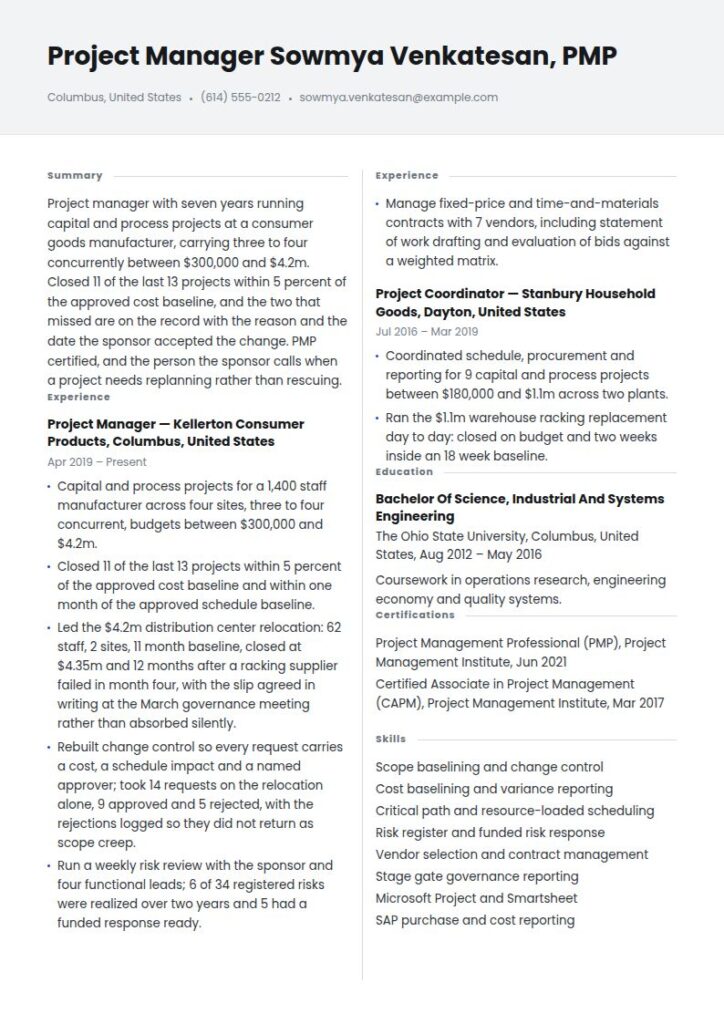
Project manager with seven years running capital and process projects at a consumer goods manufacturer, carrying three to four concurrently between $300,000 and $4.2m. Closed 11 of the last 13 projects within 5 percent of the approved cost baseline, and the two that missed are on the record with the reason and the date the sponsor accepted the change. PMP certified, and the person the sponsor calls when a project needs replanning rather than rescuing.
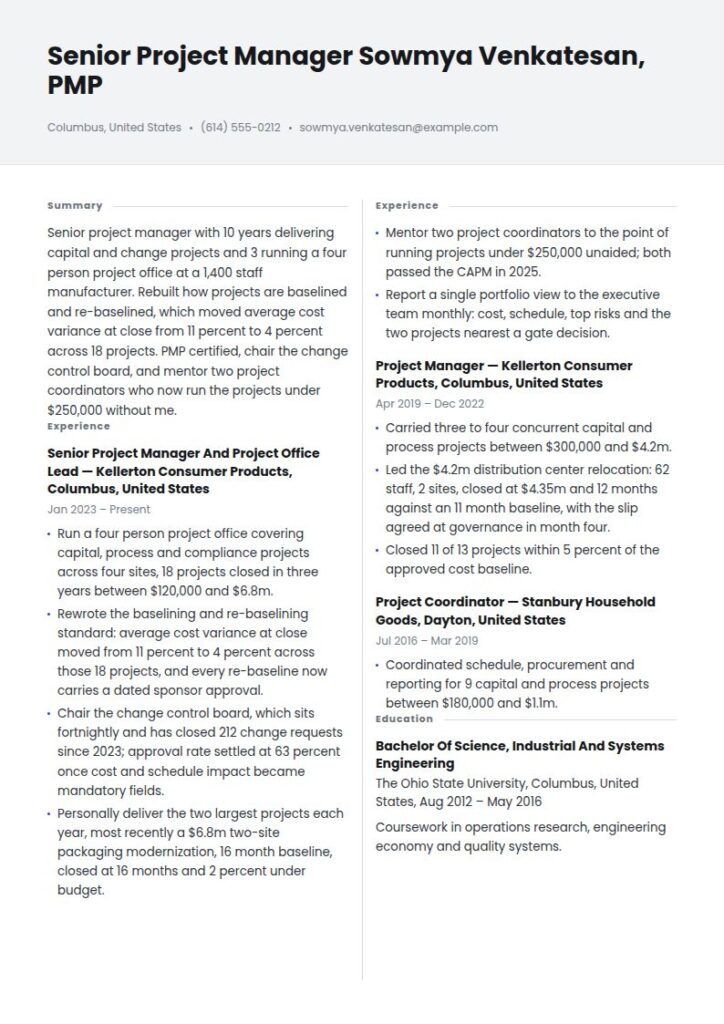
Senior project manager with 10 years delivering capital and change projects and 3 running a four person project office at a 1,400 staff manufacturer. Rebuilt how projects are baselined and re-baselined, which moved average cost variance at close from 11 percent to 4 percent across 18 projects. PMP certified, chair the change control board, and mentor two project coordinators who now run the projects under $250,000 without me.
Right vs wrong: the same project manager summary, twice
| ✅ Right | ❌ Wrong |
|---|---|
| Project manager carrying three to four concurrent projects between $300,000 and $4.2m. | Project manager with a proven track record of successful delivery. |
| Closed 11 of the last 13 projects within 5 percent of the approved cost baseline. | Consistently delivers projects on time and on budget. |
| The two that missed are on the record with the reason and the date the sponsor accepted the change. | Skilled at managing stakeholder expectations in fast-paced environments. |
The left column can be checked. The right column is what every other file in the folder says, and a reader who has seen forty of them stops reading at the third adjective.
Outline your project manager experience
Employer, sector, your title, dates, and the size band you carried there. Then three to five bullets, each one carrying a number and a decision rather than a duty.
| Instead of | Use |
|---|---|
| Delivered projects on time and on budget | Closed 11 of 13 projects within 5 percent of the approved cost baseline; the two that missed are on the record with the reason |
| Managed project risks | Ran a risk register of 34 items with named owners and funded responses; 6 risks were realized and 5 had a response already paid for |
| Handled scope changes | Took 14 change requests to change control, 9 approved and 5 rejected, with the rejections logged so they did not return as scope creep |
| Reported to stakeholders | Weekly status to one sponsor and four functional leads, with one escalation to the steering group in month four of an eleven month build |
| Led cross-functional teams | Ran a core team of 9 across engineering, operations, quality and finance, plus 3 contractors on a fixed-price installation scope |
| Used project management software | Kept the schedule in Microsoft Project with a resource-loaded critical path; change log, risk register and RAID in Smartsheet |
Project Manager, Kellerton Consumer Products, Columbus, OH, April 2019 to Present
Capital and process projects for a 1,400 staff manufacturer across four sites, three to four concurrent, budgets between $300,000 and $4.2m.
Closed 11 of the last 13 projects within 5 percent of the approved cost baseline and within one month of the approved schedule baseline.
Led the $4.2m distribution center relocation: 62 staff, 2 sites, 11 month baseline, closed at $4.35m and 12 months after a supplier failure in month four, with the slip agreed in writing at the March governance meeting rather than absorbed silently.
Rebuilt the change control process so every request carries a cost, a schedule impact and a named approver; rejected requests fell from a standing backlog to a closed log within two cycles.
Run a weekly risk review with the sponsor and four functional leads; 6 of 34 registered risks were realized over two years and 5 had a funded response ready.
Show the baseline and what moved against it
The block that turns a project manager resume into evidence is a short project record: for each project, the approved baseline for scope, schedule and cost, the actual at close, and one line on the variance.
Nobody is expecting zero variance, and a reader who has run projects will be suspicious of a file that claims it. A baseline set in February and hit to the dollar in October usually means the baseline was padded. What the reader is looking for is whether you saw the variance coming, when you saw it, who you told, and what you changed.
Three or four projects is enough. Choose the ones closest in size and type to the job you are applying for, and include at least one that did not go to plan.
Distribution center relocation. Baseline $4.2m, 11 months, 62 staff across 2 sites. Closed at $4.35m and 12 months. A racking supplier failed in month four; re-sequenced the pick module ahead of the mezzanine, absorbed six weeks of an eight week slip, and took the remaining two weeks with the sponsor's written approval at the March governance meeting.
Packaging line changeover. Baseline $1.8m, 7 months, 3 SKU families. Closed on budget and two weeks early. 14 change requests raised, 9 approved, 5 rejected at change control; scope held at the original 3 SKU families.
Customer service consolidation. Baseline $960,000, 9 months, 2 sites to 1. Closed at $912,000 and 9 months. 62 roles transferred with no interruption to order handling; the two week parallel run was the risk response that made that possible and it was funded from contingency at approval, not added later.
Labeling compliance update. Baseline $310,000, 4 months, 140 SKUs. Closed at $327,000 and 5 months. The sponsor accepted a one month slip to add a second artwork proofing cycle after the first found 19 errors across 140 SKUs.
Four things are doing the work in each of those entries: how big, how long, what actually happened, and why. Only the last one is something a reader cannot guess from your job title, and it is the only part that shows judgment.
Write the project that went wrong, and write it plainly
The instinct is to leave the bad project off. Do not. An experienced interviewer will ask for it within the first fifteen minutes, and a candidate who has clearly prepared an answer reads better than one who is improvising.
Write it in four parts: what the baseline was, what changed, what you did about it, and what the outcome was including the part that stayed bad. "Closed at $4.35m against a $4.2m baseline and twelve months against eleven" is a sentence that costs you nothing and buys you the right to be believed about the other eleven projects.
What does damage a file is a failure with no named cause, or a failure described entirely as somebody else's fault. Suppliers do fail and sponsors do change their minds, but the interesting sentence is the one about what you did next.
Build a snapshot of your key skills
Ten to fourteen entries in three groups: the delivery methods you have actually used, the controls you run, and the tools a new employer would hand you on day one.
Delivery: Predictive and phased delivery, Agile and hybrid delivery, Stage gate governance, Work breakdown structure, Critical path scheduling, Resource-loaded planning
Controls: Scope baselining and change control, Cost baselining and earned value reporting, Risk register and funded risk response, Issue and dependency management, Contingency and management reserve, Benefits handover at close
Commercial: Statement of work drafting, Vendor selection and evaluation, Fixed-price and time-and-materials contract management, Procurement and purchase order control
Tools: Microsoft Project, Smartsheet, Jira, Confluence, Power BI status reporting, SAP purchase and cost reporting
Group them like that rather than as one alphabetical strip, because the groups answer different questions. Methods tell a reader how you plan. Controls tell them what happens when the plan breaks. Tools tell them how long your onboarding takes.
List your education and certifications
Degree, institution and year, then certifications with the issuing body, the year, and whether the credential is current. Project management is one of the few fields where the certification genuinely changes which applications get opened, because a large share of postings list it as a requirement.
Bachelor of Science, Industrial and Systems Engineering, The Ohio State University, Columbus, OH, 2016
Project Management Professional (PMP), Project Management Institute, 2021, current through 2027
Certified Associate in Project Management (CAPM), Project Management Institute, 2017
Lean fundamentals and value stream mapping, internal certification, Kellerton Consumer Products, 2020
The Project Management Institute sets the PMP eligibility by education level: a four-year degree plus 36 months of experience leading projects, an associate degree or diploma plus 48 months, or a secondary school qualification plus 60 months, with 35 hours of project management training in every case or an active CAPM instead of the training hours. The exam is 180 questions in 240 minutes, weighted People 33 percent, Process 41 percent and Business Environment 26 percent, and holders keep it current with 60 professional development units in each three year cycle (Project Management Institute, accessed 13 September 2026).
The entry credential is the CAPM, which needs a secondary school qualification, an applicant who is at least 18, and 23 hours of project management education before the exam. It is 150 questions in 180 minutes and is renewed with 15 professional development units every three years (Project Management Institute, accessed 13 September 2026). If you are applying for your first project manager title and do not yet have the hours for a PMP, the CAPM is the line that says you are serious.
Choose the right layout and design
Single column, 11 or 12 point, clear headings, no photograph, no skills bar charts. The project record wants to be legible as a table or as short labeled paragraphs, and both survive parsing; a graphic timeline does not.
Give a budget, a duration and a team size for every project you name. Show the baseline and the actual, including where they differ. Say which delivery method the project actually used rather than listing all of them. Name the governance forum you reported into and how often. Put the certification with its issuing body and its current-through year. Keep one page until the project record itself needs the second.
Do not describe the meeting cadence as though it were an achievement. Do not write "on time and on budget" without a single figure behind it. Do not list every tool you have ever opened; list the ones you would be expected to work in on day one. Do not hide the project that overran, because it will be the first thing you are asked about. Do not claim a certification that has lapsed without writing that it lapsed.
Project manager job market and outlook
Project management specialists are a large and growing occupation, which is unusual among business roles and worth knowing when you negotiate.
| Measure | Value |
|---|---|
| Project management specialist jobs, 2025 | 1,094,300 |
| Projected jobs, 2035 | 1,167,400 |
| Projected change, 2025-35 | 7% (much faster than average) |
| Projected annual openings | About 76,500 |
| Typical entry-level education | Bachelor's degree |
| Prior work experience required | None |
| Median annual wage, May 2025 | $102,320 |
Source: U.S. Bureau of Labor Statistics, Occupational Outlook Handbook, project management specialists, May 2025 wage data and 2025 to 2035 projections.
Where those jobs sit matters more than the headline, because the setting changes both the work and the pay by more than twenty thousand dollars.
| Industry | Share of employment, 2025 | Median annual wage, May 2025 |
|---|---|---|
| Professional, scientific and technical services | 28% | $108,260 |
| Construction | 22% | $98,730 |
| Manufacturing | 7% | $102,640 |
| Administrative and support services | 6% | $98,890 |
| Finance and insurance | 5% | $120,700 |
Source: U.S. Bureau of Labor Statistics, Occupational Outlook Handbook, project management specialists, May 2025.
More than one in five project management specialists works in construction, and the domain variants of this job are hired on domain evidence as much as on method. If your projects are construction, information technology or clinical, say so in the header and lead with the domain vocabulary a reader in that field will check for.
Complex projects fail at roughly twice the rate of projects generally
In its Pulse of the Profession 2026 report, published May 2026, the Project Management Institute found that 97 percent of project professionals had managed at least one complex project in the previous year, with over half of them classifying those projects as significantly complex.
The same report puts the failure rate of complex projects at roughly one in three, against a 13 percent failure rate for projects overall, and concludes that professionals who manage complexity effectively raise the likelihood of project success fivefold (Project Management Institute, May 2026).
That is the argument for the project record. If a third of complex projects fail, then a resume claiming an unbroken run of on-time, on-budget closes is either describing simple projects or describing them selectively. A file that names four projects, one of which overran for a reason you can state in a sentence, is more credible than a file that names none.
What salary you can expect as a project manager
The median annual wage for project management specialists was $102,320 as of May 2025, or $49.19 an hour. The lowest 10 percent earned less than $61,580 and the highest 10 percent more than $167,970 (U.S. Bureau of Labor Statistics, Occupational Outlook Handbook, May 2025).
The industry spread is the biggest single lever. Finance and insurance pays a median of $120,700 against $98,730 in construction, a gap of roughly 22 percent for the same job title (BLS, May 2025). Project size is the second lever, and it is the one your resume controls: a candidate whose largest project is $400,000 and a candidate whose largest is $12m are not competing for the same band, and the only way a reader can tell them apart is if both numbers are on the page.
The Handbook notes that professional certification, while not always required, demonstrates competency to prospective clients and employers (BLS, Occupational Outlook Handbook, May 2025). In practice the PMP functions as a screening filter at large employers and in federal and defense contracting, which is why it belongs in the header rather than at the foot of page two.
Key takeaways for a project manager resume
- Give every project a budget, a duration and a team size, so the reader can compare it with theirs.
- Show the baseline and the actual for scope, schedule and cost, and explain the variance in one line.
- Include at least one project that did not go to plan, with the cause and what you changed.
- Write change control as numbers: requests raised, approved, rejected.
- Name the governance forum you reported into and what you escalated to it.
- Put the PMP or CAPM with the issuing body and the current-through year, in the header.
- If your projects sit in a specific domain, say so; domain evidence is half the screen.
Build your project manager resume in 15 minutes with our AI resume builder.
Related business and management resume examples
- Program manager resume
- Project coordinator resume
- Entry level project management resume
- Business analyst resume
- Product manager resume
- Product owner resume
- Team lead resume
- Manager resume
- Supervisor resume
- Consultant resume
- Event manager resume
- Business management resume
Pair it with a matching project manager cover letter.
Project manager resume questions, answered
How long should a project manager resume be?
One page for your first five years. Two once the project record is long enough that cutting it would remove the evidence, which is usually after eight to ten closed projects. Never three. If you are at two pages, the second page should be the project record and the certifications, not more bullets about the same job.
Do I need a PMP to get a project manager job?
Not universally, but it changes which applications get opened. The Bureau of Labor Statistics says professional certification is not always required and demonstrates competency to prospective clients and employers (Occupational Outlook Handbook, May 2025). Large employers, federal work and defense contracting often screen on it outright. If you do not have the 36 months of leading projects that the four-year-degree pathway requires, the CAPM is the interim credential and needs only 23 hours of project management education (Project Management Institute, accessed 13 September 2026).
What do I put on a project manager resume with no project manager title?
Write the projects you have actually run, whatever your title was. Coordinators, analysts, engineers and office managers run projects constantly without the label. Give each one a budget or a scope measure, a duration, the people involved, and the outcome. Then name what you did not own, because a reader will assume the worst if the boundary is vague: "owned schedule, procurement and reporting; the sponsor held the budget" is a stronger sentence than an implied claim to everything.
How do I write about a project that failed?
In four parts: the baseline, what changed, what you did, and the outcome including what stayed bad. Name the cause without blaming a person. A canceled project is not a failure to hide either; write what was spent, what was salvaged, and who took the decision to stop. Interviewers ask about this in almost every project manager interview, so the resume line is doing you a favor by starting the conversation on your terms.
Should I list every project I have run?
No. Pick four to six that are closest in size, sector and delivery method to the job advertised, and summarize the rest in one line: "24 further projects between $50,000 and $600,000 across four sites." A complete list reads as an inventory. A selected list reads as a candidate who understood the posting.
What is the difference between a project manager resume and a program manager resume?
A project has one deliverable and an end date, and the resume is built on baselines and variance against them. A program is several related projects managed together for a benefit that no single project produces, and that resume is built on dependencies, sequencing and benefits. They are different documents, not the same document at different seniorities. If you are applying for program roles, start from the [program manager resume example](/resume/program-manager/) instead.