Operations Coordinator, food and beverage distribution Antonella Guilbeau
Operations Coordinator
[email protected] | (225) 555-0457 | Baton Rouge, United States
Profile
Business administration graduate working as an operations coordinator for a regional food distributor, covering three depots and roughly 640 customer orders a week. Rebuilt the weekly order-to-delivery report from four exported spreadsheets into a single model, which is now the file the depot managers run their Monday meeting from. Comfortable in Excel to Power Query depth, SQL at query level, and the company's warehouse management system, and finishing a supply chain analytics certificate in evening classes.
Work Experience
04/2023 - Present, Operations Coordinator, Ardoyne Foods Group, Baton Rouge, United States
- Release the daily order file for three depots against a 6 a.m. cut-off and work the exception queue, roughly 640 customer orders a week.
- Rebuilt the weekly order-to-delivery report in Power Query on a single model, replacing four exported spreadsheets and about two days a month of manual assembly.
- Produce the Monday service pack the three depot managers run their operating meeting from.
- Log and code short and late delivery credit notes, and run the weekly exception summary for the operations analyst.
06/2020 - 03/2023, Store Operations Supervisor, Petitbois Retail Group, Baton Rouge, United States
- Ran the back-of-house operation for a 22,000 square foot store: goods receiving, a 4,100-item count cycle, markdown execution and the daily banking reconciliation.
- Supervised 14 staff across opening and closing shifts and held the schedule, including holiday coverage and the overtime call.
- Cut stock count variance from 2.9 percent to 1.4 percent of retail value over four quarters by rebuilding the receiving check.
Education
08/2016 - 05/2020, Bachelor of Science in Business Administration, Operations Management concentration, Tallowood State University, Baton Rouge, United States
Coursework included managerial accounting, business statistics, operations planning and database systems. Capstone project modeled depot capacity for a regional distributor across a twelve-week horizon.
Skills
Excel and Power Query modeling, 80
Warehouse management system administration, 65
Order release and exception handling, 75
Service level measurement, 70
SQL querying, 55
Inventory count cycles, 75
Shift scheduling and coverage, 70
Written reporting for a leadership team, 60
Managerial accounting basics, 55
Standard operating procedure authoring, 60
Languages
English, native
French, intermediate
Certificates
05/2022, Excel Associate, Microsoft
Spreadsheet certification covering formulas, tables and data handling.
Summary
A business resume is the file you write when your degree and your experience point at several functions at once and no job title describes you yet. This guide gives you three adaptable versions, a method for writing one experience three different ways without changing a fact, and current Bureau of Labor Statistics pay and outlook across the occupations a business search lands in.
Business resume examples by experience level
A business resume is the file you write when the search is wider than a job title.
Business is the largest undergraduate field in the country. The National Center for Education Statistics recorded 375,400 bachelor's degrees conferred in business in 2021 to 2022, 19 percent of all bachelor's degrees awarded that year and the largest single field (NCES, Condition of Education, published May 2024). Almost none of those graduates leave with a job title attached to the degree, which is the whole problem this page exists to solve.
The failure is always the same shape. Operations, marketing, finance, human resources and analytics all look reachable, so the resume is written to reach all of them and arrives at each one looking like it was meant for somewhere else. The fix is not to narrow your search; it is to stop sending one document to five readers.
Resume guide for a business resume
This guide and the corresponding business resume example will cover:
- How to write a business resume, section by section
- How to choose a target function before you open the file
- How to write one experience three different ways without changing a fact
- Three adaptable summaries: first role, practicing, and running something
- What the market looks like across the occupations a business search actually lands in
How to write a business resume
Six blocks: a contact header with a target line, a summary written for one function, experience, a scope block, systems, and education. One page until you have three years of full-time work behind you, two after that.
| Section | What it is answering | Where it goes |
|---|---|---|
| Target line | Which job is this person applying for? | Second line of the header, rewritten per application |
| Summary | Can they do that job, and at what scale? | Directly under the header |
| Experience | What did they do, and what moved because of it? | Reverse chronological, numbers in every bullet |
| Scope block | How much was in their hands: money, volume, people, sites? | Inside the top role, not a separate section |
| Education | Degree, concentration, anything quantitative | Last, unless you graduated this year |
The scope block is the part that travels between functions. Job duties do not survive translation from an operations posting to a marketing one, but a number does. Six hundred and forty orders a week, a $7.2 million cost line, three sites, eleven accounts: those facts mean something to every reader on your list.
Run each version through the free ATS resume checker before you send it. Business postings filter on function vocabulary more than on anything else, and function vocabulary is precisely what changes between your versions.
Choosing the best resume format for a business resume
Reverse chronological, single column, one page early. The format decision is not where the difficulty is on a business resume, and treating it as though it were is usually a way of avoiding the targeting decision underneath.
Skip the functional format. It is marketed to exactly the reader of this page, and it reads to a hiring manager as a timeline being hidden. If your history is scattered, the answer is a tighter summary and a sharper target line, not a format that removes the dates.
One exception. If you are applying straight out of a degree with internships and a capstone but no full-time role yet, put a short block of project and internship work above the employment history and keep both dated. Our college graduate resume example covers that case in full.
Include your contact information
| ✅ Right | ❌ Wrong |
|---|---|
| Antonella Guilbeau | Antonella Guilbeau |
| Operations Analyst, food and beverage distribution | Business professional seeking opportunities |
| 3 depots, 640 orders a week, $7.2M freight and labor line | Skilled in operations, marketing, finance and analytics |
| (225) 555-0457, [email protected], Baton Rouge, LA | (225) 555-0457, [email protected] |
Three lines and a contact row. The second is the target line, rewritten for every application. The third is the scope line and it stays roughly the same, because the facts do not change when the reader does. The wrong column is the failure in miniature: "Skilled in operations, marketing, finance and analytics" is a claim of breadth, and breadth is what people write when they cannot name a scope.
Make use of a summary
Four lines, rewritten per target: the seat you are applying for, the scale you have handled, the systems, and one result with a number and a period attached.
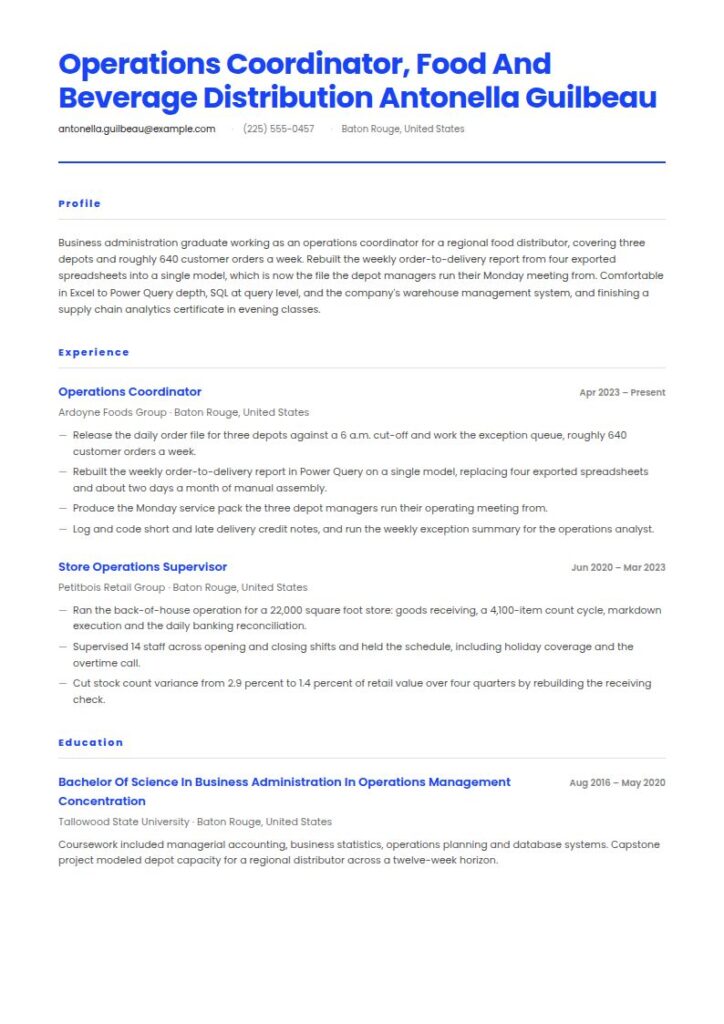
Business administration graduate working as an operations coordinator for a regional food distributor, covering three depots and roughly 640 customer orders a week. Rebuilt the weekly order-to-delivery report from four exported spreadsheets into a single model, which is now the file the depot managers run their Monday meeting from. Comfortable in Excel to Power Query depth, SQL at query level, and the company's warehouse management system, and finishing a supply chain analytics certificate in evening classes.
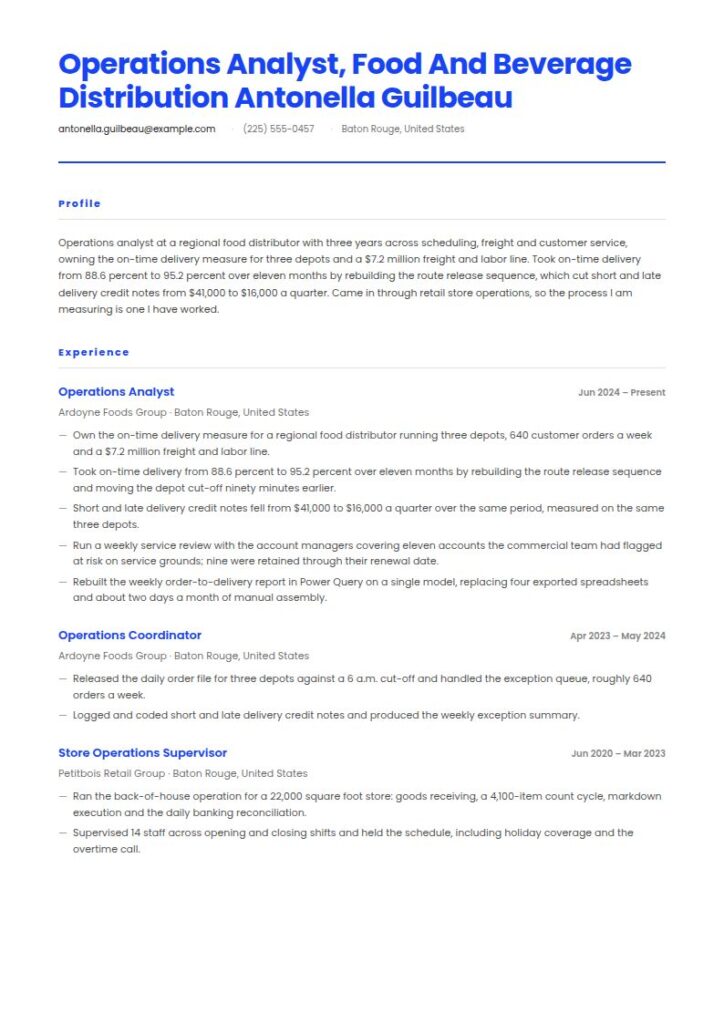
Operations analyst at a regional food distributor with three years across scheduling, freight and customer service, owning the on-time delivery measure for three depots and a $7.2 million freight and labor line. Took on-time delivery from 88.6 percent to 95.2 percent over eleven months by rebuilding the route release sequence, which cut short and late delivery credit notes from $41,000 to $16,000 a quarter. Came in through retail store operations, so the process I am measuring is one I have worked.
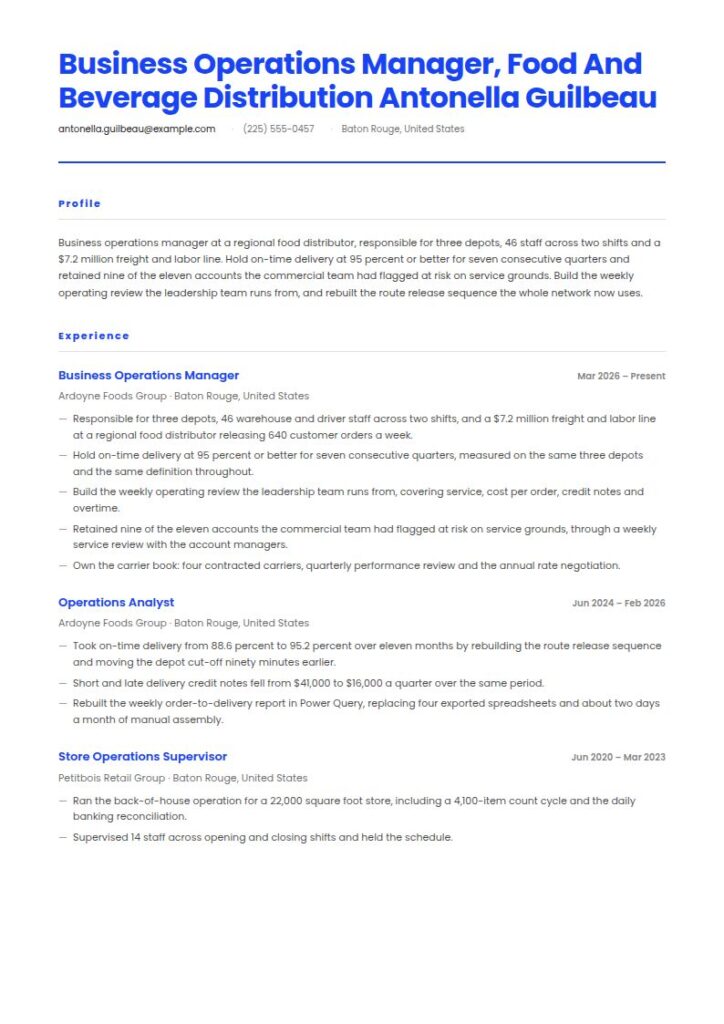
Business operations manager at a regional food distributor, responsible for three depots, 46 staff across two shifts and a $7.2 million freight and labor line. Hold on-time delivery at 95 percent or better for seven consecutive quarters and retained nine of the eleven accounts the commercial team had flagged at risk on service grounds. Build the weekly operating review the leadership team runs from, and rebuilt the route release sequence the whole network now uses.
Right vs wrong: the same business summary, twice
| ✅ Right | ❌ Wrong |
|---|---|
| Own the on-time delivery measure for three depots and a $7.2 million freight and labor line. | Results-driven business professional with strong analytical and communication skills. |
| Took on-time delivery from 88.6 percent to 95.2 percent over eleven months. | Proven ability to improve processes and drive operational excellence. |
| Came in through retail store operations, so the process I am measuring is one I have worked. | Experience across operations, marketing, finance and project work. |
The right column can be checked. The wrong column is four adjectives and a list of departments, and it is what a general business resume defaults to the moment it stops being written for a particular reader.
Outline your business experience
Employer, what it does, its size, dates. Then four to six bullets on the recent roles and two on the older ones. Every bullet carries a number, and the number carries a period of time.
| Instead of | Use |
|---|---|
| Responsible for daily operations | Released 640 customer orders a week across three depots against a 6 a.m. cut-off, with 46 warehouse and driver staff on two shifts |
| Improved delivery performance | Took on-time delivery from 88.6 percent to 95.2 percent across three depots over eleven months |
| Reduced costs | Cut short and late delivery credit notes from $41,000 to $16,000 a quarter by fixing the release sequence behind them |
Operations Analyst, Ardoyne Foods Group, Baton Rouge, LA, June 2024 to Present
Own the on-time delivery measure for a regional food distributor running three depots, 640 customer orders a week and a $7.2 million freight and labor line.
Took on-time delivery from 88.6 percent to 95.2 percent over eleven months by rebuilding the route release sequence and moving the depot cut-off ninety minutes earlier; short and late delivery credit notes fell from $41,000 to $16,000 a quarter over the same period.
Ran a weekly service review with the account managers covering eleven accounts flagged at risk on service grounds; nine were retained through renewal, and rebuilt the weekly order-to-delivery report in Power Query, replacing four exported spreadsheets and about two days a month of manual assembly.
Operations Coordinator, Ardoyne Foods Group, Baton Rouge, LA, April 2023 to May 2024
Released the daily order file for three depots against a 6 a.m. cut-off and handled the exception queue, roughly 640 orders a week.
Store Operations Supervisor, Petitbois Retail Group, Baton Rouge, LA, June 2020 to March 2023
Ran the back-of-house operation for a 22,000 square foot store: goods receiving, a 4,100-item count cycle, markdown execution and the daily banking reconciliation, supervising 14 staff across opening and closing shifts and holding the schedule.
That last entry is the one most people in a broad search shrink, because it is retail and the target is not. It is usually the strongest evidence on the page: somebody who has held a schedule, counted stock and reconciled a till has done work most graduate applicants have only read about.
Write one experience three ways: the operations, finance and commercial framing
This is the section this page exists for. A broad search is a translation problem rather than a writing or formatting problem, and the unit of translation is a single experience, not the whole document.
Take one thing you did and write down every fact about it you could prove. The facts split into three groups, and different readers care about different groups. Nothing is invented and nothing is removed; what changes is which true fact sits in the first sentence.
| If the target is | The same work is written as |
|---|---|
| Operations, supply chain, logistics | The process, the volume, the service measure and the period it moved over |
| Finance, analysis, planning | The money: the cost line, the credit notes, the recovery, the model behind it |
| Commercial, account management, customer success | The customers: accounts at risk, the review cadence, the renewals held |
The raw record, the same in all three: rebuilt the route release sequence across three depots and moved the cut-off ninety minutes earlier; on-time delivery went from 88.6 percent to 95.2 percent over eleven months; credit notes fell from $41,000 to $16,000 a quarter; of eleven accounts flagged at risk, nine were retained through renewal.
Operations framing: Rebuilt the route release sequence across three depots and moved the cut-off ninety minutes earlier, taking on-time delivery from 88.6 percent to 95.2 percent over eleven months on 640 orders a week.
Finance framing: Cut short and late delivery credit notes from $41,000 to $16,000 a quarter, a recovery of about $100,000 a year against a $7.2 million freight and labor line, by fixing the release sequence that was generating them.
Commercial framing: Held a weekly service review with the account managers covering eleven accounts flagged at risk on service grounds; service moved from 88.6 percent to 95.2 percent on-time and nine of the eleven renewed.
Do the translation on paper first. Write the raw record as a list of facts with no verbs in front of them; the groupings are much easier to see that way.
One framing per application, not a blend. A bullet carrying the process, the money and the customers at once is longer than any of the three and persuades less, because the reader has to find their own fact inside it.
The numbers must match across versions. If the finance version says $41,000 and the operations version says $40,000, one of them is wrong and a reference call will find it. Keep a single source file with the verified figures and copy from it.
Keep the dropped facts. They go into the base file, and half the time they come back as the answer to an interview question the bullet had no room for.
Keep one base file and cut every version from it
Write a master document holding every bullet you could ever use, in every framing, ordered roughly by strength. It will be four or five pages. Never send it anywhere.
For each application, copy it, delete what does not serve that target, promote the relevant framing and rewrite the target line and the summary. Name the files for their targets rather than for dates: guilbeau-operations-analyst.pdf is much harder to send to the wrong posting by accident than resume-v7-final.pdf.
Build a snapshot of your key skills
Twelve to sixteen entries in three groups, with the group matching the target function placed first. That reordering is the cheapest edit on the page: a reader skimming a skills block reads the first line properly and the rest as texture.
Operations: Route and load planning, Warehouse management system administration, Inventory count cycles, Service level measurement, Shift scheduling and coverage
Analysis and money: Power Query modeling, SQL querying, Cost per order and cost to serve, Budget tracking and variance, Forecasting on a driver model
Commercial and people: Account service review, Renewal and at-risk account handling, Standard operating procedure authoring, Training and onboarding, Written reporting for a leadership team
Name products rather than categories. The posting will name a product, and the product name is what gets matched.
List your education and certifications
Degree, concentration, institution, city, year. Then anything quantitative you took, then certifications with the body that issued them.
A business degree is a general degree and everybody reading yours knows it. What separates two of them is the quantitative content and whatever you have done since. Name the concentration, the statistics, accounting and operations coursework if it was substantial, and any certificate you are partway through with the awarding body and your position in it.
Bachelor of Science in Business Administration, Operations Management concentration, Tallowood State University, Baton Rouge, LA, 2020. Coursework included managerial accounting, business statistics, operations planning and database systems.
Certifications: Microsoft Power BI Data Analyst Associate, Microsoft, 2025. Excel Associate, Microsoft, 2022.
In progress: Certified Supply Chain Professional, APICS through the Association for Supply Chain Management, two of three modules complete, expected 2027.
Choose the right layout and design
Single column, 11 or 12 point body type, clear headings, no photograph and no graphics. Since you are producing several versions, the layout should be boring enough that swapping a section takes a minute. Keep the headings editable rather than decorative: "Operations experience", "Analysis experience" and "Commercial experience" are the same paragraphs under three labels, and the label is read first.
Decide the target function before you open the file. Keep a base file you never send. Put scope in the header: volume, money, sites, headcount. Write one experience in the framing the target reads in, and keep every number identical across versions. Name products rather than categories, and name the files for their targets. Mine the job you think is irrelevant; it usually holds the real evidence.
Do not write one resume for every function and send it five times. Do not claim breadth in the summary; it is the weakest claim available to you. Do not use a functional format to smooth over a mixed history, and do not delete the retail, hospitality or service job. Do not describe a course project as though it were paid work, or send a version whose target line does not match the posting.
Business job market and outlook
The Bureau of Labor Statistics publishes no Occupational Outlook Handbook profile for business. The Handbook describes occupations, and business is a field that feeds several dozen of them across two large occupational groups. The honest way to read your market is to look at the published occupations a business search lands in.
| Occupation | Jobs, 2025 | Change, 2025 to 2035 | Annual openings | Median wage, May 2025 |
|---|---|---|---|---|
| General and operations managers | 3,599,000 | 5 percent growth, +181,300 | Published only for top executives as a whole | $105,770 |
| Management analysts | 1,077,100 | 10 percent growth, +109,200 | About 94,100 | $101,860 |
| Market research analysts | 952,700 | 7 percent growth, +66,300 | About 82,000 | $78,760 |
| Human resources specialists | 939,700 | 6 percent growth, +60,100 | About 73,700 | $75,940 |
| Financial analysts | 443,100 | 7 percent growth, +32,000 | About 29,500 | $103,570 |
Source: U.S. Bureau of Labor Statistics, Occupational Outlook Handbook, May 2025 wage data and 2025 to 2035 projections, published 27 August 2026. Annual openings for general and operations managers are not published separately; the Handbook reports about 304,100 openings a year for top executives as a group.
A lot of business job titles land in a catch-all. The Handbook's Data for Occupations Not Covered in Detail page records business operations specialists, all other, at 1,157,600 jobs in 2025, projected to reach 1,202,300 by 2035, a 4 percent increase of 44,700 positions, with a median annual wage of $83,050 in May 2025 (BLS, published 27 August 2026). That page publishes no annual openings figure and no wage percentiles.
Two groups, two different pay ladders, and you are choosing between them
Most business careers sit inside one of two occupational groups.
Business and financial operations occupations had a median annual wage of $82,660 in May 2025, with about 886,600 openings projected each year, and overall employment in the group is projected to grow faster than the average for all occupations from 2025 to 2035 (BLS Occupational Outlook Handbook, published 27 August 2026).
Management occupations had a median annual wage of $126,520 in May 2025, with about 1.1 million openings projected each year, and the group is also projected to grow faster than the average (BLS Occupational Outlook Handbook, published 27 August 2026). Both sit well above the median annual wage for all occupations of $50,980 in the same cycle.
The management group pays a median about 53 percent higher, but entry is different in kind: the Handbook records top executives as typically requiring a bachelor's degree plus five years or more of related work experience, while most business and financial operations occupations list a bachelor's degree and no prior experience (BLS, published 27 August 2026). You enter through the first group and arrive in the second.
What salary you can expect in a business role
There is no median wage for business, because there is no occupation called business. Across the five occupations in the table above, May 2025 medians ran from $75,940 for human resources specialists to $105,770 for general and operations managers (BLS Occupational Outlook Handbook, published 27 August 2026). That spread of about $30,000 at the middle is narrower than most people expect, which means the function you choose matters less to your first salary than the scope you can describe once you are in it.
The distributions overlap heavily. General and operations managers ranged from under $50,090 at the tenth percentile to over $253,390 at the ninetieth in May 2025, and management analysts from under $60,640 to over $171,640 (BLS, May 2025). A tenth-percentile operations manager earns less than a median human resources specialist. The occupation sets the middle of your range; the scope on your page decides where in it you land.
Management analysts are projected to grow 10 percent between 2025 and 2035, the fastest of the five, with about 94,100 openings a year (BLS, published 27 August 2026), and the Handbook notes that some employers prefer a master's degree in business administration for that work. Our MBA candidate resume example covers how to write the degree while you are still in it.
Key takeaways for a business resume
- Pick one target function per application, before you open the file.
- Keep a base file holding every bullet and every framing, and never send it.
- Put scope in the header: volume, money, sites and headcount travel between functions.
- Write one experience three ways and send the one the reader is looking for.
- Keep every number identical across versions; a mismatch is checkable.
- Refuse the breadth claim in the summary; name a scope instead.
- Mine the retail, hospitality or service job rather than shrinking it.
- Name products, not categories, and reorder the skills block for each target.
Build your business resume in 15 minutes with our AI resume builder.
Related business and management resume examples
- Business management resume
- Business analyst resume
- Entry-level business analyst resume
- Manager resume
- Supervisor resume
- Project coordinator resume
- Operations manager resume
- Consultant resume
- Business development resume
- Customer success resume
- Supply chain analyst resume
- MBA candidate resume
Pair it with a matching business cover letter.
Business resume questions, answered
What is a business resume, exactly?
A resume written by somebody whose search is wider than a job title: a business graduate, a career changer or a generalist whose experience points at several functions. There is no occupation called business, so the document has to name a target function for each application and shape the same experience to it.
Should I write one business resume or several?
One base file and several pointed versions cut from it. The base file holds every bullet in every framing and is never sent. Each application gets a copy with the irrelevant framings deleted, the relevant one promoted, and the target line and summary rewritten.
What if I genuinely do not know which function I want?
Apply to one at a time anyway and let the market answer. A candidate applying precisely reads as decided even while they are still deciding. Track which targets produce interviews over six weeks; that is better information than any amount of reflection.
Which business jobs pay best at entry?
Among the occupations a business search commonly lands in, May 2025 medians ran from $75,940 for human resources specialists and $78,760 for market research analysts to $101,860 for management analysts and $103,570 for financial analysts (BLS Occupational Outlook Handbook, published 27 August 2026). Those medians cover the whole occupation rather than entry-level pay, so treat them as a ranking of ceilings rather than of starting offers.
Do I need a specialization to get hired with a business degree?
Not to get hired, but you do need a target. Business was the largest bachelor's field in the country at 375,400 degrees in 2021 to 2022 (NCES, published May 2024), so the degree itself separates nobody. What separates you is a named seat, a scope you can describe in numbers, and one named product you are good with. All three can be assembled in a first job.
How do I write a business resume with only retail or hospitality experience?
Write it at scale and in the vocabulary of your target. A shift supervisor held a schedule, ran a count cycle, reconciled cash and handled a staffing shortage, and each has a direct equivalent in an operations, finance or people posting. Give the square footage, the item count, the headcount and the takings; the graduate you are competing with does not have them.