Supply Chain Analyst, Demand Planning Aoife Brennan
Supply Chain Analyst, Demand Planning
[email protected] | (502) 555-0678 | Louisville, United States
Profile
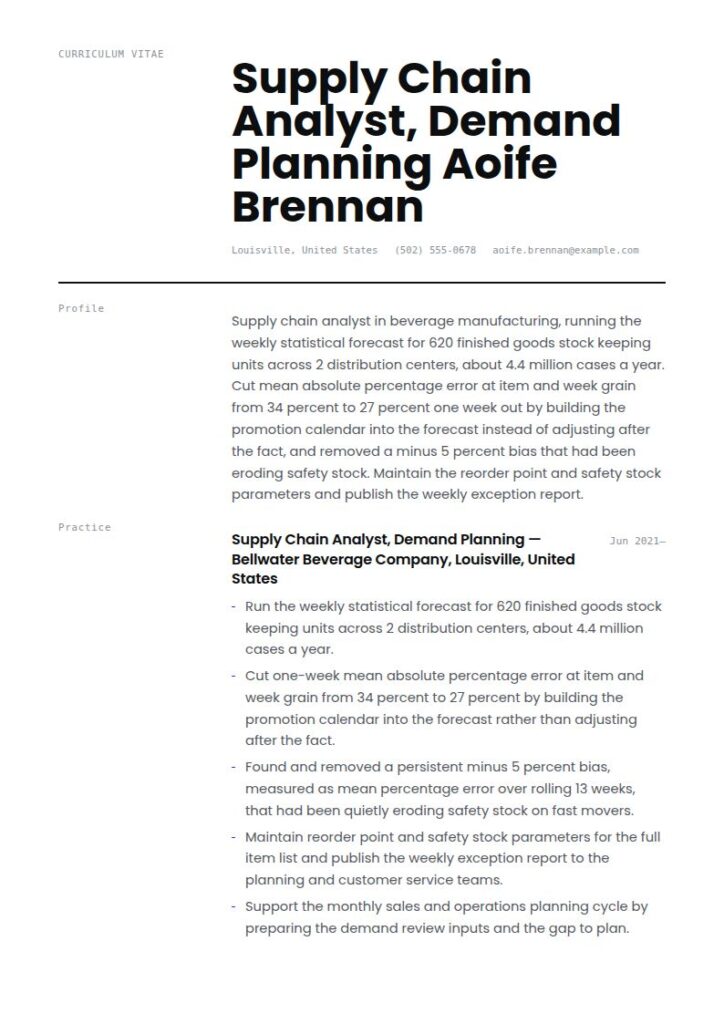
Supply chain analyst in beverage manufacturing, running the weekly statistical forecast for 620 finished goods stock keeping units across 2 distribution centers, about 4.4 million cases a year. Cut mean absolute percentage error at item and week grain from 34 percent to 27 percent one week out by building the promotion calendar into the forecast instead of adjusting after the fact, and removed a minus 5 percent bias that had been eroding safety stock. Maintain the reorder point and safety stock parameters and publish the weekly exception report.
Work Experience
06/2021 - Present, Supply Chain Analyst, Demand Planning, Bellwater Beverage Company, Louisville, United States
- Run the weekly statistical forecast for 620 finished goods stock keeping units across 2 distribution centers, about 4.4 million cases a year.
- Cut one-week mean absolute percentage error at item and week grain from 34 percent to 27 percent by building the promotion calendar into the forecast rather than adjusting after the fact.
- Found and removed a persistent minus 5 percent bias, measured as mean percentage error over rolling 13 weeks, that had been quietly eroding safety stock on fast movers.
- Maintain reorder point and safety stock parameters for the full item list and publish the weekly exception report to the planning and customer service teams.
- Support the monthly sales and operations planning cycle by preparing the demand review inputs and the gap to plan.
05/2020 - 08/2020, Distribution Center Intern, Bellwater Beverage Company, Louisville, United States
- Worked receiving and cycle counting on a 220,000 square foot distribution center floor.
- Rewrote the cycle count sampling schedule around item velocity, cutting count variance investigations by roughly a third.
Education
08/2017 - 05/2021, Bachelor of Science in Business Administration, Supply Chain Management, University of Louisville, Louisville, United States
Coursework in operations planning, transportation and statistics. Capstone on safety stock policy for seasonal demand.
Skills
Statistical forecasting, 80
Forecast error and bias measurement, 85
Reorder point and safety stock parameters, 75
Promotion and event modeling, 70
Microsoft Excel including Power Query, 85
SQL, 65
Languages
English, native
Irish, intermediate
Certificates
09/2022, Certified in Planning and Inventory Management, Part 1 passed, ASCM
Part 2 scheduled; both exams must be passed within three years.
Summary
A supply chain analyst resume is a one to two page document about a physical position: how many units you planned, how wrong the forecast was and in which direction, what safety stock you held against it, and what service level that bought. This guide gives you three adaptable versions, the inventory block that decides these hires, and current Bureau of Labor Statistics pay and outlook.
Supply Chain Analyst resume examples by experience level
A supply chain analyst resume is a one to two page document about a physical position. Units, not dollars. How many parts or cases you planned, how wrong the forecast was and in which direction, how much safety stock you carried against that error, what service level it bought, and what it all cost to hold.
That physicality makes this resume easier to write than most analyst resumes and harder to fake. A finance forecast is wrong on a slide; a supply chain forecast is wrong in a warehouse, and somebody either has the part or does not.
If your forecasting is revenue and margin for a finance team, our financial analyst resume example covers that instead.
Resume guide for a supply chain analyst resume
This guide and the corresponding supply chain analyst resume example will cover:
- How to write a supply chain analyst resume, block by block
- The inventory position: forecast error, bias, safety stock and service level
- Three adaptable summaries: analyst, planner and senior analyst
- Why bias matters more than accuracy, and how to write both
- What the job market looks like and what you can expect to earn
How to write a supply chain analyst resume
Five blocks: contact header, summary, the inventory position, employment history, then systems, skills and education. The header has to answer one question immediately: which part of the chain. Plan, source, make, deliver and return are different jobs sharing a title, and a reader hiring a demand planner will not read a file that could equally be a logistics coordinator.
| Block | What it is answering | Where it goes |
|---|---|---|
| Scope | How many items, how many sites, what volume, which part of the chain? | Header line plus a short block |
| Forecast | Error and bias, at what grain and horizon, against what | Under the summary |
| Inventory | Safety stock method, turns, excess and obsolete, weeks of cover | Its own bullets |
| Service | Fill rate or on time in full, against what target | One bullet, with the target beside it |
Give the scope in items, sites and volume before anything else
"Supply chain analyst supporting the planning team" is unreadable. Nobody knows whether that is 200 stock keeping units or 40,000, one warehouse or eleven.
Write it as three numbers: "Plan 1,840 finished goods stock keeping units across 4 distribution centers, about 2.1 million units a year." A reader can size you against their own operation in four seconds, which is the purpose of a header.
Add the demand shape if it is unusual. Seasonal, promotion-driven and long lead time offshore supply are all harder to plan than steady replenishment, and saying which you lived in is how a strong number gets read as one.
Run the finished file through the free ATS resume checker before you submit. These postings filter on the planning system by name, and a two-column template is where a parser loses it.
Choosing the best resume format for a supply chain analyst resume
Reverse chronological, single column, one page for your first three years and two once you own a book or a network decision. The progression is analyst to planner to senior analyst, and each step adds a decision you make alone rather than recommend.
Coming from a warehouse, customer service or purchasing role, keep the timeline and convert the evidence. Picks per hour, order accuracy, expedite counts and purchase order lines all translate, and time inside a building is an advantage rather than a gap.
Include your contact information
| ✅ Right | ❌ Wrong |
|---|---|
| Aoife Brennan | Aoife Brennan |
| Supply Chain Analyst, Demand and Inventory Planning, CPIM | Results-oriented supply chain professional |
| 1,840 finished goods SKUs, 4 distribution centers, 2.1M units a year | Skilled in forecasting, inventory and logistics |
| (502) 555-0678, [email protected], Louisville, KY | (502) 555-0678, [email protected] |
The third line sizes you. Without it a reader assumes the smallest plausible operation, which is the safe assumption when forty files claim the same four skills.
Make use of a summary
Four lines: the part of the chain and the scope, forecast error with its grain, what you did to inventory or service, and a decision you owned.
Supply chain analyst in beverage manufacturing, running the weekly statistical forecast for 620 finished goods stock keeping units across 2 distribution centers, about 4.4 million cases a year. Cut mean absolute percentage error at item and week grain from 34 percent to 27 percent one week out by building the promotion calendar into the forecast instead of adjusting after the fact, and removed a minus 5 percent bias that had been eroding safety stock. Maintain the reorder point and safety stock parameters and publish the weekly exception report.
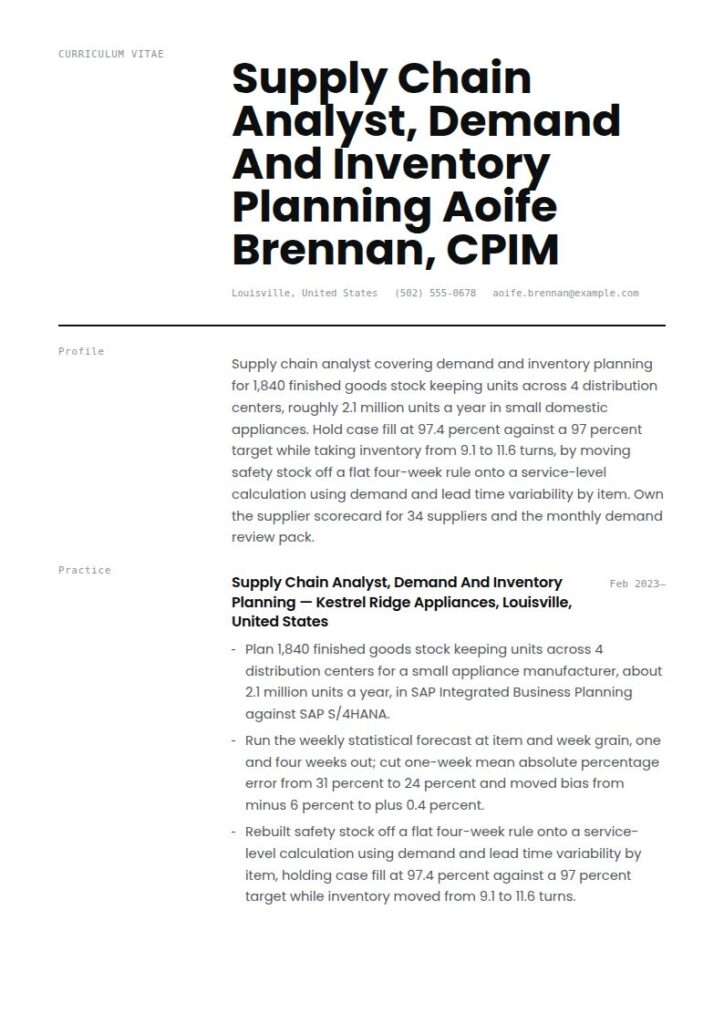
Supply chain analyst covering demand and inventory planning for 1,840 finished goods stock keeping units across 4 distribution centers, roughly 2.1 million units a year in small domestic appliances. Hold case fill at 97.4 percent against a 97 percent target while taking inventory from 9.1 to 11.6 turns, by moving safety stock off a flat four-week rule onto a service-level calculation using demand and lead time variability by item. Own the supplier scorecard for 34 suppliers and the monthly demand review pack.
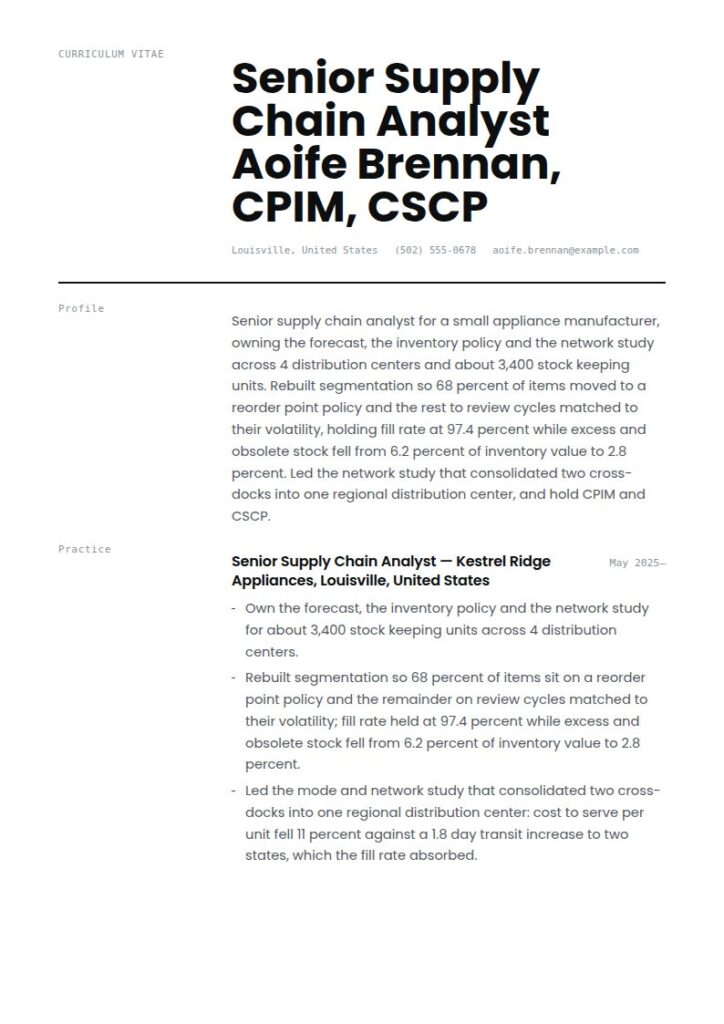
Senior supply chain analyst for a small appliance manufacturer, owning the forecast, the inventory policy and the network study across 4 distribution centers and about 3,400 stock keeping units. Rebuilt segmentation so 68 percent of items moved to a reorder point policy and the rest to review cycles matched to their volatility, holding fill rate at 97.4 percent while excess and obsolete stock fell from 6.2 percent of inventory value to 2.8 percent. Led the network study that consolidated two cross-docks into one regional distribution center, and hold CPIM and CSCP.
Right vs wrong: the same supply chain analyst summary, twice
| ✅ Right | ❌ Wrong |
|---|---|
| Plan 1,840 finished goods SKUs across 4 distribution centers, 2.1 million units a year. | Managed inventory and forecasting for a large product portfolio. |
| Case fill rate 97.4 percent against a 97 percent target. | Consistently achieved high service levels. |
| Inventory from 9.1 to 11.6 turns with fill rate held. | Reduced inventory costs and improved efficiency. |
| Removed a persistent minus 6 percent forecast bias. | Improved forecast accuracy through data analysis. |
The right column is four numbers a planning manager can compare with their own. The left column survives no question about grain.
Outline your supply chain analyst experience
Employer, what it makes or moves, the scope of your book, the systems and dates. Then four to six bullets, each carrying a unit number, a percentage with its denominator, or a decision.
| Instead of | Use |
|---|---|
| Responsible for demand forecasting | Run the weekly statistical forecast for 1,840 SKUs at item and week grain, one and four weeks out |
| Improved forecast accuracy | Cut item-week MAPE from 31 percent to 24 percent one week out and removed a minus 6 percent bias |
| Reduced inventory | Took inventory from 9.1 to 11.6 turns while holding case fill at 97.4 percent against a 97 percent target |
| Worked with suppliers to improve performance | Built the scorecard for 34 suppliers; median lead time variance fell from 6 days to 2 |
| Supported logistics cost savings | Modeled the cross-dock consolidation that cut cost to serve per unit 11 percent, at 1.8 days more transit to two states |
Supply Chain Analyst, Demand and Inventory Planning, Kestrel Ridge Appliances, Louisville, KY, February 2023 to Present
Plan 1,840 finished goods stock keeping units across 4 distribution centers for a small appliance manufacturer, about 2.1 million units a year, in SAP Integrated Business Planning against SAP S/4HANA.
Run the weekly statistical forecast at item and week grain, one and four weeks out; cut one-week mean absolute percentage error from 31 percent to 24 percent and removed a minus 6 percent bias by building the promotion calendar into the model rather than overriding after the fact.
Rebuilt safety stock off a flat four-week rule onto a service-level calculation using demand and lead time variability by item, holding case fill at 97.4 percent against a 97 percent target while inventory moved from 9.1 to 11.6 turns.
Own the supplier scorecard for 34 suppliers on on-time delivery, lead time variance and quantity accuracy; median lead time variance fell from 6 days to 2.
Prepare the monthly sales and operations planning demand review pack: consensus forecast, gap to plan and the exceptions needing a decision.
The inventory position: forecast error, safety stock and the service level it bought
This block separates a supply chain analyst resume from a general analyst resume, and it is where most files go vague. Six labeled lines, no prose.
Scope: 1,840 finished goods stock keeping units, 4 distribution centers, about 2.1 million units a year. Demand promotion-driven with a fourth-quarter peak. Supply from 34 suppliers, 9 offshore with 8 to 11 week lead times.
Forecast: weekly statistical forecast at item and week grain, one and four weeks out, with a consensus override in the monthly cycle. One-week mean absolute percentage error 24 percent, down from 31 percent. Four-week MAPE 37 percent. Bias from minus 6 percent to plus 0.4 percent, measured as mean percentage error over rolling 13 weeks.
Inventory: safety stock set by service-level calculation on demand and lead time variability by item, replacing a flat four-week rule. 11.6 turns, up from 9.1. Weeks of cover 3.4 on A items and 7.1 on C items. Excess and obsolete 2.8 percent of inventory value, down from 6.2 percent.
Service: case fill 97.4 percent against a 97 percent target, measured on order lines at the requested date. On time in full 93.1 percent, measured to the customer's original date rather than a revised one.
Supply: scorecard on 34 suppliers covering on-time delivery, lead time variance and quantity accuracy, reviewed quarterly. Median lead time variance 2 days, down from 6. Two items dual-sourced after a single-source exposure review.
Cost to serve: transport and warehousing cost per unit down 11 percent after the cross-dock consolidation, with transit time to two states rising 1.8 days, which the fill rate absorbed.
Five things make that block credible, and each is an interview question.
Grain and horizon, every time. Item-week accuracy and category-month accuracy differ by a factor that has nothing to do with skill, so write "item and week grain, one week out" beside every error figure. An analyst who omits it is usually quoting somebody else's number.
Bias separately from error. Mean absolute percentage error says how wrong you were; bias says whether you were wrong in one direction, which is what quietly builds excess stock or eats safety stock. Naming a bias you found and removed is one of the strongest lines on this page.
Safety stock as a method, not a number. A flat weeks-of-cover rule, a service-level calculation on demand and lead time variability, and a simulation are three different levels of the job. Say which.
Service with its target and its definition. Case fill and line fill differ; on time in full to the original requested date and to a revised date differ more. State which, and put the target beside it.
One trade-off, named. Inventory down usually means service at risk; consolidation means transit time; dual sourcing means unit cost. Naming the cost of your own best result reads as someone who made the decision rather than reported on it.
Write the stockout, including the one that was yours
The most useful paragraph on a supply chain resume is a short account of something that went wrong. Not a disaster story, and not one that blames a supplier.
The one you prevented: "flagged a single-source exposure on two high-volume items, dual-sourced both, and the second source covered a nine-week supplier outage the following year with no missed orders."
The one you caused is harder and reads better: "a promotion was approved after the forecast lock and I did not rerun the plan, so we went short on one item for eleven days. I changed the lock rule so any promotion inside the frozen window triggers a rerun."
Hiring managers ask about a stockout in almost every interview. Having the answer written shows you have thought about the mechanism rather than the blame.
Inventory has been coming down across the whole economy
The Census Bureau's Manufacturing and Trade Inventories and Sales report for June 2026, released on 14 August 2026, put total business inventories at $2,740.2 billion against total business sales of $2,111.3 billion, and the total business inventories to sales ratio at 1.30, down from 1.39 in June 2025 (U.S. Census Bureau, 14 August 2026).
That is the context every inventory conversation in your interview is happening inside: businesses are carrying less stock against each dollar of sales than a year ago.
Which is why the sentence that matters on your resume is not "reduced inventory". Anybody can reduce inventory; the whole economy has. The sentence that matters is inventory down and service held, with both numbers and both targets, because that version took a method rather than a decision to accept more risk.
Build a snapshot of your key skills
Twelve to sixteen entries in four groups: planning, analysis, systems and the commercial side. Put the method names in; they are what a planning manager screens for.
Planning: Statistical forecasting, Promotion and event modeling, Sales and operations planning, Safety stock and reorder point policy, ABC and XYZ segmentation, New product introduction and phase out
Analysis: Forecast error and bias measurement, Lead time variability analysis, Inventory turns and weeks of cover, Excess and obsolete review, Cost to serve modeling
Systems: SAP Integrated Business Planning, SAP S/4HANA, Blue Yonder Demand, Microsoft Excel including Power Query and Solver, SQL, Power BI
Commercial and supply: Supplier scorecard design, Dual sourcing and risk review, Freight mode selection, Incoterms in practice
Name the planning system separately from the enterprise resource planning system. They are different licenses and often different teams, and a candidate who lists only the second is read as a transactional planner.
List your education and certifications
Degree, then the supply chain certifications with issuing body and year, then anything analytical.
The certifications here come from ASCM. CPIM, Certified in Planning and Inventory Management, requires two exams passed within three years, covers demand management, supply planning, execution, inventory management and detailed scheduling, and is maintained by a certification maintenance application every five years. CSCP, the Certified Supply Chain Professional credential, is a single 150-question exam of three and a half hours, scored 200 to 350 with 300 to pass, across eight topics including global supply chain networks, sourcing, logistics and supply chain risk. ASCM has removed the CSCP eligibility requirements, so there is no experience bar to sitting it (ASCM, accessed 14 September 2026).
Bachelor of Science in Business Administration, Supply Chain Management, University of Louisville, Louisville, KY, 2021
Certified in Planning and Inventory Management, ASCM, 2024. Maintenance current.
Certified Supply Chain Professional, ASCM, 2026
SAP Integrated Business Planning for demand, employer-run training, 2023
Analytics: SQL and Power BI, continuing education, 2025
CPIM is addressed to planning and inventory inside a manufacturer or distributor, which is what most supply chain analyst jobs are. CSCP is broader and reads well if you are moving toward network, sourcing or end-to-end roles.
Choose the right layout and design
Single column, 10 or 11 point, real table markup, no graphics and no supply chain diagram. Set the inventory position as labeled lines: a planning manager scans for scope, service and turns and will not read prose to find them.
Give scope in stock keeping units, sites and annual volume. Attach grain and horizon to every forecast error figure. Report bias separately from accuracy. Say what method set your safety stock. Put the target beside the fill rate and the measurement rule underneath it. Name the planning system and the enterprise resource planning system separately. Name one trade-off you accepted.
Do not name a customer or a supplier anywhere. Do not publish supplier pricing, contract terms, rebates or landed cost figures. Do not give your employer's revenue, margin or absolute inventory value. Do not quote an accuracy number you cannot define. Do not write "reduced inventory" without the service number beside it. Do not claim a network decision you modeled but did not own.
The confidentiality rule bites hardest on suppliers. Supplier names, unit prices, payment terms, rebates and tooling agreements are commercially sensitive and often contractually protected, and a resume listing them tells a hiring manager what you would do with theirs. Describe suppliers by count, region and lead time band, and cost movement as a percentage.
Supply chain analyst job market and outlook
Unusually for an analyst title, a published Occupational Outlook Handbook profile fits most of this work: logisticians, whom the Handbook describes as people who "analyze and coordinate an organization's supply chain, the system that moves a product from supplier to consumer" and who "manage a product's entire life cycle, from design to disposal".
| Measure | Logisticians |
|---|---|
| Jobs, 2025 | 255,100 |
| Projected employment, 2035 | 300,000 |
| Projected change, 2025 to 2035 | 18 percent, much faster than average, +44,900 |
| Projected annual openings | About 26,600 |
| Typical entry-level education | Bachelor's degree |
| Work experience in a related occupation | None |
| Median annual wage, May 2025 | $82,320 |
Source: U.S. Bureau of Labor Statistics, Occupational Outlook Handbook, May 2025 wage data and 2025 to 2035 projections.
Not every supply chain analyst is counted there. Planning titles inside a manufacturer's finance or operations function are often counted as business operations specialists, all other, which the Handbook's Data for Occupations Not Covered in Detail page puts at 1,157,600 in 2025, growing 4 percent to 1,202,300 by 2035, with a May 2025 median of $83,050. That page publishes no annual openings and no wage percentiles.
An 18 percent occupation, and the industry you sit in decides the pay
Logisticians numbered 255,100 in 2025 and are projected to reach 300,000 by 2035, a gain of 44,900 jobs and 18 percent, which the Handbook calls much faster than average, with about 26,600 openings a year. The median annual wage was $82,320 in May 2025, or $39.58 an hour, with the lowest 10 percent under $50,890 and the highest 10 percent over $133,160 (BLS Occupational Outlook Handbook, May 2025 and 2025 to 2035 projections).
Where you sit moves that more than seniority does. Manufacturing holds 22 percent of the occupation at a median of $83,990; professional, scientific and technical services 15 percent at $84,730; the federal government 14 percent at $103,790; wholesale trade 11 percent at $74,920; transportation and warehousing 11 percent at $63,530 (BLS, May 2025).
The gap between federal government and transportation and warehousing is more than $40,000 inside one occupation code. Naming your sector, and the part of the chain you plan, is worth as much as naming your planning system.
What salary you can expect as a supply chain analyst
The median annual wage for logisticians was $82,320 as of May 2025, or $39.58 an hour, with the lowest 10 percent under $50,890 and the highest 10 percent over $133,160. Business operations specialists, all other, the other occupation that commonly holds this title, had a median of $83,050 in the same cycle (BLS Occupational Outlook Handbook, May 2025).
Most of the spread is sector rather than negotiation. Federal government paid a median of $103,790 against $63,530 in transportation and warehousing, with manufacturing at $83,990 (BLS, May 2025). Moving between two of those doing recognisably the same planning work covers most of the range.
Inside a band, three things move you and all three are writable. Scope, measured in stock keeping units, sites and volume. Decision rights, because an analyst who sets the inventory policy is paid differently from one who maintains parameters somebody else set. And the certification, because CPIM and CSCP are named in a large share of postings and are the cheapest signal on the list.
Key takeaways for a supply chain analyst resume
- Give scope in stock keeping units, sites and annual volume, in the header.
- Say which part of the chain you plan; plan, source, make and deliver are different jobs.
- Attach grain and horizon to every forecast error number you publish.
- Report bias separately from accuracy, and say what you did about it.
- Describe safety stock as a method, not as a number of weeks.
- Put the target beside the fill rate and the measurement rule underneath it.
- Name one trade-off you accepted, and one stockout you prevented or caused.
- Keep supplier names, prices and terms off the page.
Build your supply chain analyst resume in 15 minutes with our AI resume builder.
Related business and management resume examples
- Business analyst resume
- Senior business analyst resume
- Business intelligence resume
- Project manager resume
- Program manager resume
- Project coordinator resume
- Consultant resume
- Internal auditor resume
- Chief operating officer resume
- Manager resume
- Team lead resume
- Business management resume
Pair it with a matching supply chain analyst cover letter.
Supply chain analyst resume questions, answered
How long should a supply chain analyst resume be?
One page for your first three years, two once you own a planning book or a network decision. The second page should be the inventory position and the supplier work, not more responsibilities.
What forecast accuracy figure should I put on my resume?
Whichever one you can define and reconstruct, with its grain and horizon attached. Item-week accuracy one week out is a much harder number than category-month accuracy, and a reader who sees a figure without a grain assumes the easiest reading. Name the measure, the period and the population, and report bias alongside it.
Is 24 percent forecast error good or bad?
It depends on grain, horizon, volume and demand shape, which is why nobody can benchmark yours and why the change matters more than the level. Report what it was, what it is now, over what period, and what you did. An item-week figure in a promotion-driven business is not comparable with a category-month figure in steady replenishment.
Can I name my suppliers or their terms?
No. Supplier names, unit prices, payment terms, rebates and tooling arrangements are commercially sensitive and frequently protected by contract. Describe suppliers by count, region and lead time band, and give cost movements as percentages. A hiring manager reads that restraint as a preview of how you would treat their own.
What do I put on a supply chain analyst resume with no planning title?
Convert what you have. Warehouse work gives you order accuracy, picks, cycle count variance and receiving exceptions. Purchasing gives you purchase order lines and expedite counts. Customer service gives you order promise dates and allocation calls. Then name any planning system you have touched and put CPIM on the page if you are working toward it.