Aoife Brennan Supply Chain Analyst, CPIM, CSCP Louisville, 40202, United States [email protected] · (502) 555-0678
14 September 2026
Mr. Lorcan Galbraith Director of Supply Chain Tarnbury Foods Indianapolis, United States
Application for Senior Supply Chain Analyst, Tarnbury Foods
Dear Mr. Galbraith,
I am applying for the Senior Supply Chain Analyst post at Tarnbury Foods. I currently plan 1,840 finished goods stock keeping units across 4 distribution centers for a small appliance manufacturer, roughly 2.1 million units a year, running the weekly forecast and owning the inventory policy in SAP Integrated Business Planning.
The work I would most want to bring is the safety stock rebuild. We were on a flat four-week rule across the whole item list, which meant slow, stable items were overstocked and fast, volatile ones went short. I replaced it with a service-level calculation using demand variability and lead time variability by item, and rebuilt segmentation so 68 percent of items sit on a reorder point policy and the rest on review cycles matched to their volatility. Case fill held at 97.4 percent against a 97 percent target while inventory went from 9.1 to 11.6 turns and excess and obsolete stock fell from 6.2 percent of inventory value to 2.8 percent. The cost was real: two long lead time items needed more cover than the old rule gave them, and I had to defend that increase in a review where every other number was falling.
Your distribution footprint has grown to five sites while, from your published careers pages, planning is still run centrally. That is usually where allocation rules and inventory deployment start to matter more than the forecast does. I would want to look at deployment and at how your fill rate is measured, because original requested date and revised date give very different pictures.
I hold CPIM and CSCP from ASCM and work in SAP Integrated Business Planning and S/4HANA daily. I can start on four weeks' notice. Thank you for your time.
Sincerely, Aoife Brennan, CPIM, CSCP
Summary
A supply chain analyst cover letter names the scope you plan, one inventory or network decision you made, and the service level it bought along with what it cost. This guide gives you a full adaptable letter, the supplier confidentiality rule that decides whether a planning manager trusts you, and the openings that get a strong file read rather than skimmed.
Supply Chain Analyst cover letter examples by experience level
A supply chain analyst cover letter is a one-page letter to a planning manager who is short of stock somewhere and holding too much of something else. It names what you plan, one decision you made about it, and what that decision bought and cost.
The cost half is what almost nobody writes. Every real supply chain decision has one: inventory down risks service, consolidation adds transit days, dual sourcing raises unit cost. A candidate who states their own trade-off reads as someone who has made a call rather than reported on one.
Guide to a supply chain analyst cover letter
This guide and the corresponding supply chain analyst cover letter example will cover:
- How to structure the letter, paragraph by paragraph
- Why the scope you plan belongs in the first sentence
- One inventory or network decision as the evidence paragraph
- The supplier information that never goes in a letter
- The openings that work and the ones that waste your first line
How to write a supply chain analyst cover letter
| Paragraph | Its job | Length |
|---|---|---|
| Opening | The post, the part of the chain you plan, and the scope in items, sites and volume | 2 to 3 sentences |
| Evidence | One decision: what you changed, what service and inventory did, what it cost | 4 to 5 sentences |
| Fit | Something specific about their operation, and what you would look at first | 3 to 4 sentences |
| Close | Certification, systems, availability, thank you | 2 sentences |
Open with scope, then say which part of the chain
Plan, source, make, deliver and return are five different jobs wearing one title, and a planning manager reading a stack of letters is sorting them by which one you did.
"I plan 1,840 finished goods stock keeping units across 4 distribution centers, about 2.1 million units a year, in demand and inventory planning" answers both questions in a sentence, and it sizes you against their operation at the same time.
Add the demand shape if it is hard. Promotion-driven, highly seasonal or long lead time offshore supply are all harder to plan than steady replenishment, and the clause costs you four words.
A supply chain analyst cover letter example you can adapt
Dear Mr. Galbraith,
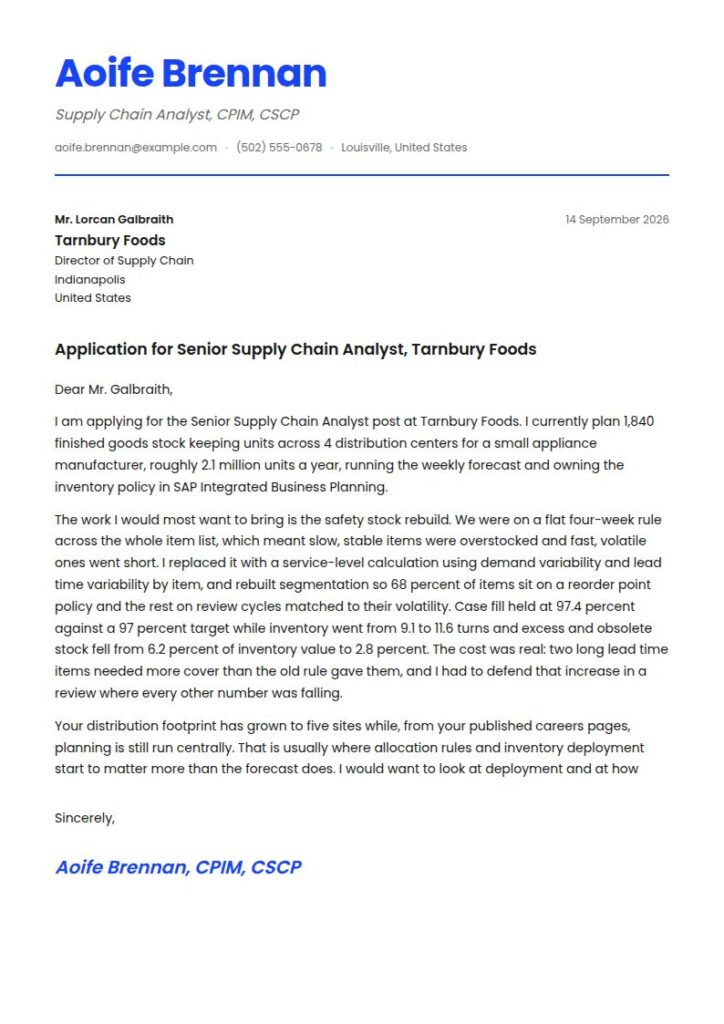
I am applying for the Senior Supply Chain Analyst post at Tarnbury Foods. I currently plan 1,840 finished goods stock keeping units across 4 distribution centers for a small appliance manufacturer, roughly 2.1 million units a year, running the weekly forecast and owning the inventory policy in SAP Integrated Business Planning.
The work I would most want to bring is the safety stock rebuild. We were on a flat four-week rule across the whole item list, which meant slow, stable items were overstocked and fast, volatile ones went short. I replaced it with a service-level calculation using demand variability and lead time variability by item, and rebuilt segmentation so 68 percent of items sit on a reorder point policy and the rest on review cycles matched to their volatility. Case fill held at 97.4 percent against a 97 percent target while inventory went from 9.1 to 11.6 turns and excess and obsolete stock fell from 6.2 percent of inventory value to 2.8 percent. The cost was real: two long lead time items needed more cover than the old rule gave them, and I had to defend that increase in a review where every other number was falling.
Your distribution footprint has grown to five sites while, from your published careers pages, planning is still run centrally. That is usually where allocation rules and inventory deployment start to matter more than the forecast does. I would want to look at deployment and at how your fill rate is measured, because original requested date and revised date give very different pictures.
I hold CPIM and CSCP from ASCM and work in SAP Integrated Business Planning and S/4HANA daily. I can start on four weeks' notice. Thank you for your time.
Sincerely, Aoife Brennan, CPIM, CSCP
Openings that work
| Instead of | Use |
|---|---|
| I am a detail-oriented supply chain professional | I plan 1,840 finished goods SKUs across 4 distribution centers, about 2.1 million units a year |
| I have experience in forecasting, inventory and logistics | I run the weekly forecast at item and week grain and own the inventory policy |
| I helped reduce inventory and improve service levels | Case fill held at 97.4 percent against a 97 percent target while inventory went from 9.1 to 11.6 turns |
| I am excited about this opportunity at your company | Your footprint has grown to five sites while planning is still central, which is where deployment starts to matter |
The right column can be checked in an interview. The left column is a set of claims that every file in the stack already made, and the reader stopped believing them years ago.
What stays out of a supply chain letter
This is the paragraph that quietly decides whether the reader trusts you with their own supplier base.
Give scope in items, sites and annual volume. Describe suppliers by count, region and lead time band. State percentages for cost movement. Name the planning system and the enterprise resource planning system. Put the target beside the service number and say how it was measured. Name what your best result cost.
Do not name a supplier or a customer anywhere. Do not give supplier pricing, payment terms, rebates or tooling arrangements. Do not publish your employer's revenue, margin or absolute inventory value. Do not describe a specific shortage in a way that identifies the customer who went short. Do not quote a fill rate without its target and its measurement rule.
Supplier terms are the commonest breach and the most damaging. They are commercially sensitive, they are frequently protected by contract, and a letter that lists them has told the reader exactly what you would do with theirs. A percentage is almost always safe and is usually more persuasive anyway.
The whole economy is carrying less stock than a year ago
The Census Bureau's Manufacturing and Trade Inventories and Sales report for June 2026, released on 14 August 2026, put total business inventories at $2,740.2 billion against total business sales of $2,111.3 billion, and the total business inventories to sales ratio at 1.30, down from 1.39 in June 2025 (U.S. Census Bureau, 14 August 2026).
Read that as the mood of the room you are writing into. Cover has been coming out across the economy, so a letter offering to reduce inventory is offering something the reader has already been doing, probably under pressure, possibly past the point of comfort.
The stronger offer is the one that holds both sides. Inventory down and service held, with both numbers and both targets, is a method rather than a decision to accept more risk, and it is the only version of the claim that is worth a paragraph.
Length, format and sending it
One page, four paragraphs, 250 to 400 words. PDF unless the portal says otherwise, named for you and the post: aoife-brennan-supply-chain-analyst-cover-letter.pdf.
Address a person. Planning managers, demand planning leads and directors of supply chain are usually findable, and a named letter reads as one written for a single employer rather than for a shortlist.
Keep every figure identical to the one on your resume. Our supply chain analyst resume example is built on the numbers used here, and a reader who finds two versions of your fill rate has found a reason to stop reading.
Key takeaways
- Open with scope in items, sites and annual volume, and say which part of the chain.
- Make one inventory, supplier or network decision the evidence paragraph.
- Give service with its target and its measurement rule beside it.
- Name what the decision cost, because every real one costs something.
- Describe suppliers by count, region and lead time band, never by name or terms.
- Use percentages for cost movement rather than absolute figures.
- Name the planning system and the certification, and address a real person.
Write your supply chain analyst cover letter in 10 minutes with our AI cover letter builder.
Supply chain analyst cover letter questions, answered
How long should a supply chain analyst cover letter be?
One page, four paragraphs, 250 to 400 words. Planning managers read these between a sales and operations planning meeting and an expedite call, and length is not read as effort.
Should I put forecast accuracy in the letter?
Only with its grain and horizon, and only if it is the point of the paragraph. An item-week figure one week out is a different claim from a category-month figure, and a reader who sees a number without a grain assumes the easiest reading. Often the inventory or service result is the better story for a letter and the accuracy figure belongs on the resume.
Can I describe a stockout?
Yes, and it is usually the strongest paragraph available to you, as long as it ends in a mechanism. Describe what happened, what you changed so it could not happen the same way again, and leave out the customer, the supplier and the revenue impact. A candidate who can describe their own mistake without blaming a vendor is unusual enough to be remembered.
What do I write with no supply chain title yet?
Convert what you have. Warehouse work gives you order accuracy, cycle count variance and receiving exceptions. Purchasing gives you purchase order lines and expedite counts. Customer service gives you promise dates and allocation calls. Say which planning system you have touched, what you did inside it, and that you are working toward CPIM if you are.
How do I write to a company whose operation I know nothing about?
Read what is public: the site list on their contact page, any distribution center opening announcement, the product range and its seasonality, and the job posting's own system list. A company that has just opened a fourth site, or that sells something highly seasonal, has told you what its planning problem is. One accurate sentence about that is worth more than a paragraph of enthusiasm.