Isolde Bergmann Director of Customer Success Boston, 02116, United States [email protected] · (617) 555-0685
14 September 2026
Ms. Noelle Vasconcelos Vice President of Customer Success Stonecross Compliance Software Portsmouth, United States
Application for Director of Customer Success, Stonecross Compliance Software
Dear Ms. Vasconcelos,
I am applying for the Director of Customer Success post at Stonecross Compliance Software. I currently run a team of seven over a $62 million book across mid-market and enterprise, and we closed 93 percent gross revenue retention and 117 percent net last year, on definitions I will happily walk you through.
The work I would want to bring is the renewal forecast. When I took the team, two fifths of our churn was unforecast, which meant the business was finding out about losses in the quarter they landed. I moved the first renewal conversation from 60 days out to 150 and required a written account review at that point covering the sponsor, the budget line, the usage trend and the open escalations. Unforecast churn fell from 41 percent of losses to 12 percent, and the quarterly forecast has landed within 4 percentage points three quarters running. The uncomfortable part is that it did not stop the losses; it made them visible early enough to argue about, which is a different and more useful thing.
Your last funding announcement described a move upmarket from small business into mid-market. That transition usually breaks the renewal motion first, because a pooled, automated renewal works at one price point and not at the next. I would want to look at where your renewal conversation currently starts and how your churn is coded, because those two decide whether a retention number can be forecast at all.
I work daily in Salesforce, Gainsight and Looker, and I am happy to talk through how we define gross and net retention. I can start on six weeks' notice. Thank you for your time.
Sincerely, Isolde Bergmann
Summary
A customer success cover letter names the book you held in accounts and revenue, the gross and net retention you closed, and one renewal you saw coming loose early enough to change. This guide gives you a full adaptable letter, the customer confidentiality rule that decides whether a hiring manager trusts you, and the openings that earn a second read.
Customer Success cover letter examples by experience level
In short, a customer success cover letter is a one-page letter to someone who is carrying a retention number and losing sleep over a renewal. Specifically, it says what book you held, what it retained, and one account you saw coming loose early enough to change the outcome.
In practice, almost every letter in their folder promises to be a trusted advisor. However, none of them says what a book was worth. The one that does earns a second read, because it is the only one a reader can check.
Guide to a customer success cover letter
This guide and the corresponding customer success cover letter example will cover:
- First, how to structure the letter, paragraph by paragraph
- Then, why the book belongs in the first sentence, in accounts and in revenue
- One renewal as the evidence paragraph, including the ones you lost
- Finally, what you may never write about a customer
- The openings that work and the ones that waste your first line
How to write a customer success cover letter
| Paragraph | Its job | Length |
|---|---|---|
| Opening | The post, the book in accounts and revenue, and whether you carried a number | 2 to 3 sentences |
| Evidence | One renewal or one churn: what you saw, what you did, what it cost or saved | 4 to 5 sentences |
| Fit | Something specific about their business, and what you would look at first | 3 to 4 sentences |
| Close | Retention figures, systems, availability, thank you | 2 sentences |
Put the book and the quota in the first two sentences
A hiring manager is sorting letters into two piles: people who have been responsible for revenue and people who have been near it. The sort takes one sentence.
"I hold 31 mid-market accounts worth $7.4 million in annual recurring revenue against a renewal quota" puts you in the first pile and sizes you at the same time.
If you did not carry a quota, say so and say what you did own: the renewal forecast, the account review, the churn analysis, the expansion referral that someone else closed. An honest no reads far better than an omission, because an omission is read as a no anyway and costs you the credit for what you did hold.
A customer success cover letter example you can adapt
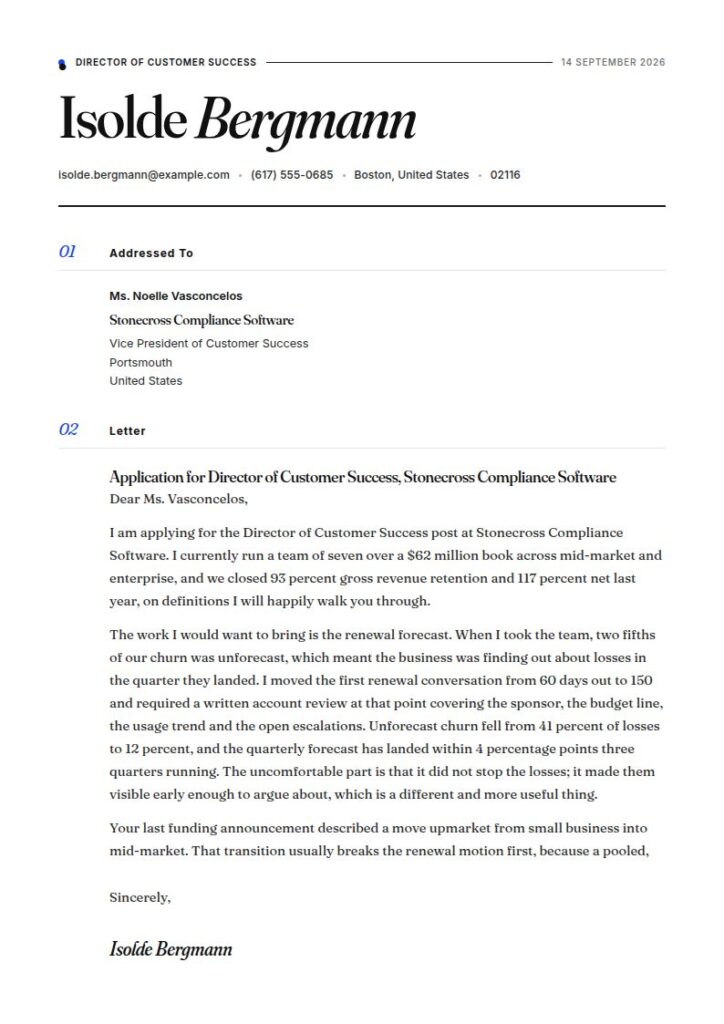
Dear Ms. Vasconcelos,
I am applying for the Director of Customer Success post at Stonecross Compliance Software. I currently run a team of seven over a $62 million book across mid-market and enterprise, and we closed 93 percent gross revenue retention and 117 percent net last year, on definitions I will happily walk you through.
The work I would want to bring is the renewal forecast. When I took the team, two fifths of our churn was unforecast, which meant the business was finding out about losses in the quarter they landed. I moved the first renewal conversation from 60 days out to 150 and required a written account review at that point covering the sponsor, the budget line, the usage trend and the open escalations. Unforecast churn fell from 41 percent of losses to 12 percent, and the quarterly forecast has landed within 4 percentage points three quarters running. The uncomfortable part is that it did not stop the losses; it made them visible early enough to argue about, which is a different and more useful thing.
Your last funding announcement described a move upmarket from small business into mid-market. That transition usually breaks the renewal motion first, because a pooled, automated renewal works at one price point and not at the next. I would want to look at where your renewal conversation currently starts and how your churn is coded, because those two decide whether a retention number can be forecast at all.
I work daily in Salesforce, Gainsight and Looker, and I am happy to talk through how we define gross and net retention. I can start on six weeks' notice. Thank you for your time.
Sincerely, Isolde Bergmann
Openings that work
| Instead of | Use |
|---|---|
| I am a customer-obsessed professional passionate about retention | I run a team of seven over a $62 million book across mid-market and enterprise |
| I have a proven track record of retaining and growing accounts | We closed 93 percent gross revenue retention and 117 percent net last year |
| I build strong relationships with key stakeholders | Unforecast churn fell from 41 percent of losses to 12 percent |
| I am excited about the opportunity to join your team | Your funding announcement described a move upmarket, which usually breaks the renewal motion first |
By contrast, the right column is a set of claims a hiring manager can interrogate. Meanwhile, the left column is the same four sentences in every letter in the stack, and they have stopped carrying information.
What you can never write about a customer
In fact, this is the paragraph that quietly decides the offer, because you are describing other companies' commercial arrangements to someone who is not party to them.
Describe accounts by industry, employee size band and contract value band. Give the book total and the retention percentages. Name churn reasons by category. Say what you changed in the process. Give expansion by motion: seats, tier, module, term.
Do not name a customer, ever, including a logo you are proud of. Do not give a named account's contract value, discount, renewal date or payment terms. Do not describe an escalation in enough detail to identify the company. Do not repeat anything said in an executive business review. Do not quote net retention with no gross beside it. Do not claim a save somebody else led.
A mutual non-disclosure agreement covers most of this, and all of it is a live test. After all, a hiring manager reading a letter that names three customers is learning what you will say about theirs in two years. The restraint costs you nothing, because bands and categories carry every piece of information the reader actually needs.
What good retention looks like, and what it does not
SaaS Capital, drawing on its own survey of more than 1,000 private business-to-business software companies, reported median net revenue retention of 103 percent and median gross revenue retention of 91 percent for bootstrapped companies with $3 million to $20 million in annual recurring revenue (SaaS Capital, 24 April 2026). Those figures describe that population and not the whole industry, so quote them with the qualifier attached.
Two things follow for the letter. A gross figure in the low nineties is a normal result rather than an apology, so write yours plainly instead of hiding it behind the net number. And a very high net figure with no gross beside it invites the one question you cannot dodge, which is how much of the book left while the survivors grew.
If your year was bad for reasons you did not control, say so in one clause and move on. A price rise, a product sunset or an acquisition wave are all real, and a manager who has run a book knows it. What reads badly is a number that is missing.
Length, format and sending it
One page, four paragraphs, 250 to 400 words. PDF unless the portal insists otherwise, named for you and the post: isolde-bergmann-customer-success-cover-letter.pdf.
Address a person. A company blog or a careers page usually names the vice president of customer success, chief customer officer or head of post-sales; as a result, a named letter reads as one written for a single company.
Keep every figure identical to the one on your resume. Our customer success resume example is built on the numbers used here, and a reader who finds two versions of your retention rate has found a reason to stop.
Key takeaways
- Open with the book in accounts and revenue, and say whether you carried a number.
- First, give gross and net retention together, never net alone.
- Make one renewal or one churn the evidence paragraph.
- Say what your change did not fix, because that is what makes the rest believable.
- Then name churn reasons by category, never by customer.
- Use industry, size band and contract value band instead of names.
- Also, offer to walk through your retention definitions, and address a real person.
Write your customer success cover letter in 10 minutes with our AI cover letter builder.
Customer success cover letter questions, answered
How long should a customer success cover letter be?
One page, four paragraphs, 250 to 400 words. The reader is usually carrying a number themselves and reading between renewal calls, so the letter has to make its case in the first two sentences.
Should I put my retention numbers in the letter?
Yes, both of them, and offer the definitions. Gross and net revenue retention are calculated differently at almost every company, so a figure without a formula is an invitation to a question. Offering to walk through how yours were measured is a short sentence that signals you have actually owned the calculation.
What if I did not carry a quota?
Say so, then say what you did own. The renewal forecast, the account review, the churn analysis, the escalation into product and the expansion you referred are all real contributions, and naming them is far stronger than leaving the question open. A manager who has to guess will guess low.
Can I mention an account I lost?
Yes, and it is often the best paragraph in the letter, as long as it ends in a change. Describe the reason by category, what you did about it afterwards, and what it cost, without naming the company or giving the contract value. A candidate who can describe a loss without blaming the product, the price or the customer is unusual.
How do I write to a company whose customer base I do not know?
Read what is public: the pricing page, the case studies, the funding announcements and the job posting's own language. A company moving upmarket, launching a second product or hiring its first enterprise customer success manager has told you what its renewal problem is about to be. One accurate sentence about that beats a paragraph about your enthusiasm for customers.