Danica Voskuil Manager, Service Operations Grand Rapids, 49503, United States [email protected] · (616) 555-0247
11 September 2026
Ms. Margarethe Sunderland Director of Operations Marchmont Fluid Systems Kalamazoo, United States
Application for Manager, Field Service Operations, Marchmont Fluid Systems
Dear Ms. Sunderland,
I am applying for the Manager, Field Service Operations post at Marchmont Fluid Systems. I currently manage 11 people across scheduling and dispatch at Caldbeck Equipment Group, 9 coordinators and 2 senior coordinators, and I am accountable for on-time completion on roughly 1,400 work orders a month. I approve hires inside an agreed headcount plan, set pay within a published band and write the performance ratings for my team.
The result I would want to repeat at Marchmont is on-time completion, which moved from 81% to 93% over two years. That came from two changes rather than from pressure: the morning dispatch sequence was rebuilt so the longest routes are set first, and a parts pre-check was added at scheduling, which took repeat visits from 14% to 6% and cost per work order from $46 to $38. Over the same period voluntary turnover in the team fell from 29% to 9%, which I attribute to a fixed two-week schedule and a published overtime rota more than to anything I said in a one to one.
Your posting mentions bringing three branches onto one dispatch queue. I have just done a version of that, and the part that decided it was the escalation rule rather than the software, because a single queue without an agreed order of precedence produces faster dispatch and slower resolution. I would also want to keep hiring in-house: seven of my current team were hired against a 30-day time to fill using a structured interview and a paid scheduling work sample, and two were promoted from inside.
I have run two performance improvement plans to a documented conclusion, one ending with the coordinator back at standard and one ending in an agreed exit, so the harder part of the job is not new to me. I could start with four weeks' notice. Thank you for your time.
Sincerely, Danica Voskuil
Summary
A manager cover letter tells the reader how many people you manage, what operational number you are measured on, and what you can decide without asking. This guide gives you a full adaptable letter, the openings that work when your title is generic, what to write for your first management job, and how to describe a performance conversation without identifying anyone.
Manager cover letter examples by experience level
In short, a manager cover letter is a one-page letter that answers the question your job title leaves open: how many people report to you, what numbers you answer for, and what you have authority to decide.
In practice, manager postings attract large volumes, and most of the letters in the pile describe leadership in the abstract. As a result, a letter that opens with a headcount and a number is unusual enough that the reader finishes it.
Guide to a manager cover letter
Specifically, this guide and the corresponding manager cover letter example will cover:
- First, how to structure the letter, paragraph by paragraph
- Then, why headcount belongs in the first two sentences
- Also, what counts as evidence when your team's work is routine
- In addition, how to write the letter for your first management job
- Finally, what you can safely say about a performance conversation
How to write a manager cover letter
| Paragraph | Its job | Length |
|---|---|---|
| Opening | The post, your team size, and the number you own | 2 to 3 sentences |
| Evidence | One measure, one before and after, one period, and how you did it | 4 to 5 sentences |
| Fit | Something specific about their operation, and the part of the job you want | 3 to 4 sentences |
| Close | Authority you hold, availability, thank you | 2 sentences |
Put a headcount in the first two sentences
The reader's first question is not why you want the job. It is how big your current job is, because that decides whether the rest of the letter is worth their time.
"I manage 11 people across scheduling and dispatch and I am accountable for on-time completion on about 1,400 work orders a month" answers it in one sentence. Every letter in the pile that opens with an interest in the opportunity has failed to answer it at all.
Then add the authority line, because almost nobody does: what you approve, sign or decide alone. A candidate who writes pay reviews and signs their own overtime is a different hire from one who recommends both, and the letter is the natural place to say which you are.
A manager cover letter example you can adapt
Dear Ms. Sunderland,
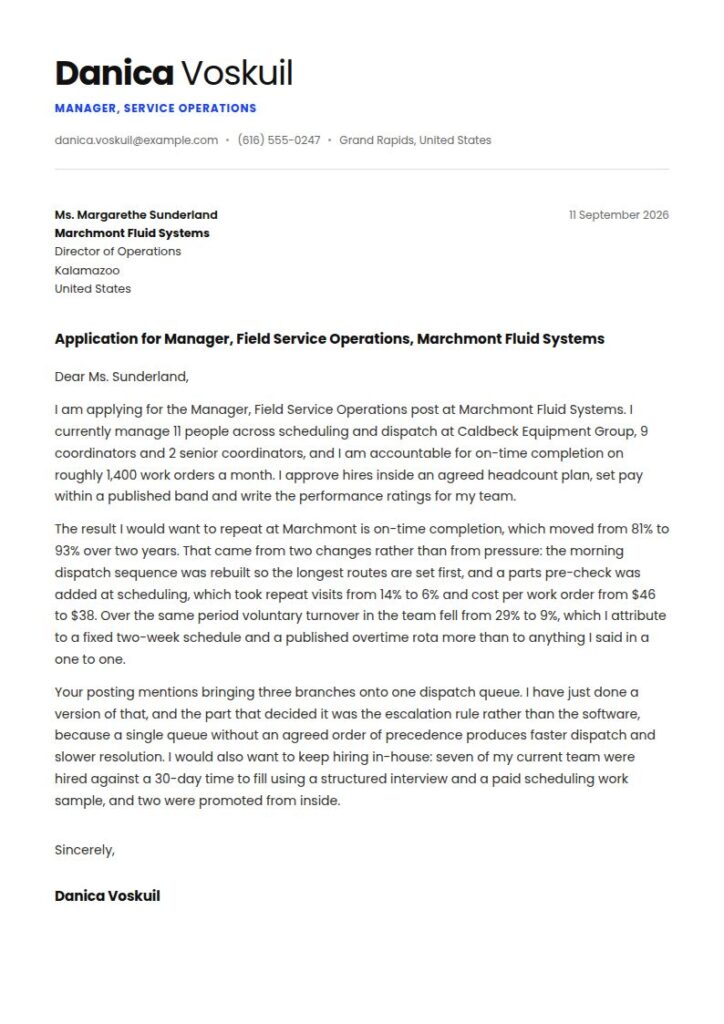
I am applying for the Manager, Field Service Operations post at Marchmont Fluid Systems. I currently manage 11 people across scheduling and dispatch at Caldbeck Equipment Group, 9 coordinators and 2 senior coordinators, and I am accountable for on-time completion on roughly 1,400 work orders a month. I approve hires inside an agreed headcount plan, set pay within a published band and write the performance ratings for my team.
The result I would want to repeat at Marchmont is on-time completion, which moved from 81% to 93% over two years. That came from two changes rather than from pressure: the morning dispatch sequence was rebuilt so the longest routes are set first, and a parts pre-check was added at scheduling, which took repeat visits from 14% to 6% and cost per work order from $46 to $38. Over the same period voluntary turnover in the team fell from 29% to 9%, which I attribute to a fixed two-week schedule and a published overtime rota more than to anything I said in a one to one.
Your posting mentions bringing three branches onto one dispatch queue. I have just done a version of that, and the part that decided it was the escalation rule rather than the software, because a single queue without an agreed order of precedence produces faster dispatch and slower resolution. I would also want to keep hiring in-house: seven of my current team were hired against a 30-day time to fill using a structured interview and a paid scheduling work sample, and two were promoted from inside.
I have run two performance improvement plans to a documented conclusion, one ending with the coordinator back at standard and one ending in an agreed exit, so the harder part of the job is not new to me. I could start with four weeks' notice. Thank you for your time.
Sincerely, Danica Voskuil
Openings that work
| Instead of | Use |
|---|---|
| I am writing to express my interest in the manager position | I manage 11 people across scheduling and dispatch and own on-time completion on about 1,400 work orders a month |
| I am a results-driven leader with a passion for developing people | Voluntary turnover in my team fell from 29% to 9% over two years and two coordinators were promoted out of it |
| I have extensive experience managing teams and operations | I approve hires inside an agreed headcount plan, set pay within a band and write the performance ratings |
| I believe I would be a great fit for your organization | Your posting mentions bringing three branches onto one dispatch queue, which I have just done |
What counts as evidence for a manager
Most managed work is routine, and routine work still produces numbers. Pick one, and give the before, the after and the period.
| Kind of evidence | What it looks like in a sentence |
|---|---|
| The operational number | On-time completion moved from 81% to 93% over two years |
| Cost | Cost per work order fell from $46 to $38 by cutting repeat visits, not hours |
| Retention | Voluntary turnover fell from 29% to 9% after a fixed two-week schedule |
| Hiring | Hired 7 coordinators against a 30-day time to fill with a paid work sample |
| Promotion | Two coordinators promoted into senior roles; one senior into a team lead role |
| Ramp | New-starter time to independent scheduling cut from 9 weeks to 5 |
| A hard conversation | Two performance plans run to a documented conclusion, one turnaround and one exit |
The last three are the ones most manager letters leave out, and they are the ones a panel remembers. Overtime can buy throughput. However, overtime cannot buy people staying, getting promoted and working under proper management.
Writing the letter for your first management job
Name the management work you already do under another title, with numbers: people trained, procedures written, escalations handled, weeks of cover. Say what happened during the cover period. Name the one thing you would change in their operation and why. State plainly which parts of the job you have not done, such as writing a rating or hiring against a requisition. Keep it to one page.
Do not call a project team a team you managed; interviewers ask who wrote the performance reviews. Do not describe yourself as a natural leader, a people person or passionate about developing others. Do not open with your interest in the opportunity. Do not name, initial or describe anyone you managed, coached or exited. Do not send the same letter to a 4-person team and a 40-person one without changing the scope paragraph.
The middle layer is where engagement fell fastest
Gallup's State of the Global Workplace: 2026 Report found manager engagement fell to 22% in 2025, from 27% in 2024 and 31% in 2022, against a move from 20% to 19% among individual contributors over the same period. Global employee engagement was 20% in 2025, which Gallup links to roughly $10 trillion in lost productivity, or 9% of global GDP. The figures come from 263,810 respondents across more than 140 countries and territories surveyed between January and December 2025 (Gallup, State of the Global Workplace: 2026 Report).
Meanwhile management occupations produce about 1.1 million openings a year, and overall employment in them is projected to grow faster than the average for all occupations between 2025 and 2035 (BLS Occupational Outlook Handbook, 2025 to 2035 projections). Most of those openings are replacements.
Put the two together and you can see what the panel is worried about. They have a manager-shaped hole, they have probably had a bad one recently, and they are screening for someone whose team does not leave. A retention figure in a manager cover letter is not a soft detail; this year it is close to the point.
Length, format and sending it
One page, four paragraphs, 250 to 400 words. PDF unless the portal says otherwise, named for yourself and the post: danica-voskuil-service-operations-manager-cover-letter.pdf.
Address a person. Also, operations leadership is usually findable, and "Dear Hiring Manager" on an otherwise specific letter suggests you copied the specificity in.
Use the same figures as your resume so the two agree under questioning. Our manager resume example is written with the numbers used here.
Key takeaways
- First, open with headcount and the number you own, in the first two sentences.
- Then say what you can decide alone: hires, pay, ratings, overtime, credits.
- Give one measure with a before, an after and a period, and say how you moved it.
- Next, include a retention or promotion figure, because it is the part panels remember.
- After that, name one specific thing about their operation and what you would do about it.
- For a first management job, however, name the management work you already do and the gap you have not closed.
- Above all, describe a performance conversation by process and outcome, never by person.
- Finally, one page to a named person, matching your resume exactly.
Write your manager cover letter in 10 minutes with our AI cover letter builder.
Manager cover letter questions, answered
How long should a manager cover letter be?
One page, four paragraphs, 250 to 400 words. Manager postings are high volume and the letter is read in under a minute, so the first two sentences carry most of the weight.
What goes in the first paragraph of a manager cover letter?
The post, your team size and shape, and the operational number you are accountable for. Add one line of authority: what you approve or sign without asking. That is four facts in three sentences, and it places you against the opening before the reader has decided how interested to be.
How do I write a manager cover letter for my first management job?
Argue a transition instead of describing a record. Name the management work you already do under another title, with numbers attached: people trained, the procedure you wrote, the escalations that come to you, the weeks you covered the team and what happened during them. Then name what you have not done, such as writing a performance rating. Panels promote people who describe that boundary accurately.
Should I name the number I own in the letter?
Yes, exactly as your employer names it, with the before, the after and the period. Vague improvement claims are read as decoration. If your number is confidential, give the movement as a percentage and say the absolute figure is not something you can share, which is a normal and unremarkable answer.
Do I mention people I have let go?
Mention the process and the outcome, never the person. "Two performance improvement plans run to a documented conclusion, one ending with the person back at standard and one in an agreed exit" shows that you finish these conversations, which is one of the few things that genuinely separates managers. Nothing identifying belongs anywhere near the letter: no name, no initial, no role held by only one person, no reason for the departure.