Ignacio Ferreiro President, Industrial Solutions Kansas City, 64111, United States [email protected] · (816) 555-0255
11 September 2026
Ms. Rosamund Bramwell Chief Executive Ulverton Holdings Omaha, United States
Application for Chief Operating Officer, Ulverton Holdings
Dear Ms. Bramwell,
I am applying for the Chief Operating Officer post at Ulverton Holdings. I currently carry a $610 million profit and loss as president of the industrial solutions business at Thornhill Materials Group, with 2,400 people across nine sites in three countries, six direct reports, and a quarterly presentation to the group board on the operating plan, capital and the leadership bench.
The decision I would want to bring is the one I am most often asked about. In 2022 I recommended building new capacity with automation rather than retrofitting an existing line, which meant $52 million of capital against a 14% hurdle rate and roughly three times the cost of the alternative. The case rested on a ten-year view of demand rather than the three-year view in the plan, and it had a stated gate at 18 months that would have stopped the second phase. It returned 18% in its second full year of operation, with unit cost down 11% and on-time delivery from 88% to 96%.
The situation you have described, bringing two manufacturing footprints together after an acquisition, is close to work I have done twice. The part that decides it is not the network model but the order in which you move people and volume, and I would want to spend the first ninety days on the leadership bench rather than the footprint. At Thornhill I took the organization from seven layers to five and promoted six of the nine site leaders from inside, and voluntary turnover in the top hundred fell from 14% to 6% while we did it.
I should also say what has not worked. I entered an adjacent geography in 2019 and closed it eighteen months later when it failed its second gate, writing off $6 million; the capital gating standard I now use came out of that review. I am available to talk at your convenience and could start with three months' notice. Thank you for your time.
Sincerely, Ignacio Ferreiro
Summary
An executive cover letter states what you carry, who you answer to at board level, and one decision you made with capital behind it. This guide gives you a full adaptable letter, the openings that work when the reader is a board chair or a search partner, what you may and may not disclose, and why the bet that failed belongs in the letter as well as the resume.
Executive cover letter examples by experience level
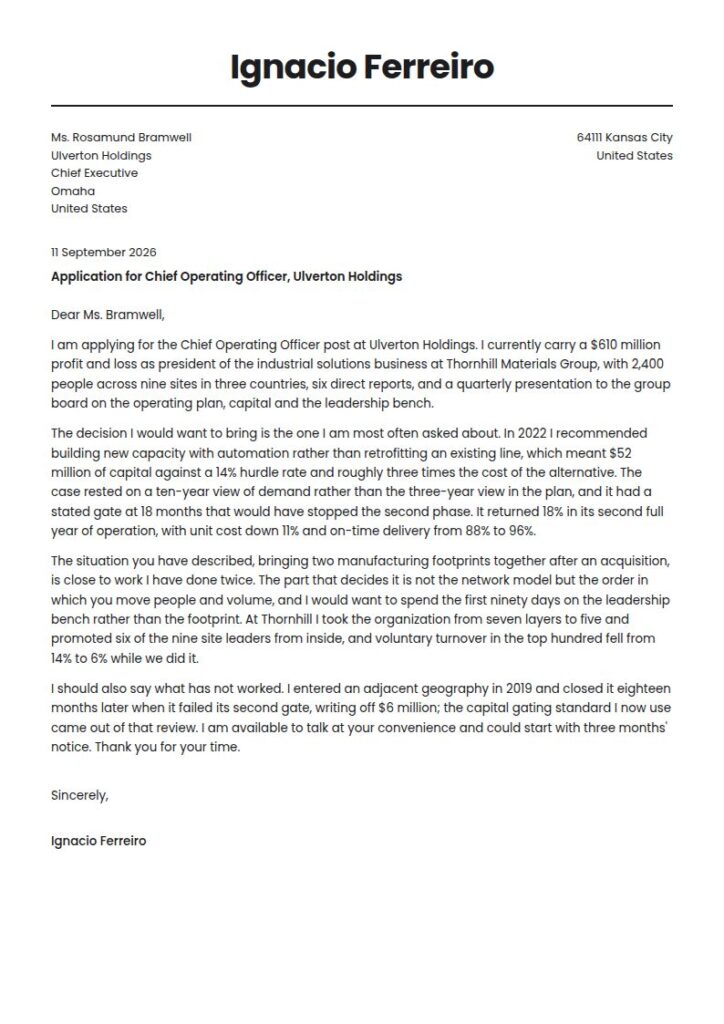
An executive cover letter is a one-page letter that states what you carry, who you answer to, and one decision you made that could have gone badly.
The reader is usually a board chair, a group chief executive or a search partner, and all three are reading for the same thing: whether your current job is the size of the one they are filling, and whether you have made a decision with real money behind it. Everything else in the letter is arrangement.
Guide to an executive cover letter
This guide and the corresponding executive cover letter example will cover:
- How to structure the letter for a board chair or a search partner
- Why scope belongs in the first two sentences
- Writing one strategic bet, including the one that did not pay
- What you may and may not disclose about your current employer
- The closings that get a senior file taken to a shortlist meeting
How to write an executive cover letter
| Paragraph | Its job | Length |
|---|---|---|
| Opening | The post, what you carry now, and who you report to | 2 to 3 sentences |
| Evidence | One decision, the capital behind it, the horizon, the result | 4 to 5 sentences |
| Fit | Something specific about their situation, and what you would take on | 3 to 4 sentences |
| Close | The bet that did not work, availability, thank you | 2 to 3 sentences |
Scope first, and in numbers
A board chair reading a shortlist is placing candidates against a distribution before reading anything else. Revenue, headcount, sites and reporting line do that in one sentence.
"I carry a $610 million profit and loss with 2,400 people across nine sites in three countries, reporting to the group chief executive" tells the reader more than a paragraph about leadership philosophy, and it tells them whether to keep reading.
Then say who you present to and how often. Presenting to a board quarterly is a specific, checkable fact, and it is one of the few things at this level that genuinely separates candidates who otherwise look identical on paper.
An executive cover letter example you can adapt
Dear Ms. Bramwell,
I am applying for the Chief Operating Officer post at Ulverton Holdings. I currently carry a $610 million profit and loss as president of the industrial solutions business at Thornhill Materials Group, with 2,400 people across nine sites in three countries, six direct reports, and a quarterly presentation to the group board on the operating plan, capital and the leadership bench.
The decision I would want to bring is the one I am most often asked about. In 2022 I recommended building new capacity with automation rather than retrofitting an existing line, which meant $52 million of capital against a 14% hurdle rate and roughly three times the cost of the alternative. The case rested on a ten-year view of demand rather than the three-year view in the plan, and it had a stated gate at 18 months that would have stopped the second phase. It returned 18% in its second full year of operation, with unit cost down 11% and on-time delivery from 88% to 96%.
The situation you have described, bringing two manufacturing footprints together after an acquisition, is close to work I have done twice. The part that decides it is not the network model but the order in which you move people and volume, and I would want to spend the first ninety days on the leadership bench rather than the footprint. At Thornhill I took the organization from seven layers to five and promoted six of the nine site leaders from inside, and voluntary turnover in the top hundred fell from 14% to 6% while we did it.
I should also say what has not worked. I entered an adjacent geography in 2019 and closed it eighteen months later when it failed its second gate, writing off $6 million; the capital gating standard I now use came out of that review. I am available to talk at your convenience and could start with three months' notice. Thank you for your time.
Sincerely, Ignacio Ferreiro
Openings that work
| Instead of | Use |
|---|---|
| I am writing to express my interest in the chief operating officer role | I carry a $610 million profit and loss with 2,400 people across nine sites in three countries |
| I am a transformational leader with a proven track record at the highest level | I recommended $52 million of capital against a 14% hurdle; it returned 18% in its second full year |
| I have extensive board-level experience | I present to the group board quarterly on the operating plan, capital and the leadership bench |
| I am confident I can deliver significant value to your organization | The situation you describe is close to work I have done twice, and the part that decides it is sequencing |
What counts as evidence at executive level
One decision, properly told, outperforms six achievements. Choose the one that could have gone wrong.
| Kind of evidence | What it looks like in a sentence |
|---|---|
| A capital decision | $52 million approved against a 14% hurdle, chosen over a cheaper retrofit, 18% in its second full year |
| A portfolio decision | Divested a product line at 6% of revenue and negative contribution after two years of attempted repair |
| An organizational decision | Seven layers to five, top-100 population down 11 roles, six of nine site leaders promoted internally |
| A commercial decision | Moved a line from direct to a two-tier channel: gross margin up 3.4 points, cost of sale down a quarter |
| A decision reversed | Closed a geographic entry at 18 months on a pre-agreed gate, writing off $6 million |
| A governance fact | Quarterly board presentation on plan, capital and bench; annual audit committee paper on operational risk |
What you may and may not put in the letter
Give approximate revenue, headcount, sites and countries. Give an investment figure with the year it was approved and the hurdle it was tested against. Say who you report to and who you present to. Name one thing about their situation taken from their own public statements. Say plainly what you recommended and who approved it.
Do not disclose unannounced results, an unclosed transaction, a pending restructuring or forward guidance; for a public issuer that is a regulatory question rather than a matter of judgment. Do not name customers, contract values or margins by product. Do not claim a board's decision as your own. Do not describe yourself as visionary or transformational. Do not run to two pages.
The market you are writing into
Top executives held 3,890,600 jobs in 2025, with employment projected to grow 5 percent between 2025 and 2035, an increase of 190,600, and about 304,100 openings a year on average. Chief executives accounted for 291,600 of those jobs and general and operations managers for 3,599,000 (BLS Occupational Outlook Handbook, May 2025 wage data and 2025 to 2035 projections).
Set 190,600 of growth over a decade against roughly 304,100 openings every year and the picture is clear: nearly all executive vacancies are replacements. Somebody was promoted, retired, or was moved out, and in the third case the search exists because of a specific dissatisfaction.
That is the argument for writing the letter around one decision rather than a career summary. A board filling a seat it has just emptied is testing judgment on a live problem, not surveying your history, and a letter built on a single bet with its capital, its gate and its result answers the question they are actually asking.
Length, format and sending it
One page, four paragraphs, 300 to 450 words. PDF unless the portal says otherwise, named plainly: ignacio-ferreiro-chief-operating-officer-cover-letter.pdf.
Address a person. At this level the recipient is knowable: a board chair, a group chief executive, a committee chair or the named search partner. If the search is confidential and run through a firm, write to the partner by name and say you understand the client is not disclosed.
Keep the figures identical to your resume. Senior processes involve several interviewers comparing notes, and an unexplained difference between the letter and the resume becomes the subject rather than a detail. Our executive resume example uses the numbers in this letter.
Key takeaways
- Open with revenue, headcount, sites and reporting line.
- Say who you present to at board level and how often.
- Build the middle of the letter on one decision with capital, a hurdle and a horizon.
- Name the bet that did not work and what changed because of it.
- Take one specific detail from their public statements and respond to it.
- Say what you recommended and who approved it, rather than claiming the decision.
- Keep unannounced results and anything from a board pack out of the letter entirely.
- One page, addressed to a named person, with figures matching your resume.
Write your executive cover letter in 10 minutes with our AI cover letter builder.
Executive cover letter questions, answered
How long should an executive cover letter be?
One page, four paragraphs, 300 to 450 words. A board chair reads it before a shortlist meeting, usually alongside five others, and length is not read as seriousness. If it runs over, cut the third paragraph rather than the scope line.
Do executives still need cover letters when a search firm is involved?
Yes, and the audience is different rather than absent. The partner uses it to write the candidate summary the client actually reads, so a letter with scope, one decision and a governance line gives them the paragraph they were going to have to draft themselves. That is a practical reason it gets used.
Should I really put a failure in an executive cover letter?
One, briefly, in the closing paragraph, with the size, the stopping point and what changed afterwards. Boards at this level have all lost money on something, and an unbroken record reads as a candidate who either has not made real decisions or will not discuss the ones that went wrong. What to avoid is the disguised version, where a closure becomes a strategic refocus and the cost is never mentioned.
How do I write the letter when I am targeting several different senior roles?
Rewrite the first and third paragraphs every time and keep the second. Scope and the decision you lead with should be chosen for the seat: an operating role wants organization, cost and delivery; a commercial role wants margin, channel and customers. The evidence paragraph can stay fixed, because it is the same decision either way.
What can I say about my current employer's numbers?
Approximate scale, an investment figure with its year, and anything already public. Not unannounced results, an unclosed transaction, margins by product or customer, contract values, or anything from a board pack, and for a public issuer the rules on material nonpublic information make that a compliance matter rather than a preference (17 CFR 243.100). If revenue is restricted, describe the business by headcount and footprint instead; no serious reader treats that as evasion.