Vice President, Operations Ignacio Ferreiro MBA
Vice President, Operations
[email protected] | (816) 555-0255 | Kansas City, United States
Profile
Operations executive in a first officer-level role, carrying a $210 million manufacturing business unit with 780 people across four plants and a seat on the operating committee. Consolidated three regional service centers into two on a $9 million investment that paid back in 26 months, taking freight cost per ton down 14% and same-week availability from 71% to 89%. Report to the divisional president and present to the executive committee monthly on cost, safety and service.
Work Experience
01/2015 - 03/2018, Vice President, Operations, Draycott Manufacturing, Kansas City, United States
- Carried a $210 million manufacturing business unit with 780 people across four plants, with a seat on the operating committee and a direct report line to the divisional president.
- Consolidated three regional service centers into two on a $9 million investment that paid back in 26 months, cutting freight cost per ton by 14% and taking same-week availability from 71% to 89%.
- Set the first capital gating standard used in the division, including a stop condition tested at 12 months.
- Presented to the executive committee monthly on cost, safety and service, and to the divisional board twice a year on the capital plan.
08/2012 - 01/2015, Director of Operations, Draycott Manufacturing, Kansas City, United States
- Ran two plants and a distribution center, 410 people, with accountability for conversion cost and delivery performance.
- Took overall equipment effectiveness from 58% to 71% across three years without new capital.
06/2009 - 08/2012, Plant Manager, Draycott Manufacturing, Springfield, United States
- Managed a 180-person plant across three shifts, including the site's first full year without a lost-time injury.
Education
08/2008 - 05/2011, Master of Business Administration, Business Administration, Olin Business School, Washington University in St. Louis, St. Louis, United States
Completed part time while working as a plant manager. Concentration in operations and finance.
08/1999 - 05/2003, Bachelor of Science, Industrial Engineering, University of Missouri, Columbia, United States
Graduated with a minor in economics.
Skills
Profit and loss ownership, 75
Operating model design, 75
Capital allocation against a hurdle rate, 70
Network and footprint consolidation, 85
Supply chain and distribution, 85
Safety leadership, 85
Executive committee reporting, 70
Continuous improvement, 85
Languages
English, native
Spanish, native
Certificates
09/2007, Certified in Production and Inventory Management, Association for Supply Chain Management, CPIM-0421887
Held from early in an operations career and maintained through the plant management years.
Summary
An executive resume is a two page document stating the profit and loss you carried, the organization you ran, who you answered to at board level, and the strategic bets you made with capital behind them. This guide gives you three adaptable versions, the bet block that separates executives from senior managers, and current Bureau of Labor Statistics pay and outlook for top executives.
Executive resume examples by experience level
An executive resume is a two page document that states four things before the reader has finished page one: the profit and loss you carried, the size and shape of the organization you ran, who you answered to at board level, and the bets you made with real capital behind them.
This page is written for a broad senior search: someone whose resume has to work across several chief operating officer, president, general manager and senior vice president postings at once, in more than one function. It is not the finance leader's version, which is a different job with a different evidence base and lives on our finance director resume example.
What separates an executive resume from a very good senior manager resume is not scale. It is irreversibility. A senior manager optimizes inside constraints somebody else chose. An executive chooses the constraints, commits money that cannot easily come back, and lives with the result for three years. If nothing on your page could have gone badly wrong, the page is describing the layer below.
Resume guide for an executive resume
This guide and the corresponding executive resume example will cover:
- How to write an executive resume that works across several C-level and vice president postings
- The scope line: profit and loss, organization, sites, reporting line
- Three adaptable summaries: first executive role, operating executive and group executive
- How to write the bet that did not work, and why it belongs on the page
- Current Bureau of Labor Statistics pay and outlook, and what the published figure does not include
How to write an executive resume
Five blocks: contact header, summary, scope line, experience with the bets inside it, and a short closing block for education, governance and board roles. Two pages. Skills lists mostly disappear at this level.
The scope line sits under the summary and does the work a title cannot. "Executive" and "vice president" describe a room, not a job. Revenue, headcount, sites and reporting line describe the job.
| Section | What it is answering | Where it goes |
|---|---|---|
| Scope line | How much revenue, how many people, how many sites, reporting to whom? | Directly under the summary |
| Experience | What did you decide, what did it cost, and what came back? | Reverse chronological, two roles deep |
| Bets | Which commitments were irreversible, and what happened to each? | Inside each role, with capital and horizon |
| Governance | Which board or committee did you present to, how often, about what? | Closing block |
What you may not put on an executive resume
Executives handle information that has rules attached to it, and a resume is a document you hand to strangers.
If your employer is a public issuer, Regulation FD applies to disclosure of "material nonpublic information regarding that issuer or its securities" by "an issuer, or any person acting on its behalf", and the persons covered include "any director, executive officer… investor relations or public relations officer, or other person with similar functions" (17 CFR 243.100 and 243.101). Unannounced results, an unclosed transaction, a pending restructuring and forward guidance are not resume material, whatever the hiring context.
For private companies the constraint is contractual rather than statutory, and the practical rule is the same. Scale is almost always safe: approximate revenue, headcount, sites, countries, an investment figure with the year it was approved. Specifics are not: named customers, contract values, margins by product, valuation multiples, anything lifted from a board pack. If even revenue is restricted, write "a mid-market industrial group" and carry the size in headcount and sites.
Run the finished file through the ATS resume checker. Executive search firms parse candidate files into structured records before a partner reads one, and a designed two column layout is where that breaks.
Choosing the best resume format for an executive resume
Reverse chronological, two pages, with the last two roles carrying eighty percent of the words and everything before them compressed to one line each. That is the one structural difference from every other page in this library, and it is worth stating plainly: an executive resume is not a longer version of a manager resume, it is a shorter one with a bigger first half.
Two pages is a ceiling, not a target you grow into. The pressure at this level runs the other way from junior resumes: you have twenty years of material and two pages, so most of your career gets a single line and you should let it.
Resist the separate three-page executive dossier some search firms circulate. It is their document, assembled from your file and an interview, and producing it yourself pushes the scope line off the first screen. What a board reads is page one. Write page one as though page two may not be opened.
Include your contact information
| ✅ Right | ❌ Wrong |
|---|---|
| Ignacio Ferreiro | Ignacio Ferreiro |
| President, Industrial Solutions, $610M revenue, 2,400 people, 9 sites | Visionary executive leader driving transformational change |
| Reports to group chief executive; presents to the board quarterly | Proven track record of delivering results at the highest level |
| (816) 555-0255, [email protected], Kansas City, MO | (816) 555-0255, [email protected] |
Three lines carrying revenue, organization and governance. A search partner or a board chair has now placed you inside a distribution and the summary has not started. Without those numbers "executive" describes several thousand very different jobs.
Make use of a summary
Four lines: what you carried, the organization you ran, the bet you are proudest of with its number, and who you answered to.
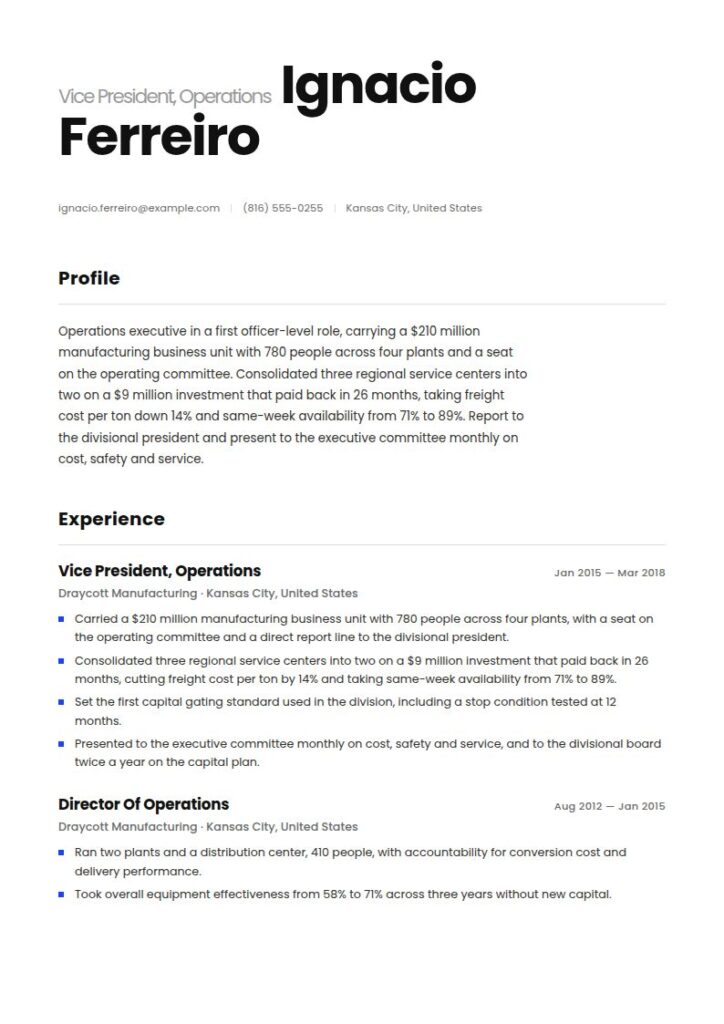
Operations executive in a first officer-level role, carrying a $210 million manufacturing business unit with 780 people across four plants and a seat on the operating committee. Consolidated three regional service centers into two on a $9 million investment that paid back in 26 months, taking freight cost per ton down 14% and same-week availability from 71% to 89%. Report to the divisional president and present to the executive committee monthly on cost, safety and service.
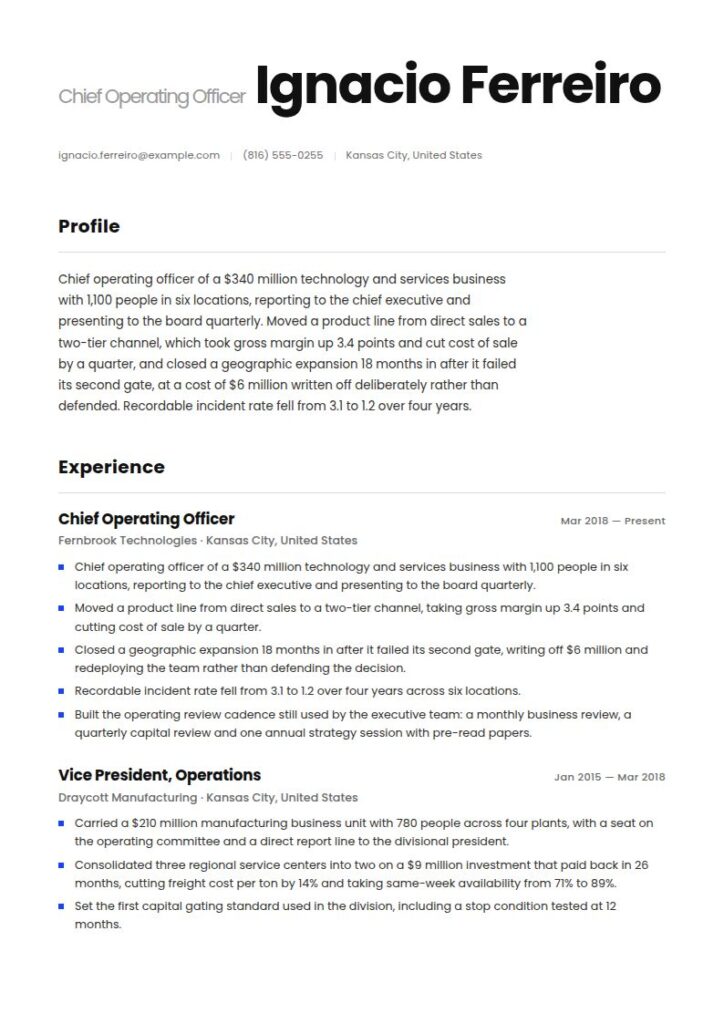
Chief operating officer of a $340 million technology and services business with 1,100 people in six locations, reporting to the chief executive and presenting to the board quarterly. Moved a product line from direct sales to a two-tier channel, which took gross margin up 3.4 points and cut cost of sale by a quarter, and closed a geographic expansion 18 months in after it failed its second gate, at a cost of $6 million written off deliberately rather than defended. Recordable incident rate fell from 3.1 to 1.2 over four years.
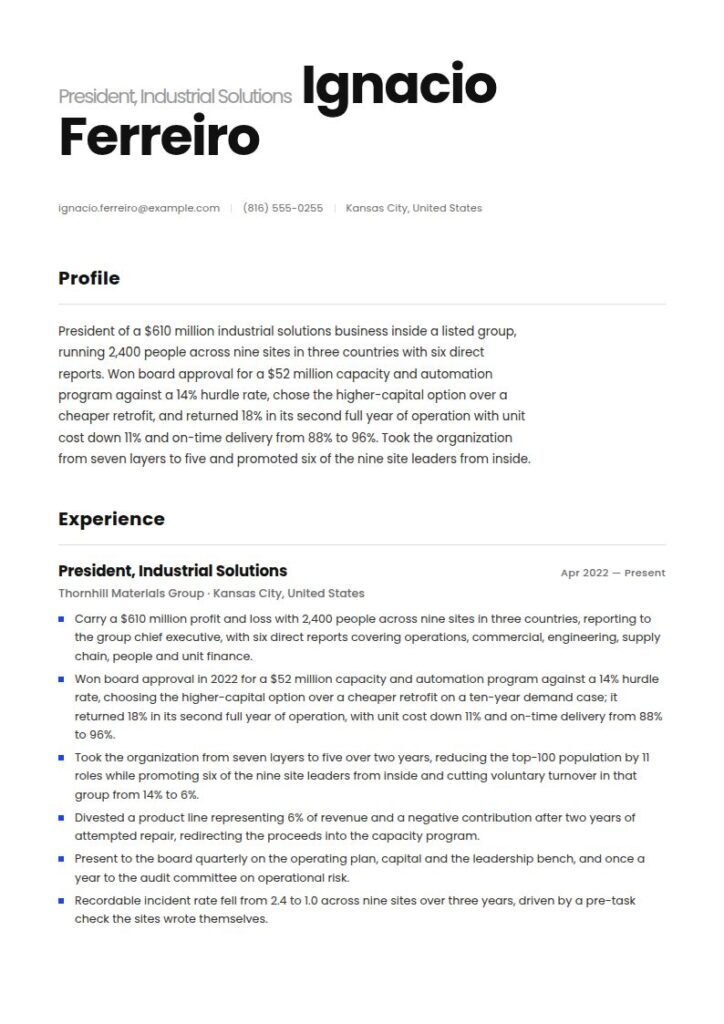
President of a $610 million industrial solutions business inside a listed group, running 2,400 people across nine sites in three countries with six direct reports. Won board approval for a $52 million capacity and automation program against a 14% hurdle rate, chose the higher-capital option over a cheaper retrofit, and returned 18% in its second full year of operation with unit cost down 11% and on-time delivery from 88% to 96%. Took the organization from seven layers to five and promoted six of the nine site leaders from inside.
Right vs wrong: the same executive summary, twice
| ✅ Right | ❌ Wrong |
|---|---|
| President of a $610 million business, 2,400 people, nine sites, three countries, six direct reports. | Senior executive with extensive experience leading large, complex organizations. |
| Won board approval for a $52 million program against a 14% hurdle; it returned 18% in its second full year. | Championed strategic initiatives that delivered significant value to stakeholders. |
| Closed a geographic expansion 18 months in after it failed its second gate, writing off $6 million. | Consistently exceeded expectations across every business I have led. |
The right column can be interrogated for an hour and survive it. The left column is what a board chair has read forty times this quarter, and it is why the middle of an executive shortlist is usually indistinguishable.
Outline your experience
Employer, what it does, revenue, headcount, sites, reporting line, dates. Then five or six bullets on the current role and three on the one before. Lead each bullet with a decision rather than an activity, and put the capital and the horizon in the sentence.
| Instead of | Use |
|---|---|
| Responsible for overall business performance | Carry a $610 million profit and loss with 2,400 people across nine sites in three countries, reporting to the group chief executive |
| Led a major transformation initiative | Won board approval for a $52 million capacity and automation program against a 14% hurdle rate; it returned 18% in its second full year |
| Restructured the organization for growth | Moved the business from seven layers to five, cutting the top-100 population by 11 roles while promoting six of nine site leaders internally |
| Exited an underperforming business | Closed a geographic expansion 18 months in after it failed its second gate, writing off $6 million and redeploying the team inside the group |
President, Industrial Solutions, Thornhill Materials Group, Kansas City, MO, $610 million revenue, 2,400 people, nine sites in three countries, reporting to the group chief executive, April 2022 to Present
Carry the profit and loss and the capital plan for the largest of the group's three business units, with six direct reports covering operations, commercial, engineering, supply chain, people and unit finance.
Won board approval in 2022 for a $52 million capacity and automation program against a 14% hurdle rate, choosing the higher-capital option over a cheaper retrofit on the basis of a ten-year demand case; the program returned 18% in its second full year of operation, with unit cost down 11% and on-time delivery from 88% to 96%.
Took the organization from seven layers to five over two years, reducing the top-100 population by 11 roles while promoting six of the nine site leaders from inside and cutting voluntary turnover in that group from 14% to 6%.
Present to the board quarterly on the operating plan, capital and the leadership bench, and once a year to the audit committee on operational risk.
Recordable incident rate fell from 2.4 to 1.0 across nine sites over three years, driven by a pre-task check the sites wrote themselves rather than by a corporate program.
Name the strategic bet: the decision, the capital behind it and what came back
This is the section that decides an executive resume, and almost nobody writes it. Everything else on the page can be produced by a capable senior manager with a good year.
A bet has four parts: the decision, stated as a choice between real alternatives; the capital or irreversible commitment behind it; the horizon over which it was supposed to pay; and the result, measured against what you told the approving body it would be. Write one bet per role, not five. Five reads as a list of projects; one reads as an executive who knows which decision was the big one.
The decision: build new capacity with automation rather than retrofit the existing line, on a ten-year demand case rather than the three-year one the plan used.
The commitment: $52 million of capital approved by the board in 2022, roughly three times the retrofit alternative, with 14 months of construction and a line moved out of service for 11 weeks.
The horizon and the test: a 14% internal rate of return over seven years, with a stated gate at 18 months that would have stopped the second phase.
What came back: 18% in the second full year of operation, unit cost down 11%, on-time delivery from 88% to 96%, and a second phase approved on the original case rather than a revised one.
The one that did not work: an adjacent-geography entry in 2019 closed after 18 months when it failed its second gate. $6 million written off, the team redeployed inside the group, and the gate structure now used on every capital case came out of the review.
Put the bet that did not work on the page
An executive resume with an unbroken record of success is the least credible document a board can read, because everyone on that board has lost money on something and knows what the distribution looks like.
The failure line has a shape, and it is not a confession. Name the decision, the size of the commitment, the point at which you stopped, what it cost, and what you changed afterwards. "Closed a geographic expansion 18 months in after it failed its second gate, writing off $6 million; the gate structure now used on every capital case came out of that review" demonstrates three things a success story cannot: that you set stopping conditions in advance, that you honored one, and that the organization learned something transferable.
What does not work is the disguised failure, where a closure is described as a strategic refocus and the money is never mentioned. Panels at this level are staffed by people who have written the same sentence about their own losses, and they ask the follow-up immediately.
Build a snapshot of your key skills
Six to eight lines at most, expressed as things you govern rather than tools you operate, and it is entirely reasonable to omit the section on an executive resume. If you keep it, keep it commercial and organizational.
Commercial: Profit and loss ownership, Pricing and margin architecture, Channel and route to market design, Customer concentration risk
Capital and portfolio: Capital allocation against a hurdle rate, Investment gating and stop conditions, Acquisition integration, Product line exit
Organization: Operating model and layer design, Executive team selection and succession, Leadership bench, Reward architecture
Governance and risk: Board and committee reporting, Operational and safety risk, Crisis and continuity leadership
List your education, qualifications and governance roles
Degrees compress to one line each at this level. The governance block is worth more than any of them, because it is the part of the job that cannot be learned quickly and the part a board screens for.
Master of Business Administration, Olin Business School, Washington University in St. Louis, St. Louis, MO, 2011
Bachelor of Science, Industrial Engineering, University of Missouri, Columbia, MO, 2003
Governance: Board member, a regional manufacturers' association, 2023 to present, remuneration committee. Presented to the Thornhill Materials Group board quarterly since 2022 and to its audit committee annually on operational risk.
Executive progression: plant manager, director of operations, vice president operations, chief operating officer, president
The progression line is worth its space. An executive who moved through operations, into an officer role and then into a full profit and loss is a different candidate from one who arrived sideways, and boards ask about the route within the first ten minutes.
Choose the right layout and design
Single column, two pages, 11 point, generous white space, no photograph, no charts, no skill bars, no logos. The scope line must survive a ten-second skim, so give it its own visual space rather than burying it in a paragraph. Save as PDF named for yourself and the level: ignacio-ferreiro-executive-resume.pdf.
Put revenue, headcount, sites and reporting line under your name. Write one bet per role with capital, horizon and result. Include one bet that did not work and what changed afterwards. Say who you present to, how often and about what. Compress everything older than fifteen years to a single line. Keep it to two pages.
Do not disclose unannounced results, an unclosed transaction, a pending restructuring or anything from a board pack. Do not claim a decision the board made as one you made; say you recommended it and it was approved. Do not use "visionary", "transformational" or "strategic leader" as a description of yourself. Do not present an unbroken record. Do not send the same two pages to a chief operating officer search and a functional vice president search without rewriting the summary.
Executive job market and outlook
Executive titles sit inside the Handbook's top executives group, which the Bureau of Labor Statistics describes as planning strategies and policies to ensure an organization meets its goals. Outlook and annual openings are published for the group as a whole rather than for chief executives separately, so the honest reading takes the market from the group and pay from the sub-occupations.
| Measure | Employment, 2025 | Projected change, 2025 to 2035 | Annual openings | Median annual wage, May 2025 |
|---|---|---|---|---|
| Top executives (group) | 3,890,600 | 5 percent growth, +190,600 | About 304,100 | $108,780 |
| Chief executives | 291,600 | 3 percent growth, +9,300 | Published only for the group, about 304,100 | $213,990 |
| General and operations managers | 3,599,000 | 5 percent growth, +181,300 | Published only for the group, about 304,100 | $105,770 |
Source: U.S. Bureau of Labor Statistics, Occupational Outlook Handbook, May 2025 wage data and 2025 to 2035 projections.
Typical entry-level education for top executives is a bachelor's degree, with five years or more of work experience in a related occupation and no on-the-job training listed (BLS Occupational Outlook Handbook, accessed 13 September 2026). The second of those is the one that matters for a resume: the occupation is entered through a prior career, so the shape of your route is part of what is being assessed.
Chief executive jobs are also not where most people assume. Self-employed workers account for 27 percent of chief executive employment, with professional, scientific and technical services at 14 percent, government at 8 percent, healthcare and social assistance at 6 percent and management of companies and enterprises at 5 percent (BLS Occupational Outlook Handbook, 2025 industry employment data). More than a quarter of the people counted as chief executives are running their own businesses.
The published executive median covers a range that is not really one job
Chief executives had a median annual wage of $213,990 in May 2025, with the lowest 10 percent under $75,700 and the highest 10 percent over $507,730. General and operations managers, the far larger group, had a median of $105,770, from under $50,090 to over $253,390. Management occupations as a whole had a median of $126,520, against $50,980 for all occupations (BLS Occupational Outlook Handbook, May 2025).
Industry moves the chief executive figure more than anything else. The May 2025 median was $358,310 in management of companies and enterprises, $237,180 in professional, scientific and technical services, $197,090 in healthcare and social assistance and $146,700 in government (BLS, May 2025). That is a spread of more than two to one for the same nominal title.
One thing cannot be added to any of it. The federal wage survey collects straight-time gross pay, including base rates, commissions, incentive pay and production bonuses, and explicitly excludes year-end bonuses, profit-sharing payments, stock bonuses, severance and the employer cost of benefits (BLS, Occupational Employment and Wage Statistics survey documentation, accessed 13 September 2026). For an executive that is most of the package. The published data covers base and regular incentive together and stops there, and no federal source publishes an annual bonus, long term incentive or equity figure for these occupations.
What salary you can expect as an executive
The usable published figures are the two sub-occupations the title straddles. Chief executives had a median annual wage of $213,990 in May 2025, from under $75,700 to over $507,730; general and operations managers had a median of $105,770, from under $50,090 to over $253,390 (BLS Occupational Outlook Handbook, May 2025).
Four things move you inside that range and all four belong on page one. Revenue scope comes first, because it is what compensation committees band against. Organization size and complexity come second: 2,400 people across nine sites in three countries is a different job from 2,400 in one building. Industry comes third, and it moves the number more than tenure does, from a $358,310 median in management of companies and enterprises to $146,700 in government (BLS, May 2025). Governance exposure comes fourth, because presenting to a board cannot be taught in a year.
Read the published figure for what it is: base pay plus regular incentive for the occupation, not a package, and it excludes exactly the components an executive negotiates hardest. Ask for the full structure during the process, and do not anchor on a bonus or equity figure you cannot source.
Key takeaways for an executive resume
- Put revenue, headcount, sites and reporting line under your name.
- Write one strategic bet per role: decision, capital, horizon, result.
- Include the bet that did not work and what changed because of it.
- Say who you present to, how often, and about what.
- Lead every bullet with a decision rather than an activity.
- Compress everything older than fifteen years to a single line each.
- Keep unannounced results and anything from a board pack off the page entirely.
- Two pages, with page one written as though page two will not be opened.
Build your executive resume in 15 minutes with our AI resume builder.
Related business and management resume examples
- CEO resume
- Chief operating officer resume
- Managing director resume
- CFO resume
- CIO resume
- CTO resume
- Operations director resume
- Business management resume
- Chief of staff resume
- Manager resume
- Entrepreneur resume
- Consultant resume
Pair it with a matching executive cover letter.
Executive resume questions, answered
How long should an executive resume be?
Two pages, with the last two roles carrying most of the words and everything older compressed to one line each. Three pages is the most common error at this level and reads as indecision rather than depth. One page is also wrong, because it cannot carry a scope line, two roles in detail, a bet and a governance line at once.
Should one executive resume cover several different C-level and vice president postings?
The two pages of evidence can be common; the summary and the scope line cannot. Rewrite the top eight lines for each search, so a chief operating officer posting sees organization, cost and delivery first and a commercial vice president posting sees margin, channel and customer first. The bets underneath stay the same, which is what keeps the document honest under questioning.
What is the difference between an executive resume and a senior manager resume?
Irreversibility, and the reader can see it in seconds. A senior manager improves performance inside constraints somebody else set. An executive sets the constraints and commits capital that cannot easily be recovered. If nothing on your page could have gone badly wrong, you have written the layer below, whatever your title says.
How do I show the board relationship if I have never sat on a board?
Say exactly what you have done, which is usually more than candidates claim. Presenting to a board quarterly, attending as a functional owner, preparing the papers, answering a committee on risk and sitting on any external or nonprofit board are all real governance exposure and belong in the closing block with the frequency and the subject attached. Implying board membership through vague phrasing does not work; it is the first thing verified.
Can I put company financials on an executive resume?
Only what is public, and otherwise only scale. Approximate revenue, headcount, sites, countries and an investment figure with the year it was approved are normal and are how the market sizes a role. Unannounced results, margins by product or customer, contract values, valuation multiples, an unclosed transaction and anything lifted from a board pack are not, and for a public issuer the constraint is a regulatory one rather than a matter of taste (17 CFR 243.100).
Do I still need a skills section as an executive?
Barely, and omitting it is defensible. If you keep one, make it six to eight lines of things you govern: capital allocation, operating model, board reporting, portfolio decisions. A list of platforms on an executive resume reads as a candidate who has not made the shift from running work to choosing what work exists.