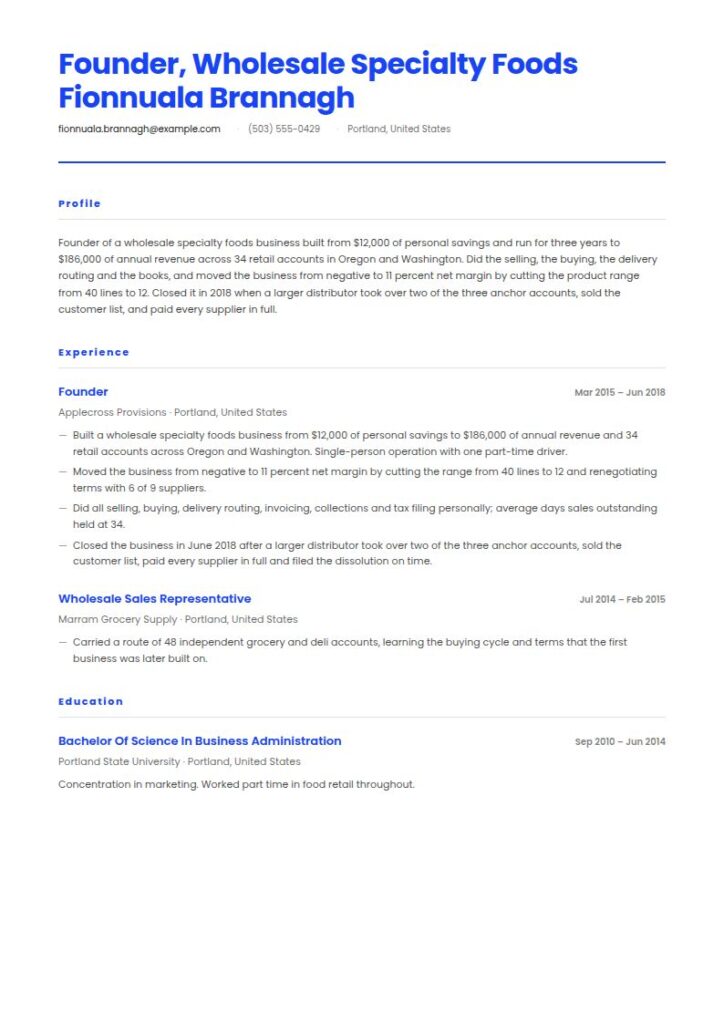
Founder, Wholesale Specialty Foods Fionnuala Brannagh
Founder
[email protected] | (503) 555-0429 | Portland, United States
Profile
Founder of a wholesale specialty foods business built from $12,000 of personal savings and run for three years to $186,000 of annual revenue across 34 retail accounts in Oregon and Washington. Did the selling, the buying, the delivery routing and the books, and moved the business from negative to 11 percent net margin by cutting the product range from 40 lines to 12. Closed it in 2018 when a larger distributor took over two of the three anchor accounts, sold the customer list, and paid every supplier in full.
Work Experience
03/2015 - 06/2018, Founder, Applecross Provisions, Portland, United States
- Built a wholesale specialty foods business from $12,000 of personal savings to $186,000 of annual revenue and 34 retail accounts across Oregon and Washington. Single-person operation with one part-time driver.
- Moved the business from negative to 11 percent net margin by cutting the range from 40 lines to 12 and renegotiating terms with 6 of 9 suppliers.
- Did all selling, buying, delivery routing, invoicing, collections and tax filing personally; average days sales outstanding held at 34.
- Closed the business in June 2018 after a larger distributor took over two of the three anchor accounts, sold the customer list, paid every supplier in full and filed the dissolution on time.
07/2014 - 02/2015, Wholesale Sales Representative, Marram Grocery Supply, Portland, United States
- Carried a route of 48 independent grocery and deli accounts, learning the buying cycle and terms that the first business was later built on.
Education
09/2010 - 06/2014, Bachelor of Science, Business Administration, Portland State University, Portland, United States
Concentration in marketing. Worked part time in food retail throughout.
Skills
Direct sales to independent retailers, 80
Pricing and margin management, 70
Supplier negotiation and terms, 70
Delivery routing and stock control, 75
Invoicing, collections and bookkeeping, 70
Food safety and labeling compliance, 75
Languages
English, native
Irish, intermediate
Certificates
04/2015, ServSafe Food Protection Manager, National Restaurant Association
Held throughout the operation of the business.
Summary
An entrepreneur resume is an awkward document, because the reader is deciding whether a founder can work for someone else. This guide shows you how to state what you built in real numbers, what you were responsible for that an employee is not, how funding or bootstrapping changes the page, and how to write a business that closed so it reads as competence rather than a hole in your history.
Entrepreneur resume examples by experience level
In short, an entrepreneur resume is an awkward document. After all, you are handing a hiring manager a page that says you built and ran your own company, and asking them to hire you into a job with a manager, a budget you do not set, and decisions you will not get to make.
Many readers carry three specific doubts: that you will leave the moment your next idea arrives, that you cannot take direction after years of giving it, and that your numbers are unverifiable because you were the only one counting them. A resume that ignores those doubts loses to one that answers them in the first ten lines, with evidence rather than enthusiasm.
Resume guide for an entrepreneur resume
To that end, this guide and the corresponding entrepreneur resume example will cover:
- To begin with, how to write an entrepreneur resume, section by section
- Then, how to state scale in numbers a stranger can sanity check
- Also, three adaptable summaries: first venture, funded founder, and operating owner
- In addition, how to write a business that closed, and the self-employment period around it
- Finally, what the job market looks like and what the comparable employed roles pay
How to write an entrepreneur resume
Six blocks: contact header, summary, the venture block, experience, skills, then education and anything external that verifies you. One page if your ventures were small, two once a company had staff, funding, or revenue in the millions.
Above all, the venture block goes directly under the summary, and it is the whole trick of this document. "Founder and CEO" tells a reader nothing: it is worn by a person with a registered company and no customers and by a person running 62 employees. Therefore, numbers settle it in four lines, and you have to volunteer them.
| Section | What it is answering | Where it goes |
|---|---|---|
| Venture block | How big was it, really, and what did you personally carry? | Directly under the summary |
| Experience | What did you do inside the business, in a language an employer recognizes? | Reverse chronological, functional bullets |
| How it ended | Sold, closed, still running, stepped back? | One line inside each venture, never omitted |
| Verification | Who can confirm any of this without taking your word for it? | Short block near the end |
Write the job you actually did, not the title you gave yourself
Founder is not a function, and a hiring manager reading "Founder and CEO, 2018 to 2023" cannot tell whether you spent five years writing code, selling, hiring, or negotiating with a bank.
Break it into the functions an employer recognizes and put percentages against them: "Roughly half my time was sales and account management, a quarter was hiring and people management across 14 staff, and a quarter was finance, from the payroll run to the annual audit and two funding rounds."
That translates your experience into the language of the role you are applying for and tells the truth about the parts you did not do. A founder who says plainly "I never managed a team larger than 14" is more credible than one who implies executive breadth across everything.
Run the finished file through the free ATS resume checker before you send it. Self-employment records parse badly, and the checker will show you what a system sees.
Choosing the best resume format for an entrepreneur resume
Overall, reverse chronological, single column, with the venture block above the history. Generally, one page for a small or short-lived venture, two once a company had employees and real revenue.
A functional format is tempting because the timeline looks unusual, and it is wrong for the usual reason: a reader assumes a hidden timeline is a bad one. Your dates are not the problem. However, an unexplained four-year block labeled "Self-employed" is, and the fix is detail, not concealment.
Also, one line under the header saying what you want now is worth its space. "Looking for an operating role inside a larger business; not fundraising, not starting anything" answers the first doubt before it forms.
Include your contact information
| ✅ Right | ❌ Wrong |
|---|---|
| Fionnuala Brannagh | Fionnuala Brannagh |
| Founder and CEO, Sedgewick Field Services, 62 employees, $11.6M revenue | Serial entrepreneur, visionary and problem solver |
| Portland, OR, seeking a general management or operations role | Open to exciting opportunities |
| (503) 555-0429, [email protected] | (503) 555-0429, [email protected] |
Two details there matter more than they look. The scale figures in line two stop the reader guessing, and the email is personal rather than a company address. Likewise, applying from your own company domain reads as someone who has not decided to leave.
Make use of a summary
In effect, four lines: what you built, its scale in numbers, what you personally ran, and what you are looking for now.
Founder of a wholesale specialty foods business built from $12,000 of personal savings and run for three years to $186,000 of annual revenue across 34 retail accounts in Oregon and Washington. Did the selling, the buying, the delivery routing and the books, and moved the business from negative to 11 percent net margin by cutting the product range from 40 lines to 12. Closed it in 2018 when a larger distributor took over two of the three anchor accounts, sold the customer list, and paid every supplier in full.
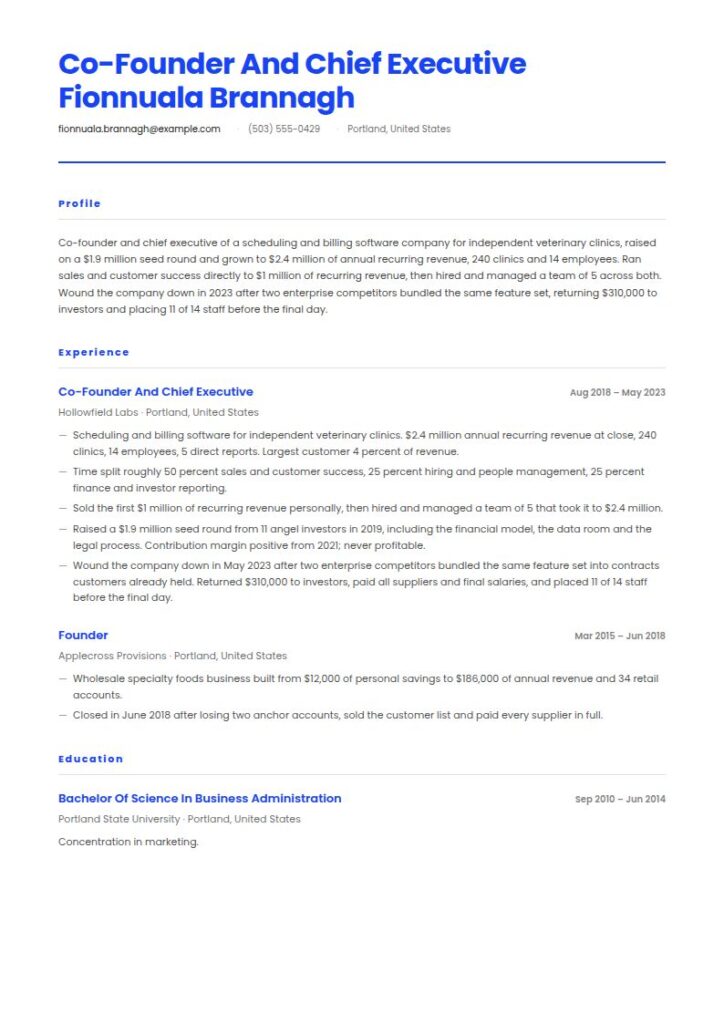
Co-founder and chief executive of a scheduling and billing software company for independent veterinary clinics, raised on a $1.9 million seed round and grown to $2.4 million of annual recurring revenue, 240 clinics and 14 employees. Ran sales and customer success directly to $1 million of recurring revenue, then hired and managed a team of 5 across both. Wound the company down in 2023 after two enterprise competitors bundled the same feature set, returning $310,000 to investors and placing 11 of 14 staff before the final day.
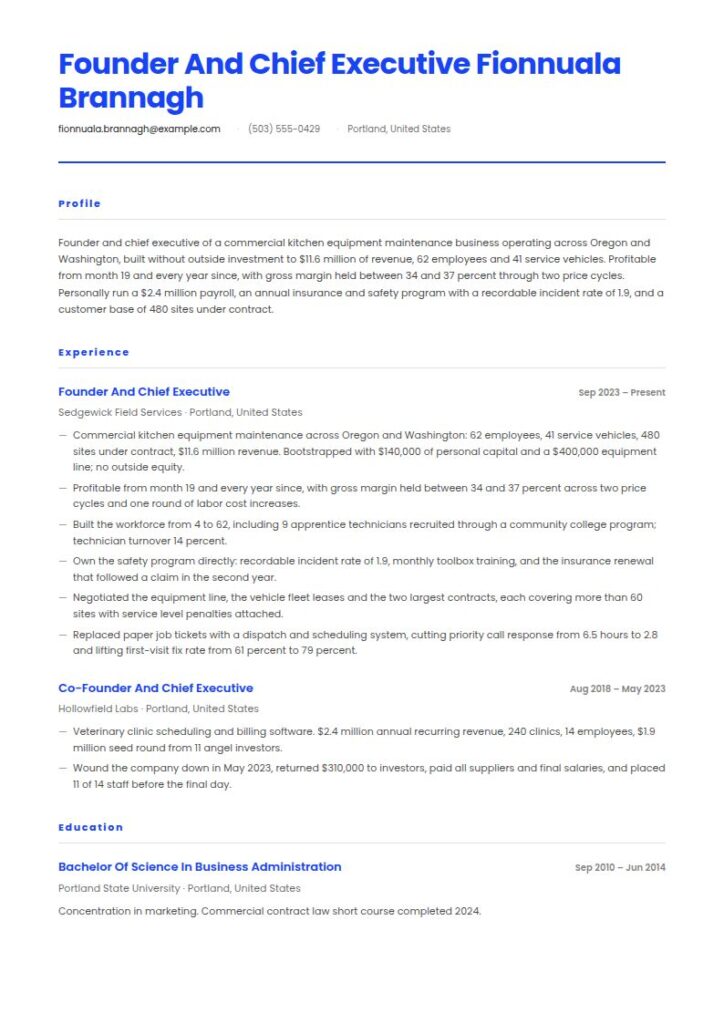
Founder and chief executive of a commercial kitchen equipment maintenance business operating across Oregon and Washington, built without outside investment to $11.6 million of revenue, 62 employees and 41 service vehicles. Profitable from month 19 and every year since, with gross margin held between 34 and 37 percent through two price cycles. Personally run a $2.4 million payroll, an annual insurance and safety program with a recordable incident rate of 1.9, and a customer base of 480 sites under contract.
Right vs wrong: the same entrepreneur summary, twice
| ✅ Right | ❌ Wrong |
|---|---|
| Built without outside investment to $11.6 million of revenue, 62 employees and 41 service vehicles. | Founded and scaled a successful business from the ground up. |
| Profitable from month 19, with gross margin held between 34 and 37 percent through two price cycles. | Delivered consistent growth and profitability year over year. |
| Wound the company down in 2023, returned $310,000 to investors and placed 11 of 14 staff. | The venture concluded in 2023 due to market conditions. |
| Ran sales and customer success directly to $1 million of recurring revenue, then hired a team of 5. | Wore many hats and led all aspects of the business. |
On one hand, the right column can be discussed for twenty minutes in an interview. On the other hand, the left column is what a reader has seen on every founder resume that reached them, and it is the reason the stack gets sorted quickly.
Outline your experience as a founder
Company, what it sold and to whom, dates, and then the scale line, the function split, and how it ended. Under that, three to five bullets written in the language of employment rather than the language of pitching.
| Instead of | Use |
|---|---|
| Founded and scaled a successful company | Built to $2.4 million of annual recurring revenue, 240 clinics and 14 employees over five years |
| Wore many hats across all business functions | Sales and account management half my time, hiring and people management a quarter, finance a quarter |
| Secured investment from investors | Raised a $1.9 million seed round from 11 angel investors, including the financial model, the data room and the legal process |
| Led a high-performing team | Hired 14 people, managed 5 directly, and lost 2 to voluntary attrition in five years |
| The business was affected by market conditions | Wound the company down in 2023 after two enterprise competitors bundled the same feature set into existing contracts |
Founder and Chief Executive, Sedgewick Field Services, Portland, OR, September 2023 to Present
Commercial kitchen equipment maintenance across Oregon and Washington. 62 employees, 41 service vehicles, 480 sites under contract, $11.6 million revenue. Bootstrapped with $140,000 of personal capital and a $400,000 equipment line of credit; no outside equity.
Profitable from month 19 and in every year since, with gross margin held between 34 and 37 percent across two price cycles and one round of labor cost increases.
Built the workforce from 4 to 62, including 9 apprentice technicians recruited through a community college program, with technician turnover at 14 percent against a widely quoted trade average well above that.
Own the safety program directly: a recordable incident rate of 1.9, monthly toolbox training, and the insurance renewal that followed a claim in the second year.
Replaced paper job tickets with a dispatch and scheduling system, cutting average response time on a priority call from 6.5 hours to 2.8 and lifting first-visit fix rate from 61 percent to 79 percent.
Write what you built as a business, then write how it ended
Specifically, every venture on your resume needs two blocks: what it was, and what happened to it. However, candidates skip the second one, and skipping it turns a founder resume into a set of unanswered questions.
To begin with, lead with scale, in figures a stranger can sanity check against each other.
| Line | What to write | Worked example |
|---|---|---|
| What it sold | The product or service and the customer type | Scheduling and billing software for independent veterinary clinics |
| Money | Revenue or recurring revenue, and profitability | $2.4 million annual recurring revenue, never profitable |
| People | Headcount, how many you managed directly | 14 employees, 5 direct reports |
| Capital | Bootstrapped or funded, how much and from what kind of investor | $1.9 million seed round from 11 angel investors |
| Customers | Count, concentration, and the size of the largest | 240 clinics, largest 4 percent of revenue |
| Ending | Sold, closed, still running, stepped back, and the date | Wound down May 2023, $310,000 returned to investors |
Venture: Hollowfield Labs, scheduling and billing software for independent veterinary clinics. August 2018 to May 2023.
Scale: $2.4 million annual recurring revenue at close, 240 clinics, 14 employees, 5 direct reports. Never profitable; contribution margin positive from 2021.
Capital: $1.9 million seed round raised in 2019 from 11 angel investors. No institutional round. Personal capital at risk: $60,000.
My function split: sales and customer success 50 percent, hiring and people management 25 percent, finance and investor reporting 25 percent.
Ending: wound down in May 2023 after two enterprise competitors bundled the same feature set into contracts our customers already held. Returned $310,000 to investors, paid all suppliers and final salaries, and placed 11 of 14 staff before the final day.
Verification: the seed round and the dissolution are on the state business register. Two former investors and the outgoing head of engineering are available as references.
How to write the ending of a venture
Then write the ending, in four moves.
Name it plainly and early. "Wound down", "closed", "sold", "still operating, I stepped back". A reader who reaches the end of your resume without knowing what happened assumes the worst version, so put one sentence in the role header.
Give the cause in commercial language, not in weather. "Two enterprise competitors bundled the same feature set into contracts our customers already held" is a business explanation; "market conditions" is a refusal to analyze. If the cause was your own decision, say that too, because founders who can name their own mistake interview well.
Write the wind-down as work, because it was. Returning capital, paying suppliers in full, placing staff, closing contracts cleanly and filing the dissolution correctly are real operational achievements, and they are what an employer wants to see.
Never inflate an outcome. Do not write "acquired" for an asset sale of a customer list, "exited" for a closure, or a valuation nobody paid. The state register, the funding record and one reference call are all cheap to check.
Half of new businesses are gone within five years, and that is the base rate
The claim that nine out of ten businesses fail is not a figure any federal series publishes. The primary data says something more useful.
Of the 677,876 private sector establishments that opened in the year ended March 2015, 50.2 percent were still operating five years later and 34.7 percent were still operating in March 2025, ten years on (U.S. Bureau of Labor Statistics, Business Employment Dynamics, survival of private sector establishments by opening year, data through March 2025).
The Small Business Administration's Office of Advocacy puts the same pattern across the whole economy: 36,207,130 small businesses, 99.9 percent of all United States businesses, of which 29,811,495 have no employees at all, and together they account for 62.3 million workers, or 45.9 percent of private sector employment (SBA Office of Advocacy, Frequently Asked Questions About Small Business, February 2026).
So closing a business is the median outcome rather than a disqualifying event, and the reader knows it. What separates candidates is the account they give of it. Write the ending as analysis and it stops being a confession.
Build a snapshot of your key skills
For skills, similarly, twelve to sixteen entries in four groups, and skew them toward the function you are applying into. In other words, a founder's skill list should look like the job description, not like a business plan.
Commercial: Direct sales and contract negotiation, Pricing and margin management, Customer retention and account concentration, Tender and service level agreement terms
Operations: Scheduling and dispatch, Capacity and route planning, Supplier and subcontractor management, Quality and first-visit fix measurement, Health and safety program ownership
Finance: Cash flow forecasting, Payroll and benefits administration, Bank and equipment facility negotiation, Statutory accounts and audit preparation, Investor reporting
People: Hiring and onboarding, Apprenticeship and trade recruitment, Performance management and dismissal, Redundancy and wind-down handling
The last entry is uncomfortable and it belongs there. Indeed, a founder who has handled an exit for their own staff has done the hardest people work there is.
List your education and what verifies you
Degrees, then anything external that confirms the business existed at the scale you claim. Moreover, this second part is specific to founder resumes and it defuses the unverifiability doubt directly.
Bachelor of Science, Business Administration, Portland State University, Portland, OR, 2014.
Verification: both companies are on the Oregon state business register under my name, with formation and dissolution dates. The seed round is on the public filing record.
External confirmation: audited statutory accounts for the last three years, available on request. Commercial bank relationship since 2023. Contractor licensing and insurance certificates current.
References: two former investors, one former head of engineering, and two current customers with contracts over 60 sites.
Continuing: commercial contract law short course, 2024. Occupational safety program management, 2025.
Founders underestimate this block. That is because every other candidate's claims can be checked by calling a previous employer; yours cannot unless you make them so, and a reader who verifies one number extends trust to the rest.
Choose the right layout and design
In general, single column, 11 point, no photograph, no company logo, no pitch deck styling. PDF unless the portal asks for Word.
Above all, resist the instinct to design this document. After all, a founder's resume that looks like a fundraising deck confirms the suspicion that you are still selling the company rather than applying for a job.
Give revenue, headcount and capital in the first block. Split your time by function with rough percentages. Say what happened to every business and when. Write the wind-down work as work. Name what you could not do as well as what you could. List the register, the accounts and the references that verify you. Say plainly what you are looking for now.
Do not write "serial entrepreneur" or "visionary". Do not call a closure an exit or an asset sale an acquisition. Do not quote a valuation nobody paid or a revenue figure you cannot evidence. Do not label four years "Self-employed" with no detail underneath. Do not apply from the company email address. Do not explain a failure with market conditions and stop there.
Entrepreneur job market and outlook
The Bureau of Labor Statistics publishes no Occupational Outlook Handbook profile for entrepreneur, because it is not an occupation. In fact, it is an employment arrangement, and the useful figures come from two places: the size of the self-employed economy, and the pay for the employed roles founders usually apply into.
| Measure | Value | Source |
|---|---|---|
| Small businesses in the United States | 36,207,130, or 99.9 percent of all United States businesses | SBA Office of Advocacy, February 2026 |
| Of which have no employees | 29,811,495 | SBA Office of Advocacy, February 2026 |
| Small business employment | 62.3 million, 45.9 percent of private sector employment | SBA Office of Advocacy, February 2026 |
| Chief executives, employment 2025 | 291,600, of whom 27 percent are self-employed | BLS Occupational Outlook Handbook, May 2025 |
| Top executives, projected change 2025 to 2035 | 5 percent, +190,600, about 304,100 openings a year | BLS Occupational Outlook Handbook, 2025 to 2035 projections |
Two things follow. Most businesses in the country have no employees at all, so a founder with staff and a payroll is already unusual and should say so in numbers. Also, the employed roles founders move into are a replacement market: about 304,100 top executive openings a year against projected growth of 190,600 jobs across the decade. Replacements are hired against a specific frustration with the last person in the seat, so state your scope plainly.
What salary you can expect after running your own business
There is no published wage for entrepreneurs, so the honest comparison is the employed role you are applying into.
Chief executives had a median annual wage of $213,990 in May 2025, with the lowest 10 percent earning less than $75,700 and the highest 10 percent more than $507,730 (BLS Occupational Outlook Handbook, May 2025). General and operations managers, which is where most founders of businesses under about 100 people actually land, had a median of $105,770, with the lowest 10 percent under $50,090 and the highest 10 percent over $253,390 (BLS, May 2025). Meanwhile, top executives as a whole had a median of $108,780 across 3,890,600 jobs (BLS, May 2025).
In particular, the gap between those two medians matters most to a founder planning a move. For instance, running a company with 62 people and $11.6 million of revenue does not price against the chief executive median, which is dominated by executives of far larger organizations. Instead, it prices against general and operations management, with your scale and margin record moving you up inside that band. General and operations managers had a median of $151,040 in professional, scientific and technical services and $130,960 in manufacturing, against $115,620 in wholesale trade (BLS, May 2025), so the sector you move into is worth more than the title you left.
Expect to be benchmarked on the scope of the role you are taking rather than the company you left. Be ready for the equity question too, because saying early that you value salary differently prevents a wasted process later.
Key takeaways for an entrepreneur resume
- Firstly, answer the three doubts early: flight risk, taking direction, and unverifiable numbers.
- Then put revenue, headcount and capital in a block under the summary.
- In addition, split your time by function with rough percentages, in the language of the job you want.
- Say what happened to every business, and when, in the role header.
- Equally, give the cause of a closure in commercial terms, never as market conditions.
- Moreover, write the wind-down work: capital returned, suppliers paid, staff placed.
- Likewise, list what verifies you: the register, the accounts, the investors, the customers.
- Finally, say what you are looking for now, and use a personal email address.
Build your entrepreneur resume in 15 minutes with our AI resume builder.
Related business and management resume examples
- Small business owner resume
- CEO resume
- Executive resume
- Consultant resume
- Business management resume
- Managing director resume
- Chief operating officer resume
- Business resume
- Manager resume
- CFO resume
- Business development resume
- Consulting resume
Pair it with a matching entrepreneur cover letter.
Entrepreneur resume questions, answered
Will a hiring manager reject me for having been a founder?
Some will. The concerns are that you will leave for your next venture, that you are used to deciding rather than being directed, and that nobody can verify your numbers. All three are answerable on the page: say what you are looking for, describe a function split that shows you did ordinary work, and list the register entries, accounts and references that confirm the scale you claim.
How do I write the gap when my business was failing and I had no income?
Write it as employment, because it was. Give the company, the dates, the scale at its peak, and what you were doing in the final period: collecting receivables, negotiating with suppliers, winding down contracts, placing staff. A period with no salary is not a gap. A line reading "Self-employed, 2018 to 2023" with nothing underneath is.
Should I put a failed business on my resume at all?
Yes, if it took more than a few months of your life. Removing it creates a hole you will have to explain anyway, and dates are easy to check. Closing is the ordinary outcome: of establishments opening in the year ended March 2015, half were gone within five years and about two thirds within ten (BLS Business Employment Dynamics, data through March 2025). Your account of it is what is being assessed.
What if my business was just me, with no staff and modest revenue?
Write it accurately at that scale and lean on the functions: selling, pricing, collections, supplier terms, scheduling and tax compliance are real skills. State the revenue and say it was a single-person operation. Most businesses in the country are exactly that: 29,811,495 of the 36,207,130 small businesses have no employees (SBA Office of Advocacy, February 2026).
Do I need to say why I am leaving my own company?
One line, about what you want rather than what went wrong. "Looking for an operating role inside a larger business" works. Avoid anything that sounds like exhaustion or like you are waiting to start again; both confirm the flight-risk doubt.
Should I apply for a chief executive role after running my own company?
Usually not as the first move, unless the target company is close in size to yours. Chief executive roles are largely filled from inside larger organizations, and the published median of $213,990 in May 2025 reflects executives of businesses much bigger than most founder-run companies (BLS Occupational Outlook Handbook, May 2025). General management and operations leadership roles convert far more often.