Owner and Operator, Hardware and Garden Retail Reynaldo Tejeda
Owner and Operator
[email protected] | (208) 555-0552 | Boise, United States
Profile
Owner and operator of an independent hardware and garden supply store in its third year, opened with $58,000 of personal savings and a $75,000 inventory and equipment loan, trading at $610,000 a year with three employees. Do the buying, the till reconciliation, the payroll and the Saturday floor shift myself, and moved gross margin from 26 percent to 31 percent by cutting the range from 9,200 stock lines to 6,400. Registered with the Idaho Secretary of State, seller's permit current, general liability and workers compensation in force.
Work Experience
09/2015 - Present, Owner and Operator, Copperline Hardware and Garden Supply, Boise, United States
- Opened an independent hardware and garden supply store with $58,000 of personal savings and a $75,000 inventory and equipment loan; no outside investors.
- Trading at $610,000 a year in year three with three employees, doing the buying, the till reconciliation, the payroll and the Saturday floor shift personally.
- Moved gross margin from 26 percent to 31 percent by cutting the range from 9,200 stock lines to 6,400.
- Hold the business registration, seller's permit, general liability and workers compensation cover and the inspection file personally.
06/2009 - 08/2015, Yard and Contractor Sales Lead, Dunmarket Building Supply, Boise, United States
- Ran the contractor trade counter and the yard for a building supply branch, quoting and picking orders for 90 to 120 accounts.
- Managed the yard stock count and the annual inventory, and trained four seasonal staff each spring.
Education
08/2010 - 05/2012, Associate of Applied Science, Business Management, College of Western Idaho, Nampa, United States
Studied part time while working full time in building supply. Coursework in accounting, business law and retail management.
Skills
Purchasing and supplier terms, 70
Point of sale administration, 80
Cash handling and till reconciliation, 85
Payroll processing, 65
Range and stock management, 70
Customer service and trade counter, 85
Languages
English, native
Spanish, proficient
Certificates
05/2018, OSHA 10-Hour General Industry, OSHA Outreach Training Program
Summary
A small business owner resume is written for a reader who cannot call your last manager, because there was not one. This guide shows you how to state revenue, payroll and margin at real small-business scale, how to list the license, the premises and the insurance the business ran on, how to answer the four questions a corporate reader asks an owner, and what the published federal data does and does not say about what you were paid.
Small Business Owner resume examples by experience level
A small business owner resume describes a business that exists to be run. Not raised, not scaled toward an exit, not pitched. Opened, licensed, insured, staffed and kept trading, week after week, by the person whose name is on the lease.
That is a different document from a founder's. Our entrepreneur resume example is for someone who raised money and is now explaining what happened to the venture. This page is for the owner-operator: the trade, the shop, the practice, the route, the yard. You did every function yourself for years, including the ones a company gives to four departments, and the hiring manager cannot call anybody to confirm a word of it.
So the problem is verification and legibility: state the business in numbers a stranger can cross-check, name the documents that prove it existed, and translate a decade of self-employment into the reader's own vocabulary.
Resume guide for a small business owner resume
This guide and the corresponding small business owner resume example will cover:
- How to write a small business owner resume, block by block
- How to state revenue, payroll and margin at real small-business scale
- Three adaptable summaries: first years, established owner-operator and two-site owner
- The license, premises and insurance block that lets a reader verify you
- What the published federal data covers, and what it cannot see about owner pay
How to write a small business owner resume
Six blocks: contact header, summary, the business block, experience by function, the license and premises block, then skills and education. Two pages once the business has employees, one if it never did.
The business block goes under the summary. "Owner" is a legal relationship rather than a job description, and a reader who sees it without numbers defaults to a sole trader with a laptop. Four lines fix that.
| Section | What it is answering | Where it goes |
|---|---|---|
| Business block | What did it sell, at what scale, with how many people, for how long? | Under the summary |
| Experience by function | Which jobs did you personally hold inside it? | Reverse chronological, grouped by function |
| License and premises | Can this be checked without a reference call? | Its own block |
| What happens to it now | Selling, closing, handing over or keeping it? | One line, near the top |
The last row belongs high on the page. A hiring manager is quietly wondering whether you will disappear for three days in February when the roof leaks. Say what the arrangement is: sold, closing on a date, handed to a manager, or held passively.
Run the finished file through the free ATS resume checker before you send it: a long single-employer record with an unusual job title parses badly.
Choosing the best resume format for a small business owner resume
Reverse chronological, single column, with the business block above the history and the functions grouped underneath rather than listed as duties.
One choice is specific to this document. Most owner-operators have one employer line covering eight, twelve or twenty years, which reads as one undifferentiated block of time. Break it into stages the way you would break a career into jobs: the opening years, the years after the first hires, the years after the second site. Three dated stages reads as progression; one line covering eleven years reads as a plateau, even when the business quadrupled.
Keep it plain: no logo, no tagline, no storefront photograph, no brand colors. Those say you are still selling the business rather than applying for a job.
Include your contact information
| ✅ Right | ❌ Wrong |
|---|---|
| Reynaldo Tejeda | Reynaldo Tejeda |
| Owner and Operator, hardware and garden retail, two stores, $4.6M revenue, 19 staff | Small business owner and entrepreneur |
| Boise, ID, seeking a multi-unit retail operations role | Hard-working self-starter open to new challenges |
| (208) 555-0552, [email protected] | (208) 555-0552, [email protected] |
The fourth line is the one people get wrong. Applying from the business address says you have not decided to leave, and it routes the reply to an inbox your staff can read.
Make use of a summary
Four lines: what the business sells and at what scale, what you personally ran, one number proving it was managed rather than merely owned, and what you want next.
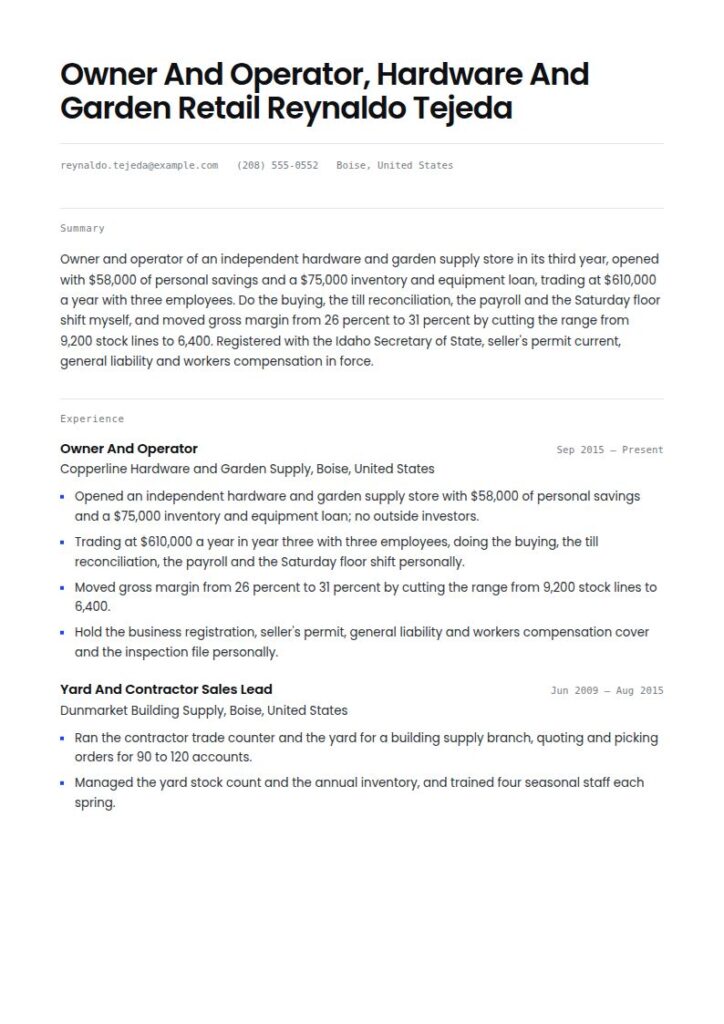
Owner and operator of an independent hardware and garden supply store in its third year, opened with $58,000 of personal savings and a $75,000 inventory and equipment loan, trading at $610,000 a year with three employees. Do the buying, the till reconciliation, the payroll and the Saturday floor shift myself, and moved gross margin from 26 percent to 31 percent by cutting the range from 9,200 stock lines to 6,400. Registered with the Idaho Secretary of State, seller's permit current, general liability and workers compensation in force.
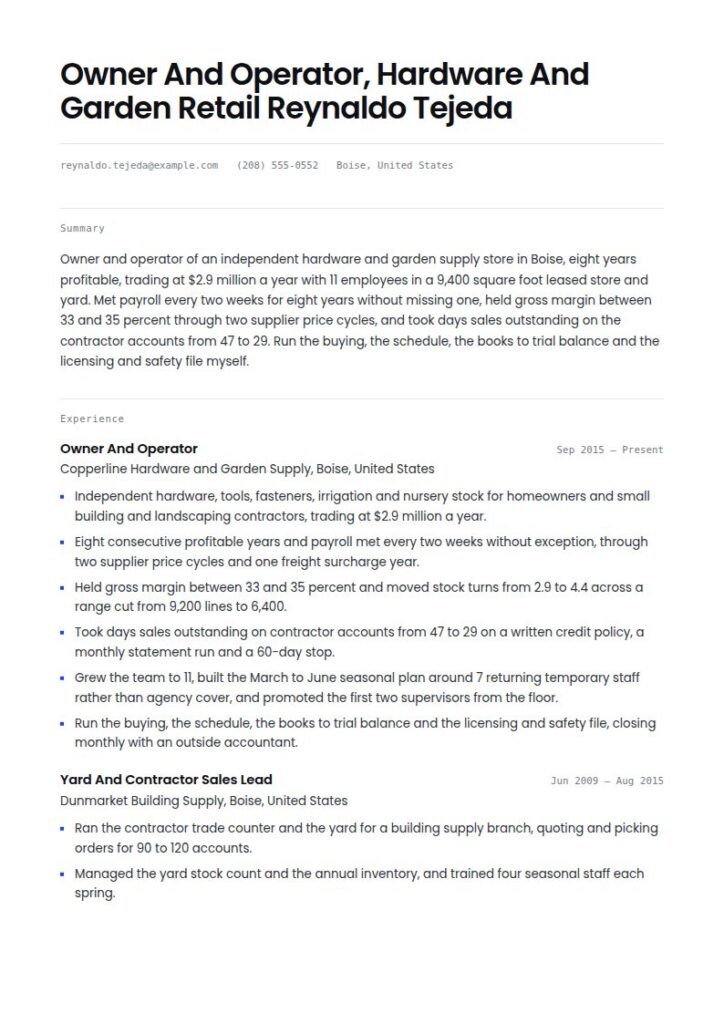
Owner and operator of an independent hardware and garden supply store in Boise, eight years profitable, trading at $2.9 million a year with 11 employees in a 9,400 square foot leased store and yard. Met payroll every two weeks for eight years without missing one, held gross margin between 33 and 35 percent through two supplier price cycles, and took days sales outstanding on the contractor accounts from 47 to 29. Run the buying, the schedule, the books to trial balance and the licensing and safety file myself.
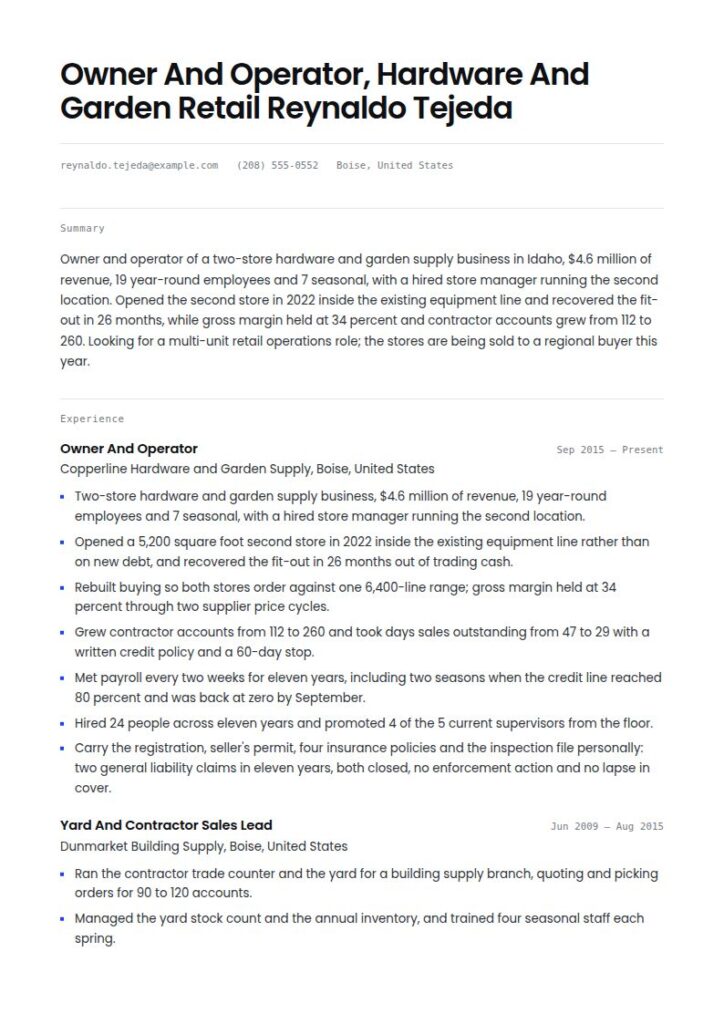
Owner and operator of a two-store hardware and garden supply business in Idaho, $4.6 million of revenue, 19 year-round employees and 7 seasonal, with a hired store manager running the second location. Opened the second store in 2022 inside the existing equipment line and recovered the fit-out in 26 months, while gross margin held at 34 percent and contractor accounts grew from 112 to 260. Looking for a multi-unit retail operations role; the stores are being sold to a regional buyer this year.
Right vs wrong: the same small business owner summary, twice
| ✅ Right | ❌ Wrong |
|---|---|
| Two stores, $4.6 million of revenue, 19 year-round employees and 7 seasonal. | Successfully built and grew a thriving local business. |
| Met payroll every two weeks for eight years without missing one. | Managed all aspects of business operations and finances. |
| Gross margin held between 33 and 35 percent through two supplier price cycles. | Consistently delivered strong financial performance. |
| Opened the second store inside the existing equipment line and recovered the fit-out in 26 months. | Expanded the business to new locations. |
The right column gives a reader four things to ask about. The wrong column is what almost every owner writes, and it is why owner files get sorted into the pile a reader cannot assess.
Outline your experience as an owner-operator
Business name, what it sells and to whom, dates, then the scale line. Group the bullets by function, which is the vocabulary the reader hires in.
| Instead of | Use |
|---|---|
| Responsible for all aspects of running the business | Held buying, scheduling, payroll, receivables and compliance directly until the first supervisor was hired in year six |
| Managed inventory | Cut the range from 9,200 stock lines to 6,400 and moved stock turns from 2.9 to 4.4 over three years |
| Handled the finances | Kept the books to trial balance in-house, closed with an outside accountant monthly, and took days sales outstanding from 47 to 29 |
| Hired and trained staff | Hired 24 people over eleven years, with 4 of the 5 supervisors promoted from the floor |
Owner and Operator, Copperline Hardware and Garden Supply, Boise, ID, two stores, $4.6 million revenue, 19 year-round employees and 7 seasonal, September 2015 to Present
Independent hardware, tools, irrigation and nursery stock, sold to homeowners and to small building and landscaping contractors. Opened with $58,000 of savings and a $75,000 inventory and equipment loan; no outside investors.
Buying and merchandising: cut the range from 9,200 stock lines to 6,400, moved stock turns from 2.9 to 4.4, and held gross margin between 33 and 35 percent through two supplier price cycles.
People: hired 24 people across eleven years, promoted 4 of the 5 current supervisors from the floor, and built the seasonal plan that covers the March to June peak with 7 returning staff rather than agency cover.
Cash and credit: met payroll every two weeks for eleven years, and took days sales outstanding on contractor accounts from 47 to 29 on a written credit policy and a 60-day stop.
Second location: opened a 5,200 square foot store in 2022 on the existing equipment line rather than new debt, recovered the fit-out in 26 months, and hired a store manager in month four.
Compliance and risk: hold the registration, seller's permit, insurance and inspection file personally; two general liability claims in eleven years, both closed.
List the license, the premises and the insurance the business ran on
This is the block that makes an owner-operator resume checkable, and almost nobody includes it. Every other candidate has a previous employer somebody can phone; you do not. What you have instead is a paper trail more verifiable than a reference call, and it takes five lines, with no certificate images and no attachments: registration and tax, the license your activity requires, the premises with its term and rent as a share of revenue, insurance and bonding with the claims record, and the inspection record.
Know the division first. The Small Business Administration states that "Business activities regulated by a federal agency will need a federal license or permit", and its list of federally regulated activities is short: agriculture, alcohol, aviation, firearms and explosives, fisheries, maritime transportation, mining and drilling, nuclear energy, broadcasting, and transportation and logistics. Everything else is state, county or city, and the same page notes that "States tend to regulate a broader range of activities than the federal government" (U.S. Small Business Administration, Apply for licenses and permits, 28 August 2026).
Name the issuer. "Licensed" on its own is worth nothing; "issued by the state department of agriculture, current, renewed annually" is worth a line.
Registration and tax: limited liability company registered with the Idaho Secretary of State in 2015, in good standing. Employer identification number held since 2015; seller's permit held with the Idaho State Tax Commission, current.
Premises: 9,400 square foot leased store and fenced yard held since 2015 on two successive five-year terms, personally guaranteed, rent at 4.1 percent of revenue. Second store, 5,200 square feet, leased 2022.
Insurance: general liability, commercial property, workers compensation and commercial auto for four vehicles, placed through one broker since 2017. Two liability claims in eleven years, both closed.
Compliance record: annual fire inspection, annual weights and measures inspection, insurer risk survey every three years. No enforcement action, no lapse in cover, no late payroll tax filing.
Verification: registration and standing are on the state business register. The accountant, insurance broker and commercial banker are available as references.
That last line does the heavy lifting. An owner-operator has professional counterparties who have watched the business for a decade, none of them a friend, and a banker who has renewed a credit line five times beats most former managers.
Write the payroll you met, not only the revenue you booked
Revenue is the number owners put on the page, and it is the weakest one available. The strong evidence is cash discipline, because that is what an operations manager does all day: how many consecutive pay runs you met, how many profitable years, what the seasonal cash trough looked like and how you covered it, what days sales outstanding was before you tightened the credit policy and what it is now.
"Met payroll every two weeks for eleven years, including two seasons when the credit line went to 80 percent and was back at zero by September" is a sentence about you. "Grew revenue to $4.6 million" is a sentence about the market. Give the ratios and the behavior.
Turn ten years of self-employment into something a corporate reader can place
A corporate reader has four questions about your record, asked in the same order every time. Answer all four and the unfamiliarity of your history stops being an obstacle.
What was your budget? The cost base you controlled is a budget: payroll, rent, inventory purchasing, vehicles, insurance, utilities and marketing. Give the total and the two largest lines. "Controlled a $3.9 million cost base, of which $1.1 million was payroll for 26 people and $2.2 million was inventory purchasing" places you against the reader's own numbers.
How many people reported to you? Give the headcount and the shape, and say when it changed. If everybody reported to you directly for six years and you then built a supervisor layer, say so: managing through supervisors is a different job and readers screen for it.
Who did you report to? This feels unanswerable and is not. You answered to a bank on facility renewal, a landlord on a guaranteed lease, an insurer on claims and risk surveys, an accountant on the annual accounts, a tax authority on payroll filings, and in some trades a licensing body. Six external parties is accountability without a line manager, which is the doubt behind the question.
What did you run it in? Name the point of sale, the accounting package, the payroll provider and the scheduling method, and be honest where the answer is a spreadsheet. Running a $4.6 million business on two systems and a disciplined spreadsheet beats implying a stack you never had.
Most American businesses have no employees, so having them is the claim
The Small Business Administration's Office of Advocacy counts 36,207,130 small businesses in the United States, 99.9 percent of all United States businesses. Of those, 17.7 percent, or 6,395,635 firms, have paid employees, and 82.3 percent, or 29,811,495 firms, have none at all (SBA Office of Advocacy, Frequently Asked Questions About Small Business, 3 February 2026).
The same publication puts small business employment at 62.3 million people, 45.9 percent of private sector employees, alongside 38.7 percent of private sector payroll and 43.5 percent of gross domestic product (SBA Office of Advocacy, February 2026).
More than four fifths of the businesses in the country never employ anybody, so an owner with a payroll, a workers compensation policy and a supervisor layer is in a small minority and should give the numbers rather than the adjective.
Build a snapshot of your key skills
Twelve to sixteen entries in four groups, weighted toward the function you are applying into. An owner's list runs too long; cut it to the job description.
Trading and margin: Category and range management, Purchasing and supplier terms, Retail pricing and markdown control, Stock turn and shrink management
Operations: Store and yard layout, Delivery scheduling and fleet management, Opening and closing controls, Inspection readiness
Money: Cash flow forecasting, Payroll and payroll tax filing, Credit control and collections, Bank facility management, Bookkeeping to trial balance
People: Hiring and induction, Seasonal workforce planning, Supervisor development, Performance conversations and dismissal
List your education and certifications
Short. Degrees or diplomas, then anything trade-specific, then continuing education that shows you kept learning while running the place.
Associate of Applied Science, Business Management, College of Western Idaho, Nampa, ID, 2012
Certifications: QuickBooks Certified ProAdvisor, Intuit, 2019. OSHA 10-Hour General Industry, OSHA Outreach Training Program, 2018.
Continuing: retail credit and collections short course, 2021. Employment law for small employers, 2024.
Progression inside the business: sole operator with 3 staff, single store with 11 staff and a supervisor layer, two stores with 19 year-round staff and a hired manager.
The progression line is worth more than the diploma: it is the only place a reader sees the business change shape three times and you change job with it.
Choose the right layout and design
Single column, 11 point, plain headings, no photograph and no business logo. Save as PDF named for yourself and the target role: reynaldo-tejeda-retail-operations-manager-resume.pdf.
Put revenue, headcount and years in the business block under the summary. Break one long ownership period into three dated stages. Convert the cost base into a budget figure. Name the license, the issuer and the status. Give the premises, its term and whether you guaranteed it. Offer the banker, the accountant and the broker as references.
Do not write "entrepreneur", "visionary" or "wearer of many hats". Do not claim revenue you cannot evidence to a lender. Do not put tax returns or a profit figure on a page you send to strangers. Do not apply from the business email address. Do not leave eleven years as one undifferentiated line. Do not imply systems the business never had.
Small business owner job market and outlook
The Bureau of Labor Statistics publishes no Occupational Outlook Handbook profile for small business owner, because it is a form of ownership rather than an occupation. Owner-operators are counted inside the occupations they perform, so self-employment appears as a share of published occupations, not a category of its own.
| Measure | Value | Source |
|---|---|---|
| Small business share of private sector payroll | 38.7 percent | SBA Office of Advocacy, February 2026 |
| Self-employed share of chief executives, 2025 | 27 percent of 291,600 | BLS Occupational Outlook Handbook, 2025 |
| Self-employed share of food service managers, 2025 | 31 percent of 344,300 | BLS Occupational Outlook Handbook, 2025 |
| General and operations managers, 2025 to 2035 | 3,599,000 jobs, 5 percent growth, +181,300 | BLS Occupational Outlook Handbook, 2025 to 2035 projections |
Two readings follow. The pay and outlook data that applies to you belongs to published management occupations rather than a separate owner category. And the employed roles owner-operators move into are dominated by general and operations management, 3,599,000 jobs growing by 181,300 across the decade, with annual openings published only for the wider top executives group at about 304,100 (BLS, 2025 to 2035 projections).
One number belongs on your own page rather than in a market section. Of the 677,876 private sector establishments that opened in the year ended March 2015, 34.7 percent were still operating in March 2025 (U.S. Bureau of Labor Statistics, Business Employment Dynamics, survival of private sector establishments by opening year, data through March 2025). If your business has traded for a decade, two thirds of comparable businesses cannot say that, which is worth a clause in your summary.
What salary you can expect as a small business owner
There is no published wage for business owners, so the useful comparison is the employed role you are applying into. Owner pay and employee pay are not measured the same way.
General and operations managers had a median annual wage of $105,770 in May 2025, with the lowest 10 percent under $50,090 and the highest 10 percent over $253,390 (BLS Occupational Outlook Handbook, May 2025). Industry moves that figure more than anything on your resume: the May 2025 median was $151,040 in professional, scientific and technical services and $112,230 in construction, against $75,860 in retail trade (BLS, May 2025). An owner moving from retail into a professional services operations role is changing two things at once, and sector is the larger one.
Then read the published number for what it measures. The federal wage survey collects straight-time gross pay including base rates, commissions, incentive pay and production bonuses, and it explicitly excludes draws, profit-sharing payments, non-production bonuses and year-end bonuses (U.S. Bureau of Labor Statistics, Occupational Employment and Wage Statistics survey documentation, accessed 14 September 2026). A draw is how a large share of owner-operators pay themselves, so what you have lived on for a decade is exactly what the survey leaves out.
That makes replacement cost the useful private figure: the salary you drew plus what it would cost to hire someone for the parts of your week you never paid for. It belongs in a conversation rather than on the page.
Key takeaways for a small business owner resume
- State revenue, headcount and years in a block under the summary; "Owner" alone says nothing.
- Break one long ownership period into three dated stages so progression is visible.
- Group the bullets by function, in the vocabulary the target employer uses.
- Put the license, the premises and the insurance on the page; they are your reference call.
- Convert the cost base into a budget figure and the staffing into a span of control.
- Name the bank, landlord, insurer, accountant and licensing body you answered to.
- Lead the money evidence with payroll met, margin held and days sales outstanding, not revenue.
- Say what happens to the business now, and use a personal email address.
Build your small business owner resume in 15 minutes with our AI resume builder.
Related business and management resume examples
- Entrepreneur resume
- Business management resume
- Manager resume
- Assistant manager resume
- Supervisor resume
- Executive resume
- CEO resume
- Chief operating officer resume
- Business resume
- Consultant resume
- Business development manager resume
- Customer success resume
Pair it with a matching small business owner cover letter.
Small business owner resume questions, answered
How is a small business owner resume different from an entrepreneur resume?
The reader's doubt differs, so the evidence differs. A founder answers for funding, growth and how a venture ended, and our [entrepreneur resume example](/resume/entrepreneur/) is built for that. An owner-operator answers whether a decade of running your own shop translates into somebody else's structure, and the evidence is continuity, cash discipline, licensing and the functions you held.
What do I write if the business was only ever me?
Write it at that scale, on functions and customers. Selling, quoting, pricing, purchasing, scheduling, collections and tax filing are all real work, and a solo business involves every one without a handoff. State the revenue, say plainly it was a single-person operation, and give the customer count and repeat rate. Businesses without employees are the norm: 29,811,495 of the 36,207,130 small businesses in the country have none (SBA Office of Advocacy, February 2026).
Should I put my business revenue on the page?
Yes, approximately, and nothing below the revenue line. Revenue, headcount, years trading, stock turns, days sales outstanding and gross margin as a percentage are what a reader needs. Net profit, the owner's draw, tax returns, bank statements, a valuation and a sale price are not, and volunteering them reads as someone who does not know which numbers stay private.
How do I explain leaving a business I own?
In one sentence about what you want, plus one about what happens to the business. "The stores are being sold to a regional buyer this year; I am looking for a multi-unit retail operations role" answers both. Avoid anything that sounds like exhaustion, and avoid implying you will keep running it in the evenings: a hiring manager hears a second job with a claim on your weekends.
What if the business failed or I had to close it?
Say so plainly, with the date and a commercial reason, then keep the page on what you built rather than the ending. An owner who closed cleanly, paid the final payroll, settled the suppliers and handed the lease back has shown the behavior an employer wants. Closure is common: of establishments that opened in the year ended March 2015, only 34.7 percent were still operating ten years later (BLS Business Employment Dynamics, data through March 2025).