Operations Consultant, Healthcare Zsofia Vaszary MHA
Operations Consultant
[email protected] | (216) 555-0503 | Cleveland, United States
Profile
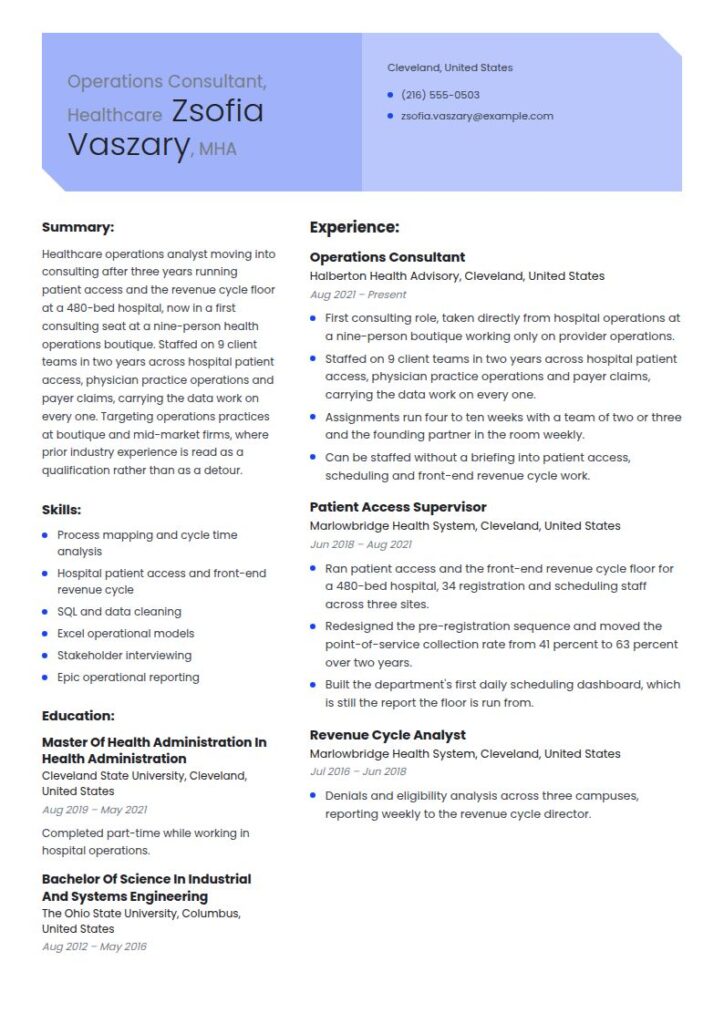
Healthcare operations analyst moving into consulting after three years running patient access and the revenue cycle floor at a 480-bed hospital, now in a first consulting seat at a nine-person health operations boutique. Staffed on 9 client teams in two years across hospital patient access, physician practice operations and payer claims, carrying the data work on every one. Targeting operations practices at boutique and mid-market firms, where prior industry experience is read as a qualification rather than as a detour.
Work Experience
08/2021 - Present, Operations Consultant, Halberton Health Advisory, Cleveland, United States
- First consulting role, taken directly from hospital operations at a nine-person boutique working only on provider operations.
- Staffed on 9 client teams in two years across hospital patient access, physician practice operations and payer claims, carrying the data work on every one.
- Assignments run four to ten weeks with a team of two or three and the founding partner in the room weekly.
- Can be staffed without a briefing into patient access, scheduling and front-end revenue cycle work.
06/2018 - 08/2021, Patient Access Supervisor, Marlowbridge Health System, Cleveland, United States
- Ran patient access and the front-end revenue cycle floor for a 480-bed hospital, 34 registration and scheduling staff across three sites.
- Redesigned the pre-registration sequence and moved the point-of-service collection rate from 41 percent to 63 percent over two years.
- Built the department's first daily scheduling dashboard, which is still the report the floor is run from.
07/2016 - 06/2018, Revenue Cycle Analyst, Marlowbridge Health System, Cleveland, United States
- Denials and eligibility analysis across three campuses, reporting weekly to the revenue cycle director.
Education
08/2019 - 05/2021, Master of Health Administration, Health Administration, Cleveland State University, Cleveland, United States
Completed part-time while working in hospital operations.
08/2012 - 05/2016, Bachelor of Science, Industrial and Systems Engineering, The Ohio State University, Columbus, United States
Skills
Process mapping and cycle time analysis, 80
Hospital patient access and front-end revenue cycle, 90
SQL and data cleaning, 75
Excel operational models, 85
Stakeholder interviewing, 70
Epic operational reporting, 75
Languages
English, native
Hungarian, native
Spanish, beginner
Certificates
04/2022, Epic Resolute Hospital Billing, Epic Systems
Maintained through the vendor update program.
11/2019, Lean Six Sigma Green Belt, Cleveland State University
Summary
A consulting resume is the file you write when you are aiming at the field rather than at one firm: entering from industry, moving between firm types, or choosing a practice. This guide gives you three adaptable versions, a map of what strategy, operations, technology, boutique and independent firms each hire for, and current Bureau of Labor Statistics pay across the two published occupations that hold most consulting work.
Consulting resume examples by experience level
A consulting resume is the file you write when the target is a field rather than a job title.
In general, most people who need this page are in one of three positions. For example, you are in industry and want to cross into consulting. You are already in consulting and moving between kinds of firm, which is a bigger change than it looks. Or you are choosing a practice and cannot yet tell whether operations, strategy or technology is your door.
However, all three produce the same draft: a resume that says the word consulting a lot and never says which consulting. As a result, that file loses to a weaker candidate who made one decision first.
Resume guide for a consulting resume
To that end, this guide and the corresponding consulting resume example will cover:
- To begin with, how to write a consulting resume, section by section
- Then, what strategy, operations, technology, boutique and independent firms each hire for
- Also, three adaptable summaries: entering the field, practicing, and leading client teams
- In addition, how the case interview changes what belongs on the page
- Finally, what the market looks like across the published occupations, and what each pays
How to write a consulting resume
Six blocks: contact header, a summary pointed at one kind of firm, a sector and staffing line, experience, skills, then education and credentials. One page while you are crossing in, two once you have led client teams.
Above all, the staffing line is the block an ordinary resume does not have. Firms hire into a staffing pool and then assign, so the reader is asking what no other employer asks: what a partner could put you in front of a client to do in week one.
| Section | What it is answering | Where it goes |
|---|---|---|
| Summary | Which kind of firm is this person aiming at, and are they aimed there on purpose? | Top, rewritten per target |
| Sector and staffing line | What could they be assigned to on Monday, and in which industry? | Directly under the summary |
| Experience | What problems have they worked, and at what level of the work? | Reverse chronological |
| Education and credentials | Degree, any postgraduate study, credentials with the issuing body | Last, with dates |
Writing up an individual piece of client work is a separate craft, covered on our consultant resume example. This page is about the decision you make first: which part of the market you are writing for.
Write the firm type into the summary before you write anything else
The most common defect in a consulting application is a file that could be sent to any firm and therefore reads as sent to all of them.
Fix it in the first line. "Operations consultant, provider and payer healthcare, boutique and mid-market firms" tells a partner where you have decided to be, and it costs nothing, because you rewrite that line per application anyway.
Run each version through the ATS resume checker. Also, firms run structured screens on experienced-hire applications, and the words that change between your versions are the ones the screen matches.
Choosing the best resume format for a consulting resume
Reverse chronological, single column, one page until you are leading client teams. Indeed, that holds whichever door you are coming through.
Two format temptations are worth naming. The first, for example, is the functional layout, which people crossing in from industry reach for when their job titles seem to work against them. They do not. In fact, a hospital operations title is the reason a healthcare practice would look at you at all, and a format that buries the timeline reads as someone burying a timeline. The second, meanwhile, is the slide: people inside firms write their resumes the way they write client material, which reads as a proposal and runs to three pages.
Include your contact information
| ✅ Right | ❌ Wrong |
|---|---|
| Zsofia Vaszary | Zsofia Vaszary |
| Operations Consultant, healthcare provider and payer | Strategic thinker and trusted business advisor |
| Staffable in week one: hospital patient access, physician practice operations, payer claims | Experience across multiple industries and functions |
| (216) 555-0503, [email protected], Cleveland, OH | (216) 555-0503, [email protected] |
Specifically, the third line separates this header from every other consulting header in the folder. In other words, it is not a list of everything you have touched. Instead, it is the shorter list of things a staffing partner could put you in front of a client to do without a briefing, and the shortness is what makes it credible.
Make use of a summary
In effect, four lines, rewritten for each kind of firm: where you are coming from, what a partner can staff you into, the level at which you have worked, and one sentence about the target.
Healthcare operations analyst moving into consulting after three years running patient access and the revenue cycle floor at a 480-bed hospital, now in a first consulting seat at a nine-person health operations boutique. Staffed on 9 client teams in two years across hospital patient access, physician practice operations and payer claims, carrying the data work on every one. Targeting operations practices at boutique and mid-market firms, where prior industry experience is read as a qualification rather than as a detour.
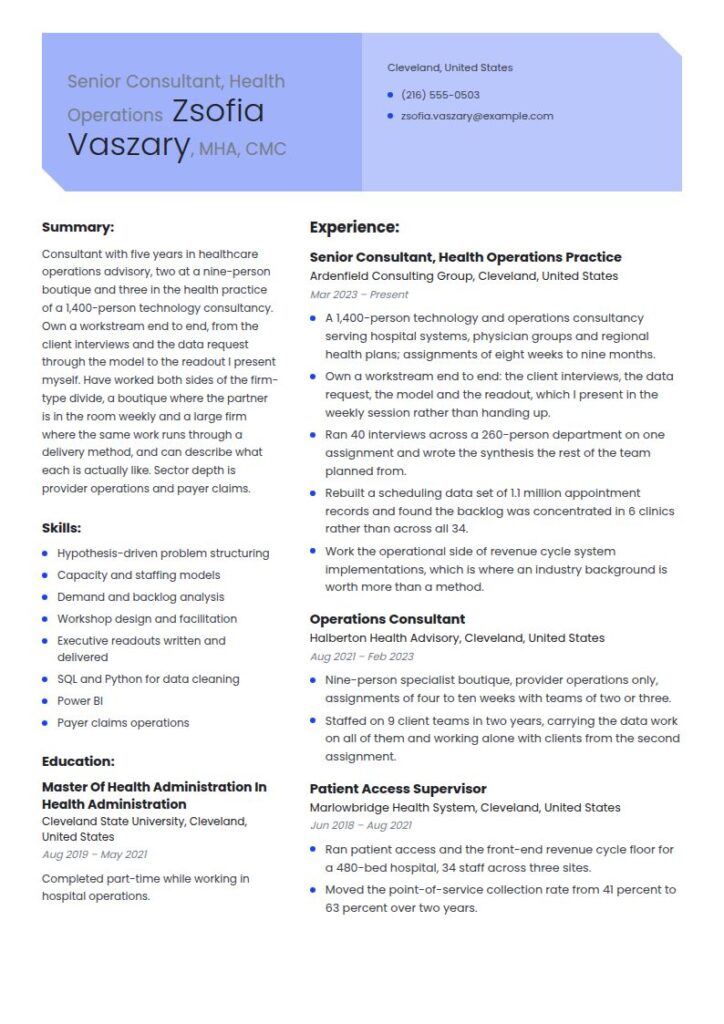
Consultant with five years in healthcare operations advisory, two at a nine-person boutique and three in the health practice of a 1,400-person technology consultancy. Own a workstream end to end, from the client interviews and the data request through the model to the readout I present myself. Have worked both sides of the firm-type divide, a boutique where the partner is in the room weekly and a large firm where the same work runs through a delivery method, and can describe what each is actually like. Sector depth is provider operations and payer claims.
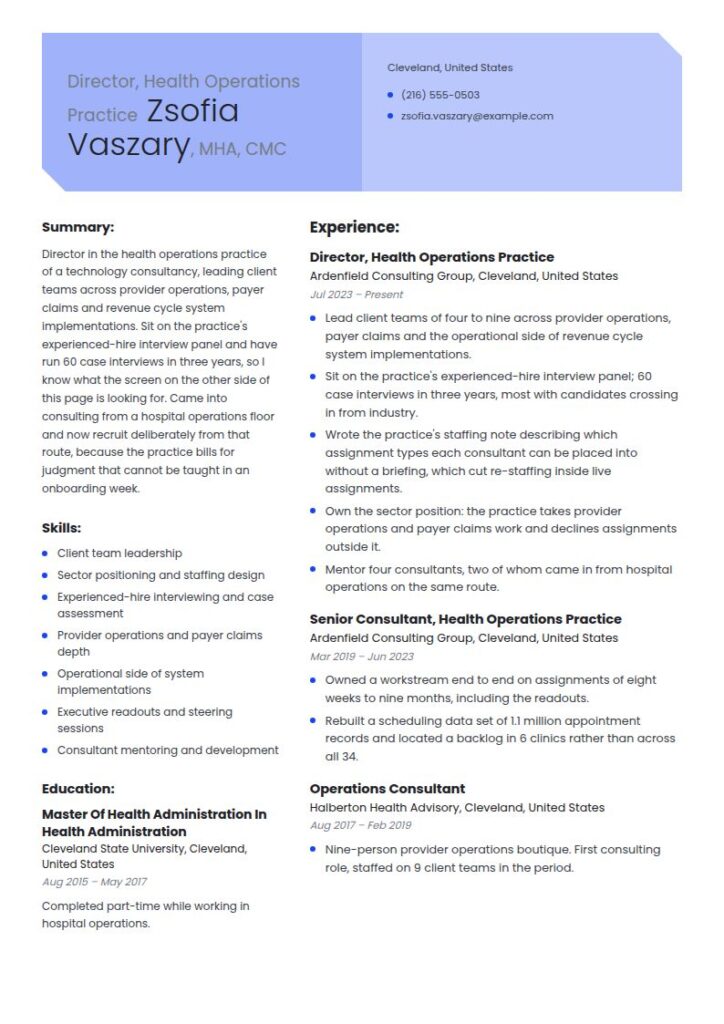
Director in the health operations practice of a technology consultancy, leading client teams across provider operations, payer claims and revenue cycle system implementations. Sit on the practice's experienced-hire interview panel and have run 60 case interviews in three years, so I know what the screen on the other side of this page is looking for. Came into consulting from a hospital operations floor and now recruit deliberately from that route, because the practice bills for judgment that cannot be taught in an onboarding week.
Right vs wrong: the same consulting summary, twice
| ✅ Right | ❌ Wrong |
|---|---|
| Operations consultant, healthcare provider and payer, targeting boutique and mid-market firms. | Versatile consultant with broad cross-industry and cross-functional exposure. |
| Staffed on 9 client teams in two years, carrying the data work on every one. | Delivered high-impact consulting projects for a range of clients. |
| Came in from three years running patient access at a 480-bed hospital. | Strong business acumen and a proven ability to solve complex problems. |
In contrast, the wrong column is claiming range, which is the least persuasive claim available in this field. Firms staff on specificity. After all, a person who could go anywhere is a person nobody has a reason to put anywhere on Monday.
Outline your consulting experience
Then give the firm, its size, the practice, your title and dates. Three to five bullets per role, each saying what part of the work was yours rather than what the team produced.
| Instead of | Use |
|---|---|
| Worked on a range of consulting projects across industries | Staffed on 9 client teams in two years, all in provider operations and payer claims |
| Supported senior team members with analysis | Built the patient access capacity model and presented it in the weekly client session myself |
| Contributed to firm initiatives | Sit on the experienced-hire panel and have run 60 case interviews in three years |
Senior Consultant, Health Operations Practice, Ardenfield Consulting Group, Cleveland, OH, March 2023 to Present
A 1,400-person technology and operations consultancy serving hospital systems, physician groups and regional health plans. Assignments run eight weeks to nine months.
Own a workstream end to end: the client interviews, the data request and the model, and the readout I present in the weekly session rather than handing up.
Ran 40 interviews across a 260-person department on one assignment and wrote the synthesis the rest of the team planned from.
Rebuilt a scheduling data set of 1.1 million appointment records to find where the backlog was concentrated.
Sit on the practice's experienced-hire interview panel; 60 case interviews in three years, mostly with candidates crossing in from industry.
Operations Consultant, Halberton Health Advisory, Cleveland, OH, August 2021 to February 2023
A nine-person specialist boutique working only on provider operations, most assignments four to ten weeks with a team of two or three.
First consulting role, taken directly from hospital operations. Staffed on 9 client teams in the two years, carrying the data work on all of them, with the founding partner in the room every week.
Five kinds of consulting firm, and what each one reads your resume for
The word consulting covers at least five different employers, and they do not want the same document.
| Firm type | What it is buying | What it reads first | What it discounts |
|---|---|---|---|
| Strategy | Structured thinking about a decision a board has not made yet | Academic record, quantitative evidence, case performance | Tool names, system implementations, operational tenure |
| Operations and implementation | Someone who can stand on a client's floor and change how work is done | Industry tenure, process and volume evidence, what changed and by how much | Brand names without a described problem |
| Technology and systems | Delivery of a system into an organization that has to keep running | The platform, your role in it, the functional side you own | Pure analysis with no delivery attached |
| Boutique and specialist | Depth in one sector, immediately billable | Sector depth, the sub-problem, whether you can be alone with a client | Breadth, rotational programs, general management language |
| Independent and contract | A defined piece of work delivered without supervision | Whether you have worked alone, the scope you can be handed, the sector | Anything that reads as needing a team around you |
Two practical consequences follow.
Consulting firm size and the two crossings
Firm size is a variable, not a proxy for quality. The boutique reader wants to know whether you can be left alone with a client; the large-firm reader wants to know whether you can work inside a method without ignoring it or hiding behind it. Say which you have done.
The two crossings are different problems. Coming in from industry, your risk is pace and ambiguity, so show work you did without a settled brief. Going back out, the risk is the reverse, that you have advised for years without owning an outcome, so show something you carried past the recommendation.
Moreover, the Bureau of Labor Statistics states the sector-depth point flatly: "organizations that specialize in certain fields typically try to hire candidates who have experience in those areas" (U.S. Bureau of Labor Statistics, Occupational Outlook Handbook, management analysts, published 27 August 2026). That is the argument for crossing in on your industry rather than apologizing for it.
The resume’s only job is to earn the case, so write for what the case tests
Most consulting hiring runs through a case interview, which Career Services at the College of Natural Sciences, University of Texas at Austin describes as "a job interview technique commonly used by consulting firms, investment banking, and tech firms" (accessed 14 September 2026).
Cornell University's career development office calls it "a simulated business problem presented during the interview process" and lists what interviewers assess: structured thinking and logical decomposition, quantitative and analytical ability, business judgment and creativity, communication clarity and persuasiveness, and flexibility when new information is introduced (Cornell University Career Development, 24 October 2025).
Read that list back as a resume brief. Each of the five can be pre-evidenced in a bullet: a problem you decomposed, a number you built rather than received, a judgment call you made, a readout you delivered yourself, and a piece of work that changed direction halfway through.
Build a snapshot of your key skills
For skills, similarly, twelve to fourteen entries in four groups: analysis you can do unsupervised, client handling, tooling, and the sector line. Also keep the sector line short, because it is a claim about what a partner can staff you into, not a list of everything you have seen.
Analysis: Process mapping and cycle time analysis, Capacity and staffing models, Demand and backlog analysis, Cost and unit economics modeling, Data quality assessment, Hypothesis-driven problem structuring
Client work: Stakeholder interviewing, Workshop design and facilitation, Executive readouts written and delivered, Data request management
Tooling: SQL, Excel financial and operational models, Power BI, Python for data cleaning, Visio and Lucidchart, Epic and Cerner operational reporting
Sectors staffable in week one: Hospital patient access and revenue cycle, Physician practice operations, Regional health plan claims operations
List your education and certifications
Degree and institution with the year, any postgraduate study, then credentials with the issuing body. Consulting is one of the few fields where the institution still appears on senior resumes, and where a degree in something other than business is not a disadvantage.
Master of Health Administration, Cleveland State University, Cleveland, OH, 2021. Completed part-time while working in hospital operations.
Bachelor of Science, Industrial and Systems Engineering, The Ohio State University, Columbus, OH, 2016
Certified Management Consultant (CMC), Institute of Management Consultants USA, 2025
Epic Resolute Hospital Billing certification, 2022, maintained through the vendor's update program
Lean Six Sigma Green Belt, 2019
The Bureau of Labor Statistics is direct about the weight of credentials here: "management analysts are not required to get certification, but having a credential may give jobseekers a competitive advantage" (Occupational Outlook Handbook, published 27 August 2026). The Certified Management Consultant designation from the Institute of Management Consultants USA is the recognized general credential in the United States; its client-reference requirements are set out on our consultant resume example.
On a technology or operations file, however, a platform certification the client's own staff hold carries more weight than either.
Choose the right layout and design
Single column, 11 or 12 point, plain headings, no photograph, no firm-style graphics. Save as a PDF named for yourself and the target: zsofia-vaszary-operations-consultant-resume.pdf.
Pick one firm type per application and put it in the first line. Keep a short staffing line naming what you could be put in front of a client to do in week one. Say which firm sizes you have worked in and what the difference was. Write the crossing you are making, into consulting or out of it, as a sentence. Show work you did without a settled brief. Name the sector, then the sub-problem inside it.
Do not write a resume that would suit every firm; it will interest none of them. Do not hide an industry background behind a functional format. Do not format the page as client slides. Do not list every sector you have been near; list the ones you could be staffed into on Monday. Do not name a client or put a client's logo on a personal file.
Consulting job market and outlook
There is no Occupational Outlook Handbook profile for consulting as a field, because the word attaches to work in almost every occupational group. In short, two published occupations hold most of what people mean by it, and reading them together is how you size the market.
| Measure | Management analysts | Computer systems analysts |
|---|---|---|
| Employment, 2025 | 1,077,100 | 544,400 |
| Projected employment, 2035 | 1,186,300 | 587,200 |
| Projected change, 2025 to 2035 | 10 percent, much faster than average, +109,200 | 8 percent, much faster than average, +42,900 |
| Projected annual openings | About 94,100 | About 32,900 |
| Typical entry-level education | Bachelor's degree | Bachelor's degree |
| Work experience in a related occupation | Less than 5 years | None |
| Median annual wage, May 2025 | $101,860 | $105,850 |
Source: U.S. Bureau of Labor Statistics, Occupational Outlook Handbook, management analysts and computer systems analysts, May 2025 wage data and 2025 to 2035 projections, published 27 August 2026.
In particular, that work-experience row is the most useful line in the table. The Handbook records prior related experience as typical for entry into management analysis and not typical for systems analysis, so the technology door opens earlier in a career and the advisory door usually opens after you have done something else first.
| Industry | Management analysts, share of employment 2025 | Median annual wage, May 2025 |
|---|---|---|
| Professional, scientific and technical services | 33 percent | $107,330 |
| Government, excluding education and hospitals | 18 percent | $97,300 |
| Self-employed | 14 percent | Not published separately |
| Finance and insurance | 13 percent | $100,300 |
| Management of companies and enterprises | 5 percent | $101,030 |
Source: U.S. Bureau of Labor Statistics, Occupational Outlook Handbook, management analysts, May 2025.
Two occupations, four doors, and one of them is not a firm at all
Management analysts numbered 1,077,100 in 2025 and are projected to reach 1,186,300 by 2035, a 10 percent rise the Bureau of Labor Statistics calls much faster than the average for all occupations, with about 94,100 openings a year. Computer systems analysts numbered 544,400, are projected at 587,200 by 2035, an 8 percent rise also described as much faster than average, with about 32,900 openings a year (U.S. Bureau of Labor Statistics, Occupational Outlook Handbook, May 2025 wage data and 2025 to 2035 projections, published 27 August 2026).
Where those people sit is worth planning around. Only 33 percent of management analysts work in professional, scientific and technical services, the industry that contains consulting firms; 18 percent work in government, 13 percent in finance and insurance, and 14 percent are self-employed (BLS Occupational Outlook Handbook, May 2025). On the technology side, 23 percent of computer systems analysts work in computer systems design and related services (BLS, May 2025).
So the field is not a ladder of firms with a partnership at the top. It is four different employers: a firm, an internal transformation team, a government body, and yourself. Deciding which one you are writing for is the highest-value edit available to you.
What salary you can expect in consulting
Specifically, management analysts had a median annual wage of $101,860 in May 2025, or $48.97 an hour, with the lowest 10 percent under $60,640 and the highest 10 percent over $171,640. Similarly, computer systems analysts had a median of $105,850, or $50.89 an hour, with the lowest 10 percent under $67,340 and the highest 10 percent over $167,710 (U.S. Bureau of Labor Statistics, Occupational Outlook Handbook, May 2025).
However, both distributions are wide and seniority does not mainly explain either. Industry explains a large share of it: professional, scientific and technical services pays management analysts a median of $107,330 against $97,300 in government, while computer systems analysts run from $108,270 in computer systems design down to $100,190 in government (BLS, May 2025).
Even so, two things you control move you inside those bands. The first is sector depth, because a firm can bill more for somebody who is useful to a client in week one. The second, for instance, is which door you walk through: a firm, an internal transformation team, a government body and independent practice pay differently for the same skill.
Key takeaways for a consulting resume
- Decide which kind of firm you are writing for before you open the document.
- Firstly, put the firm type and the sector in the first line, and rewrite it per application.
- Secondly, keep a short staffing line: what a partner could put you in front of a client to do in week one.
- Lead with industry depth when crossing in; it is the reason a practice will look at you.
- In addition, say which firm sizes you have worked in and what was different about each.
- Moreover, pre-evidence what the case interview tests: structure, numbers, judgment, delivery, adaptability.
- Finally, name the sector a partner can staff you into, not every sector you have seen.
Build your consulting resume in 15 minutes with our AI resume builder.
Related business and management resume examples
- Consultant resume
- Business analyst resume
- Senior business analyst resume
- Project manager resume
- Program manager resume
- Product manager resume
- Business development resume
- Business management resume
- MBA candidate resume
- Managing director resume
- Chief of staff resume
- Entrepreneur resume
Pair it with a matching consulting cover letter.
Consulting resume questions, answered
How do I get into consulting from industry?
Lead with the industry, not with your interest in consulting. The Handbook says organizations specializing in a field try to hire candidates with experience in that field (BLS, published 27 August 2026), and that is the door. Target the practice serving the industry you know, name the sub-problems you have personally worked on, and show work you did without a settled brief. Then prepare for the case, which is a separate skill from the job.
Should my consulting resume be one page or two?
One page until you are leading client teams, two after that. A second page earns its place by adding a different kind of evidence, such as sector depth across more than one client type or a firm role like recruiting or method ownership, not by listing more assignments in the same practice.
Is a boutique or a large firm the better place to start?
They teach different things. A small firm puts you in front of clients early and gives you depth fast, which reads well to other boutiques and to industry. A large firm gives you a method, a brand and longer implementations, which reads well to other large firms and to internal transformation teams. What matters for your file is that you can describe the difference.
How do I write a consulting resume when I cannot name my clients?
Describe each client by shape rather than by name: revenue band, site or bed count, geography and ownership model. A firm reading your resume treats a named client as a preview of how you would treat theirs. The full method is on our [consultant resume example](/resume/consultant/).
Do I need an MBA to work in consulting?
No. Typical entry-level education for both management analysts and computer systems analysts is a bachelor's degree (BLS Occupational Outlook Handbook, published 27 August 2026). A postgraduate degree matters most at strategy firms with structured intake classes, and much less at operations, technology and specialist firms, where the question is what you can do for a client in week one.
What does a consultant do after consulting?
Usually one of three things: an internal strategy or transformation team, an operating role in a client industry, or independent practice. Fourteen percent of management analysts are self-employed (BLS, May 2025), so the third route is larger than it looks. The resume problem runs in reverse, since an industry reader worries you have advised without owning a result, so put something on the page you carried past the recommendation.