Chief Information Officer Thandeka Nkosi
Chief Information Officer
[email protected] | (404) 555-0322 | Atlanta, United States
Profile
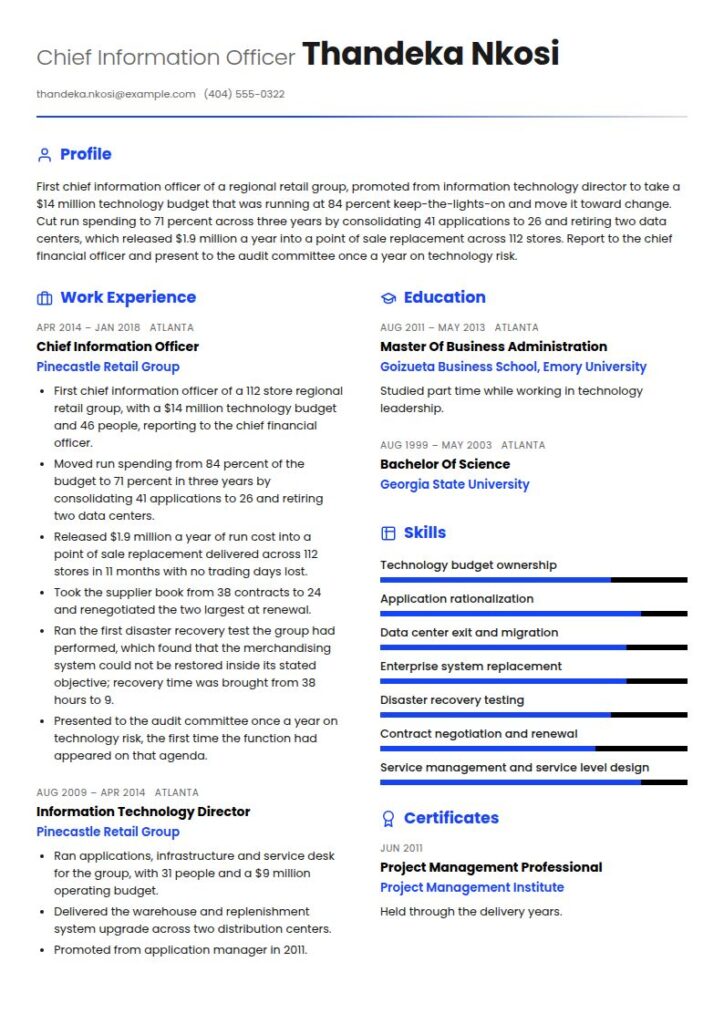
First chief information officer of a regional retail group, promoted from information technology director to take a $14 million technology budget that was running at 84 percent keep-the-lights-on and move it toward change. Cut run spending to 71 percent across three years by consolidating 41 applications to 26 and retiring two data centers, which released $1.9 million a year into a point of sale replacement across 112 stores. Report to the chief financial officer and present to the audit committee once a year on technology risk.
Work Experience
04/2014 - 01/2018, Chief Information Officer, Pinecastle Retail Group, Atlanta, United States
- First chief information officer of a 112 store regional retail group, with a $14 million technology budget and 46 people, reporting to the chief financial officer.
- Moved run spending from 84 percent of the budget to 71 percent in three years by consolidating 41 applications to 26 and retiring two data centers.
- Released $1.9 million a year of run cost into a point of sale replacement delivered across 112 stores in 11 months with no trading days lost.
- Took the supplier book from 38 contracts to 24 and renegotiated the two largest at renewal.
- Ran the first disaster recovery test the group had performed, which found that the merchandising system could not be restored inside its stated objective; recovery time was brought from 38 hours to 9.
- Presented to the audit committee once a year on technology risk, the first time the function had appeared on that agenda.
08/2009 - 04/2014, Information Technology Director, Pinecastle Retail Group, Atlanta, United States
- Ran applications, infrastructure and service desk for the group, with 31 people and a $9 million operating budget.
- Delivered the warehouse and replenishment system upgrade across two distribution centers.
- Promoted from application manager in 2011.
Education
08/2011 - 05/2013, Master of Business Administration, Business Administration, Goizueta Business School, Emory University, Atlanta, United States
Studied part time while working in technology leadership.
08/1999 - 05/2003, Bachelor of Science, Computer Information Systems, Georgia State University, Atlanta, United States
Skills
Technology budget ownership, 75
Application rationalization, 85
Data center exit and migration, 80
Enterprise system replacement, 80
Disaster recovery testing, 75
Contract negotiation and renewal, 70
Service management and service level design, 85
Languages
English, native
Zulu, native
Certificates
06/2011, Project Management Professional, Project Management Institute, PMP-1148902
Held through the delivery years.
09/2016, Certified Information Security Manager, ISACA, CISM-0418663
Taken after the first disaster recovery test exposed gaps in the group's risk reporting.
Summary
A CIO resume is a two page document about a portfolio of money, systems and suppliers rather than about engineering. It states the technology spend you control and how it splits between run and change, the estate you inherited, your tested security and resilience position, the contracts you own, and the transformation you delivered or stopped. This guide gives you three adaptable versions and current Bureau of Labor Statistics pay and outlook.
CIO resume examples by experience level
A CIO resume is a two page document about a portfolio: how much money technology spends, what proportion of it keeps the company running versus changes it, what you inherited, what you signed with suppliers, and what you delivered or stopped.
It is not an engineering resume with a bigger title, and the two are constantly confused. A chief technology officer owns the technology inside the product the company sells. A chief information officer owns technology as a business function: the systems the company runs itself on, the money that goes into them, the risk they carry, and the contracts behind them. Our CTO resume example is the other document.
The Bureau of Labor Statistics does not separate them. Both titles sit inside computer and information systems managers, an occupation the Handbook describes as planning, coordinating and directing computer-related activities in an organization (BLS Occupational Outlook Handbook, accessed 13 September 2026). Useful when you read pay data; not a reason to blur the two jobs.
Resume guide for a CIO resume
This guide and the corresponding CIO resume example will cover:
- How to write a CIO resume as a portfolio rather than a project list
- The run and change split, which is the single most informative number you can give
- Three adaptable summaries: first chief information officer role, operating CIO and group CIO
- How to write security and resilience so it survives a question
- Current Bureau of Labor Statistics pay and outlook for the occupation that covers the title
How to write a CIO resume
Six blocks: contact header, summary, the portfolio block, experience, security and resilience, and a short closing block for education and certifications. Two pages.
| Section | What it is answering | Where it goes |
|---|---|---|
| Header | How much do you spend, on what, for how many people? | Under your name, three lines |
| Portfolio | Run versus change, and what moved the ratio | Directly under the summary |
| Estate | What did you inherit: applications, versions, end of life, debt | Portfolio block, one line |
| Suppliers | Contract value under management, how many, what you renegotiated | Portfolio block, one line |
| Security and resilience | Tested recovery, findings closed, who you report risk to | Its own short section |
| Experience | What you delivered, what you stopped, and what it cost | Reverse chronological, two roles deep |
Lead with money rather than projects, because a chief executive recruiting a chief information officer is hiring an allocator. Project lists are what the layer below writes.
Run the finished file through the free ATS resume checker before you send it. Search firms parse candidate documents into structured records, and a two-column template is where that fails.
Choosing the best resume format for a CIO resume
Reverse chronological, two pages, with the last two roles carrying most of the words. Compress anything before your first director-level role into one progression line.
One rule is specific to this title: do not organize the page around technology names. A list of platforms describes a market, not a career. Name a product only where it is the point, such as the enterprise system you replaced. Everything else goes in a single tools line, or nowhere.
Include your contact information
| ✅ Right | ❌ Wrong |
|---|---|
| Thandeka Nkosi | Thandeka Nkosi |
| Chief Information Officer, health services group, 9,400 staff, 42 sites | Innovative technology leader driving digital transformation |
| $64M technology portfolio, 55% run and 45% change, 180 people, 96 suppliers | Extensive experience across cloud, data, security and infrastructure |
| (404) 555-0322, [email protected], Atlanta, GA | (404) 555-0322, [email protected] |
Three lines and a reader has placed you. The third does the work: $64 million at 55 percent run is a different job from $64 million at 80 percent run. Both are real jobs, and stating your actual position is more persuasive than implying the flattering one.
Make use of a summary
Four lines: the organization and its size, the portfolio and its split, one thing you changed about the estate, and who you report technology risk to.
First chief information officer of a regional retail group, promoted from information technology director to take a $14 million technology budget that was running at 84 percent keep-the-lights-on and move it toward change. Cut run spending to 71 percent across three years by consolidating 41 applications to 26 and retiring two data centers, which released $1.9 million a year into a point of sale replacement across 112 stores. Report to the chief financial officer and present to the audit committee once a year on technology risk.
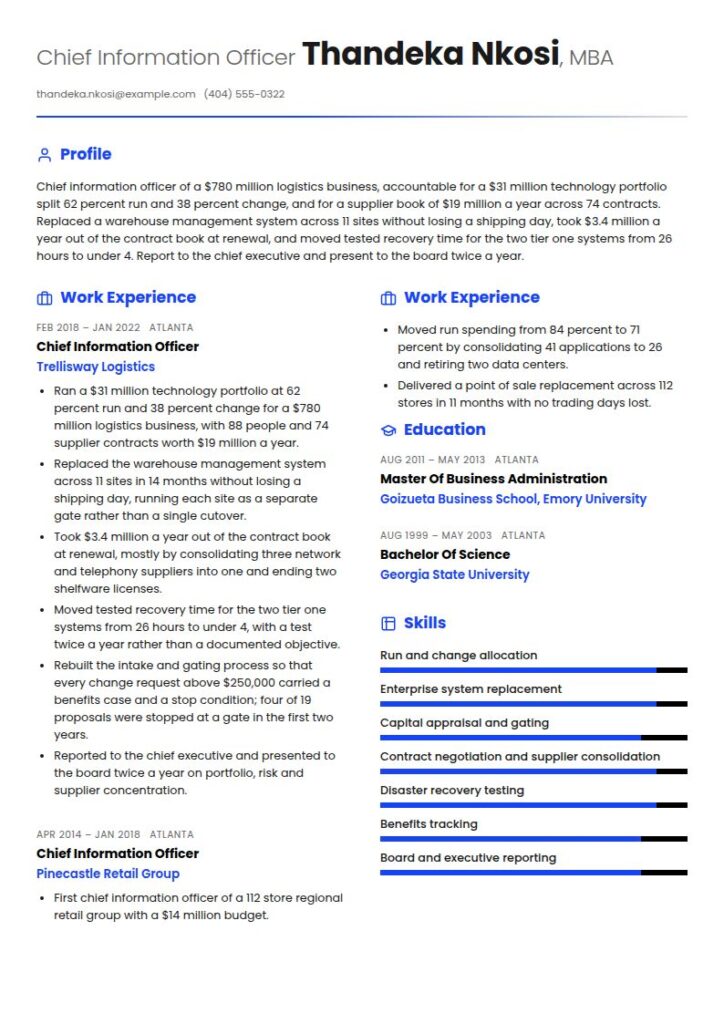
Chief information officer of a $780 million logistics business, accountable for a $31 million technology portfolio split 62 percent run and 38 percent change, and for a supplier book of $19 million a year across 74 contracts. Replaced a warehouse management system across 11 sites without losing a shipping day, took $3.4 million a year out of the contract book at renewal, and moved tested recovery time for the two tier one systems from 26 hours to under 4. Report to the chief executive and present to the board twice a year.
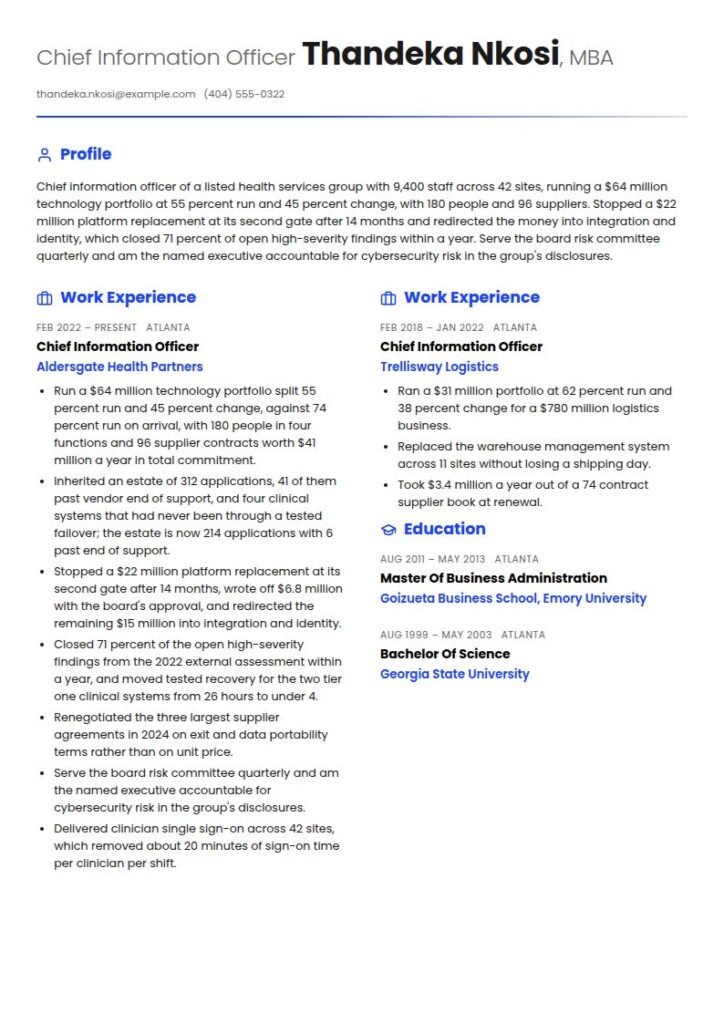
Chief information officer of a listed health services group with 9,400 staff across 42 sites, running a $64 million technology portfolio at 55 percent run and 45 percent change, with 180 people and 96 suppliers. Stopped a $22 million platform replacement at its second gate after 14 months and redirected the money into integration and identity, which closed 71 percent of open high-severity findings within a year. Serve the board risk committee quarterly and am the named executive accountable for cybersecurity risk in the group's disclosures.
Right vs wrong: the same CIO summary, twice
| ✅ Right | ❌ Wrong |
|---|---|
| A $64 million portfolio at 55 percent run and 45 percent change, with 180 people and 96 suppliers. | Responsible for all technology across a large, complex organization. |
| Stopped a $22 million platform replacement at its second gate after 14 months and redirected the money. | Led multiple large-scale digital transformation initiatives. |
| Tested recovery for the two tier one systems moved from 26 hours to under 4. | Strengthened cybersecurity and business continuity capabilities. |
The right column can be interrogated and survives it. The left column describes almost every chief information officer who has ever applied for anything, which is why it does not separate them.
Outline your experience
Organization, sector, size, sites, portfolio value, reporting line, dates. Then five or six bullets on the current role and three on the one before. Each bullet names money, a count or a time, and preferably two of the three.
| Instead of | Use |
|---|---|
| Responsible for the organization's technology strategy and operations | Run a $64 million technology portfolio at 55 percent run and 45 percent change for a 9,400 person group across 42 sites |
| Led a major digital transformation program | Replaced a warehouse management system across 11 sites in 14 months without losing a shipping day |
| Reduced IT costs | Consolidated 41 applications to 26, retired two data centers and took $3.4 million a year out of the contract book at renewal |
| Improved cybersecurity posture | Closed 71 percent of open high-severity findings in one year and moved tested recovery for tier one systems from 26 hours to under 4 |
| Canceled an underperforming project | Stopped a $22 million platform replacement at its second gate after 14 months, wrote off $6.8 million and redirected the balance to integration |
Chief Information Officer, Aldersgate Health Partners, Atlanta, GA, listed health services group, 9,400 staff across 42 sites, $64 million technology portfolio, reporting to the chief executive, February 2022 to Present
Run a $64 million portfolio split 55 percent run and 45 percent change, with 180 people in four functions and 96 supplier contracts worth $41 million a year in total commitment.
Inherited an estate of 312 applications, 41 of them past vendor end of support, and four clinical systems that had never been through a tested failover; the estate is now 214 applications with 6 past end of support.
Stopped a $22 million platform replacement at its second gate after 14 months, wrote off $6.8 million with the board's approval, and redirected the remaining $15 million into integration and identity.
Closed 71 percent of the open high-severity findings from the 2022 external assessment within a year, and moved tested recovery time for the two tier one clinical systems from 26 hours to under 4.
Serve the board risk committee quarterly and am the named executive accountable for cybersecurity risk in the group's disclosures, reporting to the committee on both process and incidents.
Split the portfolio: what you spend to run, and what you spend to change
If you write down one number on a chief information officer resume, make it this one. Run versus change tells a reader how much freedom the function has, how much debt sits underneath it, and what kind of chief information officer you have been allowed to be. A portfolio at 85 percent run is a maintenance job with a strategic title; one at 45 percent run is a company that has decided to change and is paying for it. Neither is a failing. Pretending you are the second when you are the first is.
Give four lines: the split now, the split when you arrived, what moved it, and what the change money bought.
Portfolio: $64 million a year, 55 percent run and 45 percent change; 74 percent run on arrival in 2022. Funded from the group operating budget with a separate board-approved capital envelope for clinical systems.
Estate inherited: 312 applications, 41 past vendor end of support, four clinical systems never through a tested failover, two data centers on expiring leases. Now 214 applications, 6 past end of support, all tier one systems failover tested twice a year.
Suppliers: 96 contracts, $41 million a year in total commitment, three renegotiated in 2024 on exit and data portability terms. Two suppliers carry more than 10 percent of the book each, stated in the risk register rather than left implicit.
What the change money bought: integration and identity rather than a platform replacement, after the replacement was stopped at its second gate; 71 percent of open high-severity findings closed within a year, and clinician single sign-on across 42 sites.
What moved the ratio: application retirement, two data center exits, and moving three commodity services to managed contracts, which together released about $11 million a year of run spending.
That last line is the one people forget. A ratio that improved because the change budget grew is a story about a generous board; a ratio that improved because you took cost out of run is a story about you.
Security belongs on the page, and for some companies it is a named disclosure
Chief information officers often keep security vague, either because they inherited a bad position or because they fear saying too much. Vagueness reads worse than a stated problem being worked.
For a company with registered securities, the governance of cybersecurity risk is a disclosure item. Item 106 of Regulation S-K requires a registrant to describe its processes for assessing, identifying and managing material risks from cybersecurity threats, including risks from third-party service providers, and to identify the management positions responsible for those risks, describe their relevant expertise, and say how they are informed about incidents and whether they report to the board (17 CFR 229.106, added 4 August 2023). If you are that named person, say so in one line. It is already public, and very few candidates think to state it.
What to write, whether or not you work at a registrant: tested recovery time rather than a documented objective, findings closed as a proportion of findings open, the assessment regime and who performs it, and the committee you report to and how often. What not to write: live vulnerabilities, unremediated findings in detail, control architecture, an undisclosed incident, or a security supplier whose engagement is not public. Describe posture and outcomes, never the map.
Build a snapshot of your key skills
Twelve to fifteen entries in three groups, expressed as things you are accountable for. One short tools line at the end is enough.
Portfolio and money: Technology budget ownership, Run and change allocation, Application rationalization, Capital appraisal and gating, Benefits tracking, Total cost of ownership analysis
Estate and delivery: Enterprise system replacement, Integration and identity architecture, Data center exit and migration, Release and change management, Technical debt reduction, Service level design
Risk and suppliers: Cybersecurity governance and reporting, Disaster recovery testing, Third-party and supply chain risk, Contract negotiation and renewal, Exit and data portability terms, Regulatory and audit engagement
Tools in current use: enterprise resource planning, identity and access management, service management, data warehouse and reporting platforms.
List your education and certifications
Brief. Degree lines, then certifications with issuer and year, then the governance exposure.
Master of Business Administration, Goizueta Business School, Emory University, Atlanta, GA, 2013
Bachelor of Science, Computer Information Systems, Georgia State University, Atlanta, GA, 2003
Certifications: Certified Information Security Manager, ISACA, 2016. Project Management Professional, Project Management Institute, 2011.
Governance: Board risk committee quarterly since 2022; named executive accountable for cybersecurity risk in group disclosures since 2024; audit committee annually on technology controls.
Progression: application manager, information technology director, chief information officer.
The progression line matters here, because chief information officers arrive by three routes: infrastructure and operations, applications and enterprise systems, or security. Each produces different instincts, and a board that knows your route can decide which deputy it needs next to you.
Choose the right layout and design
Single column, two pages, 11 point, no photograph, no charts, no logos, no skill bars and no technology icons. Put the portfolio block directly under the summary. Save as PDF: thandeka-nkosi-cio-resume.pdf.
Give the portfolio value and the run and change split, now and on arrival. Say what the estate looked like when you inherited it and what it looks like now. State the contract book: value, count and what you renegotiated. Give tested recovery times rather than documented objectives. Say what you stopped, what the write-off was and who approved it. Name the committee you report technology risk to.
Do not build the page around platform names; a list of products describes a market, not a career. Do not write "digital transformation" without a number attached to it. Do not publish live vulnerabilities, unremediated findings in detail or an undisclosed incident. Do not name a security supplier whose engagement is not public. Do not claim a program you sponsored as one you delivered, or a delivery you led as one you sponsored. Do not present a portfolio at 85 percent run as a change agenda.
CIO job market and outlook
The chief information officer title sits inside computer and information systems managers, which is where the Handbook also reports chief technology officers and management information systems directors. The occupation is one of the fastest growing in the management group.
| Measure | Value |
|---|---|
| Computer and information systems manager jobs, 2025 | 685,800 |
| Projected employment, 2035 | 793,900 |
| Projected change, 2025 to 2035 | 16 percent growth, much faster than average, +108,100 |
| Projected annual openings | About 53,500 |
| Typical entry-level education | Bachelor's degree |
| Work experience in a related occupation | 5 years or more |
| Median annual wage, May 2025 | $175,140 |
Source: U.S. Bureau of Labor Statistics, Occupational Outlook Handbook, May 2025 wage data and 2025 to 2035 projections.
Sixteen percent growth across the decade, against 5 percent for top executives, is the strongest published signal in this part of the market (BLS, 2025 to 2035 projections). The duties the Handbook lists map onto the blocks above: assessing costs and benefits of new projects and justifying their funding, maintaining processes to detect, prevent and mitigate security threats, and negotiating with and monitoring vendors (BLS Occupational Outlook Handbook, accessed 13 September 2026). Money, risk and contracts, not engineering.
Where the jobs sit:
| Industry | Share of employment, 2025 | Median annual wage, May 2025 |
|---|---|---|
| Computer systems design and related services | 19 percent | $179,510 |
| Finance and insurance | 13 percent | $182,510 |
| Information | 13 percent | $200,510 |
| Management of companies and enterprises | 10 percent | $176,950 |
| Manufacturing | 6 percent | $178,110 |
Source: U.S. Bureau of Labor Statistics, Occupational Outlook Handbook, 2025 industry employment data and May 2025 wage data.
A narrow industry spread and a wide seniority spread
Computer and information systems managers had a median annual wage of $175,140 in May 2025, with the lowest 10 percent under $107,550 and the highest 10 percent over $297,510 (BLS Occupational Outlook Handbook, May 2025).
The industry spread is unusually narrow for a management occupation: from $176,950 in management of companies and enterprises to $200,510 in information, about 13 percent across the five largest employing industries (BLS, May 2025). Compare chief executives, where the equivalent medians run from $146,700 in government to $358,310 in management of companies and enterprises (BLS, May 2025).
What moves a chief information officer instead is where they sit in an occupation that runs from help desk manager to the chief information officer of a listed group. That is why the portfolio number matters: it is the only thing on your resume that says which end of a $190,000 wide distribution you stand at.
The published figure covers straight-time gross pay, including base rates and incentive pay, and excludes year-end bonuses, profit-sharing payments and stock bonuses (BLS, Occupational Employment and Wage Statistics survey documentation, accessed 13 September 2026). No federal source publishes a bonus or equity figure for the occupation.
What salary you can expect as a CIO
The published median for computer and information systems managers was $175,140 in May 2025, running from under $107,550 at the tenth percentile to over $297,510 at the ninetieth (BLS Occupational Outlook Handbook, May 2025). Chief information officer sits toward the upper part of that occupation, but the Handbook publishes no separate figure for it, so treat the range as a bracket rather than a target.
Three things move you inside it, and all three are on the page if you wrote the portfolio block. Portfolio value comes first, because it is the closest published proxy for scope. The run and change ratio comes second, because a change mandate is a harder and better paid job than a maintenance one. Reporting line comes third: a chief information officer who reports to the chief executive and sits on a board committee is priced differently from one reporting through finance, so negotiate the line as well as the number.
Industry is a smaller lever here than elsewhere in management. Read the published figure for what it measures, base pay plus regular incentive across a wide occupation, and ask for the full structure rather than anchoring on a bonus number you cannot source.
Key takeaways for a CIO resume
- Lead with the portfolio value and the run and change split, now and on arrival.
- Describe the estate you inherited in counts: applications, versions past support, untested systems.
- State the contract book by value and count, and say what you renegotiated and on what terms.
- Give tested recovery times, not documented recovery objectives.
- Say what you stopped, what it cost and who approved the write-off.
- Name the committee you report technology risk to, and say if you are the named accountable executive.
- Keep platform names to a single line unless a specific product is the point.
- Two pages, single column, with the portfolio block directly under the summary.
Build your CIO resume in 15 minutes with our AI resume builder.
Related business and management resume examples
- CTO resume
- CEO resume
- CFO resume
- Executive resume
- Chief operating officer resume
- Managing director resume
- Chief of staff resume
- Business intelligence resume
- Program manager resume
- Project manager resume
- Product owner resume
- Business management resume
Pair it with a matching CIO cover letter.
CIO resume questions, answered
What is the difference between a CIO resume and a CTO resume?
Who the technology is for. A chief information officer owns technology as a business function: the systems the organization runs on, the portfolio that funds them, the risk they carry and the contracts behind them. A chief technology officer owns the technology inside the product the company sells, and writes about architecture, engineering organization and product delivery. Our [CTO resume example](/resume/cto/) is built for that. Federal data does not separate the two, reporting both inside computer and information systems managers, but hiring organizations do, and a page that blurs them reads as hedging between two searches.
Should a CIO resume list technologies?
One line, near the end, with categories plus the two or three products a reader would want to check. Every candidate has worked with roughly the same platforms, so a list separates nobody. The portfolio, the estate and the decisions do.
How do I write the transformation I stopped?
Plainly, and near the top, because it is usually the strongest thing on the page. Name the decision, the commitment, the gate at which you stopped, the write-off, who approved it and where the money went. "Stopped a $22 million platform replacement at its second gate after 14 months, wrote off $6.8 million with the board's approval, and redirected $15 million into integration and identity" shows that gates existed, that one was honored and that the money was redeployed.
How much security detail belongs on a CIO resume?
Posture and outcomes, never the map. Tested recovery times, the proportion of high-severity findings closed and over what period, the assessment regime and who runs it, and the committee you report to. Never live vulnerabilities, unremediated findings in detail, control architecture or an undisclosed incident. If you are the named accountable executive for cybersecurity risk under Item 106 of Regulation S-K, say so.
I was promoted from IT director to CIO. What changes on the page?
The unit of account. An information technology director resume is built on services, projects and teams; a chief information officer resume is built on money, risk and suppliers. If you have just made the step and do not yet have a full year of those numbers, give the position you inherited, the first decision you made about it, and which parts of the portfolio you do not yet control.
Does a CIO need an MBA?
No. Typical entry into computer and information systems management is a bachelor's degree plus five years or more of experience in a related occupation (BLS Occupational Outlook Handbook, accessed 13 September 2026). What a business qualification helps with is the gap boards worry about: whether you can argue for capital rather than only spend what you are given. A portfolio block showing you moved the run and change ratio by taking cost out demonstrates that better than a degree line.