Chief Technology Officer, Vertical Software Emre Dalkiran
Chief Technology Officer
[email protected] | (919) 555-0585 | Raleigh, United States
Profile
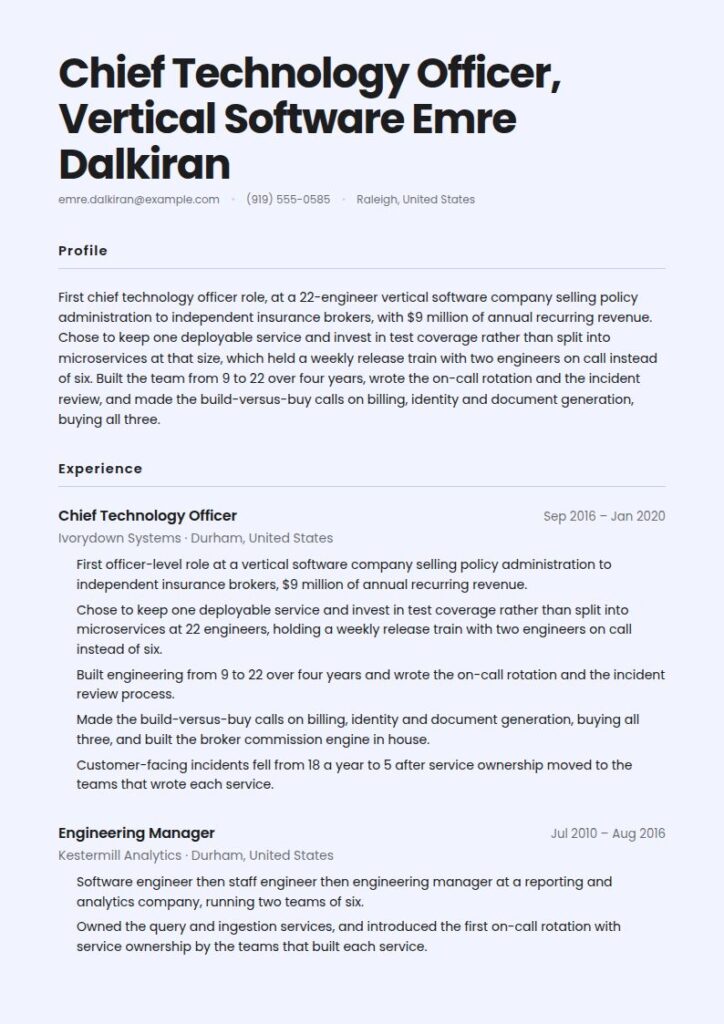
First chief technology officer role, at a 22-engineer vertical software company selling policy administration to independent insurance brokers, with $9 million of annual recurring revenue. Chose to keep one deployable service and invest in test coverage rather than split into microservices at that size, which held a weekly release train with two engineers on call instead of six. Built the team from 9 to 22 over four years, wrote the on-call rotation and the incident review, and made the build-versus-buy calls on billing, identity and document generation, buying all three.
Work Experience
09/2016 - 01/2020, Chief Technology Officer, Ivorydown Systems, Durham, United States
- First officer-level role at a vertical software company selling policy administration to independent insurance brokers, $9 million of annual recurring revenue.
- Chose to keep one deployable service and invest in test coverage rather than split into microservices at 22 engineers, holding a weekly release train with two engineers on call instead of six.
- Built engineering from 9 to 22 over four years and wrote the on-call rotation and the incident review process.
- Made the build-versus-buy calls on billing, identity and document generation, buying all three, and built the broker commission engine in house.
- Customer-facing incidents fell from 18 a year to 5 after service ownership moved to the teams that wrote each service.
07/2010 - 08/2016, Engineering Manager, Kestermill Analytics, Durham, United States
- Software engineer then staff engineer then engineering manager at a reporting and analytics company, running two teams of six.
- Owned the query and ingestion services, and introduced the first on-call rotation with service ownership by the teams that built each service.
Education
08/2008 - 05/2010, Master of Science, Computer Science, North Carolina State University, Raleigh, United States
Distributed systems and databases.
09/2003 - 06/2007, Bachelor of Science, Computer Engineering, Bogazici University, Istanbul, Turkey
Skills
Service ownership and on-call design, 85
Release engineering, 85
Build-versus-buy decision making, 80
Integration architecture, 80
Hiring and onboarding engineers, 75
Incident management and review, 85
Languages
English, native
Turkish, native
Certificates
05/2021, AWS Certified Solutions Architect, Professional, Amazon Web Services
Renewed 2024.
Summary
A CTO resume is a two page document about the technology inside the product a company sells. It states the architecture you chose and what that choice ruled out, the engineering organization you hired and how it is shaped, what it ships and how reliably, the technical debt you paid and the debt you deliberately deferred, and where you bought rather than built. This guide gives you three adaptable versions and current BLS pay and outlook.
CTO resume examples by experience level
A CTO resume is a two page document about the technology inside the product a company sells: the architecture you chose, the organization that builds it, what it ships and how reliably, and the debt you paid or decided to live with.
Start by saying which job you mean, because two titles share this territory and the split depends on company size. In a company of fifty the chief technology officer and the chief information officer are the same person: whoever runs product engineering also owns the laptops and the finance system. In a company of five thousand they are two officers with different budgets, one accountable for what customers buy and one for how the company runs itself. The CIO resume example is written for the second, so if your evidence is an internal systems estate and a supplier book, that is the page you want.
This one assumes the first: engineers, a product, customers running on it, and architectural decisions you have to defend.
Resume guide for a CTO resume
This guide and the corresponding CTO resume example will cover:
- How to write a CTO resume about architecture and organization rather than technologies
- The architecture decision, what it ruled out, and the debt register
- Three adaptable summaries: first chief technology officer role, operating CTO and scaled CTO
- Current Bureau of Labor Statistics pay and outlook, for your job and for the people you hire
How to write a CTO resume
Five blocks: contact header, summary, the architecture and debt block, the organization block, and experience. Two pages, with a short education line at the end.
| Section | What it is answering | Where it goes |
|---|---|---|
| Header | How big is the product business and how big is engineering? | Under your name, three lines |
| Architecture | What did you choose, against what, and what did it rule out? | Directly under the summary |
| Debt register | What did you pay down, and what did you defer, until when? | Inside the architecture block |
| Organization | How many teams, shaped how, hired how, leaving at what rate? | Its own short section |
Run the finished file through the free ATS resume checker before you send it. Search firms parse candidate files into structured records, and a designed two-column layout is where that breaks.
Choosing the best resume format for a CTO resume
Reverse chronological, two pages, with the last two roles carrying most of the words and everything before your first engineering leadership role in one progression line.
Two rules are specific to this title. Do not organize the page around a technology list: languages, frameworks and cloud providers describe a market rather than a career, and every serious candidate has roughly the same set. A technology earns a mention only where it was the decision, such as the database you moved off.
The second is where you stopped being hands-on. Say it plainly, because a board will ask. An officer who still reviews architecture proposals and reads incident reviews but has not merged production code in three years should say exactly that.
Include your contact information
| ✅ Right | ❌ Wrong |
|---|---|
| Emre Dalkiran | Emre Dalkiran |
| Chief Technology Officer, claims software, $190M ARR, 240 customers | Visionary technology leader and innovator |
| 142 engineers in 16 teams; single multi-tenant platform since 2025 | Full-stack expert across cloud, data, AI and security |
| (919) 555-0585, [email protected], Raleigh, NC | (919) 555-0585, [email protected] |
Three lines and the reader knows the size of the business, the size of the organization and the shape of what you run. The third is the line other candidates leave out, and it says whether you ran a platform or a portfolio of forks.
Make use of a summary
Four lines: the product business and its scale, the engineering organization, the architectural decision that defines your tenure, and what is not yours.
First chief technology officer role, at a 22-engineer vertical software company selling policy administration to independent insurance brokers, with $9 million of annual recurring revenue. Chose to keep one deployable service and invest in test coverage rather than split into microservices at that size, which held a weekly release train with two engineers on call instead of six. Built the team from 9 to 22 over four years, wrote the on-call rotation and the incident review, and made the build-versus-buy calls on billing, identity and document generation, buying all three.
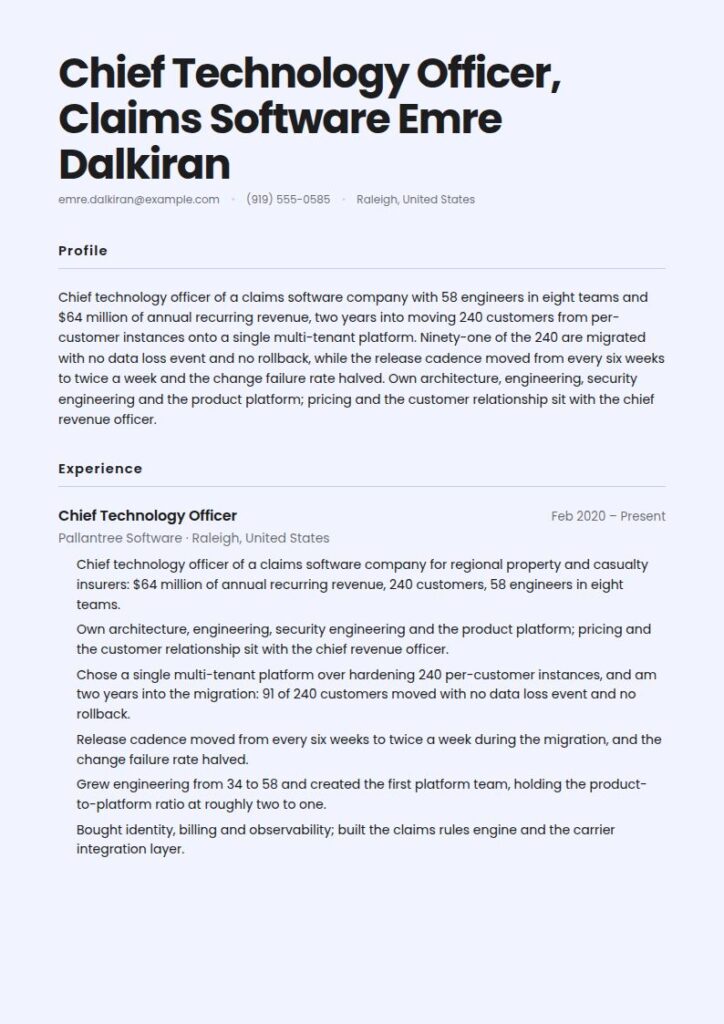
Chief technology officer of a claims software company with 58 engineers in eight teams and $64 million of annual recurring revenue, two years into moving 240 customers from per-customer instances onto a single multi-tenant platform. Ninety-one of the 240 are migrated with no data loss event and no rollback, while the release cadence moved from every six weeks to twice a week and the change failure rate halved. Own architecture, engineering, security engineering and the product platform; pricing and the customer relationship sit with the chief revenue officer.
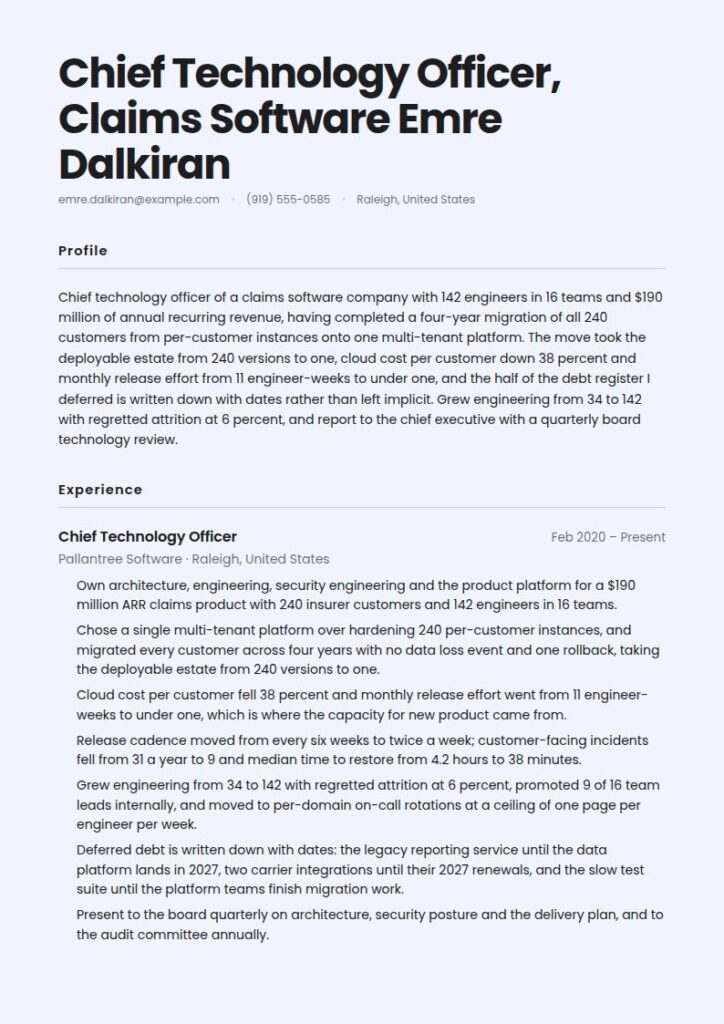
Chief technology officer of a claims software company with 142 engineers in 16 teams and $190 million of annual recurring revenue, having completed a four-year migration of all 240 customers from per-customer instances onto one multi-tenant platform. The move took the deployable estate from 240 versions to one, cloud cost per customer down 38 percent and monthly release effort from 11 engineer-weeks to under one, and the half of the debt register I deferred is written down with dates rather than left implicit. Grew engineering from 34 to 142 with regretted attrition at 6 percent, and report to the chief executive with a quarterly board technology review.
Right vs wrong: the same CTO summary, twice
| ✅ Right | ❌ Wrong |
|---|---|
| Moved 240 customers from per-customer instances onto one multi-tenant platform over four years. | Led a major cloud modernization and digital transformation. |
| Deployable estate from 240 versions to one; monthly release effort from 11 engineer-weeks to under one. | Dramatically improved engineering efficiency and velocity. |
| Grew engineering from 34 to 142 with regretted attrition at 6 percent. | Built and scaled a world-class engineering organization. |
The right column survives an hour with an experienced engineer on the panel. The left is what the other twelve candidates wrote, and it is why technical due diligence exists.
Outline your experience
Company, what the product is and who buys it, recurring revenue, engineering headcount and team count, your reporting line, dates. Then five or six bullets for the current role and three for the one before, each naming a decision, a count and a period.
| Instead of | Use |
|---|---|
| Responsible for technology strategy and engineering across the company | 142 engineers in 16 teams across product, platform, security engineering and data, for a $190 million ARR claims product |
| Led a cloud migration | Moved 240 customers from per-customer instances to one multi-tenant platform over four years, with no data loss event and one rollback |
| Hired and retained engineers | Grew engineering from 34 to 142 in four years at 6 percent regretted attrition, with 9 of 16 team leads promoted internally |
Chief Technology Officer, Pallantree Software, Raleigh, NC, claims software for regional property and casualty insurers, $190 million ARR, 240 customers, 142 engineers in 16 teams, reporting to the chief executive, February 2020 to Present
Own architecture, engineering, security engineering and the product platform. Pricing, packaging and the customer relationship sit with the chief revenue officer; internal corporate systems with the vice president of business technology.
Chose a single multi-tenant platform over hardening 240 per-customer instances, and migrated every customer across four years with no data loss event and one rollback, which took the deployable estate from 240 versions to one and cloud cost per customer down 38 percent.
Grew engineering from 34 to 142 with regretted attrition at 6 percent and promoted 9 of 16 team leads internally.
Bought identity, billing, observability and document generation, and built the claims rules engine and the carrier integration layer, which are what customers pay for. Present to the board quarterly on architecture, security posture and the delivery plan.
State the architecture you chose, what it ruled out and the debt you paid or deferred
This is the section a chief technology officer resume is won on. Everything else could have been produced by a strong vice president of engineering with a good four years.
The decision, against a real alternative. An architecture claim with no rejected option is a description, not a decision. Write the choice: one multi-tenant platform against hardening 240 per-customer instances, or migrating onto somebody else's. Give the reason in one clause and the cost in another.
What it ruled out. The half nobody writes, and the half that proves you understood the trade. Every architecture forecloses something: per-customer schema changes, on-premises deployment, a latency floor, a region you cannot serve. Naming it is the evidence the decision was made rather than drifted into.
The migration, in counts and months. Customers moved, versions retired, months taken, data loss events, rollbacks, and what the release cadence did while it ran. A migration with reliability numbers beside it is a competence claim; on its own it is a schedule.
The debt register, both halves. Say what you paid down and what you deliberately did not, with the reason and a date. Deferred debt with a date is a governance artifact; deferred debt left unmentioned is what technical due diligence finds in an afternoon and prices against you.
Build versus buy. One line, as a rule rather than a list: what you bought, what you built, and the principle separating them.
The decision: one multi-tenant platform, over hardening 240 per-customer instances and over a third-party claims platform. The instance estate cost 11 engineer-weeks a month to release and made any cross-customer feature a 240-times problem; the third-party option would have put our rules engine inside someone else's roadmap.
What it ruled out: per-customer schema customization, which four large customers relied on and which a configuration model replaced over eighteen months; and on-premises deployment, which closed two prospects in regulated segments and is a trade I would make again.
The migration: 240 customers over four years, 240 deployable versions to one, no data loss event, one rollback affecting one customer for four hours. Release cadence moved from every six weeks to twice a week during the migration, not after it.
Debt paid: the shared-nothing tenancy boundary and the schema divergence across the estate, both of which blocked multi-tenancy.
Debt deferred, with dates: the legacy reporting service, kept until the data platform lands in Q3 2027; two carrier integrations on the old adapter, scheduled for retirement at those carriers' 2027 renewals; and a slow test suite, accepted until the platform teams finish the migration.
Build versus buy: bought identity, billing, observability and document generation; built the claims rules engine and the carrier integration layer. The rule is to build what a customer would change vendors over and buy everything else.
Write the engineering organization: how it is shaped, how you built it, and what it ships
The second half of the job is the organization, and it wants four short lines rather than a paragraph about culture. Each is a number a reader can compare.
Shape. Team count and what each kind of team does: product, platform, security engineering, data, quality. Give the ratio of product to platform, because it says what proportion of your capacity serves customers directly.
How you built it. Growth from and to, over what period, plus the quality signals: time from joining to first production change, internal promotion into team lead roles, and regretted rather than total attrition. Regretted attrition is the honest measure and nobody quotes it.
On-call and reliability. Pages per engineer per week, incident count, median time to restore, and whether engineers support what they build. These belong here rather than in the architecture block, because what fixes them is who owns what.
What shipped. Two or three things that reached customers in the last year, with adoption attached. An officer who can name what shipped and how many customers use it has answered the question a chief executive has.
Shape: 16 teams, 142 engineers: eleven product, three platform, one security engineering, one data. Roughly two thirds of capacity on customer-facing product and one third on platform, held through the migration.
How it was built: 34 to 142 engineers over four years. Regretted attrition 6 percent; 9 of 16 team leads promoted internally; median time from joining to first production change 9 days, down from 31 after the onboarding rebuild.
On-call and reliability: per-domain rotations capped at one page per engineer per week, teams supporting what they build. Customer-facing incidents 31 a year to 9, median time to restore 4.2 hours to 38 minutes, with a written incident review within five working days.
Shipped in the last twelve months: a configuration model replacing per-customer schema customization, now used by 240 customers; a carrier integration framework that took new carrier onboarding from 14 weeks to 5; and automated first-notice-of-loss intake, live with 61 customers.
Say what your organization actually does with AI, in numbers
Almost every chief technology officer resume in 2026 mentions artificial intelligence and almost none says anything checkable.
In its 2025 report, DORA surveyed nearly 5,000 technology professionals worldwide and found that 90 percent use AI at work and more than 80 percent believe it has increased their productivity, while 30 percent report little or no trust in the code it generates (DORA, State of AI-assisted Software Development 2025, published 23 September 2025).
The interesting facts follow from that split: what proportion of your engineers use assistance and for what, your review policy for generated code, whether your change failure rate moved, and what you do not allow near customer data. Two sentences of that beat a paragraph naming models.
The same applies to AI inside your product: give the feature, the customers using it and the measured effect. A claim of artificial intelligence with no adoption number reads to a technical buyer as a claim of transformation reads to a chief financial officer.
Build a snapshot of your key skills
Six to eight lines, expressed as things you are accountable for, with one tools line at the end. Omitting it is defensible at officer level.
Architecture: Multi-tenant platform design, Migration strategy and sequencing, Integration architecture, Build-versus-buy decision making
Engineering organization: Team topology and platform-to-product ratio, Hiring at scale, Engineering leadership development, Onboarding and ramp measurement, Leveling frameworks
Tools in current use: one cloud provider, container orchestration, infrastructure as code and a single observability platform.
List your education and certifications
Short: degrees on one line each, then certifications with issuer and year, then governance if it is real.
Master of Science, Computer Science, North Carolina State University, Raleigh, NC, 2010
Bachelor of Science, Computer Engineering, Bogazici University, Istanbul, 2007
Certifications: AWS Certified Solutions Architect, Professional, Amazon Web Services, 2021, renewed 2024.
Governance: present to the Pallantree board quarterly on architecture, security posture and the delivery plan, and to the audit committee annually.
Hands-on position: review architecture proposals and read every incident review; last production code merged in 2022.
That last line looks odd to volunteer and is worth its space. Boards ask it in every process, and the candidates who answer precisely are the ones not pretending in either direction.
Choose the right layout and design
Single column, two pages, 11 point, no photograph, charts, logos, technology icons or skill bars. Put the architecture block directly under the summary. Save as PDF: emre-dalkiran-cto-resume.pdf.
Name the architecture decision and the alternative you rejected, and say what it ruled out. Give the migration in customers, versions, months and rollbacks. Write both halves of the debt register, with dates on the deferred half. Give team count, the product-to-platform ratio and regretted attrition. Say where you stopped being hands-on.
Do not build the page around a technology list; it describes a market, not a career. Do not claim a delivery you sponsored as one you led. Do not quote total attrition when you mean regretted. Do not put an unpatched vulnerability, an undisclosed incident or a customer name on the page. Do not mention AI without a number attached.
CTO job market and outlook
The title is counted inside computer and information systems managers, which also holds chief information officers and management information systems directors: "These managers may have other titles, such as chief information officer (CIO), chief technology officer (CTO), or management information systems (MIS) director" (BLS Occupational Outlook Handbook, accessed 14 September 2026). Neither title is described separately, so the occupation is a bracket rather than a match.
| Measure | Value |
|---|---|
| Computer and information systems manager jobs, 2025 | 685,800 |
| Projected employment, 2035 | 793,900 |
| Projected change, 2025 to 2035 | 16 percent, much faster than average, +108,100 |
| Projected annual openings | About 53,500 |
| Typical entry-level education | Bachelor's degree |
| Work experience in a related occupation | 5 years or more |
| Median annual wage, May 2025 | $175,140 |
Source: U.S. Bureau of Labor Statistics, Occupational Outlook Handbook, May 2025 wage data and 2025 to 2035 projections.
The second market that matters is the one you hire in, published separately.
| Measure | Value |
|---|---|
| Software developers, QA analysts and testers, employment 2025 | 1,905,400 |
| Projected change, 2025 to 2035 | 10 percent, much faster than average, +185,400 |
| Projected annual openings | About 106,100 |
| Median annual wage, May 2025, software developers | $135,980, from under $82,460 to over $214,670 |
| Median annual wage, May 2025, QA analysts and testers | $104,300 |
Source: U.S. Bureau of Labor Statistics, Occupational Outlook Handbook, May 2025 wage data and 2025 to 2035 projections. Employment, growth and openings are published for the combined occupation; the two medians are published separately.
Your organization is a published cost, and it is the biggest number you control
Software developers had a median annual wage of $135,980 in May 2025, with the lowest 10 percent under $82,460 and the highest 10 percent over $214,670, inside an occupation of 1,905,400 people projected to grow 10 percent and to open about 106,100 posts a year through 2035 (BLS Occupational Outlook Handbook, May 2025 wage data and 2025 to 2035 projections).
Against that median, a 142-engineer organization is a payroll in the tens of millions before benefits, which makes the product-to-platform ratio a financial statement rather than an org chart.
That is the argument for writing the organization block in numbers: team count, the product-to-platform split, time to first production change and regretted attrition measure how well that cost converts into shipped product. Industry moves the input price too, with a May 2025 median of $164,550 in software publishers against $132,050 in computer systems design and related services (BLS, May 2025).
What salary you can expect as a CTO
The published median for computer and information systems managers was $175,140 in May 2025, running from under $107,550 at the tenth percentile to over $297,510 at the ninetieth (BLS Occupational Outlook Handbook, May 2025). The chief technology officer title sits toward the upper part of that occupation, but no separate figure is published, so read the range as a bracket rather than a target.
Three things move a chief technology officer inside it, and all three are on the page if you wrote the two blocks above. Organization size first, because it is the closest published proxy for scope. Product accountability second: an officer who owns what customers buy is priced differently from one who owns internal delivery. Company stage third, because a venture-backed company and a listed group pay through different instruments.
Read the published figure for what it measures. The federal wage survey collects straight-time gross pay including base rates and incentive pay, and excludes year-end bonuses, profit-sharing payments and stock bonuses (U.S. Bureau of Labor Statistics, Occupational Employment and Wage Statistics survey documentation, accessed 14 September 2026). Equity is frequently the larger half of a chief technology officer's package and no federal source publishes a figure for it, so ask for the full structure rather than anchoring on a number you cannot source.
Key takeaways for a CTO resume
- Say in the first paragraph whether you own product technology or internal technology.
- Name the architecture decision, the alternative you rejected and the reason.
- Say what the decision ruled out; that is the proof it was a decision.
- Give the migration in customers, versions, months, data loss events and rollbacks.
- Write both halves of the debt register, and put dates on the deferred half.
- Give team count, the product-to-platform ratio and regretted rather than total attrition.
- Keep technologies to one line, put delivery and reliability numbers beside the organization, and say where you stopped being hands-on.
Build your CTO resume in 15 minutes with our AI resume builder.
Related business and management resume examples
- CIO resume
- CEO resume
- CFO resume
- Executive resume
- Chief operating officer resume
- Managing director resume
- Product manager resume
- Product owner resume
- Program manager resume
- Business intelligence resume
- Chief of staff resume
- Business management resume
Pair it with a matching CTO cover letter.
CTO resume questions, answered
What is the difference between a CTO resume and a CIO resume?
Whose technology it is. A chief technology officer resume is about the technology customers buy: architecture, the engineering organization, delivery, reliability and technical debt. The [CIO resume example](/resume/cio/) is built on the portfolio, the internal systems estate and the supplier book. At small companies one person does both and should write for whichever half the advertised job is about; at large companies they are separate officers, and a page that hedges reads as a candidate hedging.
Should a CTO resume list programming languages and frameworks?
One line, near the end, and only the things that were decisions. Every candidate has roughly the same stack, so a list separates nobody, and each line spent on tooling is taken from architecture and organization. The exception is a technology you moved off or standardized onto, which belongs in the architecture block.
How do I write technical debt without making myself look bad?
Write both halves, because writing only the paid half is what looks bad. A register showing what you paid down, what you deferred and when you intend to address it shows the debt is tracked and governed, which is the actual question. The resume that damages a candidate is the one with no debt on it at all.
What if I am a first-time CTO or the company is small?
Write the same page at the true scale. A 22-engineer company has architecture decisions, a build-versus-buy rule, an on-call rotation and a debt register, and describing them precisely beats describing a large organization vaguely. Then say what you have not held: a board relationship, a platform team, a migration at scale.
How much of the product should be on a CTO resume?
Enough to show what shipped and who uses it. Two or three things that reached customers in the last year, with adoption numbers attached, answer the question a chief executive has. A roadmap, a discovery method or a set of personas belong to the product organization, and leaning on them invites the reader to ask who owned the engineering.