Chief Operating Officer, Foodservice Distribution Winifred Vanderkolk MBA
Chief Operating Officer
[email protected] | (614) 555-0574 | Columbus, United States
Profile
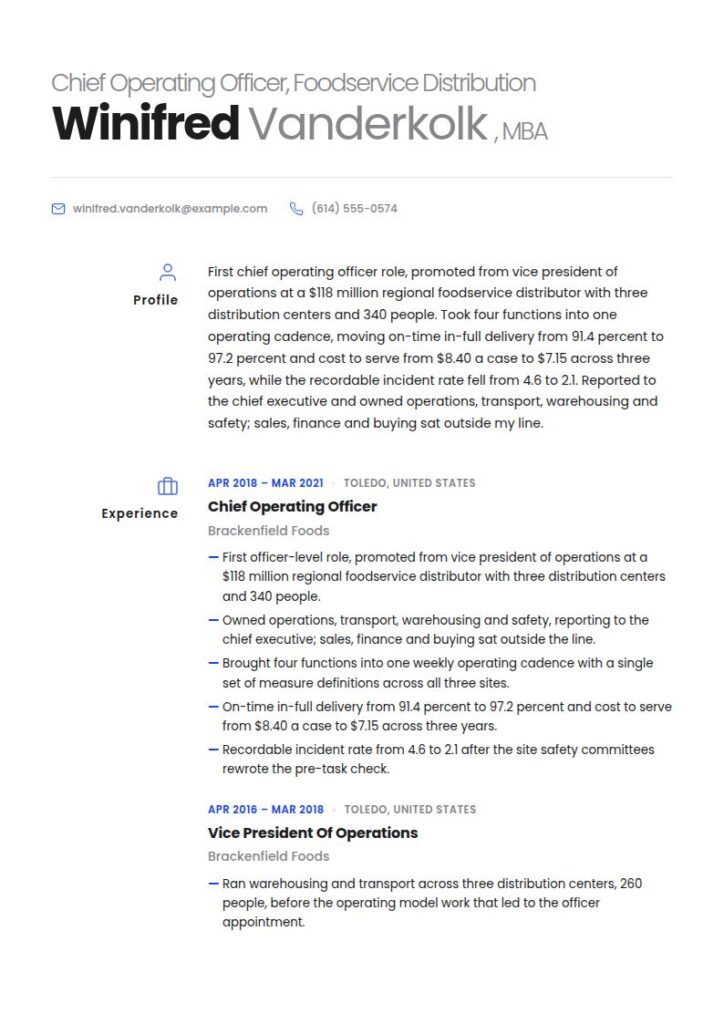
First chief operating officer role, promoted from vice president of operations at a $118 million regional foodservice distributor with three distribution centers and 340 people. Took four functions into one operating cadence, moving on-time in-full delivery from 91.4 percent to 97.2 percent and cost to serve from $8.40 a case to $7.15 across three years, while the recordable incident rate fell from 4.6 to 2.1. Reported to the chief executive and owned operations, transport, warehousing and safety; sales, finance and buying sat outside my line.
Work Experience
04/2018 - 03/2021, Chief Operating Officer, Brackenfield Foods, Toledo, United States
- First officer-level role, promoted from vice president of operations at a $118 million regional foodservice distributor with three distribution centers and 340 people.
- Owned operations, transport, warehousing and safety, reporting to the chief executive; sales, finance and buying sat outside the line.
- Brought four functions into one weekly operating cadence with a single set of measure definitions across all three sites.
- On-time in-full delivery from 91.4 percent to 97.2 percent and cost to serve from $8.40 a case to $7.15 across three years.
- Recordable incident rate from 4.6 to 2.1 after the site safety committees rewrote the pre-task check.
04/2016 - 03/2018, Vice President of Operations, Brackenfield Foods, Toledo, United States
- Ran warehousing and transport across three distribution centers, 260 people, before the operating model work that led to the officer appointment.
02/2009 - 03/2016, Director of Operations, Vellacourt Logistics, Columbus, United States
- Distribution center manager then director of operations for a third-party logistics business: two sites, a 90-vehicle transport operation and 520 people.
Education
08/2010 - 05/2012, Master of Business Administration, Operations and Strategy, Fisher College of Business, The Ohio State University, Columbus, United States
Part-time program completed while working as a director of operations.
09/1998 - 05/2002, Bachelor of Science, Industrial and Systems Engineering, University of Michigan, Ann Arbor, United States
Skills
Multi-site operating cadence, 80
Cost to serve analysis, 80
Service level design, 85
Transport and route planning, 85
Safety management systems, 85
Capacity and labor planning, 80
Languages
English, native
Dutch, conversational
Certificates
06/2014, Lean Six Sigma Black Belt, Independent certification body
09/2011, Certified Supply Chain Professional, APICS
Summary
A chief operating officer resume is a two page document about how a company runs rather than about where it is going. It names the functions that report to you, the cost base you own expressed per unit of work, the service and quality measures you are held to at scale, the integration or expansion you executed, and the parts of the job that belong to the chief executive. This guide gives you three adaptable versions and current BLS pay and outlook.
Chief Operating Officer resume examples by experience level
A chief operating officer resume is a two page document about how a company runs. Not where it is going, not how it is financed, not what the board decided. How it runs: which functions report to you, what a unit of work costs, what the customer gets and how reliably, and what happens at the seams.
That is a narrower page than it sounds, and the narrowness is the point. The CEO resume example is written for the board relationship and the company at arrival and at exit; the CFO resume example covers capital structure and what an officer signs; the executive resume example is the broad senior search file. A resume that reaches for any of those is competing on somebody else's evidence. What you have instead is the operating model, and almost nobody writes it down.
Resume guide for a chief operating officer resume
This guide and the corresponding chief operating officer resume example will cover:
- How to write a chief operating officer resume as an operating model rather than a career
- The functions, the cost base and the handoffs, in four lines
- Three adaptable summaries: first officer role, operating COO and group COO
- How to write the integration or expansion you executed
- Current Bureau of Labor Statistics pay and outlook for the occupations the title sits in
How to write a chief operating officer resume
Five blocks: contact header, summary, the operating model block, experience written as changes to how the company runs, and a short closing block for education and governance. Two pages; a skills list is optional.
| Section | What it is answering | Where it goes |
|---|---|---|
| Header | How big, how many sites, how many people report to you? | Under your name, three lines |
| Operating model | Which functions, at what cost per unit, to what standard? | Directly under the summary |
| Handoffs | What happens at the seams with functions that are not yours? | Inside the operating model block |
| Experience | What changed about how the company runs, and over what period? | Reverse chronological, two roles deep |
| The boundary | What belongs to the chief executive rather than to you? | One line per role |
The header does more work here than on any other executive page, because the title covers at least four jobs: deputy chief executive, head of one large function, integrator across several, and the person who runs the business while the founder sells. Three lines of scale and reporting shape say which one you were before the reader reaches the summary.
Run the finished file through the free ATS checker before you send it anywhere. Search firms parse candidate documents into structured records, and a two-column executive template is where parsing breaks.
Choosing the best resume format for a chief operating officer resume
Reverse chronological, two pages, with the last two roles carrying most of the words and everything before your first officer-level role in one progression line.
One structural rule matters more here than elsewhere. A page written as a project list reads as the layer below, because project lists are what directors of operations produce. Group the evidence by function and by measure instead: what warehousing cost when you arrived and costs now, what service was and is, what the organization looked like and looks like. A reader can compare that against their own numbers; a list of initiatives compares against nothing.
Include your contact information
| ✅ Right | ❌ Wrong |
|---|---|
| Winifred Vanderkolk | Winifred Vanderkolk |
| Chief Operating Officer, foodservice distribution, $640M revenue, 9 sites, 2,050 people | Results-driven COO and operational leader |
| Six functions reporting: warehousing, transport, customer service, procurement operations, safety, continuous improvement | Expert in operational excellence and business transformation |
| (614) 555-0574, [email protected], Columbus, OH | (614) 555-0574, [email protected] |
The third line separates a chief operating officer file from every other executive file in the stack. Six named functions is a job. "Operations" is a word.
Make use of a summary
Four lines: the company and its footprint, the functions that report to you, one cost measure and one service measure with a before and an after, and what is not yours.
First chief operating officer role, promoted from vice president of operations at a $118 million regional foodservice distributor with three distribution centers and 340 people. Took four functions into one operating cadence, moving on-time in-full delivery from 91.4 percent to 97.2 percent and cost to serve from $8.40 a case to $7.15 across three years, while the recordable incident rate fell from 4.6 to 2.1. Reported to the chief executive and owned operations, transport, warehousing and safety; sales, finance and buying sat outside my line.
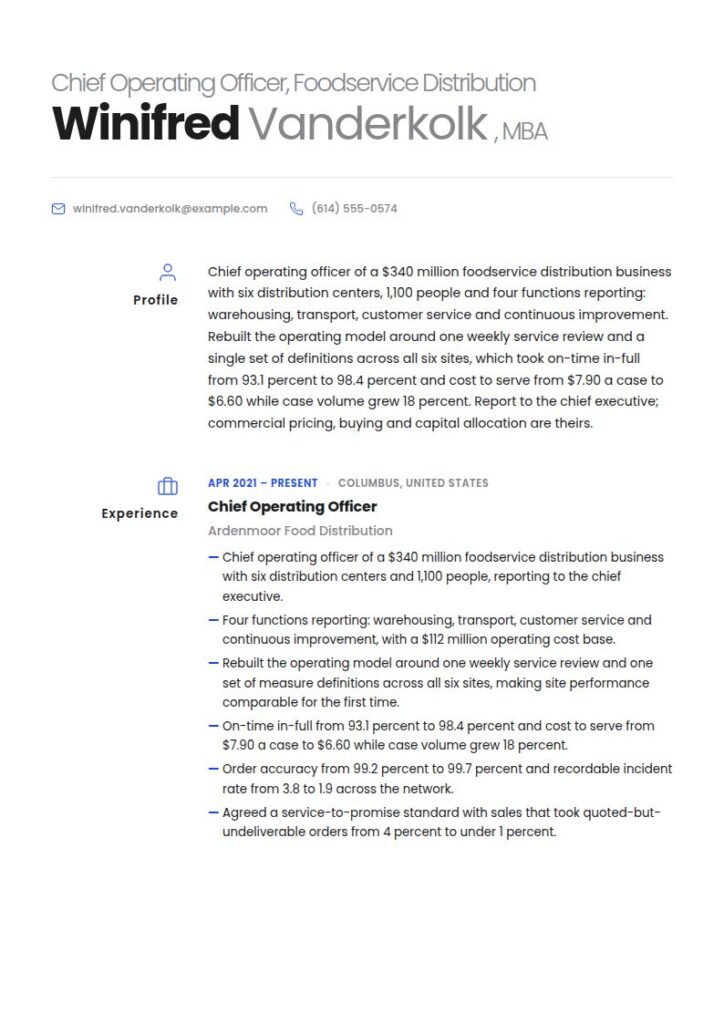
Chief operating officer of a $340 million foodservice distribution business with six distribution centers, 1,100 people and four functions reporting: warehousing, transport, customer service and continuous improvement. Rebuilt the operating model around one weekly service review and a single set of definitions across all six sites, which took on-time in-full from 93.1 percent to 98.4 percent and cost to serve from $7.90 a case to $6.60 while case volume grew 18 percent. Report to the chief executive; commercial pricing, buying and capital allocation are theirs.
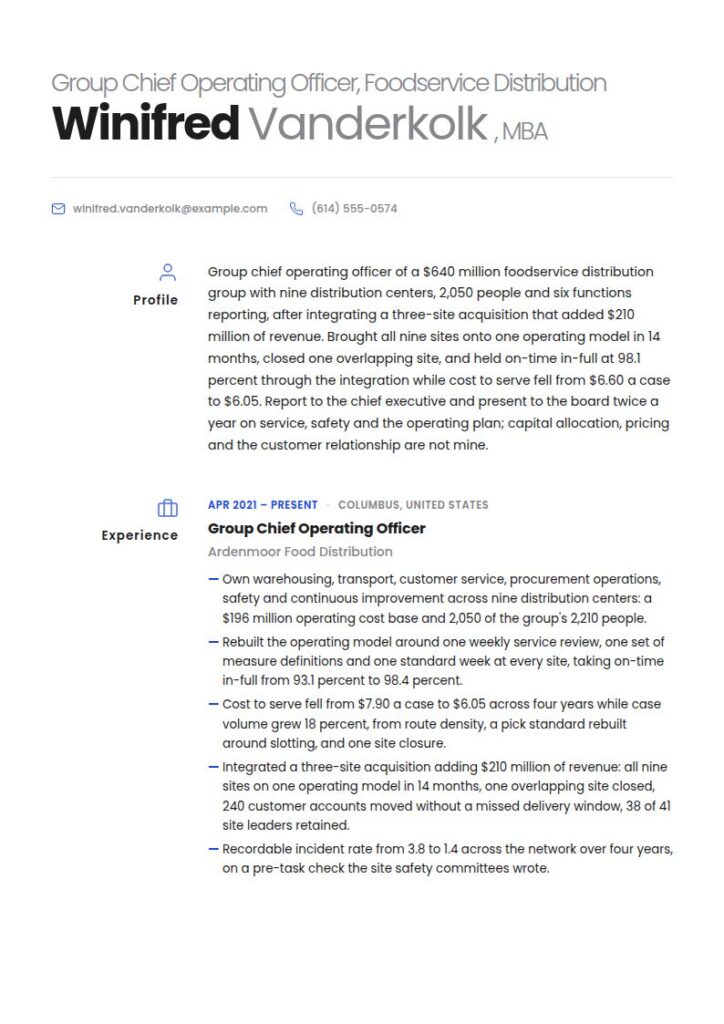
Group chief operating officer of a $640 million foodservice distribution group with nine distribution centers, 2,050 people and six functions reporting, after integrating a three-site acquisition that added $210 million of revenue. Brought all nine sites onto one operating model in 14 months, closed one overlapping site, and held on-time in-full at 98.1 percent through the integration while cost to serve fell from $6.60 a case to $6.05. Report to the chief executive and present to the board twice a year on service, safety and the operating plan; capital allocation, pricing and the customer relationship are not mine.
Right vs wrong: the same chief operating officer summary, twice
| ✅ Right | ❌ Wrong |
|---|---|
| Nine distribution centers, 2,050 people and six named functions reporting. | Responsible for all operational aspects of a large distribution business. |
| Cost to serve from $6.60 a case to $6.05 while case volume grew 18 percent. | Delivered significant operational efficiencies and cost savings. |
| Capital allocation, pricing and the customer relationship are not mine. | Partnered closely with the CEO across all areas of the business. |
Everything in the right column has a follow-up question with a real answer behind it. The wrong column is what a search partner reads forty times a quarter, and it is why the middle of a longlist is interchangeable.
Outline your experience
Company, what it does, revenue, sites, headcount, the functions reporting to you, your reporting line, dates. Give the current role five or six bullets and the one before it three. Each should change something about how the company runs and carry a number and a period.
| Instead of | Use |
|---|---|
| Responsible for day-to-day operations across the business | Six functions reporting across nine distribution centers and 2,050 people, with a $196 million operating cost base |
| Drove operational efficiency improvements | Cost to serve from $7.90 a case to $6.05 over four years while case volume grew 18 percent |
| Improved customer service levels | On-time in-full from 93.1 percent to 98.4 percent on one standardized definition, held at 98.1 percent through an integration |
| Led post-acquisition integration | Brought three acquired sites onto one operating model in 14 months, closed one overlapping site and moved 240 customer accounts without a missed delivery window |
Chief Operating Officer, Ardenmoor Food Distribution, Columbus, OH, $640 million revenue, nine distribution centers, 2,050 people, six functions reporting, reporting to the chief executive, April 2021 to Present
Own warehousing, transport, customer service, procurement operations, safety and continuous improvement: a $196 million operating cost base and 2,050 of the group's 2,210 people. Rebuilt the operating model around one weekly service review and one set of measure definitions, which took on-time in-full from 93.1 percent to 98.4 percent across nine now-comparable sites.
Cost to serve fell from $7.90 a case to $6.05 across four years while case volume grew 18 percent, from a mix of route density, a pick standard rebuilt around slotting, and one site closure.
Integrated a three-site acquisition adding $210 million of revenue: all nine sites on one operating model in 14 months, one overlapping site closed, 240 customer accounts moved without a missed delivery window, and 38 of 41 site leaders retained.
Recordable incident rate fell from 3.8 to 1.4 across the network over four years, on a pre-task check the site safety committees wrote rather than a corporate program. Replaced two of six function heads and promoted three from inside; voluntary turnover in site leadership fell from 18 to 7 percent.
Present to the board twice a year on service, safety and the operating plan. Capital allocation, pricing, buying terms and the customer relationship sit with the chief executive and the commercial director.
Draw the operating model: what reports to you, what it costs, and where it hands off
This is the section a chief operating officer resume is won on, and it is four lines. The reader's question is not what you achieved but what you were running, and the title answers neither.
The functions. Name them with headcount against each, and say whether each reports directly or through a site leader. Not "operations" but warehousing, transport, customer service, procurement operations, safety, continuous improvement. Six named functions with a headcount split is a scope statement; one word is not.
The cost base, per unit of work. Give the total operating cost you own, then give it again divided by the thing the company counts: per case, per order, per claim, per bed day, per ticket. That per-unit figure makes you comparable with a candidate from another industry. Give the before, the after and the period, and say what drove it, since a unit cost that fell with volume is a story about growth rather than about you.
Quality and service, at scale. Two or three measures, named as your company names them, each with a before, an after and a period: service or on-time, quality or error rate, and safety. A measure holding across nine sites is a different claim from the same measure at one, so say how many sites, shifts and people it covers.
The handoffs. The part nobody writes, and the part that decides whether a reader believes the rest. Every operating model has seams: with sales on what gets promised, with buying on what arrives, with finance on what gets counted, with technology on what gets built. Name two or three, say what the agreement is at each and what you changed about one. Then say in one line what is explicitly the chief executive's rather than yours: capital allocation, pricing, the board agenda. A chief operating officer who claims everything is describing a chief executive's job.
Functions: warehousing 1,480 people across nine sites, transport 390 including 210 drivers, customer service 96 in two centers, procurement operations 34, safety 12, continuous improvement 8. Nine site leaders report directly, as do the heads of transport, customer service and safety.
Cost base: $196 million of operating cost, $6.05 per case delivered, down from $7.90 four years ago on 18 percent more volume, from route density, a pick standard rebuilt around slotting and one site closure rather than headcount reduction.
Quality and service at scale: on-time in-full 93.1 percent to 98.4 percent across all nine sites on one definition; order accuracy 99.2 percent to 99.7 percent; recordable incident rate 3.8 to 1.4, all measured weekly at site level and reviewed in one meeting.
Handoffs: with sales, a service-to-promise agreement fixing what may be quoted on next-day delivery, which took quoted-but-undeliverable orders from 4 percent to under 1. With buying, a weekly availability call making inbound shortfalls visible three days earlier. With finance, one shared cost-to-serve definition.
Structural change made: moved from nine independently run sites to one operating model with 11 standardized processes and a single weekly review, while keeping local autonomy over shift patterns and recruitment.
Think hardest about the last line. Every chief operating officer inherits a model and changes it, and naming what changed structurally rather than what improved numerically is the difference between an operator and a manager of improvements.
The federal definition of an officer is a list of functions, and so is your header
There is no federal definition of a chief operating officer, but there is one of an executive officer, and it doubles as a writing instruction.
For a company with registered securities, "executive officer" means "its president, any vice president of the registrant in charge of a principal business unit, division or function (such as sales, administration or finance), any other officer who performs a policy making function or any other person who performs similar policy making functions for the registrant" (17 CFR 240.3b-7, 47 FR 11464, 16 March 1982, as amended at 56 FR 7265, 21 February 1991).
Read the middle clause. The definition does not turn on the title but on being in charge of a principal business unit, division or function. That is what your resume has to assert, with a list of functions and headcounts rather than the word "operations".
It also sets the honesty bar. If two of your six functions had a dotted line, say so: a search partner establishes that in one call, and a page that overstates a reporting line loses everything else it claimed.
Build a snapshot of your key skills
Six to eight lines at most, written as things you are accountable for rather than tools you use. Omitting it is defensible at this level.
Operating model: Multi-site operating cadence, Process standardization, Network and footprint design, Capacity and labor planning
Cost and quality: Cost to serve analysis, Service level design, Quality and error rate systems, Safety management systems
Organization: Function head selection and succession, Site leadership development, Operating committee chairing, Board reporting on operations
List your education, qualifications and governance roles
Degrees compress to one line each. The governance line matters, because how often you present to a board tells a reader how exposed you have been.
Master of Business Administration, Fisher College of Business, The Ohio State University, Columbus, OH, 2012
Bachelor of Science, Industrial and Systems Engineering, University of Michigan, Ann Arbor, MI, 2002
Certifications: Lean Six Sigma Black Belt, 2014. Certified Supply Chain Professional, APICS, 2011.
Governance: present to the Ardenmoor board twice a year on service, safety and the operating plan, and chair the group operating committee monthly. Board member of a regional food industry association since 2024.
Operating progression: distribution center manager, director of operations, vice president of operations, chief operating officer of a $118 million business, chief operating officer of a $640 million group.
Choose the right layout and design
Two pages, one column, 11 point, and nothing decorative: no photograph, no rating bars, no company marks, no org chart. Give the operating model block its own space directly under the summary, where a reader stops. Save as PDF: winifred-vanderkolk-chief-operating-officer-resume.pdf.
Name every function that reports to you, with headcount. Give the operating cost base and the same number per unit of work. Give two or three service and quality measures with a before, an after, a period and the number of sites. Name two or three handoffs and what you changed about one. State what belongs to the chief executive rather than to you.
Do not write the page as a project list; that is the layer below. Do not claim a function that reports on a dotted line without saying so. Do not report a unit cost improvement that came from volume without saying so. Do not claim the chief executive's decisions as yours. Do not put an unclosed acquisition, a customer name or a contract value on the page.
Chief operating officer job market and outlook
The Bureau of Labor Statistics publishes no separate profile for chief operating officer. The title is counted inside the Handbook's top executives group, and depending on the company it falls to either chief executives or general and operations managers. The honest reading brackets the two.
| Measure | General and operations managers | Chief executives |
|---|---|---|
| Employment, 2025 | 3,599,000 | 291,600 |
| Projected employment, 2035 | 3,780,300 | 300,900 |
| Projected change, 2025 to 2035 | 5 percent, +181,300 | 3 percent, +9,300 |
| Annual openings, top executives group | about 304,100 | about 304,100 |
| Median annual wage, May 2025 | $105,770 | $213,990 |
| Lowest 10 percent, May 2025 | Less than $50,090 | Less than $75,700 |
| Highest 10 percent, May 2025 | More than $253,390 | More than $507,730 |
Source: U.S. Bureau of Labor Statistics, Occupational Outlook Handbook, May 2025 wage data and 2025 to 2035 projections. Typical entry-level education for top executives is a bachelor's degree, with five years or more of work experience in a related occupation and no on-the-job training listed.
Where general and operations manager jobs sit, the closer bracket for most chief operating officers:
| Industry | Share of employment, 2025 | Median annual wage, May 2025 |
|---|---|---|
| Retail trade | 12 percent | $75,860 |
| Professional, scientific and technical services | 12 percent | $151,040 |
| Construction | 7 percent | $112,230 |
| Wholesale trade | 7 percent | $115,620 |
| Manufacturing | 7 percent | $130,960 |
Source: U.S. Bureau of Labor Statistics, Occupational Outlook Handbook, 2025 industry employment data and May 2025 wage data.
One occupation, two ends of a five to one range
The occupation runs from a shift operation with a handful of people to a group with thousands. General and operations managers had a median annual wage of $105,770 in May 2025, with the lowest 10 percent under $50,090 and the highest 10 percent over $253,390; chief executives had a median of $213,990, from under $75,700 to over $507,730 (BLS Occupational Outlook Handbook, May 2025).
Industry moves the general and operations manager figure by roughly two to one on its own: a May 2025 median of $151,040 in professional, scientific and technical services against $75,860 in retail trade (BLS, May 2025). Together the two effects span a five to one range.
That is the argument for the operating model block: revenue, sites, headcount, functions and cost base are the only things on your page that say where in that distribution you stand. Read the figures for what they measure. The federal wage survey collects straight-time gross pay including base rates and incentive pay, and excludes year-end bonuses, profit-sharing payments and stock bonuses (BLS, Occupational Employment and Wage Statistics survey documentation, accessed 14 September 2026).
What salary you can expect as a chief operating officer
There is no published median for the title, so read it as a position between the two bracketing occupations: general and operations managers at $105,770 in May 2025 and chief executives at $213,990, with the tenth to ninetieth percentile range running from under $50,090 to over $507,730 (BLS Occupational Outlook Handbook, May 2025).
Four things move a chief operating officer inside that space, and all four belong on page one. Scope first, and it is the functions list rather than the title: six functions and 2,050 people is priced differently from two functions and 300. Revenue and site count second, because benchmarking bands on them first. Industry third, across the range above. Complexity fourth: nine sites in one country is a different job from nine sites in four.
No federal source publishes a bonus, long term incentive or equity figure for this title, so ask for the full structure during the process rather than anchoring on a number you cannot source.
Key takeaways for a chief operating officer resume
- Name every function that reports to you, with headcount, in the header and in the model block.
- Give the operating cost base and the same number divided by the unit the company counts.
- Give two or three service and quality measures with a before, an after, a period and the number of sites.
- Name the handoffs with functions that are not yours, and what you changed about one.
- Say what you changed structurally about the model, not only what improved numerically.
- Name at least two things that belong to the chief executive rather than to you.
- Write the integration or expansion in counts and months, not as a program name.
Build your chief operating officer resume in 15 minutes with our AI resume builder.
Related business and management resume examples
- CEO resume
- Executive resume
- CFO resume
- CIO resume
- CTO resume
- Managing director resume
- Operations manager resume
- Operations director resume
- Chief of staff resume
- Program manager resume
- Business management resume
- Manager resume
Pair it with a matching chief operating officer cover letter.
Chief operating officer resume questions, answered
What is the difference between a COO resume and a CEO resume?
The unit of account. A chief executive resume is written for a board and answers what the company looked like on the day you arrived and the day you left, which is what the [CEO resume example](/resume/ceo/) is built around. A chief operating officer resume is written for a chief executive and a search partner, and answers how the company runs: functions, cost per unit, service, quality and the seams.
How do I write a COO resume when the role means something different at every company?
Stop relying on the title and write the scope. The functions list with headcounts, the cost base, the reporting line and the boundary with the chief executive define the job precisely enough that a reader never has to interpret the title. That is why one file works across different postings: the scope statement changes at the top and the evidence underneath does not.
Should a first-time COO candidate write the page the same way?
Yes. The operating model block works on a division, a region or a business unit exactly as it does on a company, and the honest version is more persuasive than an inflated one. State the functions you held, the cost base you owned and the boundary with whoever sat above you, then say what you have not yet held, such as a footprint decision or a board relationship. First interviews go straight to that gap.
How do I write an integration without disclosing anything I should not?
In counts and months: sites integrated, people retained, systems consolidated, accounts moved, how long it took and what service did while it was happening. Those are operational facts about your own work. The purchase price, the multiple, a synergy target, an unannounced counterparty and anything from a due diligence file stay off.
Can I put cost savings on a COO resume?
Yes, but convert them to a unit rate wherever you can. "Took $14 million out of the cost base" invites the question of what happened to volume, service and headcount, and an unflattering answer collapses the claim in the interview. "Cost to serve from $7.90 a case to $6.05 over four years while volume grew 18 percent and on-time in-full rose 5 points" answers all three at once.