Chief Executive Officer Xiomara Berrios MBA
Chief Executive Officer
[email protected] | (210) 555-0303 | Austin, United States
Profile
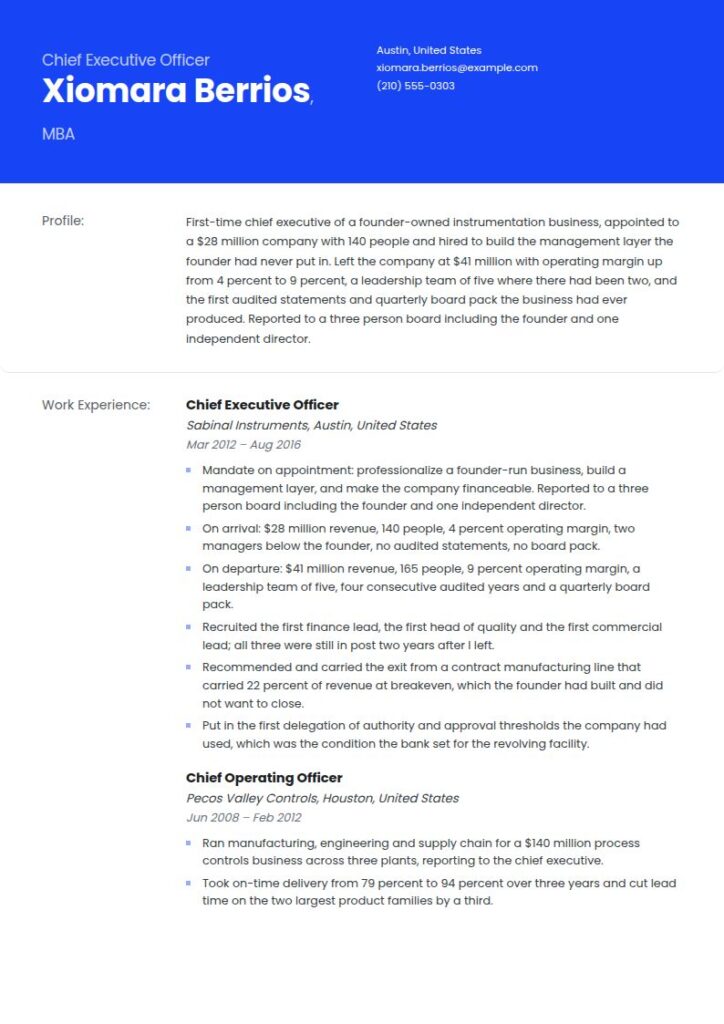
First-time chief executive of a founder-owned instrumentation business, appointed to a $28 million company with 140 people and hired to build the management layer the founder had never put in. Left the company at $41 million with operating margin up from 4 percent to 9 percent, a leadership team of five where there had been two, and the first audited statements and quarterly board pack the business had ever produced. Reported to a three person board including the founder and one independent director.
Work Experience
03/2012 - 08/2016, Chief Executive Officer, Sabinal Instruments, Austin, United States
- Mandate on appointment: professionalize a founder-run business, build a management layer, and make the company financeable. Reported to a three person board including the founder and one independent director.
- On arrival: $28 million revenue, 140 people, 4 percent operating margin, two managers below the founder, no audited statements, no board pack.
- On departure: $41 million revenue, 165 people, 9 percent operating margin, a leadership team of five, four consecutive audited years and a quarterly board pack.
- Recruited the first finance lead, the first head of quality and the first commercial lead; all three were still in post two years after I left.
- Recommended and carried the exit from a contract manufacturing line that carried 22 percent of revenue at breakeven, which the founder had built and did not want to close.
- Put in the first delegation of authority and approval thresholds the company had used, which was the condition the bank set for the revolving facility.
06/2008 - 02/2012, Chief Operating Officer, Pecos Valley Controls, Houston, United States
- Ran manufacturing, engineering and supply chain for a $140 million process controls business across three plants, reporting to the chief executive.
- Took on-time delivery from 79 percent to 94 percent over three years and cut lead time on the two largest product families by a third.
- Presented to the board twice a year on operations and capital, which was the first board exposure that later made a chief executive appointment plausible.
Education
08/2006 - 05/2009, Master of Business Administration, Business Administration, Rice University, Houston, United States
Studied part time while working in plant and operations leadership.
08/1997 - 05/2001, Bachelor of Science, Chemical Engineering, The University of Texas at Austin, Austin, United States
Skills
Board and shareholder reporting, 70
Executive team recruitment, 75
Operating model design, 85
Delegation of authority and approval thresholds, 70
Lender relationships and facility negotiation, 65
Product line exit, 70
Manufacturing and supply chain leadership, 90
Languages
English, native
Spanish, native
Certificates
04/2006, Professional Engineer, Texas, Texas Board of Professional Engineers and Land Surveyors, TX-PE-98412
Held from the plant engineering years and kept current.
Summary
A CEO resume is a two page document written for a board and for owners. It states the mandate you were hired on, what the company looked like on the day you arrived and on the day you left, the capital you raised or returned, the executive team you built, and the one decision nobody else could make. This guide gives you three adaptable versions and current Bureau of Labor Statistics pay and outlook for chief executives.
CEO resume examples by experience level
A CEO resume is a two page document that answers one question a board asks in the first minute: what did the company look like when you arrived, and what did it look like when you left?
Everything else is evidence for that comparison: the mandate you were hired on, the capital you raised or gave back, the executive team you assembled and the single decision that could not be delegated.
This is not the broad senior search document. If you are running one file across chief operating officer, president and senior vice president postings, our executive resume example is built for that. A chief executive resume is narrower and harder, because the person reading it is usually not a hiring manager.
Resume guide for a CEO resume
This guide and the corresponding CEO resume example will cover:
- How to write a CEO resume for a board, an owner or a search committee
- The arrival and exit position, which is the only structure this document really needs
- Three adaptable summaries: first chief executive role, sponsor-owned chief executive, and group chief executive
- How to write capital raised or returned without disclosing anything you should not
- Current Bureau of Labor Statistics pay and outlook, and what the published figure leaves out
How to write a CEO resume
Five blocks: contact header, summary, the arrival and exit position for each company, experience written as decisions, and a closing block for governance, boards and education. Two pages. There is no skills section worth the space.
| Section | What it is answering | Where it goes |
|---|---|---|
| Header | How big, how owned, and who do you answer to? | Under your name, three lines |
| Mandate | Why did the board hire you rather than promote someone? | First line of each role |
| Arrival and exit | What changed, measured the same way at both ends? | Under the role heading |
| Capital | What did you raise, refinance or give back? | Inside the role, with the year |
| Team | Who runs the company now, and where did they come from? | One line per role |
| Governance | Which boards, which committees, how often? | Closing block |
The mandate line is the one most candidates skip. Boards hire chief executives to do something specific the incumbent was not going to do: growth, repair, integration, separation, professionalization, succession. Naming it tells a search committee whether your last job resembles the one they are filling.
Write as though the document will be verified, because it will be. For a company with registered securities, the past five years of an executive officer's business experience and any other public company directorships held in that period are already a filed disclosure under Item 401(e) of Regulation S-K (17 CFR 229.401, most recently amended 2 April 2019), and a search committee reads your resume beside it. A page that quietly upgrades a title or stretches a date ends the process.
Run the finished file through the free ATS resume checker before you send it anywhere. Search firms parse candidate documents into structured records, and a designed two column layout is where that parsing fails.
Choosing the best resume format for a CEO resume
Reverse chronological, two pages, with the last two chief executive roles carrying almost all of the words. Everything before your first officer-level role compresses to a single progression line.
Resist three formats that circulate at this level. A one page board biography is a different document and cannot carry an arrival and exit position. A career dossier is what a search firm assembles from you, not what you send them. A slide deck belongs to the second meeting, where you present a hundred day plan.
Two pages is a ceiling. Three companies means roughly four hundred words each, which is enough if every sentence carries a number.
Include your contact information
| ✅ Right | ❌ Wrong |
|---|---|
| Xiomara Berrios | Xiomara Berrios |
| Chief Executive Officer, industrial water technology, $410M revenue, 1,600 people, 9 sites, 3 countries | Transformational CEO and visionary business leader |
| Board of seven, four independent directors; family holding company with a minority institutional investor | Proven track record of driving growth and shareholder value |
| (210) 555-0303, [email protected], San Antonio, TX | (210) 555-0303, [email protected] |
Three lines carrying scale, ownership and governance. Ownership is the line most chief executive resumes leave out and the one that places you fastest: a family holding company with a minority investor is a different job from a sponsor-owned business on a five year clock, which is different again from a listed subsidiary.
Make use of a summary
Four lines: what the company is and how it is owned, the mandate you were hired on, the arrival and exit position in one sentence, and the capital event.
First-time chief executive of a founder-owned instrumentation business, appointed to a $28 million company with 140 people and hired to build the management layer the founder had never put in. Left the company at $41 million with operating margin up from 4 percent to 9 percent, a leadership team of five where there had been two, and the first audited statements and quarterly board pack the business had ever produced. Reported to a three person board including the founder and one independent director.
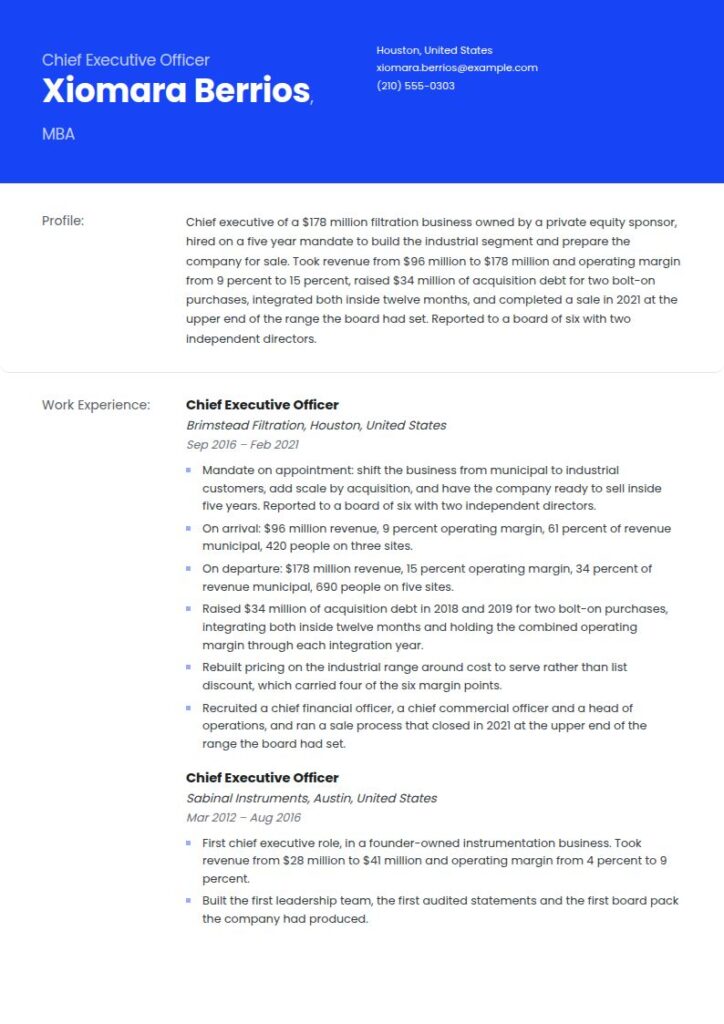
Chief executive of a $178 million filtration business owned by a private equity sponsor, hired on a five year mandate to build the industrial segment and prepare the company for sale. Took revenue from $96 million to $178 million and operating margin from 9 percent to 15 percent, raised $34 million of acquisition debt for two bolt-on purchases, integrated both inside twelve months, and completed a sale in 2021 at the upper end of the range the board had set. Reported to a board of six with two independent directors.
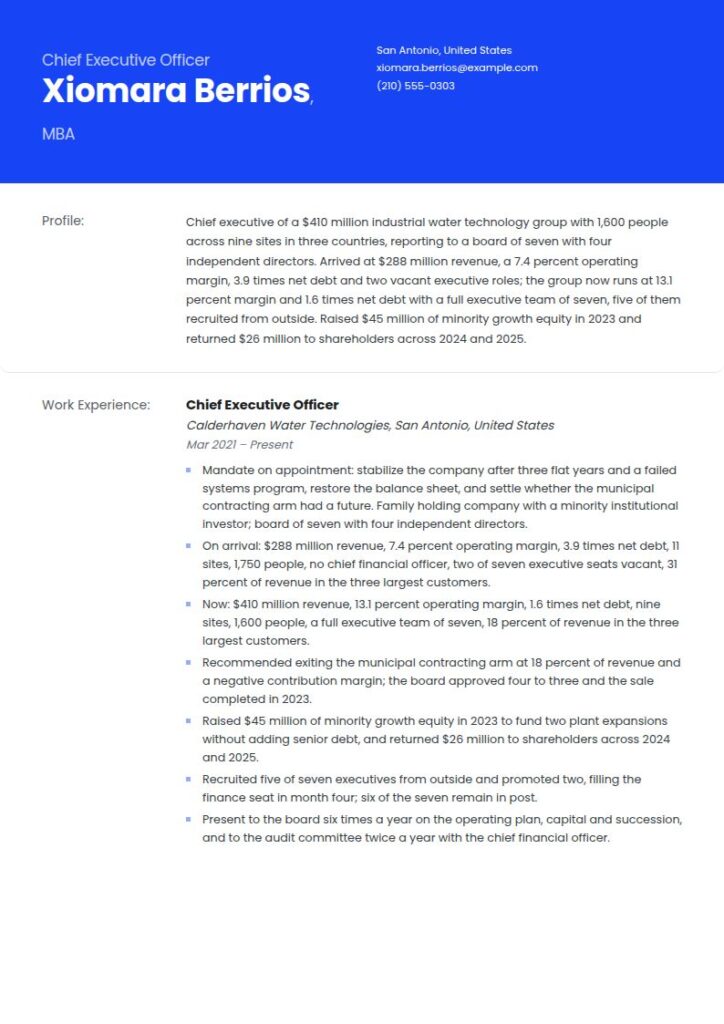
Chief executive of a $410 million industrial water technology group with 1,600 people across nine sites in three countries, reporting to a board of seven with four independent directors. Arrived at $288 million revenue, a 7.4 percent operating margin, 3.9 times net debt and two vacant executive roles; the group now runs at 13.1 percent margin and 1.6 times net debt with a full executive team of seven, five of them recruited from outside. Raised $45 million of minority growth equity in 2023 and returned $26 million to shareholders across 2024 and 2025.
Right vs wrong: the same CEO summary, twice
| ✅ Right | ❌ Wrong |
|---|---|
| Arrived at $288 million revenue, 7.4 percent operating margin and 3.9 times net debt; the group now runs at $410 million, 13.1 percent and 1.6 times. | Led the organization through a period of significant growth and transformation. |
| Hired on a five year mandate to build the industrial segment and prepare the company for sale, completed in 2021. | Partnered with the board to execute against strategic priorities. |
| Recruited five of seven executives from outside and promoted two; the finance seat was filled first, in month four. | Built and inspired a world-class leadership team. |
The left column can be checked by a search partner in two phone calls. The right column is what a nomination committee has read forty times, and it is why the middle of a longlist is interchangeable.
Outline your experience
Company, what it does, revenue, headcount, sites, ownership, board composition, dates. Then the mandate in one line, the arrival and exit position, and four or five bullets on decisions.
| Instead of | Use |
|---|---|
| Provided overall leadership and strategic direction for the company | Chief executive of a $410 million industrial water group, 1,600 people, nine sites, three countries, reporting to a board of seven with four independent directors |
| Drove significant improvement in profitability | Took operating margin from 7.4 percent to 13.1 percent over four years while revenue grew from $288 million to $410 million |
| Strengthened the balance sheet | Cut net debt from 3.9 times to 1.6 times, raised $45 million of minority growth equity in 2023, and returned $26 million to shareholders across 2024 and 2025 |
| Built a high-performing executive team | Filled seven executive seats, five from outside and two by promotion, starting with finance in month four; six of the seven are still in post |
Chief Executive Officer, Calderhaven Water Technologies, San Antonio, TX, $410 million revenue, 1,600 people, nine sites in three countries, family holding company with a minority institutional investor, board of seven with four independent directors, March 2021 to Present
Mandate on appointment: stabilize the company after three flat years and a failed systems program, restore the balance sheet, and settle whether the municipal contracting arm had a future.
On arrival: $288 million revenue, 7.4 percent operating margin, 3.9 times net debt, 11 sites, 1,750 people, no chief financial officer, two of seven executive seats vacant, 31 percent of revenue in the three largest customers.
Now: $410 million revenue, 13.1 percent operating margin, 1.6 times net debt, nine sites, 1,600 people, a full executive team of seven, 18 percent of revenue in the three largest customers.
Recommended exiting the municipal contracting arm, 18 percent of revenue at a negative contribution margin and the source of the company's working capital swings; the board approved four to three and the sale completed in 2023.
Raised $45 million of minority growth equity in 2023 to fund two plant expansions without adding senior debt, and returned $26 million to shareholders across 2024 and 2025 once leverage was inside the covenant band the lenders had reset.
Recruited five of seven executives from outside and promoted two, filling the finance seat in month four; six of the seven remain in post and two are on the succession slate for this role.
Write the arrival and exit position: what the company looked like on both days
This is the section that separates a chief executive resume from every other senior document, and the one candidates most often replace with adjectives.
The rule is simple and unforgiving: pick four or five measures and report them the same way at both ends of your tenure. Not the best four from the start and the best four from the end. The same four. A board that sees revenue and margin at arrival, then revenue, margin, leverage and headcount at exit, knows which measure went the wrong way and will spend the interview on it.
Four measures usually do the work: size, profitability, balance sheet and organization. Add a fifth if the mandate demands it, such as customer concentration, or safety in an industrial business.
The mandate: stabilize after three flat years and a failed systems program, restore the balance sheet, and settle the future of the municipal contracting arm.
Size: $288 million revenue on arrival in March 2021, $410 million now.
Profitability: operating margin 7.4 percent on arrival, 13.1 percent now, on the same definition before and after the divestment.
Balance sheet: net debt 3.9 times on arrival, 1.6 times now, after a $45 million minority equity raise in 2023 and $26 million returned in 2024 and 2025.
Organization: 1,750 people across 11 sites with two executive seats vacant on arrival; 1,600 people across nine sites and a full team of seven now, five recruited externally.
Customer concentration: 31 percent of revenue in the top three customers on arrival, 18 percent now, which was the measure the lenders watched.
The decision that was mine to make: exiting the municipal contracting arm at 18 percent of revenue. The board split four to three. I recommended it, carried it, and the working capital swing has not recurred.
The last line matters more than it looks. Everything above it could have been produced by a strong chief operating officer with a supportive board. The decision that was yours alone is the part nobody below you holds. One per company is plenty.
Capital raised or returned, without disclosing what you should not
Capital is the most checkable thing on a chief executive resume and the most frequently mishandled. The safe version gives an amount, a type and a year: "$45 million of minority growth equity, 2023", "refinanced a $120 million facility in 2024", "returned $26 million to shareholders across 2024 and 2025".
What stays off: the identity of a private investor who has not announced themselves, pricing and covenant terms on a private facility, a valuation or multiple on an unannounced transaction, data room material, and any transaction that has not closed. For a company with registered securities that is a governed question rather than a matter of taste.
If even revenue is restricted, size the company another way: headcount, sites, countries, units shipped, or "a mid-market industrial group". A board can work with that. It cannot work with four years of a chief executive's life described without a single number.
Build a snapshot of your key skills
Six lines at most, and omitting the section entirely is defensible on a chief executive resume. If you keep it, list things you are accountable for to a board, not tools.
Ownership and capital: Board and shareholder reporting, Equity and debt raising, Distribution policy, Sale and divestment processes, Lender and investor relationships
Company building: Executive recruitment and succession, Operating model and site footprint, Integration after acquisition, Customer concentration
Governance and risk: Audit and remuneration committee engagement, Delegation of authority, Crisis leadership, Regulatory and safety exposure
List your education, governance and board roles
Degrees take one line each. The governance block is the part a nomination committee actually studies, because board judgment is the hardest thing on the page to fake.
Master of Business Administration, Rice University, Houston, TX, 2009
Bachelor of Science, Chemical Engineering, The University of Texas at Austin, Austin, TX, 2001
Boards: Director, Calderhaven Water Technologies, since 2021. Non-executive director, Northvale Materials, since 2023, audit committee.
Chief executive history: Sabinal Instruments 2012 to 2016, founder-owned, $28 million to $41 million. Brimstead Filtration 2016 to 2021, sponsor-owned, $96 million to $178 million, sold 2021. Calderhaven Water Technologies since 2021.
Route to the chair: process engineer, plant manager, vice president of operations, chief operating officer, chief executive.
The chief executive history line earns its space. Three companies of increasing size, each with its ownership and its start and end position, is a career in four lines, and it is the first thing a search committee reconstructs by hand if you leave it out.
Choose the right layout and design
Single column, two pages, 11 point, no photograph, no charts, no logos, no skill bars. Give the arrival and exit block its own visual space near the top of each role, because that is where a reader stops. Save as PDF: xiomara-berrios-chief-executive-resume.pdf.
Name the mandate you were hired on, in one sentence, for every chief executive role. Report the same four or five measures at arrival and at exit. State how the company was owned and who sat on the board. Give capital raised, refinanced or returned with the year. Say where your executive team came from and how many are still there. Name the one decision that was yours alone and say how the board voted if it was close.
Do not open with "transformational" or "visionary"; both are self-assessments and neither survives a reference call. Do not report a flattering measure at exit that you did not report at arrival. Do not claim a board decision as your own; say you recommended it and it was approved. Do not put an unclosed transaction, a private valuation or anything from a data room on the page. Do not let your resume disagree with a public filing about a title or a date.
CEO job market and outlook
Chief executives are reported by the Bureau of Labor Statistics inside the wider top executives group. Employment, projected growth and pay are published for chief executives separately; annual openings only for the group.
| Measure | Value |
|---|---|
| Chief executive jobs, 2025 | 291,600 |
| Projected change, 2025 to 2035 | 3 percent growth, +9,300 |
| Annual openings | Published for top executives as a group, about 304,100 |
| Typical entry-level education | Bachelor's degree |
| Work experience in a related occupation | 5 years or more |
| Median annual wage, May 2025 | $213,990 |
Source: U.S. Bureau of Labor Statistics, Occupational Outlook Handbook, May 2025 wage data and 2025 to 2035 projections.
Three percent growth over ten years is a slow market, and it should change what you expect of the document. Roughly 9,300 net new posts across the decade is not a hiring wave; the traffic is in replacement, succession and ownership change, none of it advertised in the ordinary way. Your resume's job is to be ready when a director or a search partner calls, not to win an open competition.
Where chief executives actually sit is the other surprise:
| Sector | Share of chief executive employment, 2025 | Median annual wage, May 2025 |
|---|---|---|
| Self-employed | 27 percent | Not published separately |
| Professional, scientific and technical services | 14 percent | $237,180 |
| Government | 8 percent | $146,700 |
| Healthcare and social assistance | 6 percent | $197,090 |
| Management of companies and enterprises | 5 percent | $358,310 |
Source: U.S. Bureau of Labor Statistics, Occupational Outlook Handbook, 2025 industry employment data and May 2025 wage data.
More than a quarter of the people counted in this occupation run businesses they own. If that is you, the document you need is closer to our entrepreneur resume example, because the reader is a lender, a buyer or a partner rather than a board.
The same title, paid across a two and a half to one spread
Chief executives had a median annual wage of $213,990 in May 2025, with the lowest 10 percent under $75,700 and the highest 10 percent over $507,730 (BLS Occupational Outlook Handbook, May 2025). The title alone tells you nothing about where in that distribution a job sits.
Industry is the largest published lever. The May 2025 median was $358,310 in management of companies and enterprises, $237,180 in professional, scientific and technical services, $197,090 in healthcare and social assistance and $146,700 in government (BLS, May 2025). Same nominal job, two and a half times the money.
One thing cannot be read into any of it. The federal wage survey collects straight-time gross pay, including base rates, incentive pay and production bonuses, and explicitly excludes year-end bonuses, profit-sharing payments, stock bonuses, severance pay and the employer cost of benefits (BLS, Occupational Employment and Wage Statistics survey documentation, accessed 13 September 2026). For a chief executive those exclusions are frequently most of the package. The published figure covers base and regular incentive together and stops there.
What salary you can expect as a CEO
The published figure is $213,990 as the May 2025 median for chief executives, from under $75,700 at the tenth percentile to over $507,730 at the ninetieth (BLS Occupational Outlook Handbook, May 2025). Read it as a distribution of jobs, not a band you negotiate inside.
Four things move a chief executive within it, and all four belong on page one. Size comes first, because compensation committees band against revenue before anything else. Ownership comes second: a sponsor-owned business, a family holding company and a listed subsidiary pay differently for the same revenue. Industry comes third, across the range above. Complexity comes fourth, since nine sites in three countries is not the same job as one site of the same revenue.
Read the published number for what it measures, which is base pay plus regular incentive. Ask for the full structure during the process, including how any long term plan vests and what happens on a change of control, and do not anchor on an equity or bonus figure you cannot source.
Key takeaways for a CEO resume
- Name the mandate you were hired on, in one sentence, for every chief executive role.
- Report the same four or five measures at arrival and at exit, with no substitutions.
- State how the company was owned and who sat on the board.
- Give capital raised, refinanced or returned with the year and the type.
- Say where your executive team came from and how many are still in post.
- Name the one decision that was yours alone, and say how the board voted if it was close.
- Keep unannounced transactions, private valuations and data room material off the page, and make sure nothing on it can disagree with a public filing.
Build your CEO resume in 15 minutes with our AI resume builder.
Related business and management resume examples
- Executive resume
- Chief operating officer resume
- CFO resume
- CIO resume
- CTO resume
- Managing director resume
- Chief of staff resume
- Entrepreneur resume
- Small business owner resume
- Business management resume
- Manager resume
- Consultant resume
Pair it with a matching CEO cover letter.
CEO resume questions, answered
Is a CEO resume different from a board biography?
Completely, and sending the wrong one is a common error. A board biography is third person, three hundred words, written for an annual report, and it summarizes standing. A chief executive resume is two pages and records what changed on your watch, with numbers at both ends. Keep both, and never send the biography to a search committee that asked for a resume.
What do I put on a CEO resume if my results were bad?
The same four measures, honestly reported, plus the mandate. Boards know that some mandates are repairs and some are wind-downs. A chief executive who writes "revenue fell from $210 million to $168 million as we exited two loss-making segments; operating margin moved from negative 3 percent to positive 6 percent and net debt halved" has described a job well done. What does not survive is a page of adjectives with no numbers, because the reader assumes the numbers are the reason.
Should a first-time CEO candidate write the page the same way?
Yes, with one addition. The structure still works on a business unit or division: give it a mandate, an arrival position and an exit position. Then say plainly what you did not hold, such as the board relationship, the capital structure or the hiring of the finance seat. Committees are more comfortable with a candidate who names the gap than one who blurs it.
Can I name the investors, lenders or acquirers I worked with?
Only where the relationship is already public, and even then it is rarely worth the line. An unannounced investor, a private lender, a bidder who did not buy and anything sourced from a data room are off the page. What the reader needs is the type and size of capital and the year, which you can give without naming a counterparty.
How much of the executive team story belongs on a CEO resume?
One line per company, carrying three facts: how many seats you filled, how many came from outside, and how many of those people are still in post. Retention turns a hiring claim into evidence. A chief executive who recruited five executives and kept six of seven has said something a board can verify.