Managing Director Lorcan Cavanaugh
Managing Director, Industrials
[email protected] | (704) 555-0335 | Charlotte, United States
Profile
Newly appointed managing director in a middle-market advisory firm, promoted from director after four years of origination and carrying a personal fee book rather than a profit and loss. Closed 7 sell-side transactions in my first two years at this level, originated $5.8 million of the $9.4 million in fees credited to me, and converted 71 percent of signed engagements to close against a firm average of 58 percent. Hold the Securities Industry Essentials and Series 79 registrations and report to the head of the industrials group.
Work Experience
01/2015 - 06/2019, Managing Director, Industrials, Marchgate Partners, Charlotte, United States
- Covered industrial manufacturing and distribution for a middle-market advisory firm, carrying a personal fee book with no profit and loss responsibility.
- Closed 7 sell-side transactions in the first two years at this level, with enterprise values between $20 million and $90 million.
- Originated $5.8 million of the $9.4 million in fees credited to me, with the split stated separately in every internal review.
- Converted 71 percent of signed engagements to close, against a firm average of 58 percent over the same period.
- Led deal teams of three to five and took two analysts through to associate.
- Registered with the Securities Industry Essentials examination and the Series 79 Investment Banking Representative registration.
08/2011 - 12/2014, Director, Industrials, Marchgate Partners, Charlotte, United States
- Ran execution on sell-side and buy-side processes and built an origination pipeline in industrial distribution.
- Sourced the first three mandates credited to me, which was the basis for promotion to managing director.
07/2004 - 08/2011, Vice President, Corporate Development, Kestrelbrook Group, Charlotte, United States
- Ran acquisition screening, diligence and integration planning for a mid-market industrial group, completing 6 acquisitions.
- Promoted from analyst in 2008.
Education
08/2009 - 05/2011, Master of Business Administration, Business Administration, Fuqua School of Business, Duke University, Durham, United States
08/2000 - 05/2004, Bachelor of Arts, Economics, University of North Carolina at Chapel Hill, Chapel Hill, United States
Skills
Sector coverage and origination, 80
Sell-side process management, 90
Valuation and materials review, 85
Negotiation and closing, 80
Deal team leadership, 80
Client development and repeat mandates, 75
Languages
English, native
Irish, intermediate
Certificates
11/2011, Series 79, Investment Banking Representative, FINRA
Held alongside the Securities Industry Essentials examination.
Summary
Managing director means two different jobs. In a corporate group it is the head of a country or business unit carrying a profit and loss. In banking and professional services it is a senior producer carrying a fee book. This guide helps you decide which one your reader means, then gives three adaptable versions, the numbers each reading is judged on, and current Bureau of Labor Statistics pay and outlook for the occupations the title straddles.
Managing Director resume examples by experience level
Before you write a word, settle one thing: which managing director job is this?
The title covers two roles that share almost nothing. In a corporate group, and in most of the world outside the United States, a managing director runs a country, a subsidiary or a business unit and carries a profit and loss. In investment banking, advisory, consulting and law, the same title means a senior producer who originates and closes work, carries a fee book and may have no profit and loss at all. A resume written for one reads as confused to a reader expecting the other.
| Country or business unit head | Senior producer | |
|---|---|---|
| Found in | Corporate groups, subsidiaries, family businesses, non-US headquarters | Investment banking, advisory, consulting, professional services |
| The core number | Revenue and operating profit for the unit | Fees originated, credited and closed |
| Second number | Headcount, sites, markets | Conversion rate and repeat clients |
| Hired by | A group, a board or a sponsor, reporting to a group chief executive | A firm, usually for the book you bring |
Decide from the job description, not from your own title. Subsidiary, country, general management, operating profit and headcount point to the first column; origination, coverage, mandate, pitch, deal team and fee point to the second. If the posting uses both vocabularies, it is usually a producer role with unit leadership attached, so write the fee book first.
Resume guide for a managing director resume
This guide and the corresponding managing director resume example will cover:
- How to tell which of the two managing director jobs a posting means
- The numbers each reading is judged on, and how to show both when you hold both
- Three adaptable summaries: newly appointed managing director, sector head, and country managing director
- Which registrations and qualifications belong on the page, and for which reading
- Current Bureau of Labor Statistics pay and outlook for the occupations this title straddles
How to write a managing director resume
Five blocks in both readings, with different contents: contact header, summary, the scope block, experience, and a closing block for qualifications and registrations. Two pages.
| Block | Unit head version | Producer version |
|---|---|---|
| Header | Revenue, people, sites, markets, reporting line | Sector, fee book, transaction count, registrations |
| Scope | Profit and loss, balance sheet exposure, legal entity responsibilities | Origination versus execution split, conversion, repeat client share |
| Experience | What the unit looked like at arrival and now | Transactions closed, with size band and role |
| Team | Direct reports and how many you hired | Deal team, juniors developed, group you lead if any |
| Closing | Directorships, governance, education | Registrations, education, memberships |
The single most common failure on this page is writing the producer version for a unit head role, because production numbers feel more concrete. A group chief executive filling a country role will read a page of transaction counts and conclude you have never carried a cost base.
Run the finished file through the free ATS resume checker before you apply, since firms and corporate portals both parse the document into structured fields.
Choosing the best resume format for a managing director resume
Reverse chronological, two pages, with the last two roles carrying most of the words.
One format decision follows from the ambiguity above. If you have done both jobs, and many people at this level have, do not merge them into one narrative. Keep the reverse chronological spine and give whichever reading the posting wants its own block near the top: a profit and loss scope block for a unit head role, a fee and origination block for a producer role. The other version compresses into two lines further down.
Include your contact information
| ✅ Right | ❌ Wrong |
|---|---|
| Lorcan Cavanaugh | Lorcan Cavanaugh |
| Managing Director, United States, middle-market advisory, $46M revenue, 118 people, 3 offices | Senior managing director and seasoned business leader |
| Personal fee book alongside the P&L; SIE, Series 79 and Series 24 registered | Extensive experience in mergers, acquisitions and business leadership |
| (704) 555-0335, [email protected], Charlotte, NC | (704) 555-0335, [email protected] |
Three lines that answer the ambiguity before the reader has to ask. The second is a unit head line: revenue, people, offices. The third says the producer half is still live, which matters in professional services.
Make use of a summary
Four lines. Name the reading first, then the core number, then one thing you built, then the reporting line.
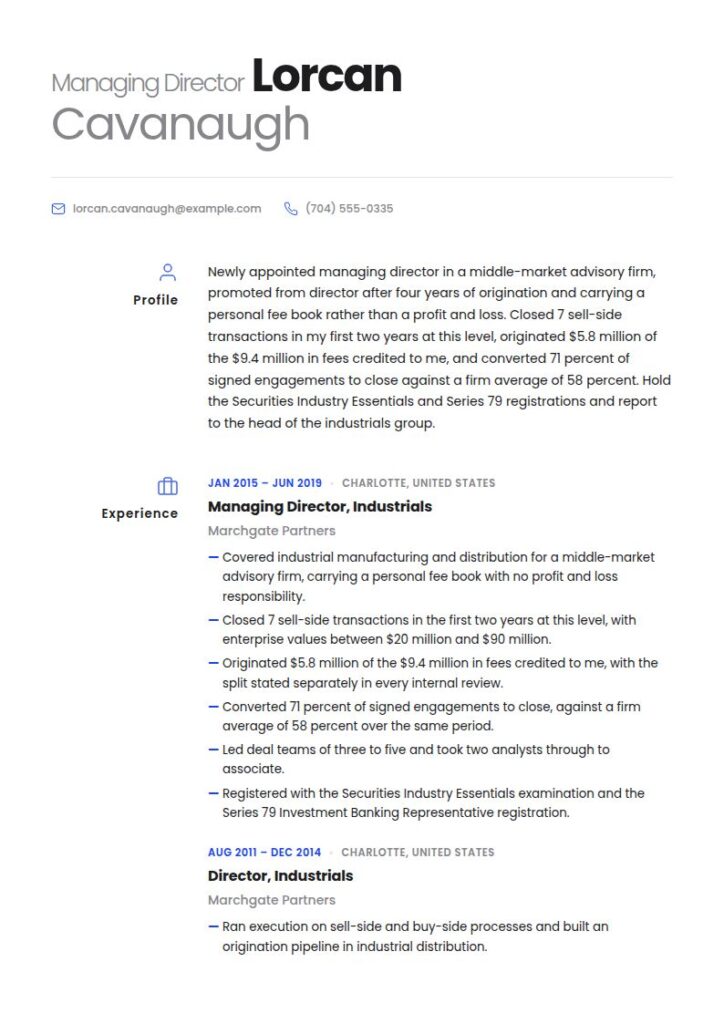
Newly appointed managing director in a middle-market advisory firm, promoted from director after four years of origination and carrying a personal fee book rather than a profit and loss. Closed 7 sell-side transactions in my first two years at this level, originated $5.8 million of the $9.4 million in fees credited to me, and converted 71 percent of signed engagements to close against a firm average of 58 percent. Hold the Securities Industry Essentials and Series 79 registrations and report to the head of the industrials group.
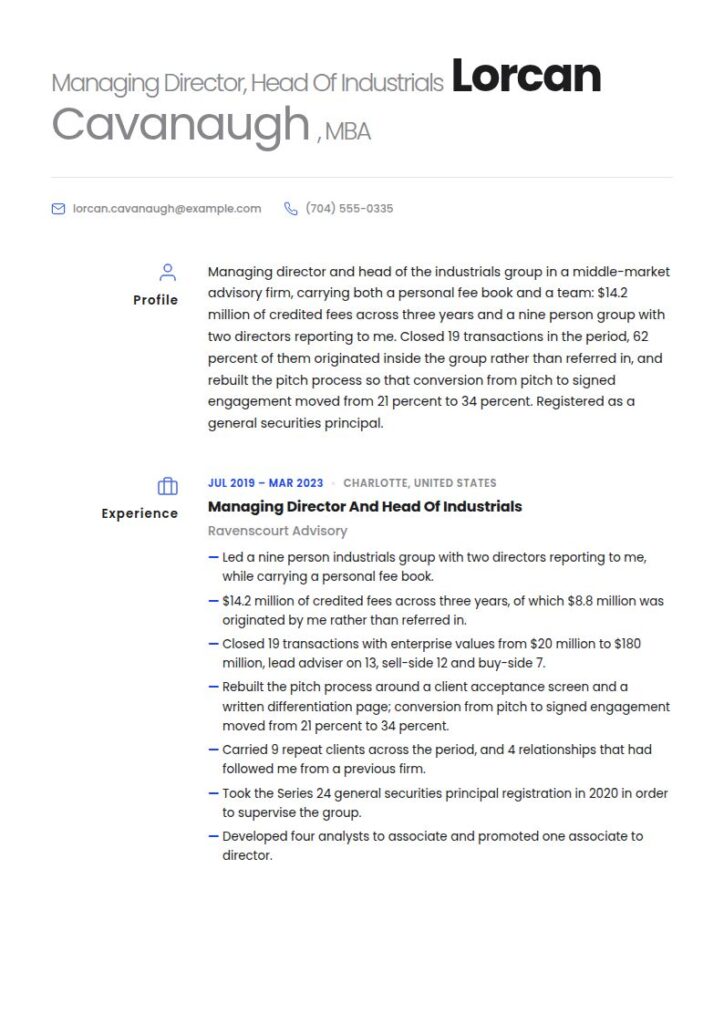
Managing director and head of the industrials group in a middle-market advisory firm, carrying both a personal fee book and a team: $14.2 million of credited fees across three years and a nine person group with two directors reporting to me. Closed 19 transactions in the period, 62 percent of them originated inside the group rather than referred in, and rebuilt the pitch process so that conversion from pitch to signed engagement moved from 21 percent to 34 percent. Registered as a general securities principal.
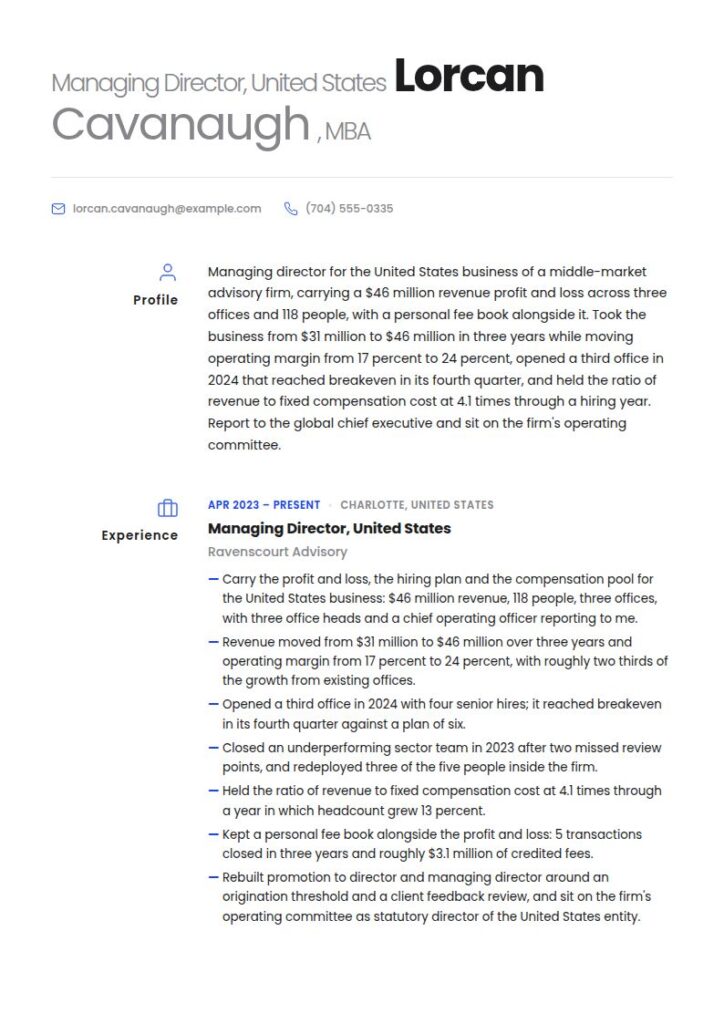
Managing director for the United States business of a middle-market advisory firm, carrying a $46 million revenue profit and loss across three offices and 118 people, with a personal fee book alongside it. Took the business from $31 million to $46 million in three years while moving operating margin from 17 percent to 24 percent, opened a third office in 2024 that reached breakeven in its fourth quarter, and held the ratio of revenue to fixed compensation cost at 4.1 times through a hiring year. Report to the global chief executive and sit on the firm's operating committee.
Right vs wrong: the same managing director summary, twice
| ✅ Right | ❌ Wrong |
|---|---|
| Carry a $46 million revenue profit and loss across three offices and 118 people, reporting to the global chief executive. | Senior leader responsible for driving growth and operational excellence. |
| $14.2 million of credited fees across three years, 62 percent originated inside my group rather than referred in. | Consistently exceeded revenue targets and built strong client relationships. |
| Opened a third office in 2024 that reached breakeven in its fourth quarter. | Successfully expanded the business into new markets. |
The right column tells a reader which managing director you are within about four seconds. The left column could be either, which means it is neither.
Outline your experience
For a unit head role: entity, what it does, revenue, people, sites, markets, reporting line, dates, then the arrival and current position. For a producer role: firm, sector, coverage, fee book, transaction count, registrations, dates, then the transactions with size bands and your role in each.
| Instead of | Use |
|---|---|
| Responsible for the performance of the US business | Carry a $46 million revenue profit and loss across three offices and 118 people, reporting to the global chief executive |
| Grew revenue significantly over my tenure | Took the business from $31 million to $46 million in three years while operating margin moved from 17 percent to 24 percent |
| Led business development and client relationships | Originated $5.8 million of the $9.4 million in fees credited to me, with 62 percent of group volume originated rather than referred |
| Closed numerous high-value transactions | Closed 19 transactions in three years across the $20 million to $180 million enterprise value band, lead adviser on 13 |
Managing Director, United States, Ravenscourt Advisory, Charlotte, NC, $46 million revenue, 118 people, three offices, reporting to the global chief executive, April 2023 to Present
Carry the profit and loss, the hiring plan and the compensation pool for the United States business, with three office heads and a chief operating officer reporting to me, and sit on the firm's operating committee.
Revenue moved from $31 million to $46 million over three years and operating margin from 17 percent to 24 percent, with roughly two thirds of the growth from existing offices rather than from the new one.
Opened a third office in 2024 with four senior hires, which reached breakeven in its fourth quarter against a plan of six, and closed one underperforming sector team the year before after two missed review points.
Held the ratio of revenue to fixed compensation cost at 4.1 times through a year in which headcount grew 13 percent, by moving two thirds of new senior hires onto origination-linked arrangements.
Kept a personal fee book alongside the profit and loss: 5 transactions closed in three years and roughly $3.1 million of credited fees, which is deliberate rather than residual.
Which managing director are you: the one with a P&L or the one with a book?
Answer this in the first four lines, because a reader who cannot tell will assume the answer that makes you smaller. The two readings are judged on different evidence, and mixing them without labeling is what makes so many managing director resumes feel weightless.
Profit and loss: $46 million revenue, 24 percent operating margin, $31 million and 17 percent on arrival in 2023.
Organization: 118 people across three offices, up from 104 across two; three office heads and a chief operating officer reporting to me; voluntary turnover from 21 percent to 9 percent.
Cost base: own the hiring plan and the compensation pool; revenue to fixed compensation cost held at 4.1 times through a 13 percent headcount increase.
Governance: statutory director of the United States entity; report to the global chief executive.
Fee book: $14.2 million credited across three years, of which $8.8 million originated by me rather than referred in.
Volume and shape: 19 transactions closed, enterprise values from $20 million to $180 million, lead adviser on 13, sell-side 12 and buy-side 7.
Conversion: 34 percent of pitches converted to signed engagement, against 21 percent when I took the group; 71 percent of signed engagements reached close.
Clients: 9 repeat clients across the period, and 4 relationships that followed me from a previous firm.
Registrations and team: Securities Industry Essentials, Series 79 and Series 24; a nine person group with two directors reporting to me.
Two more things about the producer reading. First, separate originated from credited: a reader assumes inflation unless you split the two, and the candidate who volunteers "originated $8.8 million of the $14.2 million credited" is believed on both numbers. Second, say what is portable. A firm hiring a managing director is buying future origination under a new letterhead, and the honest signals are repeat clients, relationships that already moved with you once, and sector rather than institutional coverage.
Registrations belong on the page, and only for one of the two readings
For the producer reading in the United States, securities registration is a gate, and stating it saves a conversation.
The Series 79 Investment Banking Representative exam covers advising on or facilitating debt or equity securities offerings and mergers and acquisitions. It is 75 multiple choice items over 2 hours and 30 minutes, and the Securities Industry Essentials examination must be passed before or alongside it (FINRA, Series 79 exam page, with a content outline dated October 2025). Principal-level supervision requires a separate registration.
Write the ones you hold, with nothing else attached: "Securities Industry Essentials, Series 79, Series 24". Do not describe a lapsed registration as current, and do not claim a supervisory registration you have never used; compliance checks all of this before an offer.
For the unit head reading, none of this applies and listing it reads as a candidate applying for a different job. The equivalent line there is statutory directorships and the legal entity responsibilities that come with them.
Build a snapshot of your key skills
Ten to twelve entries, grouped to match the reading you have chosen. Do not list both sets in full; pick one and give the other two lines.
Business leadership: Profit and loss ownership, Compensation pool and cost base management, Office opening and market entry, Hiring plan and senior recruitment, Promotion and performance frameworks, Statutory entity responsibilities
Origination and execution: Sector coverage and origination, Sell-side and buy-side process management, Valuation and materials review, Negotiation and closing, Client development and repeat mandates, Deal team leadership
Governance: Operating committee membership, Conflicts and client acceptance, Compliance and supervision, Risk and quality review
List your education, registrations and qualifications
Short, and ordered by what the reading needs.
Master of Business Administration, Fuqua School of Business, Duke University, Durham, NC, 2011
Bachelor of Arts, Economics, University of North Carolina at Chapel Hill, Chapel Hill, NC, 2004
Registrations: Securities Industry Essentials; Series 79, Investment Banking Representative; Series 24, General Securities Principal.
Governance: Statutory director of the United States operating entity since 2023; member of the firm's operating committee since 2023.
Progression: corporate development analyst, vice president of corporate development, director, managing director, head of industrials, managing director for the United States.
The progression line shows that the same person has held both versions of the title, which is the honest answer to why one resume needs two versions.
Choose the right layout and design
Single column, two pages, 11 point, no photograph, no charts, no logos and no deal tombstone graphics. Put the scope block, whichever reading you chose, directly under the summary. Save as PDF: lorcan-cavanaugh-managing-director-resume.pdf.
Decide from the job description which managing director job is being filled, and write that version first. Put the profit and loss or the fee book in the top four lines. Split originated fees from credited fees. Say which client relationships are portable. Give transaction counts with size bands and your role in each, and name statutory directorships and registrations where the reading calls for them.
Do not send one document to both kinds of role; the top third has to change. Do not quote a credited fee number without saying what you originated. Do not name a client, a counterparty or a transaction that is not public. Do not list securities registrations on an application for a corporate country role, or describe a lapsed registration as current. Do not claim a transaction where you supervised a team as one you led.
Managing director job market and outlook
The Bureau of Labor Statistics publishes no profile for the title "managing director": the two jobs sit in different occupational families. The honest reading is a bracket across four published occupations, two for each version of the role.
| Occupation | Employment, 2025 | Projected change, 2025 to 2035 | Annual openings | Median annual wage, May 2025 |
|---|---|---|---|---|
| General and operations managers | 3,599,000 | 5 percent growth, +181,300 | Published for top executives as a group, about 304,100 | $105,770 |
| Chief executives | 291,600 | 3 percent growth, +9,300 | Published for the group | $213,990 |
| Managers, all other | 1,338,800 | 5 percent growth, +65,600 | Not published | $141,900 |
| Securities, commodities and financial services sales agents | 531,000 | 1 percent growth, +7,500 | About 35,100 | $78,660 |
Source: U.S. Bureau of Labor Statistics, Occupational Outlook Handbook, May 2025 wage data and 2025 to 2035 projections. The "Managers, all other" line comes from the Handbook's Data for Occupations Not Covered in Detail table, which publishes employment, projections and a median but no annual openings and no wage percentiles.
The first three lines are the unit head reading: a managing director running a country or a subsidiary is usually captured in general and operations managers or, in a larger group, in chief executives. The fourth is the producer reading, since the securities, commodities and financial services sales agents profile covers investment bankers who assist with public offerings and with mergers and acquisitions (BLS Occupational Outlook Handbook, accessed 13 September 2026).
Two occupations, two completely different distributions
General and operations managers had a median annual wage of $105,770 in May 2025, with the lowest 10 percent under $50,090 and the highest 10 percent over $253,390. Chief executives had a median of $213,990, from under $75,700 to over $507,730 (BLS Occupational Outlook Handbook, May 2025).
The producer reading looks completely different. Securities, commodities and financial services sales agents had a median of $78,660, with the lowest 10 percent under $48,040 and the highest 10 percent over $212,880, and the industry spread inside that occupation is the widest part of the picture: a median of $103,030 in securities and commodity contracts against $61,720 in credit intermediation, where 54 percent of the occupation's employment sits (BLS, May 2025 wage data and 2025 industry employment data). A middle-market advisory managing director sits at the far right of that distribution.
None of these figures can be read as a managing director package. The federal wage survey collects straight-time gross pay, which includes commissions, incentive pay and production bonuses but excludes year-end bonuses, profit-sharing payments and stock bonuses (BLS, Occupational Employment and Wage Statistics survey documentation, accessed 13 September 2026). In advisory and banking the year-end award is frequently the larger part of the year, and carried interest and partnership distributions are not covered at all.
What salary you can expect as a managing director
Which bracket applies to you depends entirely on which reading of the title you have, and the two are not close.
For the unit head reading, the usable figures are general and operations managers at a $105,770 median, from under $50,090 to over $253,390, and chief executives at $213,990, from under $75,700 to over $507,730 (BLS Occupational Outlook Handbook, May 2025). What moves you inside that is the size of the unit, whether you carry a full profit and loss or only a revenue line, the number of markets and legal entities, and whether you are a statutory director; all four belong in your top four lines.
For the producer reading, the published occupation is securities, commodities and financial services sales agents, with a $78,660 median and a tenth to ninetieth percentile range of under $48,040 to over $212,880 (BLS, May 2025). Read that with care: the occupation is dominated by credit intermediation, 54 percent of employment at a $61,720 median, while securities and commodity contracts pays a $103,030 median (BLS, May 2025). What moves you inside it is the fee book, the origination share and the sector.
For both readings the published number is base plus regular incentive, and it excludes the components that dominate pay at this level. Ask for the full structure, including how the annual award is determined and what any deferral or partnership arrangement involves.
Key takeaways for a managing director resume
- Decide which managing director job the posting means before you write anything.
- Put the profit and loss or the fee book in the top four lines, not both.
- For a unit head role, give the unit at arrival and now, plus the cost base you own.
- For a producer role, split originated fees from credited fees, always.
- Say which client relationships are portable and which belong to the institution.
- Give transaction counts with size bands and your actual role in each.
- List securities registrations only for the producer reading, and statutory directorships only for the other.
- Rewrite the top third for each application; the two versions do not merge.
Build your managing director resume in 15 minutes with our AI resume builder.
Related business and management resume examples
- CEO resume
- Executive resume
- Chief operating officer resume
- CFO resume
- CIO resume
- Chief of staff resume
- Business development resume
- Consulting resume
- Consultant resume
- Business management resume
- Manager resume
- Entrepreneur resume
Pair it with a matching managing director cover letter.
Managing director resume questions, answered
Is a managing director the same as a CEO?
Sometimes, depending on the country and the corporate structure. In many groups outside the United States the managing director is the most senior executive of a company or subsidiary, which is the chief executive job under a different name, and our [CEO resume example](/resume/ceo/) is the closer document. In a United States group a managing director usually runs a unit below the chief executive, and in banking and advisory it is a seniority grade. Say which one you are in the header.
How do I write a managing director resume when I hold both jobs?
Pick the reading the posting wants for the top third, and compress the other into two lines. A country head with a live fee book leads with the profit and loss and adds one line saying the book is deliberate; a sector head with a small unit budget leads with fees and mentions the cost base once. An even split reads as a candidate unsure what they were hired to do.
What do I do about confidential transactions and clients?
Give the shape, never the name. Enterprise value bands, sector, sell-side or buy-side, your role and the year are sufficient. Named clients, named counterparties, unannounced transactions and any deal that did not close are not, whether or not the engagement has ended. If a transaction is public and you were named in the announcement, naming it is fine.
Should a managing director resume include a deal list?
For the producer reading, yes, as a compact block rather than a page: eight to twelve lines, each with sector, size band, side and your role, and a count above it. For the unit head reading, no; a transaction list there reads as a candidate who has not moved out of execution, so keep one deal line at most.
How much does the fee credit number need explaining?
Enough to be believed. Every firm credits differently, so a bare number invites discounting. The strongest form gives both sides, originated and credited, with the period. Adding conversion figures such as pitch to engagement and engagement to close makes the block harder to dismiss, because those ratios cannot be inflated by a credit policy.
What registrations should be on the page?
For the producer reading in the United States, the ones you actually hold, listed plainly: the Securities Industry Essentials examination, the Series 79 Investment Banking Representative registration, and a principal registration such as Series 24 if you have used it. Firms verify these before an offer. For the unit head reading, leave them off and list statutory directorships instead.