Shift Supervisor, Second Shift Idalia Arredondo
Shift Supervisor, Second Shift
[email protected] | (559) 555-0352 | Fresno, United States
Profile
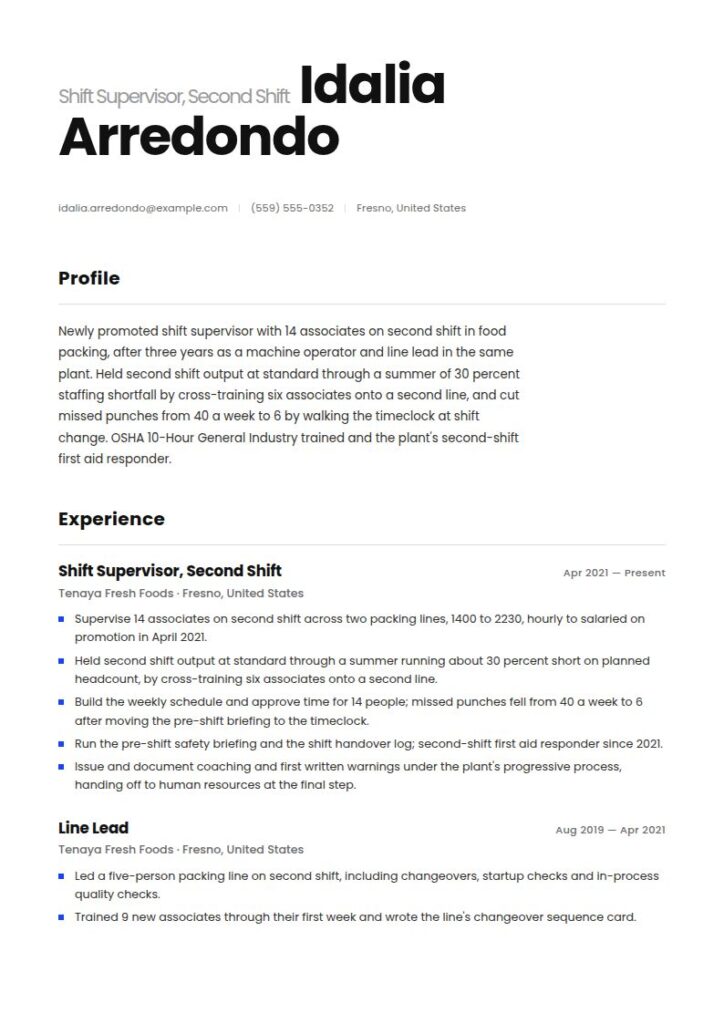
Newly promoted shift supervisor with 14 associates on second shift in food packing, after three years as a machine operator and line lead in the same plant. Held second shift output at standard through a summer of 30 percent staffing shortfall by cross-training six associates onto a second line, and cut missed punches from 40 a week to 6 by walking the timeclock at shift change. OSHA 10-Hour General Industry trained and the plant's second-shift first aid responder.
Work Experience
04/2021 - Present, Shift Supervisor, Second Shift, Tenaya Fresh Foods, Fresno, United States
- Supervise 14 associates on second shift across two packing lines, 1400 to 2230, hourly to salaried on promotion in April 2021.
- Held second shift output at standard through a summer running about 30 percent short on planned headcount, by cross-training six associates onto a second line.
- Build the weekly schedule and approve time for 14 people; missed punches fell from 40 a week to 6 after moving the pre-shift briefing to the timeclock.
- Run the pre-shift safety briefing and the shift handover log; second-shift first aid responder since 2021.
- Issue and document coaching and first written warnings under the plant's progressive process, handing off to human resources at the final step.
08/2019 - 04/2021, Line Lead, Tenaya Fresh Foods, Fresno, United States
- Led a five-person packing line on second shift, including changeovers, startup checks and in-process quality checks.
- Trained 9 new associates through their first week and wrote the line's changeover sequence card.
- Covered the shift supervisor for three separate weeks, including the schedule, two escalations and a new starter's first week.
06/2018 - 08/2019, Machine Operator, Tenaya Fresh Foods, Fresno, United States
- Ran case packing and labeling equipment on second shift, with operator-level preventive maintenance and quality checks.
Education
08/2016 - 05/2018, Associate of Science, Business Administration, Fresno City College, Fresno, United States
Studied evenings while working full time on second shift.
Skills
Shift scheduling and coverage planning, 70
Cross-training plans, 75
Timekeeping and attendance administration, 80
Pre-shift briefings and shift handover, 80
In-process quality checks, 75
Changeover and startup routines, 85
Near-miss reporting, 70
Kronos timekeeping, 70
Languages
English, native
Spanish, native
Certificates
10/2019, OSHA 10-Hour General Industry, OSHA Outreach Training Program
Completed as a line lead before promotion to shift supervisor.
01/2026, First Aid and CPR, American Red Cross
Second-shift first aid responder for the plant.
Summary
A supervisor resume is a one to two page document naming the shift you cover, the people on it, the daily numbers you are held to, and the decisions you make without asking. This guide gives you three adaptable versions, the coverage block that separates a supervisor from a manager, and current Bureau of Labor Statistics pay and outlook for the occupations around the title.
Supervisor resume examples by experience level
A supervisor resume is a one to two page document that says which shift you cover, how many people are on it, what numbers you are held to at the end of that shift, and what you can decide without picking up the phone.
It is written for shift and floor supervision in an operational setting: a plant, a warehouse, a service line, a kitchen, a call floor. The person who builds the schedule, fills the gap when two people call out at five in the morning, approves the timecards, holds the daily quality and safety numbers, and starts a disciplinary process that human resources finishes.
The difference from a manager is not seniority or headcount. A supervisor directs work; a manager owns the outcome and the headcount decisions behind it. You can supervise sixty people and hold no requisition, no pay band and no final performance rating, and a good resume says which of those you hold rather than letting the reader guess. Our manager resume example covers the layer above.
Resume guide for a supervisor resume
This guide and the corresponding supervisor resume example will cover:
- How to write a supervisor resume, section by section
- The coverage block: shift, headcount, absence and overtime
- Three adaptable summaries: newly promoted, established and lead supervisor
- How to write about discipline, timekeeping and safety without naming anyone
- What the job market looks like and what supervisors can expect to earn
How to write a supervisor resume
Six sections: contact header, summary, the coverage block, experience, skills and systems, and education and certifications. One page for your first five years supervising, two once you have covered more than one shift or department. The order is built around what an operations manager screens for: they have a shift that is not running well, and they read for whether you have stood on that floor at that hour and held the numbers.
| Section | What it is answering | Where it goes |
|---|---|---|
| Coverage block | Which shift, how many people, and what happens when two of them are out? | Directly under the summary |
| Experience | What did the shift produce while you ran it, in numbers, over a stated period | Reverse chronological |
Say whether the role was hourly or salaried, and never claim a status you did not hold
Supervisor is one of the few titles that sits on both sides of the overtime line, and readers in operations know it. Some supervisors are paid hourly and clock in with the crew, some are salaried. State which you were, because it places your layer better than the title does: "promoted from line lead to salaried shift supervisor in March 2022" is exact.
The Department of Labor announced a technical amendment on 14 May 2026 restoring regulations that "require that most exempt executive, administrative, and professional employees be paid a salary of at least $684 per week" and set "a total annual compensation threshold of $107,432 for certain highly compensated employees" (U.S. Department of Labor, 14 May 2026).
Do not write exempt or non-exempt as though it were a credential, and do not call yourself exempt if your pay stub says otherwise. Write the pay basis as a fact and move on.
Run the finished file through the free ATS resume checker before you send it. Supervisor postings at large employers are filtered by software first.
Choosing the best resume format for a supervisor resume
Reverse chronological. One page for your first five years, two once there is a second shift or a second department worth describing in detail.
The reason is promotion history. Most supervisors came off the floor, so split an internal promotion into separate dated entries under the same employer. "Machine Operator, 2016 to 2018" above "Line Lead, 2018 to 2019" above "Shift Supervisor, 2019 to 2022" is three facts; one merged entry is one. Functional formats fail here because the reader wants to know which shift, which building and for how long.
Include your contact information
| ✅ Right | ❌ Wrong |
|---|---|
| Idalia Arredondo | Idalia Arredondo |
| Production Supervisor, first shift, 26 associates | Hardworking supervisor and team player |
| 118,000 lb processed a shift, 99% on-time truck departure | Motivated leader with strong communication skills |
| (559) 555-0352, [email protected], Fresno, CA | (559) 555-0352, [email protected] |
Shift, headcount and one volume figure under your name, and the reader knows your layer before the summary starts. Without them a hiring manager defaults to the smallest reading of the title.
Make use of a summary
Four lines: the shift and what it runs, headcount, the one number you are held to with a before and an after, and one thing about people, usually coverage, turnover or safety.
Newly promoted shift supervisor with 14 associates on second shift in food packing, after three years as a machine operator and line lead in the same plant. Held second shift output at standard through a summer of 30 percent staffing shortfall by cross-training six associates onto a second line, and cut missed punches from 40 a week to 6 by walking the timeclock at shift change. OSHA 10-Hour General Industry trained and the plant's second-shift first aid responder.
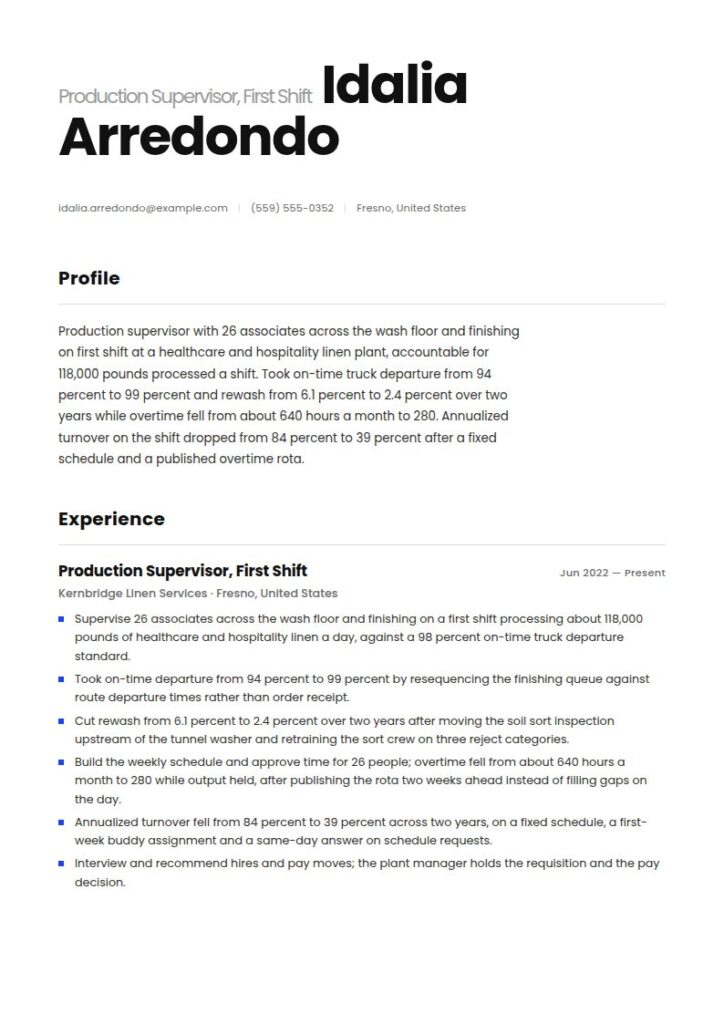
Production supervisor with 26 associates across the wash floor and finishing on first shift at a healthcare and hospitality linen plant, accountable for 118,000 pounds processed a shift. Took on-time truck departure from 94 percent to 99 percent and rewash from 6.1 percent to 2.4 percent over two years while overtime fell from about 640 hours a month to 280. Annualized turnover on the shift dropped from 84 percent to 39 percent after a fixed schedule and a published overtime rota.
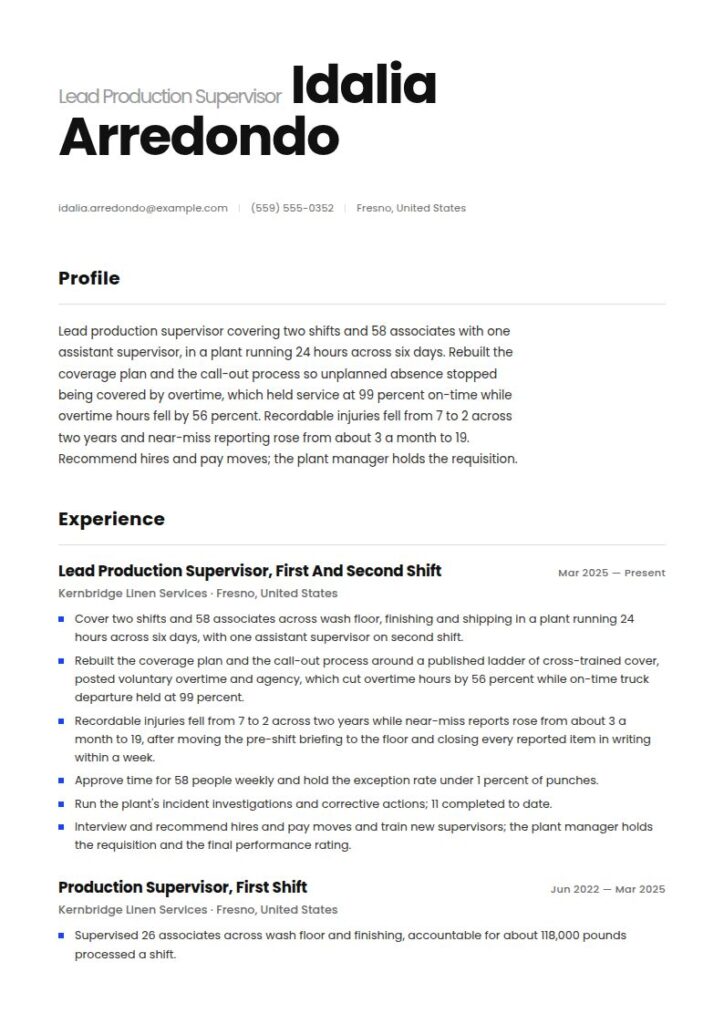
Lead production supervisor covering two shifts and 58 associates with one assistant supervisor, in a plant running 24 hours across six days. Rebuilt the coverage plan and the call-out process so unplanned absence stopped being covered by overtime, which held service at 99 percent on-time while overtime hours fell by 56 percent. Recordable injuries fell from 7 to 2 across two years and near-miss reporting rose from about 3 a month to 19. Recommend hires and pay moves; the plant manager holds the requisition.
Right vs wrong: the same supervisor summary, twice
| ✅ Right | ❌ Wrong |
|---|---|
| Production supervisor with 26 associates on first shift, accountable for 118,000 pounds processed a shift. | Experienced supervisor with a proven ability to lead teams in a fast-paced environment. |
| On-time truck departure 94 percent to 99 percent; rewash 6.1 percent to 2.4 percent over two years. | Responsible for overseeing daily operations and ensuring productivity targets were met. |
| Annualized turnover fell from 84 percent to 39 percent after a fixed schedule and a published overtime rota. | Skilled at motivating employees and maintaining a positive working environment. |
The left column is checkable in a reference call and specific to one building. The right column could have been written by anyone who ever held the title, which is why the reader stopped at the third file.
Outline your experience
Employer, what the site does, your shift, headcount and dates. Then four to six bullets on the current role and two or three on the one before. Every bullet moves a number, names a process you built, or describes a decision you took.
| Instead of | Use |
|---|---|
| Supervised a team of production associates | Supervise 26 associates across wash floor and finishing on first shift, 6 of them cross-trained onto two departments |
| Responsible for meeting daily production targets | Accountable for 118,000 pounds processed a shift and a 98 percent on-time truck departure standard |
| Improved quality | Cut rewash from 6.1 percent to 2.4 percent over two years by moving the sort inspection upstream of the tunnel washer |
| Maintained a safe work environment | Recordable injuries fell from 7 to 2 across two years while near-miss reports rose from about 3 a month to 19 |
| Addressed performance issues | Issued and documented coaching and written warnings under the plant's progressive process, handing off to human resources at the final step |
Production Supervisor, First Shift, Kernbridge Linen Services, Fresno, CA, June 2022 to March 2025
Supervised 26 associates across the wash floor and finishing on a first shift processing about 118,000 pounds of healthcare and hospitality linen a day, against a 98 percent on-time truck departure standard.
Took on-time departure from 94 percent to 99 percent by resequencing the finishing queue against route departure times rather than order receipt.
Cut rewash from 6.1 percent to 2.4 percent over two years after moving the soil sort inspection upstream of the tunnel washer and retraining the sort crew on three reject categories.
Built the weekly schedule and approved time for 26 people; overtime fell from about 640 hours a month to 280 while output held, after publishing the rota two weeks ahead instead of filling gaps on the day.
Write the shift: coverage, the daily numbers and where your authority stops
This is the block a supervisor resume is won on, and it takes four short lines directly under the summary. The title tells a reader almost nothing; these four facts tell them everything.
The shift. Which shift, what hours, how many people, and what they run. Not "a team of associates" but "26 associates on first shift, 0500 to 1330, wash floor and finishing". Say whether you cover a second shift or a weekend operation.
The coverage. Almost nobody writes this and it is the actual work. Planned headcount against what shows up, the unplanned absence rate, the overtime hours you carry, and how you fill a gap in the order you fill it: cross-trained associate, voluntary overtime, mandatory overtime, agency, or run short and tell the customer. Describing that ladder in one sentence says more than a page of adjectives.
The daily numbers. The two or three measures read at the end of your shift, named as your employer names them, each with a before, an after and a period: volume, service, quality, safety. Pick the ones you were reviewed against, not the ones that sound largest.
Where your authority stops. What you decide alone, what you recommend, and where it leaves your hands. Do you sign overtime, approve a shift swap, stop the line, issue a written warning or only the verbal step? Does your recommendation decide the hire? A reader finds this out in the interview anyway, and saying it on the page reads as accuracy.
Shift: first shift, 0500 to 1330, 26 associates across wash floor and finishing, 6 cross-trained across both. One working lead, no indirect reports.
Coverage: planned 26, average attendance 23. Unplanned absence 11 percent. Ladder is cross-trained associate, then posted voluntary overtime, then agency, then a call to the route planner before running short. Overtime 640 hours a month to 280 across two years.
Daily numbers: 118,000 lb processed a shift; on-time truck departure 94 percent to 99 percent; rewash 6.1 percent to 2.4 percent; recordable injuries 7 to 2 across two years.
Authority: build the schedule, approve time and shift swaps, sign overtime to a weekly ceiling, stop the line on a quality or safety call, issue coaching and written warnings. Interview and recommend; the plant manager holds the requisition and the pay decision.
Four lines, and a reader can place you against their own vacancy in six seconds.
Timekeeping is a record, not an administrative chore, and it belongs on the page
Approving time is the least glamorous thing on a supervisor's list and one of the most consequential, because the record you sign off is the record the employer has to keep.
Under the Fair Labor Standards Act an employer must keep, for each non-exempt worker, the "time and day of week when employee's workweek begins", the "hours worked each day" and the "total hours worked each workweek", preserving payroll records for at least three years and the records wage computations are based on for two (U.S. Department of Labor, Wage and Hour Division, Fact Sheet #21, revised July 2008). The same fact sheet notes that "any timekeeping plan is acceptable as long as it is complete and accurate", and complete and accurate is the supervisor's job every week.
So write it as a control rather than a chore: how many people you approve time for, the exception rate you inherited and the one you reached. "Approve time for 26 associates weekly; missed-punch exceptions fell from 40 a week to 6 after moving the badge reader to the shift-change door" reads as the operational improvement it is.
Build a snapshot of your key skills
Ten to fourteen entries in three groups: running the shift, running the people, and the systems you run it in. Keep the systems honest; a new employer is estimating your onboarding time.
Running the shift: Shift scheduling and coverage planning, Line balancing, Changeover and startup routines, Throughput and cycle time, Root cause and corrective action, Preventive maintenance coordination, 5S and standard work
Running the people: Onboarding and cross-training plans, Daily shift handover, Toolbox and pre-shift briefings, Progressive discipline documentation, Timekeeping and attendance administration, Return to work coordination
Safety and quality: Job hazard analysis, Near-miss reporting, Lockout tagout verification, Incident investigation, In-process quality checks, Hold and release decisions
Systems: Kronos timekeeping, SAP production reporting, Microsoft Excel scheduling models
List your education and certifications
Most supervisor postings in operations ask for a high school diploma with experience, and many take experience alone. Safety certificates carry real weight because they are checkable and map to the accountabilities. Put the promotion path on its own line: it is the cheapest credibility on a supervisor resume and the one people leave off.
Associate of Science, Business Administration, Fresno City College, Fresno, CA, 2018
Certifications: OSHA 30-Hour General Industry, OSHA Outreach Training Program, 2023. OSHA 10-Hour General Industry, 2019. First Aid and CPR, American Red Cross, 2026.
Internal: Completed the plant's four-module supervisor development program, 2022. Trained incident investigator since 2023, 11 investigations completed.
Progression: Machine Operator, Line Lead, Shift Supervisor, Production Supervisor, Lead Production Supervisor
Choose the right layout and design
Single column, 11 or 12 point, plain headings, no photograph, no skill bars. Keep the coverage block on the top half of page one so it survives a six-second skim. Save as a PDF named for yourself and the role, for example idalia-arredondo-production-supervisor-resume.pdf, unless the portal asks for Word. Plant and distribution employers often use kiosk applications, and plain single-column text is what survives them.
Name the shift and its hours. Give headcount and one volume figure under your name. Write the coverage ladder you use when people are out. Give two or three daily numbers with a before, an after and a period. State what you decide alone and where it stops. Split an internal promotion into separate dated entries. Say whether the role was hourly or salaried.
Do not write "supervised a team" with no number attached. Do not claim hiring authority you do not hold; a reference call settles it in one question. Do not describe a disciplinary matter as a story about a person. Do not list a lapsed safety card without saying so. Do not pad with duties every supervisor performs.
A supervisor’s pay sits in the gap between the crew and the manager, and only the resume says where
Production occupations had a median annual wage of $46,990 in May 2025, below the $50,980 median for all occupations, with about 867,700 openings projected each year, largely to replace workers who leave permanently, and employment projected to show little or no change from 2025 to 2035 (U.S. Bureau of Labor Statistics, Occupational Outlook Handbook, published 27 August 2026).
Above that sit the published management profiles: industrial production managers had a median of $126,060 in May 2025 and general and operations managers $105,770 (BLS Occupational Outlook Handbook, May 2025). A supervisor's band lives between those figures, and nothing in the title says where, which is why headcount, volume and authority have to be on the page.
When a group turns over at that rate, keeping a shift staffed is most of the job, so turnover, absence and overtime belong on the page with the same weight as throughput.
Supervisor job market and outlook
The Bureau of Labor Statistics publishes no Occupational Outlook Handbook profile for supervisor. The Handbook covers broad occupations rather than job titles, and first-line supervision is split across the group being supervised, so no single published figure describes the title.
No current-cycle figure for first-line supervisors in production, transportation, office support, retail or food service could be retrieved from the Handbook's Data for Occupations Not Covered in Detail table, so none is quoted here. What follows is a bracket: the group typically supervised, the management profiles a supervisor is promoted into, and the catch-all management row.
| Bracketing measure | Employment, 2025 | Projected change, 2025 to 2035 | Annual openings | Median annual wage, May 2025 |
|---|---|---|---|---|
| Production occupations (the group supervised) | Not published as a single total | Little or no change | About 867,700 | $46,990 |
| Industrial production managers | 252,100 | 3 percent, about as fast as average, +6,500 | About 17,000 | $126,060 |
| General and operations managers | 3,599,000 | 5 percent growth, +181,300 | Reported within top executives: about 304,100 | $105,770 |
| Managers, all other | 1,338,800 | 5 percent, +65,600 | Not published | $141,900 |
Source: U.S. Bureau of Labor Statistics, Occupational Outlook Handbook, May 2025 wage data and 2025 to 2035 projections, published 27 August 2026, including the Handbook's Data for Occupations Not Covered in Detail table, which publishes employment, projections and medians but no annual openings and no wage percentiles.
Two things follow. Your next title is often a published occupation even when your current one is not, so read the profile for the job above you. And sector moves the band more than another year in the role: industrial production managers earned a median of $135,530 in chemical manufacturing against $116,250 in food manufacturing in May 2025 (BLS Occupational Outlook Handbook, May 2025).
What salary you can expect as a supervisor
No federal median exists for the bare title, so think about pay as a position between two published numbers. Below you is the group you supervise: production occupations had a median of $46,990 in May 2025. Above you is the manager: industrial production managers had a median of $126,060 in the same cycle, with the lowest 10 percent under $78,000 and the highest 10 percent over $205,520, and general and operations managers had a median of $105,770 with the lowest 10 percent under $50,090 (BLS Occupational Outlook Handbook, May 2025).
Three things move you inside that space, and all three are resume facts. Headcount and shift pattern come first: a nights and weekends supervisor covering 58 people is a different job from a day-shift supervisor covering 12. Safety exposure is second, because a regulated site pays for a supervisor who can evidence a falling recordable rate. Breadth is third: two departments beats another year on one line.
Read the published figures for what they measure. The federal wage survey collects straight-time gross pay including base rates, piece rates and production bonuses, and excludes overtime pay, shift differentials, non-production bonuses and year-end bonuses (U.S. Bureau of Labor Statistics, Occupational Employment and Wage Statistics survey documentation, accessed 13 September 2026). For an hourly supervisor working a differential and regular overtime that exclusion is a real part of earnings, so compare offers on total scheduled pay.
Key takeaways for a supervisor resume
- Name the shift, its hours and the headcount in the first line, because the title alone places you nowhere.
- Write the coverage block: shift, coverage ladder, the daily numbers, where authority stops.
- Give two or three operational numbers with a before, an after and a period, not a list of duties.
- Put absence, overtime and turnover on the page next to throughput; they are half the job.
- Write safety as rates and reporting behavior, and timekeeping as a control with an exception rate.
- Describe discipline as a process and a step, never as a person's story.
- Split every internal promotion into its own dated entry so the climb is visible.
Build your supervisor resume in 15 minutes with our AI resume builder.
Related business and management resume examples
- Manager resume
- Team lead resume
- Assistant manager resume
- Operations manager resume
- Project coordinator resume
- Event coordinator resume
- Business manager resume
- Project manager resume
- Program manager resume
- Customer success resume
- Executive resume
- Business management resume
Pair it with a matching supervisor cover letter.
Supervisor resume questions, answered
How long should a supervisor resume be?
One page for your first five years supervising. Two once you cover more than one shift or department, or once the promotion history needs the room. Never three. If you run to two pages on a single shift, the second page is usually duties every supervisor performs.
What is the difference between a supervisor resume and a manager resume?
Authority over outcomes and headcount. A supervisor directs the work: the schedule, the daily numbers, the coverage, the first steps of a disciplinary process. A manager owns the result, the requisition, the pay band and the final rating, and is measured over a month rather than a shift. Writing that distinction plainly is more convincing than blurring it. If you are applying upward, start from the [manager resume example](/resume/manager/).
How do I write about disciplinary action without naming anyone?
Describe the process and your step in it. "Issued and documented coaching and written warnings under the plant's progressive process, handing off to human resources at the final step" shows you complete difficult conversations and identifies nobody. Keep off the page every name or initial, any role held by only one person, any reason for a departure, and anything drawn from a personnel file.
I supervise but I am paid hourly. Does that weaken my resume?
No, and hiding it does. Hourly supervision is normal in plants, warehouses, kitchens and call floors. Write the pay basis as a fact and let the coverage block persuade. If you moved from hourly to salaried, that transition deserves its own dated line, because it is a promotion your title may not show.
What if I supervise without the supervisor title?
Write the work. Lead operator, charge hand, crew lead and acting supervisor all do the job under another name. Give the headcount you directed, the shifts you covered alone, the schedule you built and the numbers the shift produced. Then state what you did not hold; a vague claim reads worse than an accurate boundary.
Should safety numbers go on a supervisor resume?
Yes, and they are often the strongest thing on it. Give the recordable rate with a before, an after and a period, and pair it with a reporting measure such as near misses raised per month: a rising near-miss count alongside a falling injury count tells an experienced reader the culture changed. Do not describe any incident in a way that could identify the person involved.