Customer Success Associate Isolde Bergmann
Customer Success Associate
[email protected] | (617) 555-0685 | Boston, United States
Profile
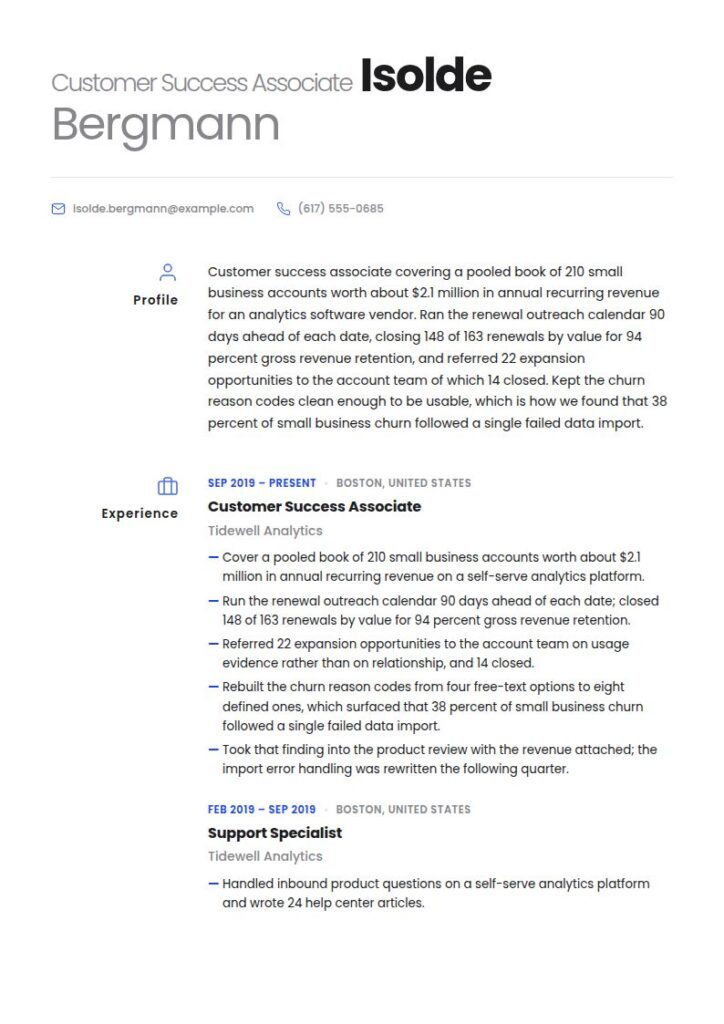
Customer success associate covering a pooled book of 210 small business accounts worth about $2.1 million in annual recurring revenue for an analytics software vendor. Ran the renewal outreach calendar 90 days ahead of each date, closing 148 of 163 renewals by value for 94 percent gross revenue retention, and referred 22 expansion opportunities to the account team of which 14 closed. Kept the churn reason codes clean enough to be usable, which is how we found that 38 percent of small business churn followed a single failed data import.
Work Experience
09/2019 - Present, Customer Success Associate, Tidewell Analytics, Boston, United States
- Cover a pooled book of 210 small business accounts worth about $2.1 million in annual recurring revenue on a self-serve analytics platform.
- Run the renewal outreach calendar 90 days ahead of each date; closed 148 of 163 renewals by value for 94 percent gross revenue retention.
- Referred 22 expansion opportunities to the account team on usage evidence rather than on relationship, and 14 closed.
- Rebuilt the churn reason codes from four free-text options to eight defined ones, which surfaced that 38 percent of small business churn followed a single failed data import.
- Took that finding into the product review with the revenue attached; the import error handling was rewritten the following quarter.
02/2019 - 09/2019, Support Specialist, Tidewell Analytics, Boston, United States
- Handled inbound product questions on a self-serve analytics platform and wrote 24 help center articles.
Education
09/2015 - 05/2019, Bachelor of Arts, Economics, Northeastern University, Boston, United States
Coursework in econometrics and industrial organization. Two cooperative education placements in business operations.
Skills
Renewal outreach and calendar management, 80
Churn reason coding, 80
Expansion opportunity qualification, 70
Cohort retention analysis, 65
Salesforce, 75
Zendesk, 80
Languages
English, native
German, native
French, intermediate
Certificates
06/2021, Gainsight Associate Certification, Gainsight
Summary
A customer success resume is a one to two page document about a book of accounts and what happened to its revenue: what renewed, what churned and for which reason, what expanded, and the gross and net retention those add up to. This guide gives you three adaptable versions, the renewal ledger that decides these hires, and current Bureau of Labor Statistics pay for the occupations that hold the work.
Customer Success resume examples by experience level
In short, a customer success resume is a one to two page document about a book of accounts and what happened to its revenue. That is, what renewed, what churned and for what reason, what expanded, and the two retention numbers those add up to.
This is the commercial half of the discipline, and the half that gets cut when budgets tighten unless it can show a number. Adoption, onboarding design and health scoring are the other half, and our customer success manager resume example covers them. This page assumes you carried, or contributed directly to, a renewal and expansion result.
Resume guide for a customer success resume
To that end, this guide and the corresponding customer success resume example will cover:
- To begin with, how to write a customer success resume, block by block
- Then, the book: accounts, annual recurring revenue, segment and renewal calendar
- Also, three adaptable summaries: associate, manager and director
- Gross and net revenue retention, what they exclude, and why both belong on the page
- Finally, what the job market looks like and what you can expect to earn
How to write a customer success resume
Five blocks: contact header, summary, the renewal ledger, employment history, then skills and education. Generally, one page for your first three years, two once you carry a number or run a team.
Above all, the header answers one question: what were you responsible for in money. A file that never says is read as the cheapest version of the job, because that is the safe assumption.
| Block | What it is answering | Where it goes |
|---|---|---|
| Book | How many accounts, worth how much, in which segment? | Header line plus a short block |
| Retention | Gross and net revenue retention, defined | Under the summary |
| Churn | How much left, and for which reasons | Its own bullets |
| Expansion | Seats, tier, modules, multi-year, and what you closed | Its own bullets |
| Quota | Did you carry one, and what was attainment? | One line, plainly |
State the book in accounts and in annual recurring revenue
"Managed a portfolio of enterprise accounts" is unreadable. Forty accounts worth $600,000 and forty worth $18 million are different jobs with different pay bands.
Write both numbers: "31 mid-market accounts, $7.4 million in annual recurring revenue, average contract value $239,000." That is the single most useful line on the page, and most candidates leave it off because they have never been asked for it in those terms.
If your employer will not let you publish the total, publish the shape: segment, account count, contract value band and renewal cycle length. A band is a description of you; an exact figure is a description of somebody else's business.
Run the finished file through the free ATS resume checker before you submit. Retention figures set inside a chart or a sidebar are exactly what a parser drops.
Choosing the best resume format for a customer success resume
Overall, reverse chronological, single column, with the book and its retention as a short block under the summary. In other words, one page early, two once you carry a number or manage.
Segment progression is the story this format tells well, and it is a real career shape: pooled coverage, then mid-market, then enterprise. For example, each step means fewer accounts, more revenue behind each, longer cycles and more people who have to say yes. Therefore, a reader wants to see the account count fall as the book value rises.
Meanwhile, if you come from support, account management or sales, keep the timeline and convert the evidence. In particular, anything with a renewal date, a contract value or a customer decision attached is ledger evidence.
Include your contact information
| ✅ Right | ❌ Wrong |
|---|---|
| Isolde Bergmann | Isolde Bergmann |
| Customer Success Manager, Mid-Market, $7.4M book | Trusted advisor and customer advocate |
| 96% gross revenue retention, 114% net, carried renewal quota | Proven track record of retaining and growing accounts |
| (617) 555-0685, [email protected], Boston, MA | (617) 555-0685, [email protected] |
Specifically, three numbers in the header do the work of a page of adjectives: what you held, what you kept, and whether the outcome was your responsibility or somebody else's.
Make use of a summary
Four lines: the book in accounts and revenue, gross and net retention, the churn or expansion story, and whether you carried a quota.
Customer success associate covering a pooled book of 210 small business accounts worth about $2.1 million in annual recurring revenue for an analytics software vendor. Ran the renewal outreach calendar 90 days ahead of each date, closing 148 of 163 renewals by value for 94 percent gross revenue retention, and referred 22 expansion opportunities to the account team of which 14 closed. Kept the churn reason codes clean enough to be usable, which is how we found that 38 percent of small business churn followed a single failed data import.
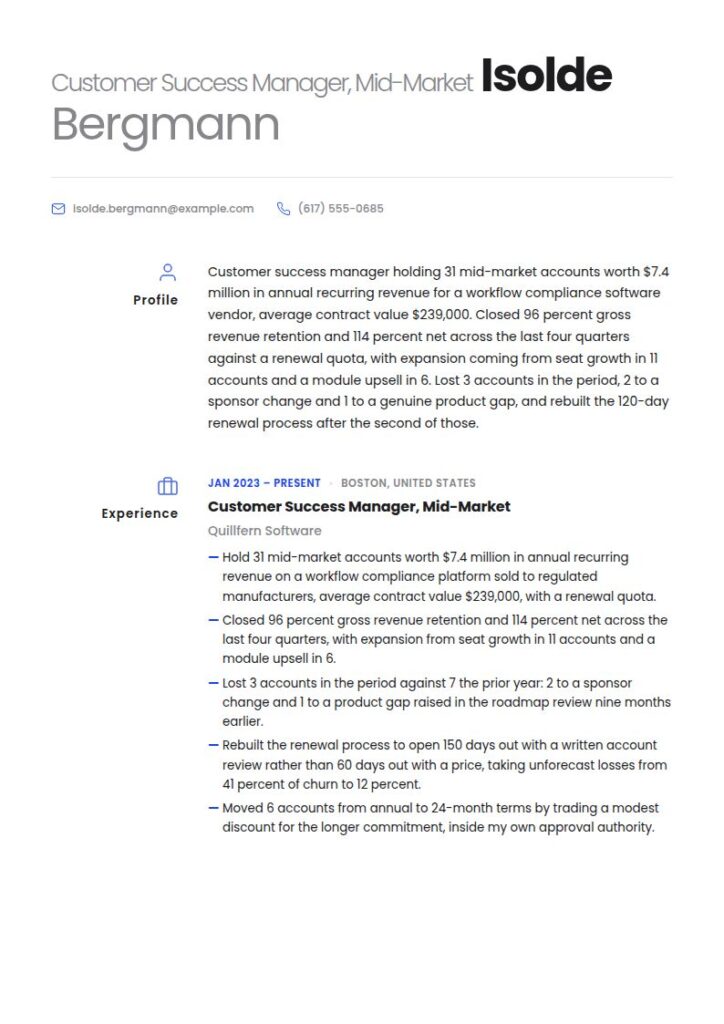
Customer success manager holding 31 mid-market accounts worth $7.4 million in annual recurring revenue for a workflow compliance software vendor, average contract value $239,000. Closed 96 percent gross revenue retention and 114 percent net across the last four quarters against a renewal quota, with expansion coming from seat growth in 11 accounts and a module upsell in 6. Lost 3 accounts in the period, 2 to a sponsor change and 1 to a genuine product gap, and rebuilt the 120-day renewal process after the second of those.
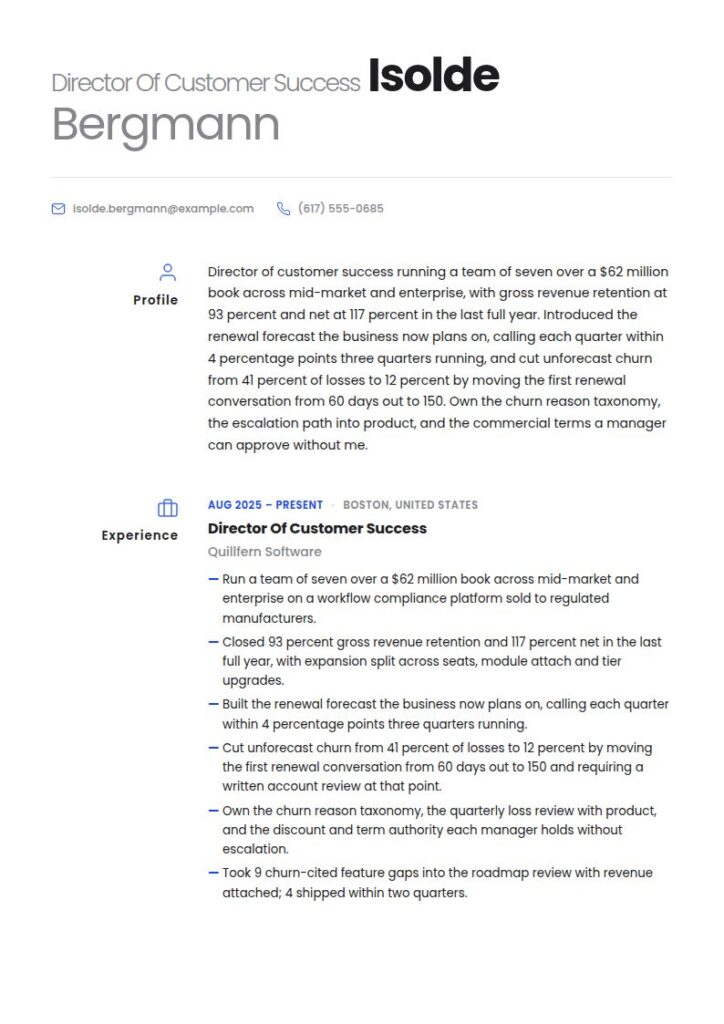
Director of customer success running a team of seven over a $62 million book across mid-market and enterprise, with gross revenue retention at 93 percent and net at 117 percent in the last full year. Introduced the renewal forecast the business now plans on, calling each quarter within 4 percentage points three quarters running, and cut unforecast churn from 41 percent of losses to 12 percent by moving the first renewal conversation from 60 days out to 150. Own the churn reason taxonomy, the escalation path into product, and the commercial terms a manager can approve without me.
Right vs wrong: the same customer success summary, twice
| ✅ Right | ❌ Wrong |
|---|---|
| 31 mid-market accounts worth $7.4 million in annual recurring revenue. | Managed a portfolio of strategic accounts. |
| 96 percent gross revenue retention, 114 percent net, against a renewal quota. | Consistently exceeded retention and growth targets. |
| Lost 3 accounts: 2 to a sponsor change, 1 to a product gap. | Proactively mitigated churn risk across the book. |
| Expansion from seat growth in 11 accounts and a module upsell in 6. | Identified and drove upsell opportunities. |
The right column is a ledger. In contrast, the left column is a description of a job title, and a hiring manager who has read forty of them cannot tell any of the candidates apart.
Outline your customer success experience
Then give the employer, what the product does and who buys it, the segment, the book in accounts and revenue, and dates. Then four to six bullets, each carrying a retention, churn or expansion number.
| Instead of | Use |
|---|---|
| Managed customer relationships to drive retention | Held 31 mid-market accounts worth $7.4 million in annual recurring revenue at 96 percent gross retention |
| Reduced churn across my portfolio | Lost 3 accounts in four quarters, 2 to a sponsor change and 1 to a product gap, against 7 the prior year |
| Identified upsell and cross-sell opportunities | Closed seat expansion in 11 accounts and a module upsell in 6, taking net retention to 114 percent |
| Conducted regular check-ins with customers | Moved the first renewal conversation from 60 days out to 150, cutting unforecast churn from 41 percent of losses to 12 percent |
| Worked with product on customer feedback | Took 9 churn-cited feature gaps into the roadmap review with revenue attached; 4 shipped within two quarters |
Customer Success Manager, Mid-Market, Quillfern Software, Boston, MA, January 2023 to Present
Hold 31 mid-market accounts worth $7.4 million in annual recurring revenue on a workflow compliance platform sold to regulated manufacturers, average contract value $239,000, with a renewal quota.
Closed 96 percent gross revenue retention and 114 percent net across the last four quarters, with expansion from seat growth in 11 accounts and a module upsell in 6.
Lost 3 accounts in the period against 7 the prior year: 2 to a sponsor change and 1 to a product gap I had raised in the roadmap review nine months earlier.
Rebuilt the renewal process to open 150 days out with a written account review rather than 60 days out with a price, which took unforecast losses from 41 percent of churn to 12 percent.
Moved 6 accounts from annual to 24-month terms by trading a modest discount for the longer commitment, with the discount approved inside my own authority.
The renewal ledger: gross retention, net retention and the renewals you closed
This is the block that separates a customer success resume from a customer service resume; however, it is missing from almost all of them. Seven labeled lines, no prose.
Book: 31 mid-market accounts, $7.4 million annual recurring revenue, average contract value $239,000, contract terms 12 to 36 months. Regulated manufacturers, 200 to 3,000 employees. Named coverage, not pooled.
Renewal calendar: 163 renewal events over four quarters by contract line, concentrated in the first and fourth quarters. First renewal conversation opens 150 days out with a written account review.
Gross revenue retention: 96 percent, calculated as starting annual recurring revenue less churn and less downgrade, divided by starting annual recurring revenue, expansion excluded. Measured on the cohort present at the start of the period.
Net revenue retention: 114 percent, the same cohort including expansion from seats, tier and modules, new logos excluded.
Churn: 3 accounts and $296,000 lost. Reason codes: sponsor change 2, product gap 1. Downgrade a further $84,000 across 4 accounts, all seat reductions following customer headcount cuts.
Expansion: $1.31 million. Seat growth in 11 accounts, module upsell in 6, tier upgrade in 2. 6 accounts moved from annual to 24-month terms.
Commercial authority: carried a renewal quota, attainment 104 percent. Discount authority to 8 percent without approval; anything above went to the vice president of customer success.
Moreover, five things make that block credible, and all five are interview questions.
Define both retention numbers before you quote them. Gross and net revenue retention are calculated differently at almost every company. Say whether downgrades are in gross, whether expansion is excluded from it, whether new logos are excluded from net, and what cohort and period you measured. A candidate who states the formula is trusted; one who states a percentage is asked to.
Customer success churn, expansion and quota
Give both, never one. Net retention alone hides churn behind expansion: a book losing a quarter of its accounts can still print 110 percent net if the survivors grow. Gross alone hides that nothing is growing. The pair is the only honest picture, and offering it unprompted is unusual enough to be noticed.
Code your churn. Three losses with reasons attached are worth more than a claim of low churn. Sponsor change, budget cut, acquisition, product gap, service failure and price are different diagnoses with different fixes, and knowing which you lost to shows you did the analysis. Say which reasons you could influence and which you could not.
Split expansion by type. Seat growth, tier upgrade, module attach, usage overage and term extension are five different motions needing five different conversations. "Grew the book" tells a reader nothing; "seat growth in 11 accounts and a module upsell in 6" tells them which motion you are good at.
Answer the quota question in one line. Some customer success roles carry a renewal or expansion number with variable pay attached; some hand the commercial conversation to an account manager. Both are real jobs, hired and paid differently. State which you held and, if you carried a number, give the attainment. Leaving it open reads as a no, not as modesty.
Retention is a published benchmark, and most books are not at 120 percent
SaaS Capital, drawing on its own survey of more than 1,000 private business-to-business software companies, reported median net revenue retention of 103 percent and median gross revenue retention of 91 percent for bootstrapped companies with $3 million to $20 million in annual recurring revenue (SaaS Capital, 24 April 2026). Those figures cover that population specifically, not the whole industry, and they should be quoted with the qualifier attached.
Two things follow. A gross number in the nineties and a net number a little over a hundred are respectable results in that population, and reporting 96 and 114 with definitions attached gives a reader something they can place. Claiming 140 percent net without saying whether new logos were excluded invites the only question you do not want.
The second is honest framing when the number is bad. Books lose revenue for reasons a customer success manager cannot touch: a price rise, a product sunset, an acquisition wave, a segment the company should never have sold into. Write the number, name the cause, and show what you protected. "Gross retention 84 percent in a year the company sunset two products; retained 91 percent of accounts not affected" beats a missing number.
Build a snapshot of your key customer success skills
Twelve to fourteen entries in four groups, weighted toward the commercial work rather than temperament. Temperament is what everybody claims.
Renewal and commercial: Renewal forecasting, Multi-year term negotiation, Discount and approval authority, Contract and order form review, Procurement and legal navigation
Retention analysis: Gross and net revenue retention calculation, Churn reason coding, Cohort retention analysis, Downgrade and seat reduction analysis, Save plan design
Expansion: Seat growth mapping, Module and tier attach, Multi-threading and sponsor mapping, Executive business review with a commercial ask
Systems: Salesforce, Gainsight, Looker, Zendesk, DocuSign, Slack Connect for customer channels
Also name the customer success platform and the customer relationship management system separately. After all, they hold different records, and a candidate who only lists the second is read as an account manager with a different title.
List your education and certifications
Degree, then anything about the commercial discipline, then the product and domain training. Likewise, keep it short; this field does not gate on credentials.
Bachelor of Arts, Economics, Northeastern University, Boston, MA, 2019
Negotiation and commercial terms, employer-run program, 2024
Gainsight Associate Certification, Gainsight, 2023
Salesforce Certified Administrator, Salesforce, credential ID SF-6104772, 2024
Domain training: quality management systems for regulated manufacturing, 2025. Data handling and customer confidentiality, refreshed annually.
The domain line matters more than it looks in regulated software. Indeed, a manager who can hold a conversation about the customer's own compliance obligations is in a different negotiation from one who can only talk about the product.
Choose the right layout and design
In general, single column, 10 or 11 point, real table markup for the ledger, no graphics and no retention chart. After all, a chart is a picture; a parser reads text and a reader scans labeled lines.
Give the book in accounts and annual recurring revenue. Define gross and net retention before quoting either. Give both. Code your churn by reason and say which you could influence. Split expansion by motion. State plainly whether you carried a quota and what attainment was. Use bands where an exact figure would identify a customer.
Do not name a customer anywhere, ever. Do not publish a named account's contract value, discount or renewal date. Do not quote net retention on its own. Do not claim a save you did not lead. Do not describe a churn as entirely somebody else's fault; a reader assumes the missing half. Do not leave the quota question unanswered, because an unanswered question is answered against you.
Above all, the customer confidentiality rule is the one that costs offers. In fact, customer names, contract values, discounts, renewal dates, escalation details and anything said in an executive business review belong to the customer and your employer, and most of it sits under a mutual non-disclosure agreement. Therefore, describe customers by industry, size band and contract value band; a hiring manager reads that restraint as a preview of how you would handle theirs.
Customer success job market and outlook
However, the Bureau of Labor Statistics publishes no Occupational Outlook Handbook profile for customer success. No single published profile matches it: the Handbook covers broad occupations rather than job titles, and this work is counted in different places depending on whether the role is commercial or service.
Three published occupations bracket it. Instead, sales managers, whom the Handbook describes as workers who "plan, direct, or coordinate the delivery of a product or service to the customer", cover the leadership end. Meanwhile, managers, all other, holds many mid-level titles without a clean occupational home. Customer service representatives is where service-side coverage sits, and it is the floor rather than the target.
| Bracketing occupation | Employment, 2025 | Projected change, 2025 to 2035 | Annual openings | Median annual wage, May 2025 |
|---|---|---|---|---|
| Sales managers | 650,100 | 4 percent, +29,000 | About 47,300 | $148,270 |
| Managers, all other | 1,338,800 | 5 percent | Not published | $141,900 |
| Customer service representatives | 2,666,000 | Decline of 5 percent, -141,800 | About 289,500 | $44,770 |
Source: U.S. Bureau of Labor Statistics, Occupational Outlook Handbook, May 2025 wage data and 2025 to 2035 projections. Moreover, the Managers, all other row comes from the Handbook's Data for Occupations Not Covered in Detail page, which publishes employment, projections and the median but no annual openings and no wage percentiles.
The service occupation is shrinking and the commercial ones are not
Customer service representatives numbered 2,666,000 in 2025 and are projected to fall 5 percent by 2035, a loss of 141,800 positions, while still producing about 289,500 openings a year, effectively all replacement. The Handbook attributes the decline to self-service: "Self-service systems, social media, and mobile applications enable customers to do simple tasks without interacting with a representative" (BLS Occupational Outlook Handbook, 2025 to 2035 projections).
Sales managers are projected to grow 4 percent over the same decade from 650,100 jobs, with about 47,300 openings a year and a May 2025 median of $148,270, ranging from under $73,170 to over $290,540. Managers, all other, a residual category of 1,338,800, is projected to grow 5 percent with a median of $141,900 (BLS, May 2025).
The gap between those medians is the argument for writing the commercial half of your job. Answering a question a customer already knew how to ask is being automated. Working out which of thirty-one accounts will not renew in nine months, and changing the outcome, is not, and it is paid in a different column.
What salary you can expect in customer success
There is no federal figure for the title, so the range has to be bracketed rather than quoted, and the brackets are genuinely wide.
Specifically, sales managers had a median annual wage of $148,270 in May 2025, with the lowest 10 percent under $73,170 and the highest 10 percent over $290,540. Similarly, managers, all other, had a median of $141,900 in the same cycle. In contrast, customer service representatives, the service-side floor, had a median of $44,770, or $21.53 an hour (BLS Occupational Outlook Handbook, May 2025).
In short, real packages sit between those poles and three things decide where. Book value, for example, is the largest: a $7.4 million mid-market book and a $60 million enterprise book are different bands under one title, and the header settles it.
The second is whether the number is yours. Similarly, a seat carrying a renewal or expansion quota usually carries variable pay and a higher base; a pure adoption seat usually does not. Neither is the better job, but which you held is worth more than any adjective.
The third is complexity. Enterprise coverage with procurement, legal and security review in every renewal is priced above scaled coverage, and you show it by the account count falling while book value rises.
Key takeaways for a customer success resume
- Firstly, put the book in the header: accounts, annual recurring revenue and segment.
- Define gross and net revenue retention before you quote either figure.
- Give both. Net alone hides churn behind expansion.
- Secondly, code your churn by reason, and say which reasons you could influence.
- In addition, split expansion into seats, tier, modules and term.
- State plainly whether you carried a quota, and give attainment if you did.
- Equally, never name a customer or publish a named account's contract terms.
- Finally, use bands wherever an exact figure would identify somebody else's business.
Build your customer success resume in 15 minutes with our AI resume builder.
Related business and management resume examples
- Business development resume
- Business development manager resume
- Consultant resume
- Consulting resume
- Product manager resume
- Product owner resume
- Business analyst resume
- Project manager resume
- Program manager resume
- Manager resume
- Team lead resume
- Business management resume
Pair it with a matching customer success cover letter.
Customer success resume questions, answered
How long should a customer success resume be?
One page for your first three years, two once you carry a number or run a team. The second page should be the renewal ledger and the churn analysis, not a longer list of responsibilities.
What is the difference between gross and net revenue retention?
Gross revenue retention takes the revenue you started the period with, subtracts churn and downgrades, and divides by the starting figure; expansion is excluded, so it can never exceed 100 percent. Net revenue retention is the same cohort with expansion included, so it can exceed 100 percent. The two answer different questions and the definitions vary between companies, so write yours out rather than assuming the reader shares it.
Should I put retention percentages on my resume if they were poor?
Yes, with the cause and what you protected. A book can lose revenue for reasons outside your control: a price rise, a product sunset, an acquisition wave, a segment that should never have been sold into. "Gross retention 84 percent in a year the company sunset two products; retained 91 percent of accounts not affected" is a paragraph a reader believes. A missing number is assumed to be worse than it was.
What do I write with no customer success title?
Whatever ledger evidence your role produced. Account managers have renewals and contract values; support leads have escalations that ended in a save; implementation consultants have go-lives and the accounts that expanded afterwards. Then describe the book you supported, in accounts and revenue band, and be exact about your part in it.
Can I name my customers?
No. Customer names, contract values, discounts, renewal dates and anything said in an executive business review are confidential and usually covered by a mutual non-disclosure agreement. Describe customers by industry, employee size band and contract value band. Managers notice candidates who do this unprompted, because it is the same judgment the job requires every week.