Customer Success Associate, Scaled Segment Thandiwe Baptiste
Customer Success Associate, Scaled Segment
[email protected] | (512) 555-0159 | Austin, United States
Profile
Customer success associate on the scaled segment of a workflow software vendor, covering 94 accounts and about 1,900 seats through one-to-many programs rather than named coverage. Cut median time to first value from 51 days to 34 by rewriting onboarding into three checkpoints with a named customer owner at each, and took 60-day seat activation across the segment from 58 percent to 71 percent. Run 11 live office hours a quarter, own the in-product adoption email sequence, and did not carry a renewal or expansion target in this seat.
Work Experience
01/2020 - Present, Customer Success Associate, Scaled Segment, Barton Springs Software, Austin, United States
- Covered 94 accounts and about 1,900 seats through one-to-many programs, webinars and in-product messaging rather than named coverage.
- Cut median time to first value from 51 days to 34 by rewriting onboarding into three checkpoints, each with a named customer owner and an exit condition.
- Took 60-day seat activation across the segment from 58 percent to 71 percent, with activation defined as a login plus one completed task.
- Ran 11 live office hours a quarter and owned the in-product adoption email sequence, which reached 1,600 users a month.
- Carried no renewal or expansion target; supplied usage summaries to the account management team ahead of each renewal date.
06/2018 - 01/2020, Technical Support Specialist, Barton Springs Software, Austin, United States
- Handled 30 to 40 tickets a day on workflow configuration, permissions and data import.
- Wrote 24 help center articles that removed the two most frequent onboarding-stage ticket types.
Education
08/2013 - 05/2017, Bachelor of Arts, Communication Studies, The University of Texas at Austin, Austin, United States
Minor in management information systems.
Skills
Onboarding checkpoint design, 75
Seat activation analysis, 70
One-to-many adoption programs, 80
Help center and enablement content, 80
Zendesk and Jira, 85
Gainsight, 65
Languages
English, native
French, intermediate
Certificates
03/2022, Gainsight Associate Certification, Gainsight
Summary
A customer success manager resume is a one to two page document built on adoption evidence: how fast customers reach first value, how many purchased seats are in use, how deep that use goes, and what the health score covering those accounts is genuinely measuring. This guide gives you three adaptable versions and current Bureau of Labor Statistics data for the occupations the work is counted inside.
Customer Success Manager resume examples by experience level
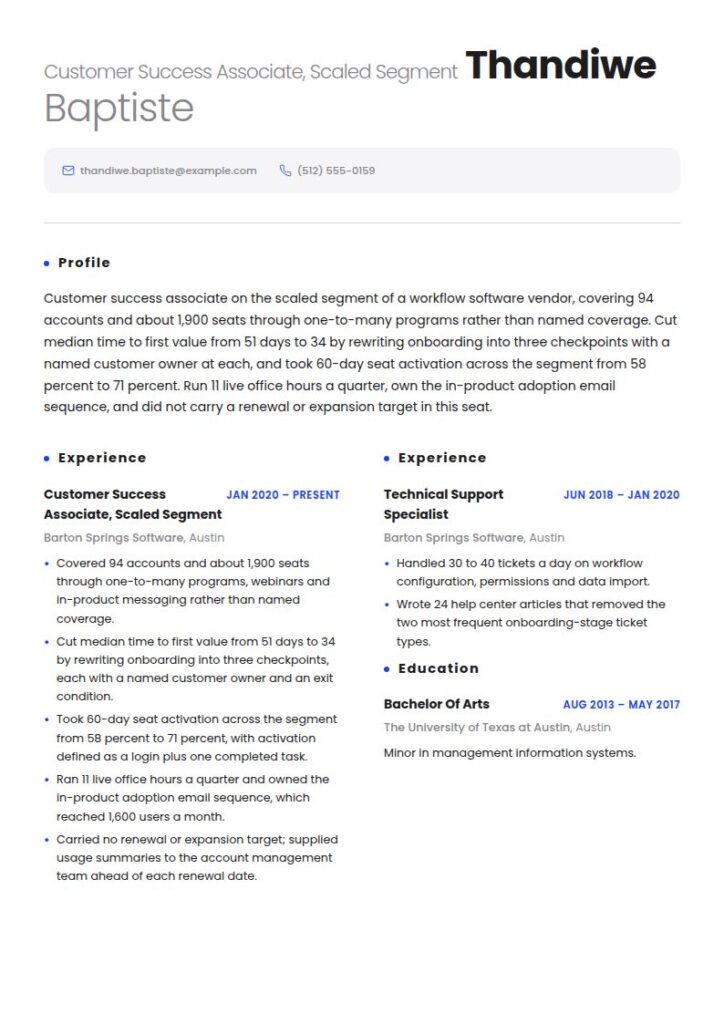
A customer success manager resume is a one to two page document built on adoption evidence: how quickly customers reached first value, how many of the seats they paid for are in use, how deep that use goes, and what the health scores on your portfolio were made of.
Customer success is a young function and the title is used loosely, so hiring managers screen hard. The file that gets read twice describes adoption as measurement rather than attentiveness, and can say which parts of a health score were signal and which were noise. The worked example here is business-to-business software: a workflow automation platform sold to operations teams.
Resume guide for a customer success manager resume
This guide and the corresponding customer success manager resume example will cover:
- How to write a customer success manager resume, block by block
- Onboarding, time to first value and the adoption metrics that move
- Three adaptable summaries: associate, mid-market and enterprise
- What goes into a health score, and why a red account is sometimes scored wrong
- Whether you carried a commercial number, and why that line changes the read
How to write a customer success manager resume
Five blocks: contact header, summary, the portfolio and its adoption picture, employment history, then skills, tools and education. One page for your first two years, two once you have carried enterprise accounts or owned a playbook other people run. The portfolio block is what a hiring manager looks for first, and it is missing from most files.
| Block | What it is answering | Where it goes |
|---|---|---|
| Portfolio | How many accounts, what segment, how many seats behind them? | Directly under the summary |
| Adoption | Time to first value, activated seats, depth of use, workflows live | Inside the portfolio block |
| Health | What the score is made of and what you did with it | Its own bullets |
| Commercial scope | Did you carry a number, and if so, which one? | One line, in the summary |
Seats bought and seats used are two different numbers
A portfolio described as "38 accounts" tells a hiring manager almost nothing. The work is in the seats behind those accounts and the share of them that ever logged in.
Write both: "38 mid-market accounts covering 5,900 purchased seats, 84 percent activated within 60 days of go-live, up from 62 percent." That is a portfolio, a target and a change in one sentence.
Then add depth, because activation alone is a vanity number. A seat that logs in weekly and runs four live workflows is a different customer from one that logs in quarterly.
Run the finished file through the free Rezoom ATS resume checker first. Adoption figures set in a sidebar or a chart are what a parser drops.
Choosing the best resume format for a customer success manager resume
Reverse chronological, with the portfolio and its adoption numbers as a short table under the summary. One page for your first two years, two once you have moved into enterprise.
Segment progression is the story this format tells well. Scaled coverage, then mid-market, then enterprise is a real career shape, and each step means fewer accounts, more seats, more stakeholders and longer cycles. A reader wants to see how the account count fell as complexity rose.
Coming from support, implementation or training, keep the timeline and convert the numbers. Tickets resolved, onboardings delivered and training sessions run all translate into adoption evidence.
Include your contact information
| ✅ Right | ❌ Wrong |
|---|---|
| Thandiwe Baptiste | Thandiwe Baptiste |
| Customer Success Manager, Mid-Market, Workflow Software | Customer-obsessed relationship builder |
| 38 accounts, 5,900 seats, 84% activated within 60 days | Proven track record of delighting customers |
| (512) 555-0159, [email protected], Austin, TX | (512) 555-0159, [email protected] |
Put the segment in the header. Scaled, mid-market and enterprise customer success are three different jobs with different account loads, stakeholder maps and pay bands, and a reader who cannot tell which you have done will assume the lightest.
Make use of a summary
Four lines: the portfolio in accounts and seats, the adoption change you produced, one thing you did with health scoring, and whether you carried a commercial number.
Customer success associate on the scaled segment of a workflow software vendor, covering 94 accounts and about 1,900 seats through one-to-many programs rather than named coverage. Cut median time to first value from 51 days to 34 by rewriting onboarding into three checkpoints with a named customer owner at each, and took 60-day seat activation across the segment from 58 percent to 71 percent. Run 11 live office hours a quarter, own the in-product adoption email sequence, and did not carry a renewal or expansion target in this seat.
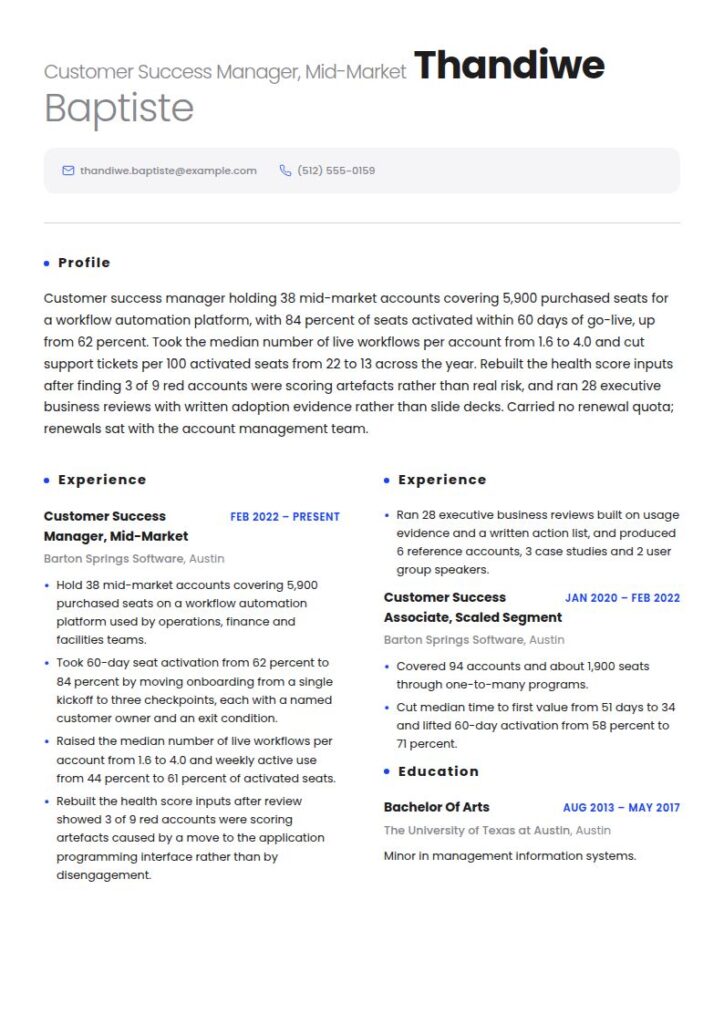
Customer success manager holding 38 mid-market accounts covering 5,900 purchased seats for a workflow automation platform, with 84 percent of seats activated within 60 days of go-live, up from 62 percent. Took the median number of live workflows per account from 1.6 to 4.0 and cut support tickets per 100 activated seats from 22 to 13 across the year. Rebuilt the health score inputs after finding 3 of 9 red accounts were scoring artefacts rather than real risk, and ran 28 executive business reviews with written adoption evidence rather than slide decks. Carried no renewal quota; renewals sat with the account management team.
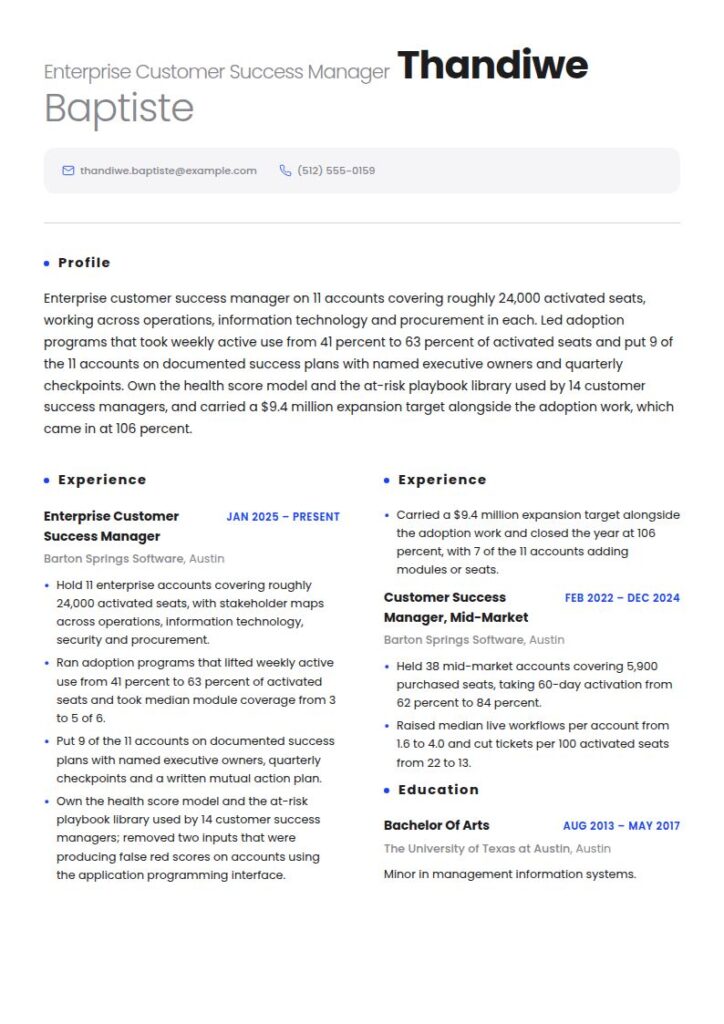
Enterprise customer success manager on 11 accounts covering roughly 24,000 activated seats, working across operations, information technology and procurement in each. Led adoption programs that took weekly active use from 41 percent to 63 percent of activated seats and put 9 of the 11 accounts on documented success plans with named executive owners and quarterly checkpoints. Own the health score model and the at-risk playbook library used by 14 customer success managers, and carried a $9.4 million expansion target alongside the adoption work, which came in at 106 percent.
Right vs wrong: the same customer success manager summary, twice
| ✅ Right | ❌ Wrong |
|---|---|
| 38 mid-market accounts covering 5,900 purchased seats. | Managed a portfolio of valued customers. |
| 84 percent of seats activated within 60 days, up from 62 percent. | Drove strong product adoption across my accounts. |
| Median live workflows per account from 1.6 to 4.0. | Helped customers get more value from the platform. |
| Found 3 of 9 red accounts were scoring artefacts, not real risk. | Proactively monitored account health and mitigated risk. |
The right column comes out of a product analytics query in under a minute. The left column is what every other file says, and a manager who reads it twice a day stopped believing it.
Outline your customer success experience
Employer, what the product does, who uses it, the segment and portfolio you held, and the dates. Then three to five bullets, each carrying an adoption, health or advocacy number.
| Instead of | Use |
|---|---|
| Onboarded new customers onto the platform | Cut median time to first value from 51 days to 34 across 94 scaled accounts |
| Drove product adoption across my portfolio | Took 60-day seat activation from 62 percent to 84 percent across 5,900 purchased seats |
| Built strong relationships with key stakeholders | Mapped 4 named roles per account and put 9 of 11 accounts on written success plans |
| Monitored customer health and flagged risks | Rebuilt the health score after 3 of 9 red accounts proved to be scoring artefacts |
| Ran regular business reviews with customers | Ran 28 executive business reviews, each opening with usage data and a written action list |
| Worked with support to resolve customer issues | Cut tickets per 100 activated seats from 22 to 13 by fixing two onboarding steps |
| Turned happy customers into references | Produced 6 reference accounts, 3 case studies and 2 user group speakers |
Customer Success Manager, Mid-Market, Barton Springs Software, Austin, TX, February 2022 to Present
Hold 38 mid-market accounts covering 5,900 purchased seats on a workflow automation platform used by operations, finance and facilities teams.
Took 60-day seat activation from 62 percent to 84 percent by moving onboarding from a single kickoff to three checkpoints, each with a named customer owner and an exit condition.
Raised the median number of live workflows per account from 1.6 to 4.0 and weekly active use from 44 percent to 61 percent of activated seats.
Rebuilt the health score inputs after review showed 3 of 9 red accounts were scoring artefacts caused by a move to the application programming interface rather than by disengagement.
Ran 28 executive business reviews built on usage evidence and a written action list, and produced 6 reference accounts, 3 case studies and 2 user group speakers.
The health score, and the adoption evidence underneath it
A health score is a summary of other numbers. It is only as good as what feeds it, and the fastest way to establish credibility is to show you know what yours was made of.
Portfolio: 38 mid-market accounts, 5,900 purchased seats, contract terms of 12 to 36 months. Operations, finance and facilities users. Segment coverage is named, not pooled.
Onboarding: median time to first value 34 days from contract signature, against a 45-day target. Three checkpoints, each with a named customer owner and an exit condition. First value defined as one workflow live in production with real data.
Activation: 84 percent of purchased seats activated within 60 days of go-live, up from 62 percent. Activation defined as a login plus one completed task, not a login alone.
Depth: median 4.0 live workflows per account, up from 1.6. Weekly active use 61 percent of activated seats. 3 of 6 core modules in use across the portfolio median.
Health score inputs: activation rate, weekly active trend over 8 weeks, workflow count, administrator engagement, support signal, executive relationship mapped and time to renewal. Seven weighted inputs, recalculated weekly.
Support signal: 13 tickets per 100 activated seats a quarter, down from 22, with the two commonest onboarding-stage tickets removed by a configuration change.
Advocacy: 6 reference accounts approved, 3 published case studies, 2 user group speakers, 11 product advisory participants.
Commercial scope: no renewal quota in this seat. Renewals and pricing sat with account management; my contribution was documented adoption evidence 90 days before each renewal date.
Seven things make that block credible, and each is a question the hiring manager will put to you directly.
Define first value before claiming to have shortened it. "One workflow live in production with real data" is testable. "The customer sees value" is not, and a candidate who cannot state the definition usually inherited the number rather than moved it.
Define activation too. A login is not adoption; a login plus a completed task is a harder and more useful bar, and saying which you used tells a reader whether your 84 percent means anything.
Report depth, not just breadth. Workflows live, modules in use and weekly active share separate a customer who would notice the product disappearing from one who would not, and breadth without depth is the pattern that precedes a quiet loss.
Say what feeds the health score and how often it recalculates. Listing seven weighted inputs is a short line doing a lot of work, because it shows you have seen the machinery and not just the color.
Then say when the score was wrong, the sentence that separates the experienced from the plausible. Scores go red for reasons that are not risk: a customer moving traffic to the application programming interface so logins collapse, a seasonal business in its quiet quarter, a license audit that removed dormant seats, an administrator on leave. A candidate who found three false reds in nine and corrected the model is describing judgement, which is what the interview tests.
Use support data as an adoption signal rather than a complaint log. Tickets per hundred activated seats, the two most common types and what you changed to remove them is a customer success argument, and it shows you can work across functions without a mandate.
Finish with advocacy, the evidence that someone is genuinely getting value. References approved, case studies published, user group speakers found and advisory participants recruited are all countable, and each required a customer to say yes with their own name attached.
Executive business reviews belong inside this evidence rather than beside it. A review that exists because the calendar said so is a meeting; one that opens with eight weeks of usage data, names the gap between what was bought and what is in use, and closes with a written action list and owners is an artefact. Report the count and say what each contained.
What you should say about a commercial number
State plainly somewhere on the page whether you carried a renewal or expansion target. One line is enough.
The two versions of this job are hired and paid differently. A customer success manager who owns adoption and hands the commercial conversation to an account manager is measured on usage, health and advocacy. One who owns a renewal or expansion number is measured on revenue too, usually with a variable component.
Ambiguity costs you either way. If you carried a number, name it and give the attainment, because leaving it out reads as though you did not. If you did not, say so and describe what you contributed instead, such as documented adoption evidence delivered ninety days ahead of each renewal date. A manager who has to guess will guess low.
Build a snapshot of your key customer success skills
Twelve to fourteen entries in four groups, weighted toward measurement rather than temperament.
Onboarding: Time to first value design, Checkpoint and exit criteria definition, Implementation handover from sales, Administrator enablement, Data migration coordination
Adoption and analytics: Seat activation analysis, Feature depth and module usage reporting, Weekly active use trending, Workflow and use case expansion, Cohort comparison across the portfolio
Health and risk: Health score design and weighting, False positive review, At-risk playbook execution, Escalation and remediation planning, Success plan and mutual action plan authorship
Systems: Gainsight, Salesforce, Pendo, Zendesk, Looker, Jira, Slack Connect for customer channels
Name the systems by product. A customer success platform, a product analytics tool and a ticketing system are three separate stacks, and managers screen for the one their team runs.
List your education and certifications
Degree, then any credential relating to the discipline or the product domain, then the platform certifications. Keep it short.
Bachelor of Arts, Communication Studies, The University of Texas at Austin, Austin, TX, 2017
Gainsight Associate Certification, Gainsight, 2022
Salesforce Certified Administrator, Salesforce, credential ID SF-5590318, 2023
Pendo Product Analytics Certification, Pendo, 2024
Domain training: business process modeling fundamentals, 2023. SOC 2 awareness and customer data handling, refreshed annually.
In security-sensitive software the domain training matters more than the customer success training. Answering a data handling question in an executive review without escalating keeps the conversation on adoption, and that is where this block earns its space.
Choose the right layout and design
Single column, 10 or 11 point, real table markup for the portfolio, no photograph and no health score graphic. A traffic light is a picture; a parser reads text.
Give accounts and seats together. Define first value and activation before quoting either. Report depth as workflows, modules and weekly active use. List what feeds the health score and how often it recalculates. Say when a score was wrong and what you changed. Use support tickets per hundred activated seats as an adoption signal. Count the advocacy you produced. State plainly whether you carried a commercial number.
Do not report logins as adoption. Do not give a health score color without its inputs. Do not claim 100 percent of accounts were green; nobody believes it and the interview will test it. Do not name your customers; name the segment and the seat count. Do not describe executive business reviews by their frequency alone. Do not leave the commercial question open, because an unanswered question is answered against you.
Customer success manager job market and outlook
The Bureau of Labor Statistics publishes no customer success manager occupation, so the market is read from the occupations the work is counted inside: customer service representatives at the individual contributor end and sales managers at the leadership end.
| Measure | Customer service representatives | Sales managers |
|---|---|---|
| Median annual wage, May 2025 | $44,770 | $148,270 |
| Median hourly wage, May 2025 | $21.53 | Not applicable |
| Jobs, 2025 | 2,666,000 | Not used here |
| Projected change, 2025-35 | -5% (decline), -141,800 | Not used here |
| Projected annual openings | About 289,500 | Not used here |
| Entry-level education | High school diploma | Bachelor's degree |
Source: U.S. Bureau of Labor Statistics, Occupational Outlook Handbook, 2025-35 projections and May 2025 wage data.
Say which occupation you are reading when you quote these figures. Neither is a clean match, and presenting the customer service representative median as a customer success benchmark will be corrected in the first interview.
The shrinking occupation and the growing job title
Customer service representatives numbered 2,666,000 in 2025 and are projected to fall 5 percent by 2035, a loss of 141,800 positions, while still producing about 289,500 openings a year (BLS Occupational Outlook Handbook, 2025-35 projections). Twelve percent of that employment sits in insurance carriers and related activities and 7 percent in professional, scientific and technical services, which is the slice closest to software (BLS, May 2025).
A decline of that size in an occupation defined by reactive contact handling is the clearest signal available about what is being automated. Answering a question a customer already knew how to ask is disappearing. Working out which of five hundred customers is quietly failing to use what they bought is not.
Write your resume on the second side of that line. Every adoption cohort you compared, every false red you caught and every workflow you got live is work an automated reply does not absorb.
What salary you can expect as a customer success manager
There is no federal figure for this title, so build the expectation from the two occupations bracketing it. Customer service representatives had a median annual wage of $44,770, or $21.53 an hour, as of May 2025; sales managers, at the leadership end of commercial customer work, had a median of $148,270 in the same cycle (BLS, May 2025).
Real packages sit between those poles, and three things decide where. Segment is the first: enterprise coverage of a handful of accounts with thousands of seats pays well above scaled coverage of a hundred, and the header is where that gets settled. Technical depth is the second, because a manager who can configure the product, query its analytics and hold a data handling conversation costs more to replace.
The third is whether you carry a commercial number, and it is what candidates most often leave ambiguous. A seat with a renewal or expansion target usually carries a variable component and a higher band; a pure adoption seat usually does not. Neither is the better job, but the line saying which one you held is worth more than any adjective on the page.
Key takeaways for a customer success manager resume
- Give accounts and seats together, with the segment named in the header.
- Define first value and activation before you quote a figure for either.
- Report depth: workflows live, modules in use, weekly active share.
- List what feeds your health score and how often it recalculates.
- Say when a score was wrong and what you changed as a result.
- Use tickets per hundred activated seats as an adoption signal.
- State plainly whether you carried a renewal or expansion number.
Build your customer success manager resume in 15 minutes.
Related sales resume examples
- Account manager resume
- Sales engineer resume
- Account executive resume
- Sales manager resume
- Sales assistant resume
- Field sales professional resume
- Sales representative resume
- Sales resume
- Telemarketer resume
- Insurance agent resume
- Travel agent resume
- Merchandiser resume
Pair it with a matching customer success manager cover letter.
Customer success manager resume questions, answered
How long should a customer success manager resume be?
One page for your first two years, two once you have carried enterprise accounts or built a playbook others run. The second page should be portfolio and adoption detail, not a longer list of duties.
What is the difference between a customer success manager and an account manager?
In most software companies the customer success manager owns adoption and outcomes while the account manager owns the commercial conversation: the contract, the price and the growth attached to it. Plenty of companies merge them. Write which version you held in one line, because the hiring manager is screening for it and cannot infer it.
What do I put on a customer success manager resume with no customer success title?
Whatever adoption evidence your previous role produced. Implementation consultants have time to first value and go-live counts; support specialists have ticket patterns and deflection; trainers have enablement completion numbers; coordinators have stakeholder maps and review cadence. Then describe the portfolio you supported and your part in it accurately.
Should I put health scores on my resume?
Put the inputs, not the colors. A line naming activation, weekly active trend, workflow count, administrator engagement, support signal, executive relationship and time to renewal is credible. A line saying 92 percent of accounts were green is not, because the reader cannot know what green meant in your instance.
How do I show results when the product was new and adoption was low everywhere?
Report the change and the cohort rather than the absolute. Activation moving from 62 percent to 84 percent inside one segment is a result wherever the company started, and a comparison between accounts that took your onboarding program and those that did not is stronger still. Give the period, the population and the definition, and the number stops being a claim.