Thandiwe Baptiste Customer Success Manager, Mid-Market Austin, 78704, United States [email protected] · (512) 555-0159
12 September 2026
Ms. Lucia Ferrante Director of Customer Success Northbank Operations Cloud Denver, United States
Application for Customer Success Manager, Mid-Market
Dear Ms. Ferrante,
I am applying for the Customer Success Manager post on your mid-market team. I currently hold 38 mid-market accounts covering 5,900 purchased seats on a workflow automation platform, with 84 percent of those seats activated within 60 days of go-live, up from 62 percent when I took the portfolio. I define activated as a login plus one completed task, not a login alone.
The change came from onboarding rather than from attention. I replaced a single kickoff call with three checkpoints, each with a named customer owner and an exit condition, and defined first value as one workflow live in production with real data, which brought median time to first value down from 51 days to 34. Depth followed: median live workflows per account went from 1.6 to 4.0, weekly active use went from 44 percent to 61 percent of activated seats, and support tickets fell from 22 to 13 per 100 activated seats after we removed two configuration steps that were generating most of them. The work I am proudest of is less flattering. Reviewing nine red accounts, I found three of them were scoring artefacts caused by customers moving traffic to the application programming interface, so I rebuilt the score inputs rather than the accounts.
Your platform sits with operations teams who buy far more seats than they light up in the first quarter, which is the same shape of problem, and your published onboarding guide suggests the checkpoint structure is not yet defined by exit conditions. In my first sixty days I would run an activation cohort analysis across the segment, find where seats stall, and bring you a checkpoint model with definitions attached.
I have not carried a renewal quota; renewals sit with account management here and my contribution is documented adoption evidence ninety days ahead of each renewal date. I am glad to carry an expansion number if the seat comes with one. Thank you for your time.
Sincerely, Thandiwe Baptiste
Summary
A customer success manager cover letter shows a hiring manager that you treat adoption as measurement: how fast customers reached first value, how many purchased seats are in use, how deep that use goes, and what your health score was actually made of. This guide gives you a full adaptable letter, the openings that work, and the one line about a commercial number that changes how the whole file is read.
Customer Success Manager cover letter examples by experience level
A customer success manager cover letter is a one-page letter that shows a hiring manager you treat adoption as measurement rather than as attentiveness: how fast your customers reached first value, how many of the seats they bought are in use, and what the health scores on your portfolio were actually made of.
Nearly every letter in the folder says the writer is customer-obsessed. Yours can say 84 percent of purchased seats were activated within sixty days, up from 62 percent.
Guide to a customer success manager cover letter
This guide and the corresponding customer success manager cover letter example will cover:
- How to structure the letter paragraph by paragraph
- Why an adoption number belongs in the first two sentences
- The one line about a commercial number that changes how the file is read
- What to write when moving in from support, implementation or training
How to write a customer success manager cover letter
| Paragraph | Its job | Length |
|---|---|---|
| Opening | The role, your segment and portfolio, and one adoption number | 2 to 3 sentences |
| Evidence | What you changed, how you measured it, and what it was defined as | 4 to 5 sentences |
| Fit | Something real about their product or customers, and what you would do first | 3 to 4 sentences |
| Close | Commercial scope, availability, thank you | 2 sentences |
Lead with the portfolio and one adoption number
A hiring manager reading these applications wants two things first: what size of account you have carried, and whether you can measure your own work.
One sentence answers both. "I hold 38 mid-market accounts covering 5,900 purchased seats, with 84 percent activated within 60 days of go-live, up from 62 percent."
Then define the term, because the definition is the credibility. "Activated meaning a login plus one completed task, not a login." Almost nobody writes that sentence, and the people who do are the people who have actually run the query.
A customer success manager cover letter example you can adapt
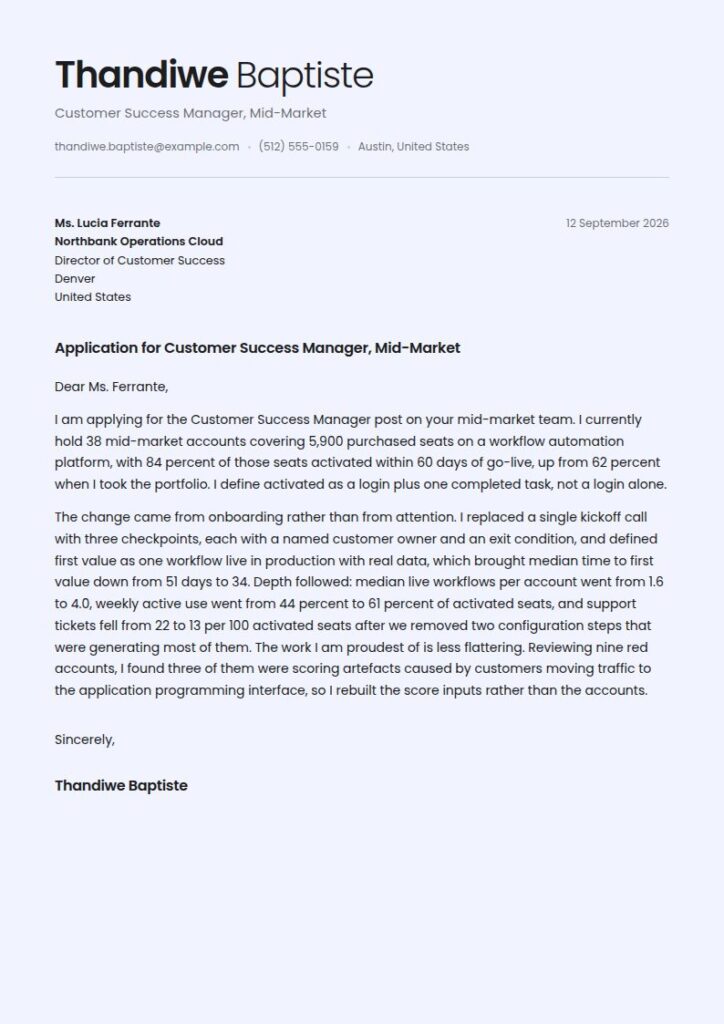
Dear Ms. Ferrante,
I am applying for the Customer Success Manager post on your mid-market team. I currently hold 38 mid-market accounts covering 5,900 purchased seats on a workflow automation platform, with 84 percent of those seats activated within 60 days of go-live, up from 62 percent when I took the portfolio. I define activated as a login plus one completed task, not a login alone.
The change came from onboarding rather than from attention. I replaced a single kickoff call with three checkpoints, each with a named customer owner and an exit condition, and defined first value as one workflow live in production with real data, which brought median time to first value down from 51 days to 34. Depth followed: median live workflows per account went from 1.6 to 4.0, weekly active use went from 44 percent to 61 percent of activated seats, and support tickets fell from 22 to 13 per 100 activated seats after we removed two configuration steps that were generating most of them. The work I am proudest of is less flattering. Reviewing nine red accounts, I found three of them were scoring artefacts caused by customers moving traffic to the application programming interface, so I rebuilt the score inputs rather than the accounts.
Your platform sits with operations teams who buy far more seats than they light up in the first quarter, which is the same shape of problem, and your published onboarding guide suggests the checkpoint structure is not yet defined by exit conditions. In my first sixty days I would run an activation cohort analysis across the segment, find where seats stall, and bring you a checkpoint model with definitions attached.
I have not carried a renewal quota; renewals sit with account management here and my contribution is documented adoption evidence ninety days ahead of each renewal date. I am glad to carry an expansion number if the seat comes with one. Thank you for your time.
Sincerely, Thandiwe Baptiste
Openings that work
| Instead of | Use |
|---|---|
| I am passionate about helping customers succeed | I hold 38 mid-market accounts covering 5,900 purchased seats |
| I am writing to express my interest in your CSM opening | I am applying for the Customer Success Manager post on your mid-market team |
| I have a proven record of driving adoption | 84 percent of purchased seats activated within 60 days, up from 62 percent |
| I build strong relationships with stakeholders | 9 of 11 accounts on written success plans with named executive owners |
| I am highly analytical and data-driven | Median live workflows per account went from 1.6 to 4.0 |
The line about a commercial number
Put one sentence in the letter saying whether you carried a renewal or an expansion target, and say it plainly either way.
The two versions of this job are hired against different scorecards. An adoption seat is judged on usage, health and advocacy. A seat with a number attached is judged on revenue as well and usually carries variable pay. If you leave it open, the reader guesses, and the guess is nearly always the cheaper one.
The second half of the sentence matters as much as the first. If you did not carry a number, say what you contributed instead, such as usage evidence delivered before each renewal date or expansion cases built from adoption gaps. If you did carry one, give the figure and the attainment.
Coming in from support, implementation or training
Convert what you already measured. Implementation has go-live counts and time to first value; support has ticket patterns and the fixes that removed them; training has enablement completion and administrator certification numbers. Say which segment you want and why. Read their product documentation before you write and name one real thing about how onboarding works. Offer the first analysis you would run.
Do not describe adoption without a definition, because the definition is the whole claim. Do not report logins as usage. Do not claim every account you touched was healthy. Do not name customers; name the segment and the seat count. Do not write a letter whose only evidence is that customers liked you, since every file in the folder says that.
A shrinking occupation and a job title that is not in it
The Bureau of Labor Statistics publishes no customer success manager occupation. The nearest measures are customer service representatives, at a median annual wage of $44,770, or $21.53 an hour, with 2,666,000 jobs in 2025, a projected 5 percent decline through 2035 worth 141,800 positions, and about 289,500 openings a year; and sales managers at the leadership end, with a median of $148,270 (BLS Occupational Outlook Handbook, 2025-35 projections and May 2025 wage data).
The decline is the useful part. Reactive contact handling is being absorbed by automation. Working out which of five hundred customers quietly stopped using what they bought is not, because it requires someone to define activation, query it and then act.
That is the argument your letter should make without stating it. Every definition you give and every cohort you compared is evidence you do the second kind of work.
Length, format and sending it
One page, four paragraphs, 250 to 400 words. PDF unless the portal says otherwise, named for yourself and the post: thandiwe-baptiste-customer-success-manager.pdf.
Address a person. Customer success leadership is usually visible on a company site or a conference program, and a named salutation on a letter carrying real adoption numbers reads as someone who prepares.
Keep the figures identical to your resume. Our customer success manager resume example uses the numbers in this letter, and a manager who spots a mismatch will discount both documents.
Key takeaways
- Open with the segment, the account count and the seats behind them.
- Give one adoption number with its definition attached.
- Show the mechanism you changed, not the attention you paid.
- Include one time your health score was wrong and what you did.
- State plainly whether you carried a renewal or expansion number.
- Name one real thing about their product or onboarding.
- Offer the first analysis you would run in the seat.
Write your customer success manager cover letter in 10 minutes.
Customer success manager cover letter questions, answered
How long should a customer success manager cover letter be?
One page, four paragraphs, 250 to 400 words. Hiring managers in this function read applications in batches and the adoption numbers are what they are scanning for, so put them early and stop.
Should I mention a health score in a cover letter?
Only with its inputs or with a story attached. "My accounts were 92 percent green" means nothing to a reader who does not know your instance. "Three of nine red accounts were scoring artefacts, so I rebuilt the inputs" is a judgement story and it is the sentence people remember.
What if I have never carried a renewal or expansion number?
Say so, in one clause, and describe what you did contribute. Adoption evidence supplied before renewal dates, expansion cases built from usage gaps, or executive relationships mapped are all real contributions to a commercial outcome. Ambiguity is the only answer that hurts you.
How do I write this letter moving in from support?
Lead with the ticket data, because it is adoption data that nobody else in the folder has. Tickets per hundred seats, the two commonest types, and what you changed to remove them is a customer success argument already. Then say which segment you want and what analysis you would run first.
Do I need to know their product before I write?
Enough to say one accurate thing. Read the onboarding documentation, the help center and any published customer story, then name a specific piece of the adoption path and what you would look at first. That sentence cannot be reused in the next letter.