Colette Njoku Field Sales Professional, Commercial Facility Services Richmond, 23220, United States [email protected] · (804) 555-0157
12 September 2026
Ms. Adaeze Okonjo Regional Sales Director Tidewater Facility Partners Norfolk, United States
Application for Field Sales Professional, Hampton Roads and Eastern Shore
Dear Ms. Okonjo,
I am applying for the Field Sales Professional post covering the Hampton Roads and Eastern Shore ground. I currently cover 14 counties in central Virginia and the Southside corridor for a commercial facility services company, with 236 accounts under coverage tiered 41 A, 78 B and 117 C, contacted monthly, quarterly and twice a year, at 7 face-to-face calls a day and 33 a week.
The part I would most want to bring across is the arithmetic underneath that week. I run about 640 road miles and 14 drive hours a week with 4 nights away a month, inside a $1,140 monthly expense envelope, which works out at roughly $63 a face-to-face call. Last year that coverage produced $1.94 million of annualised contract value across 46 new agreements, 71 percent of them still in force at first renewal. I close each year at 97 percent of calls entered the same day, the only honest record of a week nobody saw.
Hampton Roads reads as denser ground than the one I run now, with more multi-site property management and a logistics base that buys facility services on longer agreements. My first four weeks would go on a tier rebuild: rank every account by annual value and site count, cluster the calls by drive time rather than by city, and bring you a plan showing how many A accounts get seen monthly and what that costs.
My Virginia driving record is clean and the abstract is current, and I hold an OSHA 10-hour general industry card. I can start within four weeks of an offer. Thank you for reading.
Sincerely, Colette Njoku
Summary
A field sales professional cover letter tells a regional director how you run a week they will never see: how many accounts you cover, how they are tiered, how many face-to-face calls a day that produces, and what the road costs. This guide gives you an adaptable letter, the openings that work, and what to write when you are moving into the field for the first time.
Field Sales Professional cover letter examples by experience level
A field sales professional cover letter tells a regional director how you run a week nobody supervises: how much ground you cover, how the accounts are tiered, how many face-to-face calls that produces, and what each call costs.
Every other letter in the folder promises drive and hunger. Yours can state a coverage model, and the reader notices that in the first ten seconds.
Guide to a field sales professional cover letter
This guide and the corresponding field sales professional cover letter example will cover:
- How to structure the letter paragraph by paragraph
- Why the coverage model belongs in the first paragraph
- What counts as evidence when nobody watched you work
- How the letter changes when you are moving into the field for the first time
How to write a field sales professional cover letter
| Paragraph | Its job | Length |
|---|---|---|
| Opening | The role, the ground you cover now, and the coverage model in one line | 2 to 3 sentences |
| Evidence | One number from the week and one from the commercial result | 4 to 5 sentences |
| Fit | Something specific about their ground or their customers, and what you would do first | 3 to 4 sentences |
| Close | Driving record, availability, thank you | 2 sentences |
Open with the coverage model, not with the ambition
A regional director reading applications holds an uncovered geography and a start date they cannot move. The first thing they need is whether you have run something comparable.
Give it in one sentence: "I cover 14 counties in central Virginia, 236 accounts tiered into monthly, quarterly and twice-yearly contact, at 33 face-to-face calls a week." That answers their first question in one line.
Then add the number that proves you understand the budget: "About 640 miles and 4 nights away a month, which runs at roughly $63 a face-to-face call."
A field sales professional cover letter example you can adapt
Dear Ms. Okonjo,
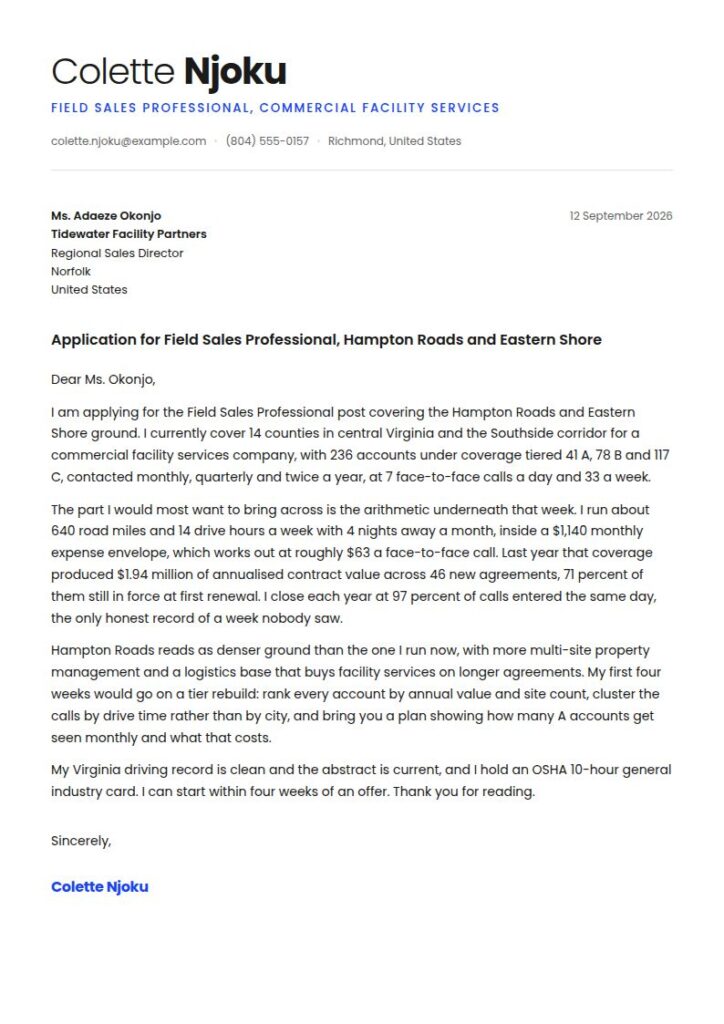
I am applying for the Field Sales Professional post covering the Hampton Roads and Eastern Shore ground. I currently cover 14 counties in central Virginia and the Southside corridor for a commercial facility services company, with 236 accounts under coverage tiered 41 A, 78 B and 117 C, contacted monthly, quarterly and twice a year, at 7 face-to-face calls a day and 33 a week.
The part I would most want to bring across is the arithmetic underneath that week. I run about 640 road miles and 14 drive hours a week with 4 nights away a month, inside a $1,140 monthly expense envelope, which works out at roughly $63 a face-to-face call. Last year that coverage produced $1.94 million of annualised contract value across 46 new agreements, 71 percent of them still in force at first renewal. I close each year at 97 percent of calls entered the same day, the only honest record of a week nobody saw.
Hampton Roads reads as denser ground than the one I run now, with more multi-site property management and a logistics base that buys facility services on longer agreements. My first four weeks would go on a tier rebuild: rank every account by annual value and site count, cluster the calls by drive time rather than by city, and bring you a plan showing how many A accounts get seen monthly and what that costs.
My Virginia driving record is clean and the abstract is current, and I hold an OSHA 10-hour general industry card. I can start within four weeks of an offer. Thank you for reading.
Sincerely, Colette Njoku
Openings that work
| Instead of | Use |
|---|---|
| I am a results-driven sales professional with a hunter mentality | I cover 14 counties in central Virginia, 236 accounts, 33 face-to-face calls a week |
| I am writing to express my interest in your field sales opening | I am applying for the field seat covering Hampton Roads and the Eastern Shore |
| I consistently exceed my sales targets | Last year's coverage produced $1.94 million of annualised contract value across 46 agreements |
| I am comfortable with extensive travel | I run 4 nights away a month, about 18 percent of working nights |
| I am a self-starter who needs no supervision | I close each year at 97 percent of calls entered the same day |
What counts as evidence when nobody watched you work
The hardest thing about hiring for a field seat is that the work is invisible, so a letter that solves that problem does something no other letter in the pile does.
| Kind of evidence | What it looks like in a sentence |
|---|---|
| Coverage | 236 accounts tiered 41 A, 78 B and 117 C, on monthly, quarterly and twice-yearly contact |
| Week shape | 7 face-to-face calls a day and 33 a week across four and a half field days |
| Road | About 640 miles and 14 drive hours a week, 4 nights away a month |
| Cost | $1,140 monthly expense envelope, roughly $63 a face-to-face call |
| System discipline | 97 percent of calls entered the same day, checked against the activity report |
| Events | 4 regional shows a year, 118 scanned contacts, 31 first appointments |
| Commercial result | $1.94 million of annualised contract value, 71 percent still in force at first renewal |
Pick two and no more. A letter is not the coverage model; it is the invitation to ask about it.
Moving into the field for the first time
Convert the week you have run into the week they are hiring for: calls a day, appointments set, proposals written, accounts touched. Say plainly that this would be your first field seat, then describe their ground in drive times rather than adjectives. Name your driving record and say the abstract is current. Ask for a ride-along, because a candidate who wants to be observed early is rare.
Do not claim field experience you do not have; a director will ask for the mileage in the interview. Do not describe the geography with a compass direction when the county list is published on their own site. Do not promise five full field days a week, since nobody works them and the claim marks you as someone who has not done the job. Do not send a letter with no numbers in it at all.
A flat occupation that still hires constantly
The Bureau of Labor Statistics publishes no field sales professional occupation. The nearest published one, wholesale and manufacturing sales representatives, held 1,571,400 jobs in 2025 and is projected to change by 0 percent through 2035, a fall of 7,700 positions, while producing about 123,400 openings a year (BLS Occupational Outlook Handbook, 2025-35 projections). The median annual wage was $76,460, or $36.76 an hour, and for representatives of products other than technical and scientific ones it was $72,080 (BLS, May 2025).
An occupation that shrinks slightly and still turns over roughly eight percent a year is a replacement market. Almost every field seat exists because somebody left a geography, not because one was created.
That is the argument for writing the letter around coverage. The director is not looking for someone to invent a market, but for someone who will be in front of the right forty accounts next February.
Length, format and sending it
One page, four paragraphs, 250 to 400 words. PDF unless the portal insists otherwise, named for yourself and the post: colette-njoku-field-sales-hampton-roads.pdf.
Address a person. Regional and district directors are usually findable, and a named salutation on a letter containing a coverage model reads as someone who prepares.
Use the same numbers as your resume so the two agree. Our field sales professional resume example is built on the figures used here, and a director who spots a mismatch stops reading both.
Key takeaways
- Put the ground, the account count and the tiering in the first paragraph.
- Give calls a day and calls a week, never an annual total.
- State nights away as a percentage of working nights.
- Divide the expense envelope by the calls for a cost per call.
- Offer your same-day logging rate as proof of unsupervised work.
- Describe their ground in drive times, not adjectives.
- Close with the driving record and a start date.
Write your field sales professional cover letter in 10 minutes.
Field sales professional cover letter questions, answered
How long should a field sales professional cover letter be?
One page, four paragraphs, 250 to 400 words. A regional director reads these between appointments, often on a phone in a car park, and length is not read as effort.
Should I really put mileage and expenses in a cover letter?
One line of it, yes. The director approving your offer holds a budget in which fuel, lodging and hospitality are line items against a call count. Keep it to a clause and let the interview do the rest.
What do I write if this would be my first field seat?
Say so in the first paragraph, then spend the letter on transferable volume and on homework. Calls a day, appointments set and proposals written all translate. Describe the ground in drive times and account types, and ask for a ride-along inside the first fortnight.
Do I need to mention my driving record?
Name it in the closing line if it is clean, and say the abstract is current. A field offer runs through a vehicle policy and a motor vehicle report, and that check is a common place for a start date to slip.
How do I write to a company whose ground I do not know?
Spend twenty minutes on their site and a map first. Find the branch addresses, the customer types they name and the counties those imply, then say one accurate thing about the drive: which loops are day trips and which are overnights. That sentence cannot be pasted into the next letter.